It’s been lots of interlocking activities for me this December 2024.
Nine days since last post, and that one (actually two) appeared from thin air, a gift of a slight lull between printing out our Christmas newsletter and preparing all of the cards for them. I’m still old-fashioned in that way. I believe a pretty card with an appropriate printed message and augmented with a personal one maintains ties of friendship and family better than an email (or worse, a social media post). It shows a commitment to spending time for your recipient, to let them know you still think of them (even if it’s only once per year and due to their inclusion on the Christmas card address list).
One last ‘task’ today: decorate the tree. We had planned to do so Monday and Tuesday, but we were waiting for a new tree-topper which only arrived yesterday evening. We’ll spend a leisurely afternoon doing this, and we’ll end with some delightful liquid Christmas cheer from one of the many special beers I purchased yesterday. From here on it’s preparing to sing for the Midnight Mass in the late evening of Christmas Eve, the drowsy-but-satisfied feeling of Christmas Day, the indulgent-but-hopefully-easy Christmas dinner, and the beginning of Christmastide, otherwise known as the Twelve Days of Christmas. While I may again post daily during this period, I suggest you revisit last year’s which starts here and marches through the twelve days with absolutely no seriousness except for the unintended kind. See ya soon!
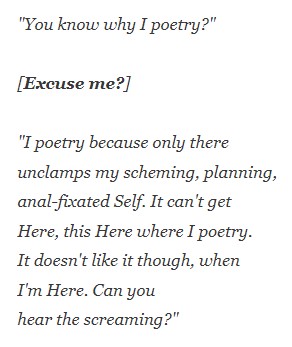
what my latest poem looks like on my desktop computer monitor. October 2023.
Something perhaps has changed with WordPress. I’ve been irritated to see that choosing the “Verse” setting for a block, which I thought yielded the above, doesn’t even come close on some devices. Here’s what my friend received in his email:
what my poem looks like on an Android phone, as delivered in a Gmail message. October 2023.
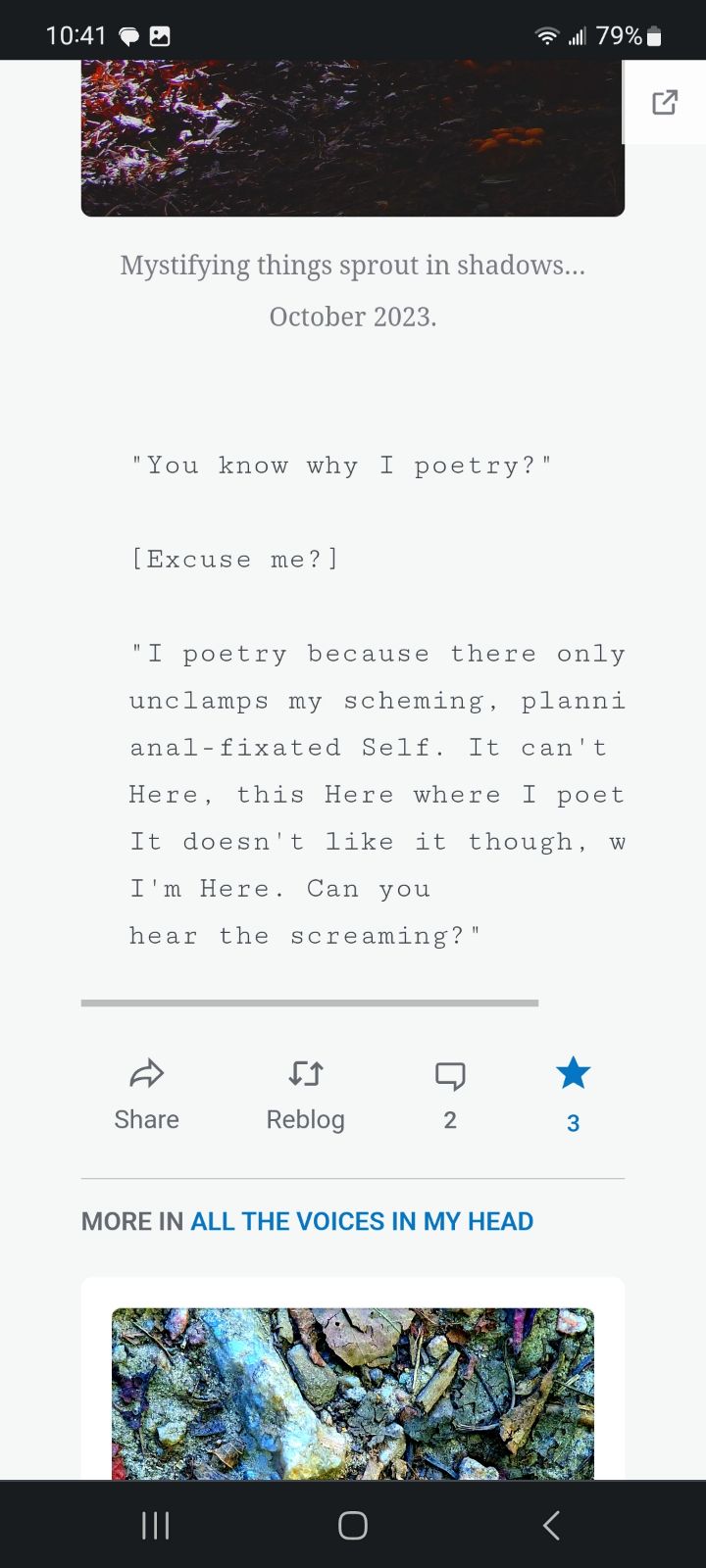
I knew that WordPress converted poetry to a monospaced font, rather liked it actually, because I follow a couple of poetry blogs which deliver the entire poem to my inbox. I’m pretty sure in the past that I saw the same thing on the WordPress website when I used my phone. Ah, but now there is Jetpack, newly changed for the…better? This is what appears on my actual blog when using an Android phone:
What my poem looks like on an Android phone using WordPress/Jetpack. October 2023.
That’s not “verse,” WordPress, nor is it “poem.” That is called “paragraph” and “prose” and perhaps “simplistic crap” unless one makes a living as a stream-of-consciousness author, and even then one must establish a certain cadence and structure to ‘musically’ signal to the Reader that yes, this is something beyond prose. (Unless one is James Joyce, then nevermind.)
Canadian philosopher and communications theory god Marshall McLuhan invented the phrase “the medium in the message”. I’ve perverted what this means. He meant that content doesn’t really matter, that a children’s cartoon or a vicious slasher movie is all the same when broadcast identically on television. To me he meant the message of any communication effort takes its ultimate meaning from the medium by which it is delivered. Spoken words in a living room conversation take on new meanings when sung in a concert hall. More familiarly, books turned into movies tell a different story and cannot help do otherwise. Even if Peter Jackson had managed to control every reference in his Lord of the Rings movies, visual, aural, or what-have-you, the story still would have been just as vastly different than the books as they turned out to be.
For these reasons, it’s deeply unsettling to oldsters such as me to watch the different devices reformat and repackage the content of what purportedly is the same thing. I see this nearly every day as I follow Major League Baseball. MLB.com presents a side-by-side box score for both teams, but on the phone you must select one team or the other–never can you present them at the same time on your phone’s screen. Baseball-Reference.com displays a wonderfully useful tool when looking at any particular season for a baseball team: a histogram of green and red bars which tell the tale of the entire season, game by game, read left to right. Mouse over any bar and it tells you the date of that particular game, who this team played (and where), and what the score was. It also shows what the team’s Won-Lost record was when the game finished. On a mobile device (tablet or phone) this histogram tool disappears. It makes me wonder if certain features of a website are completely unknown to a majority of the younglings who stare into their phones for 90% of the time they’re awake.
Thus, we come back to my dilemma/consternation and the question posed in the headline. Have I delivered a poem at all when it looks like a short paragraph raising an offhand question? Does the trivialization effected by the mobile presentation indicate my poem lacked substance and can only stake a claim to poetry because of its window-dressed arrangement? (Believe me, I’ve thought some unkind thoughts about other’s postings which, if returned to a more prose-like arrangement, look like the musings of a teenager in a diary. Am I just as shallow?) Did McLuhan not go far enough? Does the message ultimately get defined by how the technology delivers it, even when it lives simultaneously in different media formats?
A light bulb creates an environment by its mere presence.
Marshall McLuhan from Understanding Media (as quoted in Wikipedia)
Ultimately I think McLuhan would argue each device configuration represents a medium. But I never signed up for this, WordPress! My understanding of the matter was this: you give me the tools to put my message together, and I pay for it by giving you ultimate ownership of my content (which I cannot believe I did, but there ya go). I expected a bit more, though. I expected a very nuanced difference to my content. Sure, I’ll accept McLuhan’s theory that those who read my stuff on a phone get a different message than those who read it on a big desktop monitor, but I would prefer to be left out of the “definition changing” part of the equation. You’ve made me a partner to it by changing my content not just the medium.
Which leaves me little closer to answering my question but has given me an excellent opportunity to rely on that first college degree and to prove yet again that old age clothes old men in curmudgeonly behaviors as surely as dogs become grizzled and oaks gnarled.
Assess today, try harder tomorrow. Make your resolutions every day… every minute. Resolutions annually have little impact six months from now. Every moment is now, every day is today, every future is “the new year”. It’s great to usher out an arbitrary measurement of time, but really folks: let’s focus on where we really are!
During my adult years I developed a letter-writing habit. Perhaps it was always there, instilled by people who could count on nothing so much as a letter. Phones were problematic. Nothing else existed for communication except telegrams–“someone better be dying or sending us money”–or an in-person visit. Obviously one didn’t jump in the car and drive 285 miles across the state just to discuss the weekly news, find out the latest on your cousin’s marriage, or to shoot the breeze. (I’ll admit that in college on several occasions I more or less did the latter: I would pick up and travel a couple hundred miles or so just to say “hi” to the family, and as a young man I would routinely drive dozens of miles on a whim late in the afternoon to catch a dinner in a nearby city or visit a girlfriend or somesuch.)
Ultimately no other communications medium served the role of the letter–certainly not telephones. During the first ten years of my life (into the early-1960s), my family paid only for party-line phone service. When you picked up the phone, if someone was talking, you just put the receiver back on the cradle of the desktop-model black telephone. In addition to scrimping on telephone charges by having a party line, my parents learned from their parents that one didn’t make long distance calls on whims, one didn’t linger on long distance calls when they were made, and one didn’t call collect except in the most dire of emergencies. Today’s ubiquitous carrying of a smartphone makes one instantly available. Today our calling plans include the costs of everything–long distance, calls between carrier systems, voice mail, the addition of extra lines, and the ability to download data to our handheld computers. It makes the concept of the desk-bound black telephone seem a relic from further back in the past than just 50 or 60 years.
Habitually writing a letter, though, became ingrained into me even as others my age leaned into the idea that long distance phone calls could be made more often. I’m sure the phone company (there was but one no matter where you lived) made it easier somehow, with a calling plan or discounts or something. My family wrote. It hadn’t been a long time since letters were the only form of communication other than telegrams (see above). My grandparents were born just as telephones were being introduced to the world. It took many years for telephone lines to be strung to all the corners of rural America. One wrote, and one wrote often. Young men with reputations to uphold stayed at the Young Men’s Christian Association (YMCA) where they were encouraged to “write your mother”. My parents undoubtedly had access to telephones in their homes–especially my mother since her father worked for the telephone company. Beyond the house, in the dormitories and fraternities/sororities of college, and perhaps even as new graduates, they didn’t have their own telephones. Letters sufficed.
I remember the letters from my father’s parents (mostly his mother) which arrived weekly. Grandma would type them on thin onion-skin paper so that she could put carbon paper between two pieces of paper and thereby make a copy as she typed. One would be sent to my father, her elder son, and one to my uncle, the younger son. To be fair, grandma would alternate pages of the carbon with originals because the carbon copy was fuzzier. A three or four page letter would alternate between black (original) and blue (copy) pages. That was a lot of news! Grandma believed in not wasting the paper. Margins were about 1/4 to 3/8 of an inch all the way around; the letters were single-spaced.
My mother’s parents were less frugal. My grandfather’s employment entitled them to lower-cost telephone service, and my grandmother was more likely to pick up the telephone to communicate, usually on a Saturday morning. I know this seems to negate what I wrote earlier, but this was an exception due to Grandpa’s privileged employment status. These calls were not frequent: no more than two per month. I believe my grandfather wrote his only daughter occasionally, putting pen to paper longhand like many people did, writing cursively.
My parents thus inculcated letter-writing into me, a habit which has not been broken these 50 years since I left home. Our communications became much more frequent and regular with the advent of email. For the last 15-20 years of their lives, my parents would email a letter to my brother and me, usually on a Saturday. My brother and I would each respond to that letter with our own, and the weekly news would be transmitted. In the two years since my mother died and left us to our own devices, my brother and I continue to send the weekly weekend emails, although we also use texting for shorter notes. It pains me to see this skill die out as younger people today disdain email entirely and communicate in other, more terse formats. After thousands of years the letter appears to be dying out as a common form of communication between friends and family members. This rewiring of our brain and of society does not bode well. Humans, never great at believing the best about strangers, have retreated into communication silos out of which we had only recently been attempting to break.
I doubt I will see the next evolution in communications between friends and family members unless someone comes up with a method to visit one another in person easily and on a whim, a la the transporter we see in our sci-fi stories. The face-to-face video calls (FaceTime, et al) would seem to bridge the gap between letters and that instantaneous travel. It will have to do. I don’t see the point: an emailed letter is more convenient because it doesn’t demand that I drop everything to answer it. The video call won’t permit me to derisively laugh at the foibles of others (without their knowledge), encourages me to make sure my bladder is empty, doesn’t let me study the words to make sure I understand what the sender wants me to understand, and gives me nothing to refer back to an hour later. On the other hand they permit the sharing of laughter, of music, of certain sights which might be within the range of the device. Ultimately, though, the video call remains a “call” and not a literary device–and for that reason I mourn its seeming demise.




 all the voices in my head