I’m flat running on poetic fumes. Numbers 99 and 100 have outlines, but we’re not there yet. This is one of three in the countdown to the countdown. I’m not being aided by what seems to be a slight relapse toward the sick end of the spectrum.
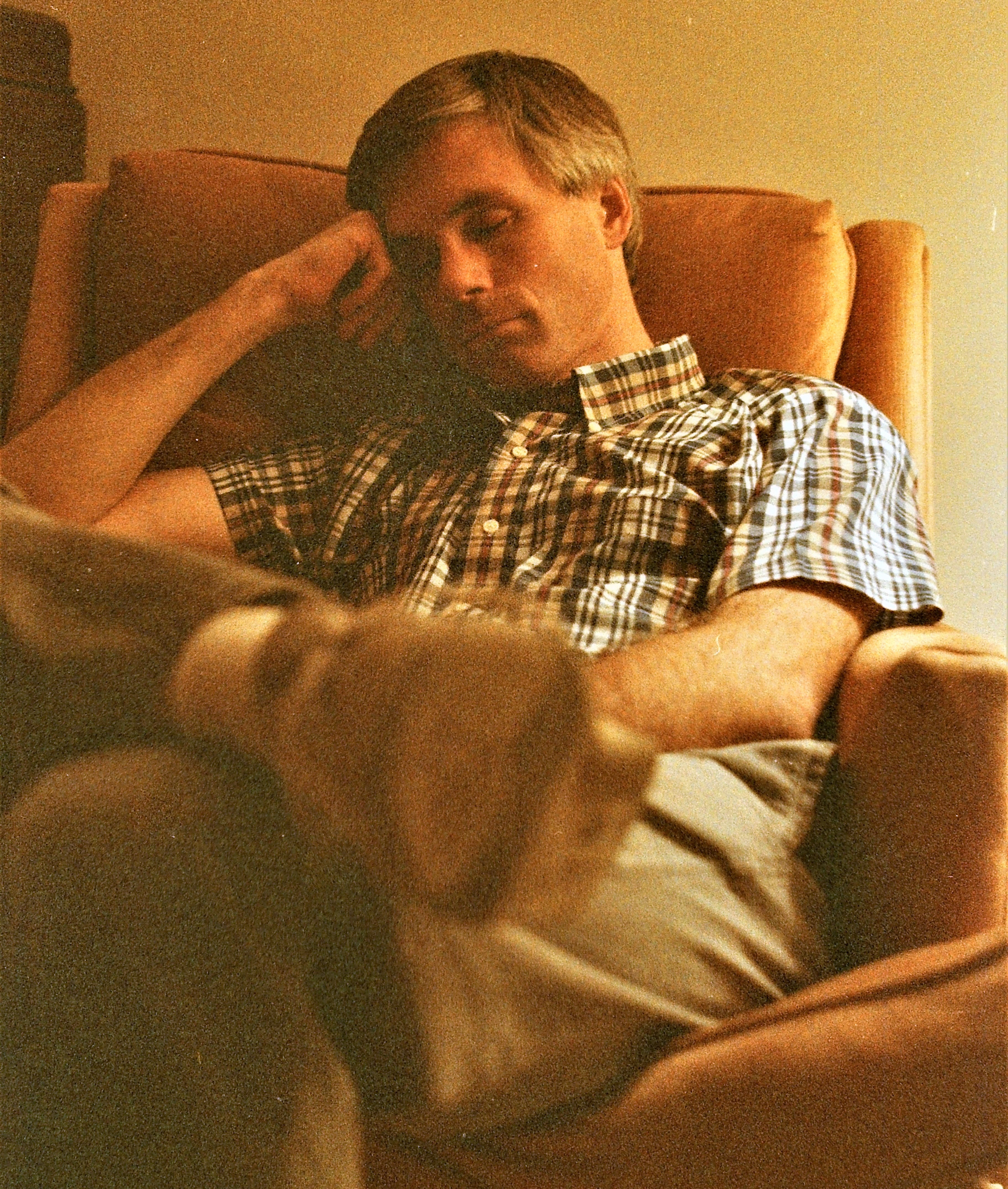
This is what happens when you have children. My brother, circa 1989 when his children were aged approximately 7 and 4.
Never having children,
I decided not to grow up.
Perhaps, rather, these two
thoughts intertwined,
reinforcing the other.
Prospective parenthood
seemed to demand more
maturity than I cared to
exhibit on a continual
basis. And toys! Surely
I deserved toys as much,
no, more than some lucky
random assignation of
my genes?

Truly this screams of
revisionist history.
My arrival at the
Maturity Party came
late. I could not more
think of children while
teaching 150 of 'em
each day than I could
see how my chances to
sire some dwindled each
year I drifted away from
my partner. One last gasp,
one chance to Be The Dad,
dashed when my new wife
vanquished cancer but
destroyed motherhood in
the process. Just as well.
Advanced Childhood has
served me as well as
Stumbling Adulthood
seems to have served others.
I’m going to apologize right up front: this does not measure up to my writing standards. (And my standards aren’t that high compared to others who write for pleasure and/or money.) I’ve wrestled with this one for a year, and I’m done, at least for now. I’ve learned a little bit from writing this, which in the end represents all I seek to gain from my writing these days. Well, that and the ego-boost of seeing it ‘in print’ and knowing the world can see it too.
A confusion of color, symbolic to my topic. Open air display in Tacoma, WA, by Dale Chihuly. December 2009.
Last year on June 22nd I started a series about my father, intending to write 3-6 essays examining my life by examining his. I posted but three, and one is just a photo: here, here, and here. My roadblock occurred because I don’t want to speak ill of the departed, certainly not my father, but by avoiding the flaw in the diamond I’m not admitting to its true value and nature. And yet, though I accept that I must engage the topic, that I must “write it out,” I’m not going to do it, at least not entirely.
My father’s birthday is June 22nd. In America we honor fathers on the third Sunday of June which can be anywhere from the 15th to the 21st (as it was this year), smack dab in front of his birthday. My brother and I would complain about this: “I have to buy another present? I just bought him one!” Now in my twilight years its placement seems appropriate. He epitomized fatherhood, although I’m biased on the matter. He set the tone in the family, the example for his sons, the rules for their behavior, and the schedule of family events. He demonstrated love. He taught us about faith in God. All of this is inarguably good. He had a darker side, however, which could never be fully admitted to himself or us: a struggle with depression which clawed my father away from us in his final years. Or did it? Even now with the perspective of a dozen years past his death and a half dozen since my mother’s, I wonder if I’ve just concocted a storyline to avoid life’s messiness. We don’t live within well-paced literary arcs to our storylines. They bob, they weave, they stand in place, and even while standing in place, they may hide a different storyline we’re not even admitting exists.
I don’t know much about clinical depression, not its terms or conditions or permutations. I know only that during my lifetime a perpetually buoyant man interested in everything and seemingly always smiling, slipped several times into a very dark place. And I know or rather I strongly suspect the impossible standards he set for himself tripped him up when he realized he wasn’t meeting them, couldn’t meet them.
The first time I remember this occurring, I was in junior high in either the 8th or 9th grade. It was 1968. It could have spanned the end of one grade and the beginning of the next. Hindsight always changes the past, and I therefore cannot tell at this point if I knew he had been dissatisfied with his job or if I learned this afterward. At the age of 14, I didn’t know much, if anything, about mid-life crises, but he had turned 43 to realize there was no goodness in corporate America. For a preacher’s son, raised by a strict mother and a dreamy, idealistic father, this lack of moral behavior couldn’t be tolerated. Too much cognitive dissonance. Therefore he quit. We had only the profit-sharing money from his employer with which to support the family—my mother didn’t earn a salary from the moment she birthed me until her death in 2019. In today’s terms, that “profit-sharing” would be a 401(k). Oddly, one of the first things he did was to buy a second car for the family, reasoning that his search for purpose and a new job would require wheels, which would conflict with his wife’s need to shop for groceries, run other errands, and socialize.
There began a very odd time for us which thankfully my usually vivid memory has failed almost totally to record. He sought counseling, but in later years I learned it was career counseling, not emotional counseling. My brother and I were dropped off with family friends for a few days while my father and mother spent a little alone time. I can only conjecture what that might have been: re-igniting their marriage? reassuring my mother? frank discussions about “when are you going to get a job?” My folks had established close ties with three other families from “the old neighborhood” where we lived from 1956-1962. Even as the families scattered across the city, they remained close. It was to one of these families that my brother and I were farmed out for those days, and it was from another family friend that my father’s career rescue eventually occurred.
In the fall of 1968 this family friend contacted my father about a possible job opening. The increasing demands of directing financial affairs for a large local hospital and concurrently for the order of Catholic nuns which ran the hospital had grown to be too much for him. He asked my father if he would consider taking a comptroller’s position with the hospital. This suited my father’s psyche better. He got to work primarily with finances. Because the hospital represented an act of mercy for the Sisters, he needn’t worry about any conniving capitalism or lack of moral character. And as an added side benefit, I’m sure some kind of decent medical plan came along with it (although medical insurance back then differed from what it became in the 1980’s and beyond). As my father’s close friend received promotions, so did my father, eventually retiring almost 20 years later as the director of fiscal services for the hospital.
Primarily my father regained his equilibrium and was happy, but I believe he slipped again, not too much later. Again, my memory just didn’t record a lot of details. I know one unassailable fact: in 1991 when I sought counseling after an abrupt end to my eight-year marriage (a relationship of ten years), I initially went to a psychiatrist who had treated my father. If I pair this with another, shakier memory—that my father slipped mentally a bit when he realized that his new job still was “just a job”—I’m left thinking that sometime between 1969 and 1989 he had endured another dark time. And it could have been fairly soon after. I recall a visit to his parents’ house where he talked with his mother about how her perfectionism had made it impossible for him to measure up to his own expectations. Theoretically one’s realizations help one to cope. I’m not sure this occurred for my father because of what happened toward the end of his life.
I’m sure working in finance for the final 20 years of his career reinforced his belief that he had a talent for managing finances at the level of a large entity. This became a Catch-22 for him. In November of 2007, it came to light that the secretary for their church had embezzled a sizeable amount of money—at least, it ranked as sizeable for a modestly-sized Presbyterian church in Spokane, WA. My father at that time chaired the stewardship committee, which is a fancy term for “the laypeople who make sure all that tithing is being put to responsible use.” I don’t recall who discovered the embezzlement: was it my father? (doubtful) Was it the police? (I’m not sure how they would’ve known.) Was it just a combination of several committee members who couldn’t make the money add up? Regardless, as he said at that time, “It happened on my watch.” He felt responsible. By 2008 as he approached his 83rd birthday, his emotional state began to spiral. The embezzlement just shouldn’t have happened if he had been fulfilling his responsibilities. He had failed.
After my father died at the end of 2013, I would bring this up to my mother. She quibbled with my account, but I stand by it. I remember how we flew cross-country to visit in May 2008, something we never did before or after because the weather in Spokane, always a crapshoot most months, reaches its pinnacle of “who the hell knows?” in May. I’ve endured snowstorms, freezing rain, and 80-90 degree weather, all over the Mother’s Day weekend. I can show you photographs of my father at this time, but looking at most of them, you would call me a liar. My father is smiling, apparently having the time of his life, all because he cultivated a smile from when he was a child. (His high school yearbook actually singles out “the freshman who’s always smiling” when he and his family moved to Havre, MT.) Two photos tell the tale, I think, from both content and context. Here is one of the several posed photos I took. (Forgive the quality; this early digital camera didn’t do well.)
My parents on May 27, 2008. Sandpoint, ID.
My mother always hated when I captured her candidly. No wonder. But unlike her, my father instinctively knew to smile. Here’s what he looked like otherwise that day:
My father that same day. Sandpoint, ID.
Is it unfair to snap a photo of a man as he walks away from the restrooms? Absolutely. Yet the fact I would do it speaks volumes. I would never otherwise snap such a photo. I like candids, sure, but that’s not why I just suddenly chose to snap this one. A photographer shooting a candid chooses the story he’s trying to tell, or more accurately, the story that’s playing out in front of him. He doesn’t just point and snap willy-nilly. I chose to shoot this, and therefore we must assume I had good reason for this odd shot. It might help to know I cropped this photo a lot. It’s a shot across a parking lot of a man hunched over, deep in thought, as he walks from the restroom. He’s participating in a family outing to a beautiful place several hours from Spokane, where he lives. He should be looking around for his family, or the strikingly handsome geese we had just seen, or the grandeur of the mountains splayed out in front of him if he would only turn his head to the left.
The view to his left. Sandpoint, ID. May 2008.
I’ve lived that walk. You’re in your head and when you can muster the energy to be sociable, you slide the veneer on. You want to assure everyone that you’re okay. You’re not. The tape loop plays in your head, telling you whatever you did wrong, or how the world has mistreated you, or perhaps more horribly, both.
My parents visited us in Raleigh, NC, over Mother’s Day 2009, approximately a year later. I distinctly remember being worried about my dad’s outlook. I said to him the day we drove to coastal North Carolina, “well, Dad, you seem to be pretty upbeat today.” He frowned a bit and answered, “well…not really.” That’s all. His voice trailed off.
He lived in and out of this state for the remainder of his life, another five years. How much of it should we attribute to the inevitable decline many of us go through as we walk up to that door which will usher us out of this mortal life? I don’t know. I’ve watched four parents die, mine and my wife’s. There’s a detachment that develops those final years. But the thing that haunts me still is this: I think somewhere during 2008 and 2009 my father—the man who eagerly rose in the morning, excited about what the day would bring, the man who took delight in all the numbers and patterns, the man who just plain found life delightful—suddenly didn’t find life very delightful at all and that he would just tread water until he died.
Maybe my mother was right. I could have invented a story from bits and pieces. Maybe I’m just eager to tell a story where none exists. “But…but…,” my mind sputters, “he used to be so upbeat, so jolly! What happened to that?” Indeed. I’d really like to know if the inevitable tiredness and struggle of one’s fading years explains it all or if he took one too many psychic blows. I’d really like to know because I’m a lot like him. I’d like to know if I should circle the psychic wagons as I enter my 80’s—only eight years away!—or if I should just accept that one tires and detaches at the end of the journey. Yeah,…I’d really like to know.
The world is going to hell in a handbasket. This attitudinal shift remains a nearly unavoidable aspect of aging. We age and cast off following things for their own sakes. For example, fashion? Oh sure, we keep an eye on it, rotating neckties or jewelry to our favorite “it-will-come-back-into-fashion” location, but we pick and choose. Skinny, tailored suits? On this old beer-bellied bod? I think not. Hip-hugging jeans, says my wife? “I never wore them when they were in fashion decades ago!” And don’t get her started about wearing clothes which look more like lingerie than outer garments.
Everything’s going to hell. For us oldsters, new technologies get picked up as they’re convenient, and when they serve a purpose, not because they’re trendy. Consider: smart phones debuted (debatably) in 2006. I waited six years, until 2012, to get one. Even then I got it mostly because I needed a better communication tool when I started consulting. I might have picked up one eventually. I’m sure I would have been forced/enticed into it sometime before 2020…maybe. After all, I’m a techie; I like all the toys. About forty years ago I could hardly wait to upgrade my first desktop computer or for it to conk out and justify buying a new one. Now? I’m leisurely approaching the time when I’ll dig into my Windows 10 machine and tweak its registry settings to permit upgrading to Windows 11. Another old man thing: texting has proven to be a boon but it doesn’t replace email. And why trade clean, open texting for the closed gardens of WhatsApp, the-app-formerly-known-as-Twitter, or Instagram? I resisted Facebook for years, but joined ten years ago. I grew uneasy with a technology that demands everyone ‘talk’ all the time. Doesn’t someone have to listen? And how can everyone something important to say? The horrible year of 2020 pushed me to delete the account. Who wants to be sanctioned for being reasonable? (I understand getting attacked for being ‘out there’, but for being calm and objective?) My point’s drifting here, old man! It’s this: seven decades in, one learns it isn’t very important to follow every trend…or pretty much any trend.
These thoughts crept into my mind as it wandered from thinking about our church’s chorister program (elementary and junior high students who sing in the cathedral once in a while) to the pre-pubescent boys who sing at New College, Oxford, or in the Vienna Boys choir, until finally it came to rest on my own 5th and 6th grade experience of participating in All-City Chorus in Spokane, WA. This program met once or twice a week after school in the most centrally located public high school, Lewis and Clark. How did I get there? I took the bus. Due to its meandering route the trip lasted about half an hour as it drove the seven miles from my elementary school to LCHS. I can’t remember if I took the bus home, or if my father picked me up, since he worked less than a mile away and would have been leaving work about that time. My brother similarly took private clarinet lessons in an old building downtown. It housed a music store on the street level and housed offices on the second floor, one for his teacher. My brother also took the bus, catching it at the end of the block where we lived, and traveling the same amount of time and distance as I. This wasn’t unusual for 10-year-olds at the time. My mind kept wandering. I wondered how common that is now. I don’t know as a parent if I would rest easy letting my child do the same. I’m certain few if any modern parents would. Kids seem to be scheduled for most of their free time and driven by an adult to these activities. This illustrates my point, the one I wandered to this morning:
Old people experienced a different world. I don’t care which generation you’re considering, it wasn’t necessarily worse in their mind. We–any of us at any point in time–dealt with what we dealt with. Life presented itself, and we were up to date with it. We cling to some of the practices from back then, not because they’re antiquated but because they worked. We cling to the beliefs which those practices engendered. Let me explain, by way of an example, how life occurred and thus, how we think and thought. Consider the situation in which two parents decide to let their boys travel alone on a city bus after school. During the winter we left our respective music activities in the dark—Spokane lies a latitudinal degree further north than Duluth, MN, and almost three degrees further north than Bangor, ME. How could a parent allow this? First, we didn’t have two cars. Though we were comfortably middle class, it wasn’t that unusual for families to have only one car. My parents decided they could share it—Dad took the bus at least two days each week—and the money would be better saved for other things (notably our college education). Dad could have taken the bus on those music days, though, leaving Mom the car to shuttle her children.
But you see, that was just a strange notion back in the 1960’s. Kids gained in freedom when they gained in age and maturity. When we were very young, three to five years old, we were told where our boundaries were in the neighborhood. We respected them (mostly). We got to travel the block and only on our street. I got in severe trouble when I crossed the street at the end of our block and decided with a couple other kids it would be fun to roll rocks down the hillside. (It didn’t occur to me that there were cars on the road a hundred feet below us or what a rock the size of a teapot might do to a car.) When a county sheriff’s deputy delivered us to our parents, we caught a lot of hell. When we were in elementary school we wandered wooded lots, rode bicycles for miles away from our homes, and all we had to do was say, “Mom, I’m headed down to Mitch’s house!” As we neared and then entered junior high it was more like, “so where did you two wind up today?” from my mother. Our parents expected us to entertain ourselves, stay safe, and observe the behavioral rules they laid down. We did pretty good with that first part, fairly good with the second part, and…what they didn’t know didn’t hurt them, right?
Today therefore represents a path to perdition, always, for every old person. I stay optimistic generally (and the further I look into the future), but many things worry me about habits which younger people have acquired. I now can see that 100 years ago cars would worry a 70-year-old born in 1855. “Everybody scootin’ and tootin’ these infernal muh-SHEENS! T’aint nachurl! Next thing ya know, people won’t even live together cuz they can just drive to work!” with the word “drive” carrying all the distaste and disapproval an old man might feel.
Humans measure the world using an internal scale developed through experience. We slow our learning process with each passing year, experience becoming a boon and an obstacle to learning new ways. Fifty years later, we don’t even see the same world as younger people do. This is neither good or bad; it simply explains our attitudinal shift. Maybe you caught a bit of that here, but I fear I’m too caught up in it to accurately relay it to you. Everyone my age is nodding their head while everyone thirty years younger has made some derisive sound en route to dismissing the whole notion out of hand.