Bibliophilia: books about books

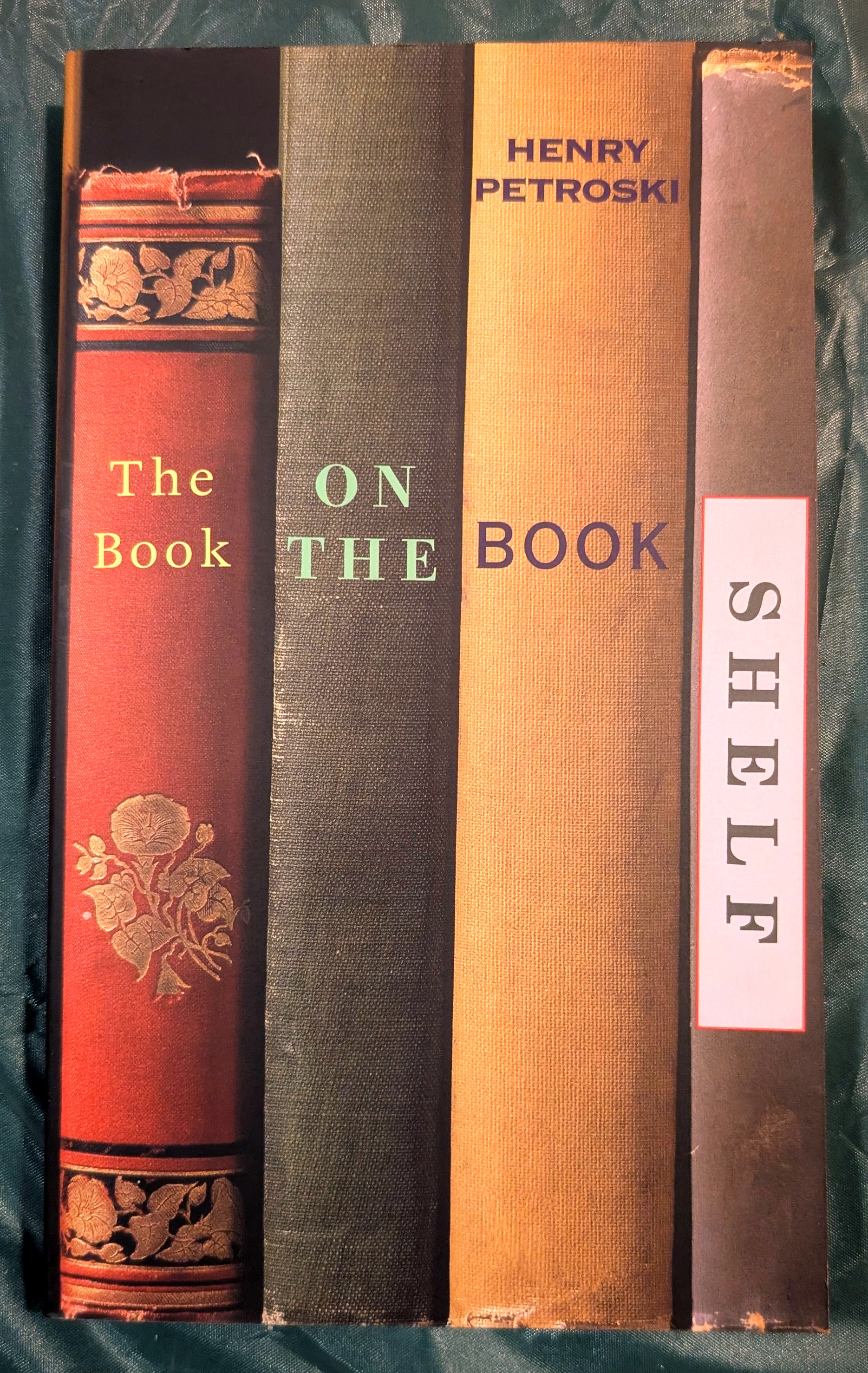
The cover to The Book On The Shelf

People who truly, truly love books, love books about books. One of the most unique of these appears above. Henry Petroski’s book The Book On The Bookshelf traces the history of books from their earliest inception as scrolls through the Middle Ages when they were chained to the shelf, and proceeds in its history to the present day. It’s a lovely read. Petroski winds up the book with a chapter about bookshops, another on the shelving of books, and a final one about the care of books.

The phrase “books about books” includes those about reading them. My original photo for this Bibliophilia subplot is repeated here:
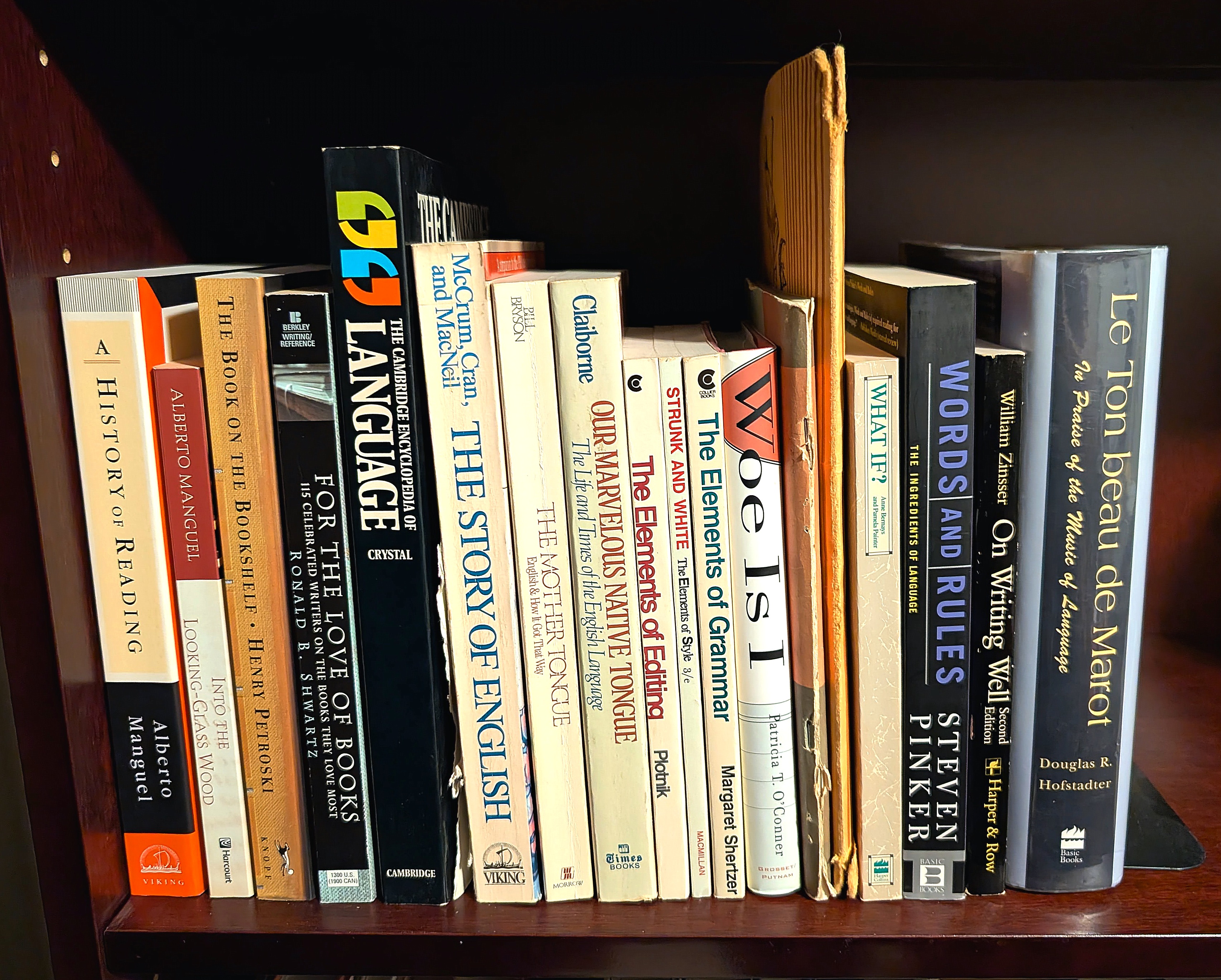
Books about books, language, grammar, and linguistics. July 2025.

In the semi-arbitrary manner I use to organize my bookshelves, books about books (and reading them) precede those which address English and languages. Alberto Manguel, an Argentine-Canadian writer (and translator, editor, essayist, and director of the National Library of Argentina) has two entries, both wonderful. A History of Reading celebrates the reader. With chapters such as “Being Read To” and “The Missing First Page” Manguel explores all of the aspects of the author-reader experience. Manguel divides the book into two sections: “Acts of Reading” and “Powers of the Reader”. I particularly liked this second section with its chapters of “The Author as Reader” and “The Book Fool”.

Manguel’s other book, Into The Looking-Glass Wood contains essays about books and reading. These range more widely than his History of Reading. Essays include reviews, reactions to other authors, browsing for books, essays about wordplay, and other more wide-ranging topics.

Ronald B. Shwartz’s book For The Love Of Books gets included here, simply because it’s on the shelf, and I can’t bear to part with it despite its shortcomings. I’m not one for the types of books which sample a range of acclaimed artists about a certain topic. This book gets the subtitle “115 Celebrated Writers On The Books They Love Most”. Yeah, so? What makes their opinion better or even equal to the critic for the New York Times Review of Books? Or any literature professor at dozens of highly regarded universities? Or, frankly, me? Regardless, I succumbed when I saw the authors cited include Joyce Carol Oates, Michael Ondaatje, John Irving, Bruce Jay Friedman, Doris Lessing, Norman Mailer, Witold Rybczynski, Kurt Vonnegut, John Updike, and Gay Talese. (Actually…I’m not sure I’ve ever completed this book! It still captures my imagination, and thus, it remains on my shelves.)

There you have it, books about books. If we can happily descend into the depths of books about books, how dare we deplore those who delve into the backgrounds of various oeuvres such as Tolkien’s Lord of the Rings? A nerd is a nerd is a nerd…

Book review: Watering Words

Watering Words: 52 Short Stories by Bridgette Kay.
Self-published 2025. ISBN: 979-8-218-58862-5

Artists differ from most of the rest of humanity. Artists tap emotions and experiences others prefer to hide or, at best, to reveal carefully to select individuals and audiences. Unlike the careful revelation practiced by most, artists display their work on the public walls like graffiti in subways. Wedged between “For a good time, call ###” and obscenities, the artist inserts a portrait, often rooted in pain or struggle and rendered in words, brushstrokes, sculpted metal, or other media. Where most humans rush to clothe their naked feelings, the artist drops such obscurations to the ground and invites the errant passerby to look, but more than that, to judge. This is how they differ: they invite comment upon creations rooted in their own psyches, their own souls.

Humans hurt. We all hurt. We bear our wounds heroically, badly, simperingly, stoically, resentfully, and sometimes all of these and more depending on the time of day. Authors live with the uncomfortable knowledge that their wounds, their innermost thoughts, beliefs, prejudices, emotions, and most of all, memories, will bleed out—must bleed out—onto the pages they write, an emotional, psychic wound which perversely will not staunch without being exposed. It’s analogous to being handed a bite bar and hearing, “this is gonna hurt but you’ll thank me later.” Authors bleed out into their words and wait for the comments, but in truth, their healing began when the words gelled, the pages were printed, and the books displayed.

Commenting in any manner on such courageous behavior feels wrong. There cannot be a wrong way “to art.” As a teacher of English, though, I learned there exist many wrong ways to connect with an audience. And ultimately, anyone who publishes a book expects an audience to react to it. I’ve followed Kay’s blog Bridgette Tales for several years. Her personal revelations in that space represent why blogs need to be written. Done honestly and well, a blog sends joy and pain and struggle and hope out to the world, asking only to be heard. In the process, blogs show others, “Look! I hurt like you, love sunsets like you, see little clumps of moss like you, and I revel in it, even the painful stuff.” They build the global community. It came as a relief, then, when I discovered the stories were actually good. I’ve seen many a near-breathless author hand me something with excitement in their eyes and words, only to find upon reading it that the author hadn’t a clue either about constructing a story or writing one.

Don’t read Watering Words expecting John Cheever. These stories are not “high literature”—they instead represent what most readers look for: engaging stories with whimsy, a little magic, humor, and told with style. These stories speak less to the human condition than to one human’s condition. As one who has followed her blog, I see the pain, longing, fears, insecurities, joy, laughter, righteousness, sadness, glee, and maturity I’ve sensed in her near-daily posts. Two of the early stories stand out.

In the first story, “Waiting For The Bus”, every author will resonate with Kay’s personification of all those fears and excuses with which we keep ourselves from writing. The narrator’s ultimate triumph echoes Kay’s, I’m sure. And in “Final Goodbye” I invest my supposition that Kay writes of a home in her past (at least symbolically). I detect references to tragedies mentioned on her blog, but leave them for others to discover.

Read this book. Read it not for “high” literature but for “hi” literature: an author reaching out and saying, “Here I am. I’m saying it as best, as entertainingly as I can. Do you see me? Do you feel the same?

“Do your wounds match mine?”