
Guilt motivates, terrifies, handicaps, and depresses us. It informs, too. My guilt about not posting more than weekly here tells me I want to write more, photo more, pour myself into creative pursuits more than I have been. It also informs me other things must carry higher levels of guilt which trump my Creativity Guilt. Taking on a project, though, motivates me. Therefore, I’m tasking myself to write daily/frequently about what’s blocking the blogging.
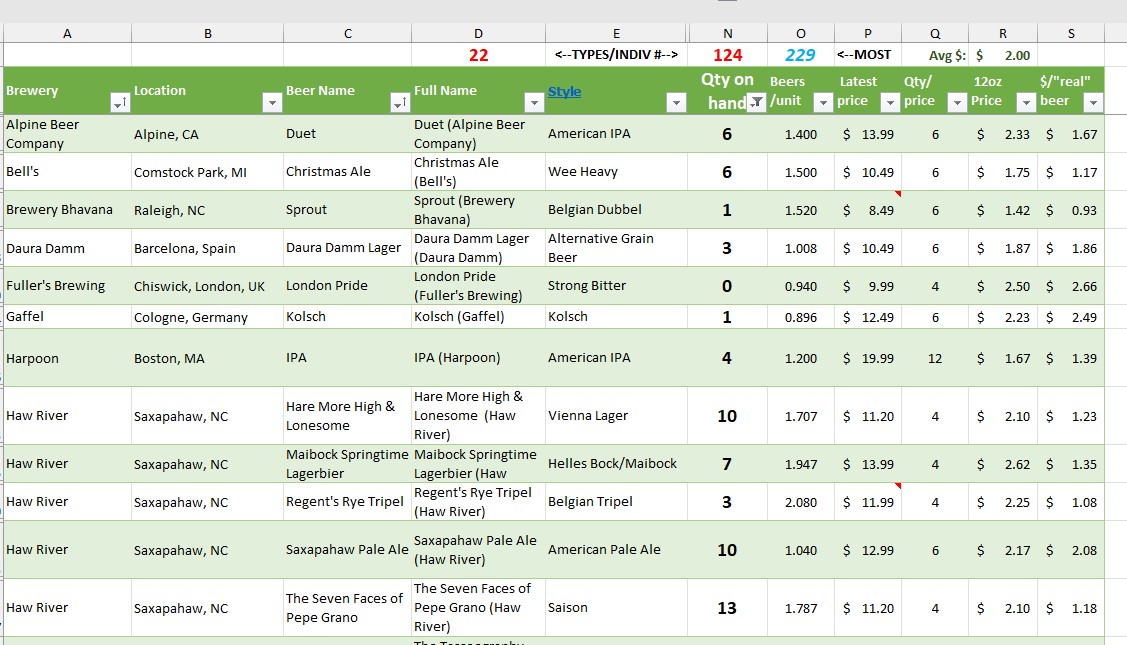
Take a look at that spreadsheet screenshot above. One would think I created it to keep track of the approximately 22 kinds of beer in the beer fridge. Sigh. I wish it were so, and it remains a side benefit of the real reason I created it: that “Beers/unit” (Column O) feeds another sheet in the same workbook which is used to calculate how much I drank yesterday. Every morning for the past decade I make a short entry in my Health Log, maintained in Microsoft Excel. These days it’s simple: record my weight, make sure the meds I took yesterday is complete and accurate, and write 3-6 sentences about my general health mental and emotional. Examples? Life’s slings and arrows manifested as aching hips, arthritis starting to develop in my fingers, whether my collapsing ankles have caused any more ligament damage, and the condition of twitchy back. Lately it gives a couple terse lines about what happened yesterday, a sort of bulleted journal entry. I began adding these more and more in retirement.
More consistently than anything else, this log daily has tracked my ongoing battle to Not Drink So Much. It unflinchingly has recorded for the past decade the exact amount of beer I drink (I don’t drink wine or hard liquor anymore). It has done so with graphs illustrating rate of consumption, with 7-day and 14-day moving averages, with tables that project how much more the next beer will cost me, with histograms–and not one bit of it has made much of a difference in my rate of consumption. I had thought simple awareness would make a difference, much like cigarette smokers are told to record how and when they smoke. Awareness has made no difference whatsoever, even when I have done it in real time, as I’m drinking. The snippet of the calculating worksheet is shown below. Columns D, E, and F are the ones which look to the inventory sheet, multiplying the Beers/unit by the quantity drunk.

Columns A and B record odd-quantity beers, which usually occur when ordering at restaurants. I’m not going to go into all the calculations for what a medical beer is; you can see the definition at the top there and do the math yourself. Although I quit (finally) graphing the daily intake, I still list it in the health log entry. And now the beer-rating sheet gets maintained all the time. Filter the quantity on hand to ignore “0” and you can narrow the 400+ beers to a handy beer list to print out for when your wife says, “What’s in the fridge?”
This isn’t a cry for help. It illustrates the premise of the introduction: setting up these interlocking worksheets takes time. There are five other worksheets in this spreadsheet file that I’m not describing. And this is but one application. There’s a monster financial one which I think I could’ve sold back in the day I roamed the country as a self-employed consultant and needed to keep track of hours, rates, contracts, bills, accounts receivable, and how they drove our personal budget and finances. I just updated a Google Sheets app to plan music for our weekly masses and to show our choir what the music will be for a given Sunday–hymn numbers, responsorial psalm number, and the name of the anthem. It’s not a listing tool, like electronic paper. It requires the music director to pick the liturgical name of a given mass (such as the 5th Sunday of Easter) which then causes the application to pick the correct psalm information. The choir list looks to the planner. The printout for the cantor to use is driven from the planning sheet and the liturgy sheet. And etcetera for other things in my life.
In short, I analyze. I might read some political thing about the imbalance of power inherent in the two-US Senators-from-every-state part of the Constitution and go down a rabbit hole to compare the ratios of state populations in 1792 versus 2020 just to see if they’re markedly different or not. (I stopped myself on that one, thank goodness.) I might spend two or three hours to make some points about baseball like I did 18 months ago on this blog. This stuff happens all the time, and….
That’s one reason I don’t get to my writing like I think I want to.
 all the voices in my head