Things that have been bouncing around in my head lately:
What’s wrong with these directions from a recipe I used this morning? “Sift before measuring: 2 cups flour.” Seriously, Joy of Cooking? How do I sift 2C without measuring it first? (The waffles were delicious, however.)
I’m trying to be on a stay-cation while my wife travels to Florida. This means I don’t want to do “chores” — but I reminded myself that “even on vacation, one has to pack the trunk.”
One of the all-time best blues-rock (Chicago style) performances is Kenny Wayne Shepherd’s “Dance For Me Girl” on Live in Chicago.
“Attaboy, Harper!” Jesus, don’t poke the bear, Arcia. That’s just basic Survival 101. As if Bryce needed more motivation!
I’ve realized recently my emotional IQ hovers around “special needs”. Unfortunately, my intellectual IQ makes me think I’m the smartest person in the room at all times. In terms of roulette, smart people think that just because it comes up red 98% of the time, it will always come up red. So, 2% of the time they’re wrong. Unfortunately, we never know if “this time” is in the 2% or not.
Getting old sucks.
I will need to be institutionalized if my wife dies before I do. There’s only so much crazy society can tolerate. (Our current politicians notwithstanding.) I’ve been alone for four days, and I remember how the internalized thoughts and lack of social contact distill the craziness. Not pretty.
Those of you with big families have no idea the paucity of having few (if any) relatives. I have/had one uncle, four cousins, and one brother. Grandparents died, the uncle died, one of the cousins has died. My brother had two children–one is estranged to the point of “whereabouts unknown”. My close family consists of a brother and a niece. My wife, meanwhile, has seven siblings, and 23 nieces and nephews, and her parents are still living. Those nieces and nephews have had a good handful of children. It’s night and day here in my house.
I daily lament not “getting to the important things” and then spend the afternoon reading, cruising the Interweb, and drinking beer. And writing posts like these. Not one important thing is addressed.
I’ve been pondering (to quote one of my new favorite bloggers) that I stand on the threshold of 70 and I’ve only 10-15 years of travel left in me. This starkly scares me. I usually figure two or three significant times of travel per year. Twenty to forty-five seems like a goodly amount, but it’s that lower end that makes me wonder: if I’ve only 20 trips left, and I want to go to Europe more than once, to Hawaii, to places in the USA, to just experience certain periods of unfettered wandering…how much is left in me?
It’s funny. You think for much of your life, “hey, there’s plenty of time for that,” because you’re 35 or 45 and decades stretch out before you. Then you get up toward retirement, and frankly you’re just thinking about that retirement. There are a lot of channels to negotiate to retire: income when you’re not working, riding herd on the expenses, and the projects you always thought you’d do but you just didn’t have the time or the money to do them. You negotiate that when suddenly a little global pandemic kinda s-t-r-e-t-c-h-e-s that whole process out. When the world comes to, everyone removes their masks (assuming they were wearing them in the first place), and you realize, “crap, I’m almost 70. How much time is there?”
This clarifies things but in a brutal way. When someone comes at you with a knife, your options suddenly are VERY focused. When life comes at you with a knife…… Didn’t the Fates snip a man’s life thread and end it?
One of the nicest things about retirement occurs every morning. The alarm doesn’t go off–not that it sounded much in the past 25 years–and I lie in bed debating about getting up or rolling over for a bit more ‘driftology’ (the study of drifting through my inner time and space). Usually five minutes proves I won’t be dropping back into sleep. I quietly slide out of bed; leave my sleeping wife to her dreams; grab some clothes, my cellphone, my glasses, and the glass of water sitting on my bedside stand; and I walk to the kitchen to start the morning ritual. I avoid the weakening spot on the bedroom floor near my side of the bed, the one which squeaks loudly. Similarly, I walk closely to the wall as I pass the living room, again avoiding the creaking spots in the floor. In the kitchen I put on my morning clothes in the dark. They’re a completely inappropriate fashion statement proclaiming “hey, it’s warm.”
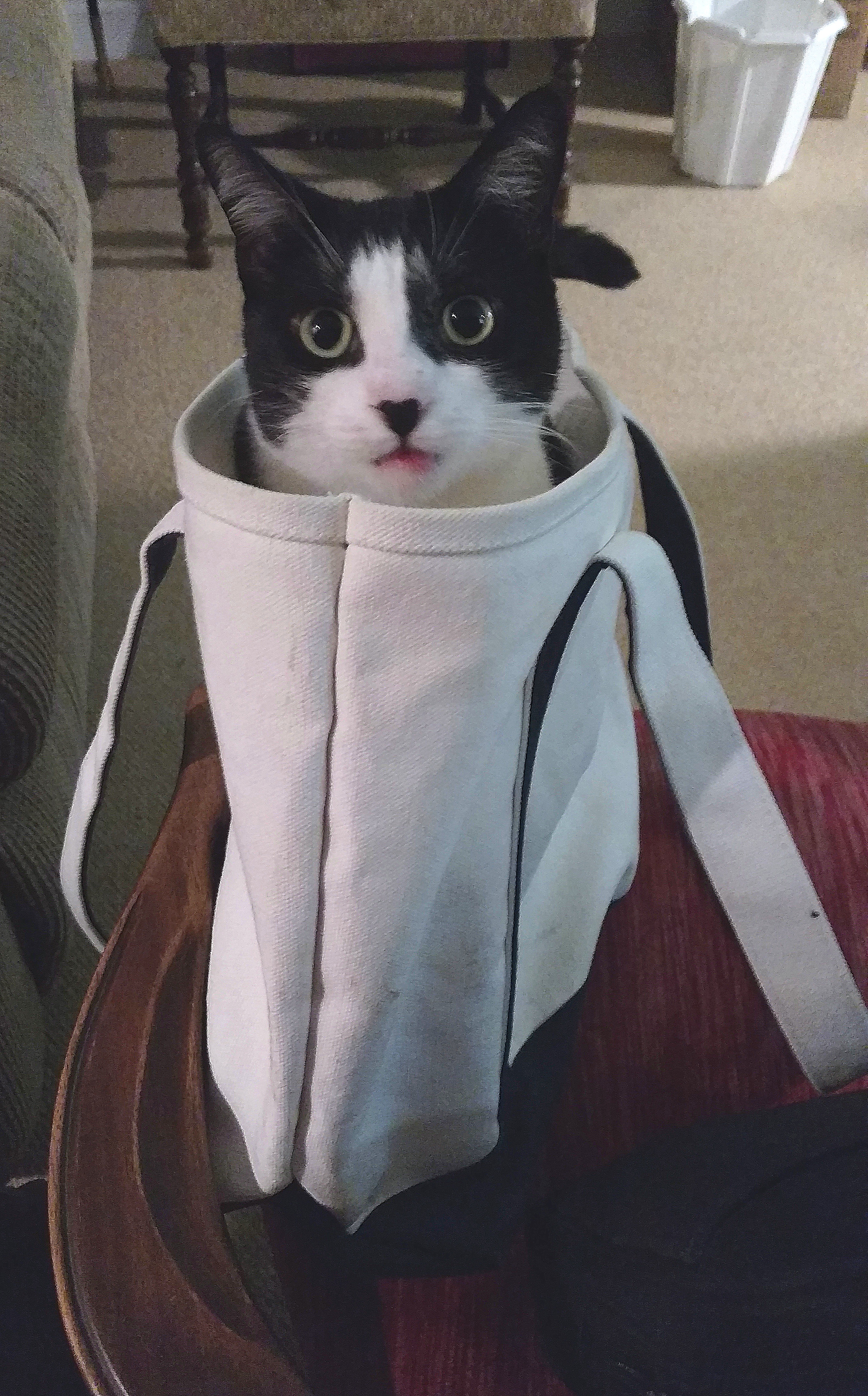
Sometimes Benny, one of our two nearly-identical black-and-white cats, accompanies me. The rest of the time he trots out a few minutes into my routine. I’m made aware of his presence by a gentle body slam against my calves. Despite having started the morning coffee ritual, I’ll stop and feed him. He likely isn’t hungry but why not? Returning to the ritual: coffee filter wetted, cup warmed, grounds measured, and when the water boils, a gentle dribble coaxes the coffee’s blooming. Then a steady pour fills the filter holder. After years of this I usually pour just the correct amount of water to fill the cup.
While these steps play out I’ve downed a glass of water to quench dehydrated cells, and I’ve opened kitchen blinds to prepare for the day. Regardless of standard or “daylight saving” time, very little light comes in these now-opened blinds, unless we’re near the summer solstice: on Retired Saving Time I wake at the slight lightening of the pre-dawn sky regardless the time. Birds will have just started their chirping in the spring. The sun will have become more insistently bright near the summer solstice. Nearing the winter solstice I might beat the sun to rising.
How to convey the calm of living rhythmically? Of waking at first light? Of eating a midday meal when hungry, regardless if it’s 11:30 a.m. or 2:30 p.m.? Of going to bed when tired, never caring if it’s 8:30 p.m. or 11 p.m.? The day becomes a physical meditation. Divorced from it, I can turn into a snarly bear, but being in tune with it resembles breathing at the steady, resonating rate synchronous with All Being.
In 1995 or 1996 I removed the watch from my wrist and never returned it. I turned off the morning alarm. Though I benefitted from a corporate job back then which allowed a laissez-faire approach to the start of the workday, I’m pretty sure I would have done this even had I been a shift worker. The slight tension induced in knowing there’s no alarm served to wake me with plenty of time to tackle morning matters; it proved far preferable to waking 25 minutes before the alarm was due to go off only to lie there cursing because I couldn’t get back to sleep and “why bother anyway”. In retirement this natural rhythm has extended to the whole day, but the slight tension doesn’t wake me anymore.
Coffee in hand, my day officially begins with reading. It may be the Morning Briefing from the New York Times. It might be the comics. It might be baseball, more specifically anything written overnight about the Phillies. Recently, during Lent, my morning read has been The Sign of Jonas, the journals of the Trappist monk Thomas Merton. This last requires turning on a light since it is a physical book, not something on my tablet or cellphone. For that reason my reading necessarily takes place downstairs where a light can illumine without bothering my sleeping wife. Benny benefits too: when I comfortably settle in front of a fire downstairs or in an old wing-backed chair in our library, Benny gets to jump up for a morning petting session. (If I’ve happened to have decided on reading material on my computer, he’ll happily claim my lap there, too.) Reading becomes a bit challenging with a cat squirming around, kneading and delivering headbutts. Soon he settles down and allows me to continue my study of Merton, my inquisitive plunge through data at my computer, or the latest take on This Stuff Really Matters (Today).
Henry Clay Mansion, KY. July 2014.
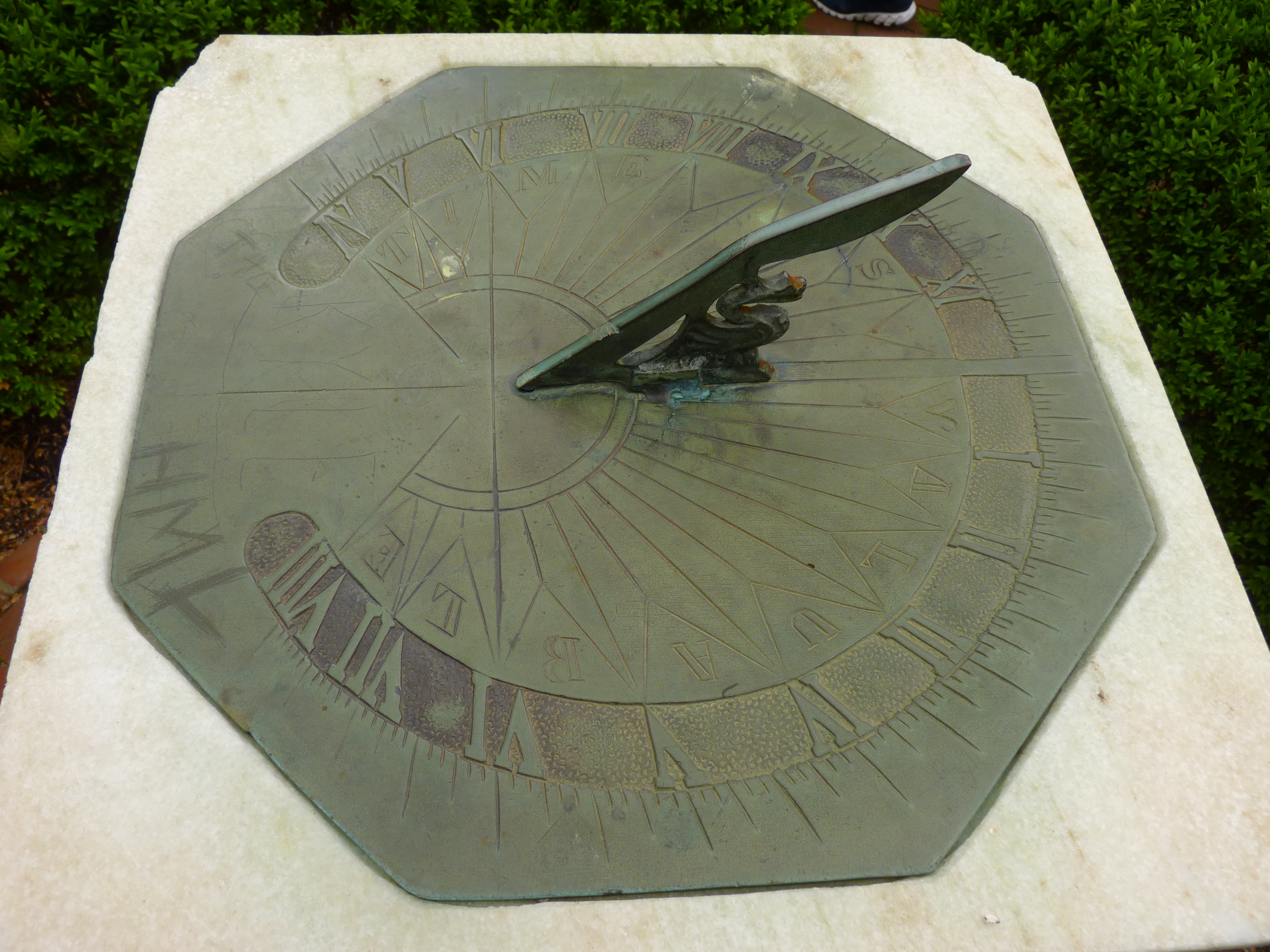
Because I’ve moved to the rhythm of the day for nearly 30 years, I alternate between chuckling or muttering in irritation when people rant about jumping forward to Daylight Saving Time or falling back to Standard Time. Time–being but a mental ruler imposed by humans upon our perception of past, present, and future–doesn’t exist. Every day we are reminded how a group of people living through the same events do not experience it in the same way, do not remember it in the same way, and will sometimes seek to rewrite those events to suit a particular purpose. To put it in someone else’s words:
What usually happens is that, once scientists have worked out their equations [for a Grand Unification Theory], time is nowhere to be found. And if it’s not part of the fundamental fabric of the universe, how do we know it’s not something we’ve invented to explain what we don’t understand?
In most senses I don’t care if it exists or not. Hours, minutes, and the clocks which measure them indisputably resemble rulers, nothing more. Just as that tree on the hill doesn’t get any closer if I declare I’m a foot closer to it (while not moving my feet), I don’t perceive time appearing or disappearing because we move to DST. Just as retirement has brought a detached view of the working world (and many other matters), so too has it altered my perception of time. (Time as a malleable substance?) Stereotyped jokes show us older folks forgetting the day of the week with regularity. Is this any wonder when time doesn’t exist? If I stop using a tape measure to measure how far I travel, am I assailed when I lose touch of my sense of distance? I can still walk from Here to There, can’t I?
[Which sparks a possible and humorous but too truthful dialog:
“Do you know what day it is, Mr. Pilcher?”
“Yes.”
“Would you tell me?”
“Yes.”
“What day is it Mr. Pilcher?” (a bit of exasperation now)
“It’s today.”
“And what day is ‘today’, Mr. Pilcher?” (more than a bit of exasperation now)
“It’s always today. I don’t understand your question.”
“What DAY of the WEEK is it, Mr. Pilcher?”
“Gee, I’m sorry if I annoyed you. I have no idea what day of the week it is. It’s a day between Sunday and Sunday; I go to church on Sunday, and I didn’t go to church today.”
(lengthy pause while Mr. Pilcher’s treatment plan is revised to indicate he is losing his marbles)]
My paternal grandfather spent many minutes and hours staring out of windows in his later years. He at times seem befuddled. He also showed he was sharp as a tack when it came to philosophical and existential questions. He had studied theology and led congregations for decades. Staring out of a window came with the territory, especially when composing this week’s sermon. While the need to write sermons disappeared in retirement, the window-staring did not. Did this indicate a dissociative mind? Doubtful. More likely old habits outlived their usefulness. So too my need to keep track of every hour of the day, every day of the week. I never did, much. Why should I be punished for that? I wouldn’t be punished for a deteriorating sense of distance; why a deteriorating sense of time?
I would argue my rising with the predawn light, moving through the day totally in touch with what needs to be done Now, whether it be eating, my taxes, planning meals, pruning shrubs, reading books, attending a doctor appointment on time, or going to bed when tired keeps me in a meditative state. Retirement provides extra incentive to be in touch with the here and now. I shouldn’t be penalized because I’ve approached a more natural state of being, I should be admired or at the very least respected. Instead, I feel the need to document how my memory of many things has been tenuous throughout my supposedly ‘with it’ years. I have never been able to tell you what I have to do today. As a reporter in my late 20s, I would drive to work oblivious of what stories I had to run down that day. As a teacher in the years that followed, I had only a fuzzy idea of what I had to teach that day, usually because I had planted the seed in my brain the night before: “you have to get to school quickly to print that test you’re giving today.” Ask me on Monday what the lesson plan for Thursday will be, and you would have received a panicked look. In the corporate world where each day’s list of to-do’s varied quite a bit, I had no idea what I would do that day until I looked at the task list. (Bless you Franklin planners for focusing me the idea of A, B, and C tasks.)
And now? How do I prove to those who will judge my mental competence that I have never been able to remember what I have to do today? That I’ve marched through many a day thinking it was Thursday, only to be reminded continuously “no, it’s Wednesday”? When my mother neared the end of her life, she was subjected to many a judgement like this. When she microwaved a throw pillow because she thought she could warm it up and use it on her sore neck, her dramatically shocked visiting nurse felt that Mom was ‘losing it’. Well, somewhat, yes, I concurred. “But Mom has always had a tenuous grasp of the physical sciences including those which govern a microwave. Just because it wasn’t marked “microwavable” on the throw pillow shouldn’t totally count against her. After all, she had several microwaveable neck pillows which she did put in the microwave each night–and they didn’t have “microwavable” on some tag attached to them, because they were handmade by the good ladies at her church. Should she have responded to the smoke filling the room? Yeah, probably. Then again, my wife should have reacted to the smoke filling our house that night in midwinter 2002 when the furnace’s chimney had decomposed, and I came home to a house filled with smoke and a wife merrily preparing my dinner. Losing your marbles doesn’t occur when you misplace the bag of marbles. You lose one here, one there, never noticing the slightly lighter bag you’re holding.
Our perception of time varies from person to person, and time’s but a human construct. Our perception of reality–whatever reality is according to the popular philosophers of the day–varies even more. We should be judged on who we are and who we were, not on who someone wants us to be. Want to scare yourself? Pretend you’re the plaintiff in a court hearing to prove that you are mentally incompetent. My guess? You can’t prove you’re competent right now! Good luck when you’re 80.
God forbid I should be denied my mornings with Benny, coffee, and reading material simply because someone says I need to stay in bed longer, or get into a shower, or do anything else I don’t want to do. “Oh Lord, I pray my ability to perceive how I’m being treated matches how I’m being treated.”
I’ve just finished entering my latest e-book purchases into my preferred library cataloging software, LibraryThing. Entering new books into the library brings joy, frustration, smug self-satisfaction, and fills me with an urgency for and desire to read. I’ve noted before my acceptance for “owning” books which I will never read, that in essence I spend minor amounts of money to reserve a book, for it to sit on my bookshelves real or electronic, to tantalize me and inspire me to read. But why?
Today I’ve 422 unread books. I suppose I’ll live another 20 years. That’s 21 books per year, and frankly I’ve disappointed myself with my slow pace of late. (On the other hand I’ve read 661 books on those shelves. I’m still ahead, right?) The combination of time remaining and still to be read has changed my reading habits. No longer do I tolerate and read mediocre books. I give them a suitable audition then cruelly call “Next!” to them. The definition of mediocre has changed too. No longer does this word represent quality, but rather suitability: perfectly respectable books which just don’t grab me get tossed aside. A good example is Ben Okri’s The Famished Road winner of the Man Booker Prize for literature in 1991. It purported to be the type of book I like, a meaningful fiction filled with magical realism. Yet it became tedious (likely by design) as I endured dream-chase sequences again and again. Finally, after a much longer audition than planned (four weeks), I read a plot summary and realized little of note was going to happen which I hadn’t encountered already. Goodbye, Mr. Okri. Thanks for the entertainment.
I’ve gone through a spate of this. Gore Vidal’s Inventing a Nation proved a sad disappointment after reading Burr and Lincoln, two other books in his loose series on American history. Though I peer dimly through the decades since I read Washington, D.C., from the same series, I remember it with admiration also.
I’ll use a random number generator to select ten unread books from my library to illustrate some points. But first let’s confess to liking some of the children less than others: books are categorized as “To read” but the ones I really want to read also sit in the “To read ASAP” category. Books to consider for my next read get special billing: “The Short List” whose members change with the whims of this reader.
Our first candidate is Gap Creek: The Story of a Marriage by Robert Morgan. It interests me little. I didn’t purchase it (my wife did), it boasts of inclusion in Oprah’s Book Club–not a kiss of death, but smacking of the detraction of populism for sure–and, sadly, because it is a physical book. Nearly all of my books of interest now are e-books, a whole ‘nother topic for ‘nother day. In its favor? According to The New York Times, it’s a “Notable Book” written by a professor of English, and this blurb from the New York Times Book Review intrigues: “At their finest, his stripped-down and almost primitive sentences burn with the raw, lonesome pathos of Hank Williams’s best songs.” (Let us pause and thank the NYT Book Review for properly writing the singular possessive form of Williams.) Chances of being read before I die? Around 25%.
Book #2: A Handbook to Literature assembled by C. Hugh Holman. Another physical book, likely picked up at a garage sale in the 1980s. This is not an anthology of literature as one might suspect from the title, but instead a type of reader’s encyclopedia. In this digital age, virtually superfluous. The fact I own Benet’s Reader’s Encyclopedia kills any chance I would have of reading anything in this book. (Why is it still on my shelf?)
Book #3: Empires of the Word: A Language History of the World by Nicholas Ostler. It promises to dish out a history of all of “the world’s great tongues”. I remain equally an amateur linguist and student of literature. It sounds interesting but one must consider the reading menu. Chances I read it? About 25%.
Book #4: Northanger Abbey and Persuasion from the Oxford Illustrated Jane Austen, volume five. Intellectually I want to say, “sure, I’ve read Jane Austen.” In truth I never have. Just didn’t get assigned in college courses, didn’t break through certain barriers I had as a youth when I read just about anything, and now fights against so many more modern and personally relevant books. On the other hand, I’ve read books from the 1800s to great enjoyment. Why not Austen? I don’t know. We’ve got the entire six volumes of it, plus I snagged Sanditon as an e-book. The chance I’ll read this particular book instead of Pride and Prejudice or Sense and Sensibility or Emma? Pretty much zero.
Book #5: Between Two Worlds (The Lanny Budd Novels Book 2) by Upton Sinclair. Tellingly, I react with, “Oh. That book.” Based on a well-written blurb once, I started collecting the entire 11-book series whenever one would be offered on sale. It seemed like a good idea. Not until I had all eleven did I read book one, World’s End. How disappointing. It made me want to cry or hit someone because instead of writing a story, Sinclair wrote a narrative about a story. Don’t tell me; show me. I’m still trying to figure out how this series could ever be considered as highly as it apparently was about 75 years ago. Chances of being read? 1%, based on the perception that “maybe book two is better than book one…even though I bailed on book one before I was done with it.”
Book #6: Antimony by Spider Robinson, a science fiction anthology of his short stories. I enjoyed reading his Lady Slings the Booze, but he has a tongue-in-cheek style of writing which is clever, not good. Watching someone settle for the easy, quick, and stereotypical would bother me now. The chances I’ll read a bunch of his short stories? About 10%.
Book #7: Writing Down Your Soul: How to Activate and Listen to the Extraordinary Voice Within by Janet Conner. It’s the first book here marked “to read ASAP” because it’s Amazon review quotes at the top, “I am a writer. Today I write.” This grabbed me when I couldn’t ignite this writing life. Now that I’ve done so (thank you, WordPress), I’m kinda turned off by this book. The author “discovered how to activate a divine Voice by slipping into the theta brain wave state…while writing.” Yeah, no. I’m out. And I’m dropping the ASAP designation.
We’re down to the final three contenders and nothing much to show for it…but here’s one at #8: The Ghost Road (Regeneration Book 3) by Pat Barker. The first book in this series, Regeneration, was nominated for the Booker Prize. Ms. Barker felt she had been typecast as a feminist writer so she undertook this trilogy about the First World War. It purports to weave history and fiction with doses of poetry, to throw real and fictional characters into the mix, and to address how war can be terrible yet valuable all at once. I’ve categorized it “To read ASAP”, and I’m looking forward to reading it, 100%.
At #9 we have…a quite intriguing book: My Grandmother Asked Me to Tell You She’s Sorry: A Novel by Fredrik Backman, translated from Swedish by Henning Koch. This is another “read ASAP” book. In this book Backman imagines a “different” 11-year-old girl who connects only with her crazy grandmother. Grandmother dies, leaving letters apologizing to people she has wronged. The granddaughter carries out her grandmother’s wish to have these delivered and experiences the connection between real and fable, experience and stories. I made that up, obviously since I’ve never read it, but I feel as if I have in an abstract sense. I yearn to read the details which underpin this story’s arc. Chance I’ll read it? 100%
Here we are at #10: New American Short Stories 2: The Writers Select Their Own Favorites edited by Gloria Norris. I can tell this physical book has sat on my shelves for 30-35 years as I’ve moved nearly a dozen times. Will I read it? The chances are a bit less than 50% because I’m not a big fan of short stories anymore unless they’re illustrative of a great writer.
There you have it. As a 27-year-old I was challenged by a professor well past her retirement age to consider the judgment of time regarding the “greatness” of an author and of a work. I slowly came around to her idea as I put more years behind me–I know several works which smacked of greatness back then now seem merely good. That’s not to disparage them, but they seem embedded in their time, incapable of providing the illuminating experience which truly great works command. Some recent (past 100 years) authors exist there already: Jose Saramago, Carson McCullers, Italo Calvino, Lawrence Durrell, Jim Harrison, Ernest Hemingway, and Gabriel Garcia Marquez to name but a few. Some contemporaries–F. Scott Fitzgerald, Donald Harington, Hortense Calisher, Annie Proulx, Neal Stephenson, John Irving, and the just mentioned Fredrik Backman–must wait until the jury renders its verdict, likely not in my lifetime. We read, though, for our own enlightenment, our own enjoyment, and our own sense of needing to connect with more than we are. We write for those same reasons. We need make few, if any, excuses for reading or writing the works which will do that for us.
We are falling from the moment we are born. Until forty, we don’t know this. We think we’re going forward, outward, “Onward!” Growing; not understanding we are Shrinking, no, crystalizing into the final Jewel we are, will be, maybe. So much Wiggle-room, so many paths, so Endowed with timelessness!
At forty, we understand, turn, Brace for the fall— Realizing we haven’t jumped up— Realizing we’ve hurtled ourselves toward our doom— Realizing falling’s inevitability: We thought we’re responsible! We acknowledge falling, but abstractly: “There’s plenty of time!”
Our sixties—a.k.a. When Our Parents Die—we See the barrier against which we all Crash. We understand: not only Didn’t we start anything, We won’t be able to End it, either.
These moments of clearer revelation, Shorn of pretense (hopefully), Our backs against the wall of our Inexcusable behavior, our Youthful ‘revelations’, our Moments we thought were heart-rending, Heart-ending, Our happiness we thought Never-ending, our Aimless or purposeful existence, regardless, Brought us here, To this place where Time is short— Dreams are ending— Fruition MUST occur or Be buried forever while we Begin to plant ourselves in the ground— Then…then…we see clearly what can be done, And what can’t, and We do it. Or we don’t. As it always was! As it can be! It’s our best/worst time, Happiness. Fear. Resignation.
Our diamond-quest involves vast pressure. Let it come, let it come. Harden, clarify, Add color, sparkle, luminescence— They mean something: To yourself, to Those who wait, to Those who follow, and again, To yourself.




 all the voices in my head