Many tales have been told of this forest. I won’t recount them. Our guide said the rugged hills finally became settled when financial incentives were made (“land”). At the end of our mesmerizing ride in a tour bus on winding mountain roads, we were dumped into a created-for-tourists facsimile Black Forest village where seemingly every tour bus stopped. It didn’t engender itself. After starting on the guided tour to the small church on the grounds, it got a little better.
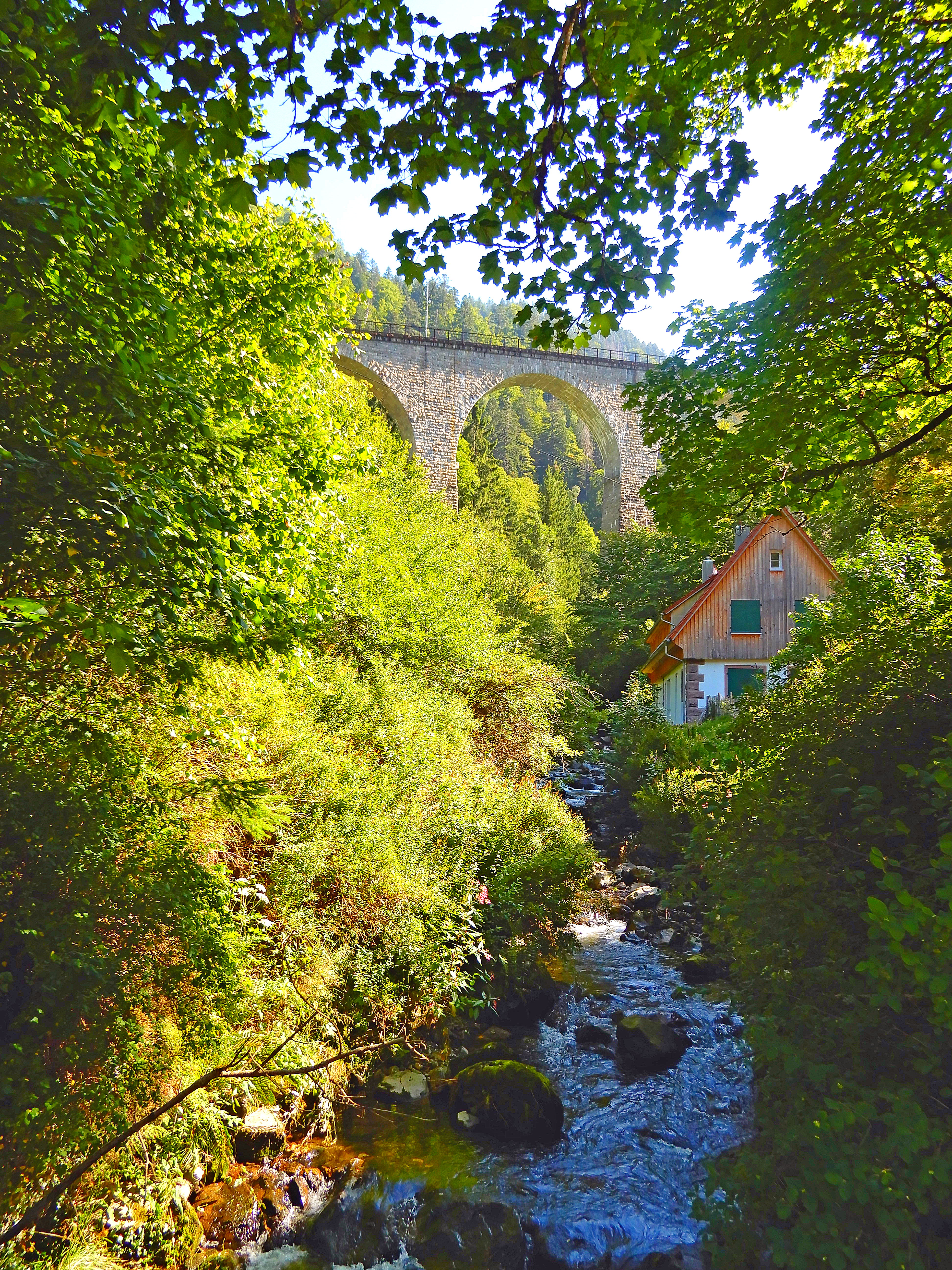
The Black Forest with creek. The bridge in the background is for passenger rail. A train appeared there minutes before this photo. September 2025.
Things were looking up! Until an “elderly” gentleman (i.e., older than me) fell badly on our way to the St. Oswald’s Chapel on the property. He escaped serious injury, thankfully. We meandered past pastures to the little chapel.
Cows outside the chapel. The slope well represents the entire Black Forest. September 2025.
This guided tour yielded one of the two poor guides we had during the six full days of the cruise. (Embarkation and debarkation days don’t have tours.) I remain greatly disturbed that she noted this chapel still saw use—meaning it’s a sacred space to any Christian—yet encouraged our group to grab a convenient rope to ring the church’s bell, all with a conspiratorial tone of “well we really shouldn’t…” The altar area was fenced and locked, but the rope snaked out under the fencing. (I’m also disturbed I didn’t say anything about how it disturbed me.) Annoyed, I went outside where a different kind of disturbance awaited me. When churches consecrate burial grounds and use them for decades and centuries, they fill up. Practically, this requires them to remove the older bones to make room for the new ones! Because these bones still deserve some respect, churches designate a more convenient place to store them, not worrying about whether they mingle. As I left the chapel and walked toward the sanctuary end of it, I saw a small locked grating which accessed a crawl space under the altar-end of the chapel. “Why would this mesh grating have a lock and a crucifix on it?” I wondered. Surprise!
I believe this would be called an ossuary. Black Forest village chapel, August 2025.A closer look at the ossuary. August 2025.Detail of framed crucifix on the Black Forest village chapel. August 2025.
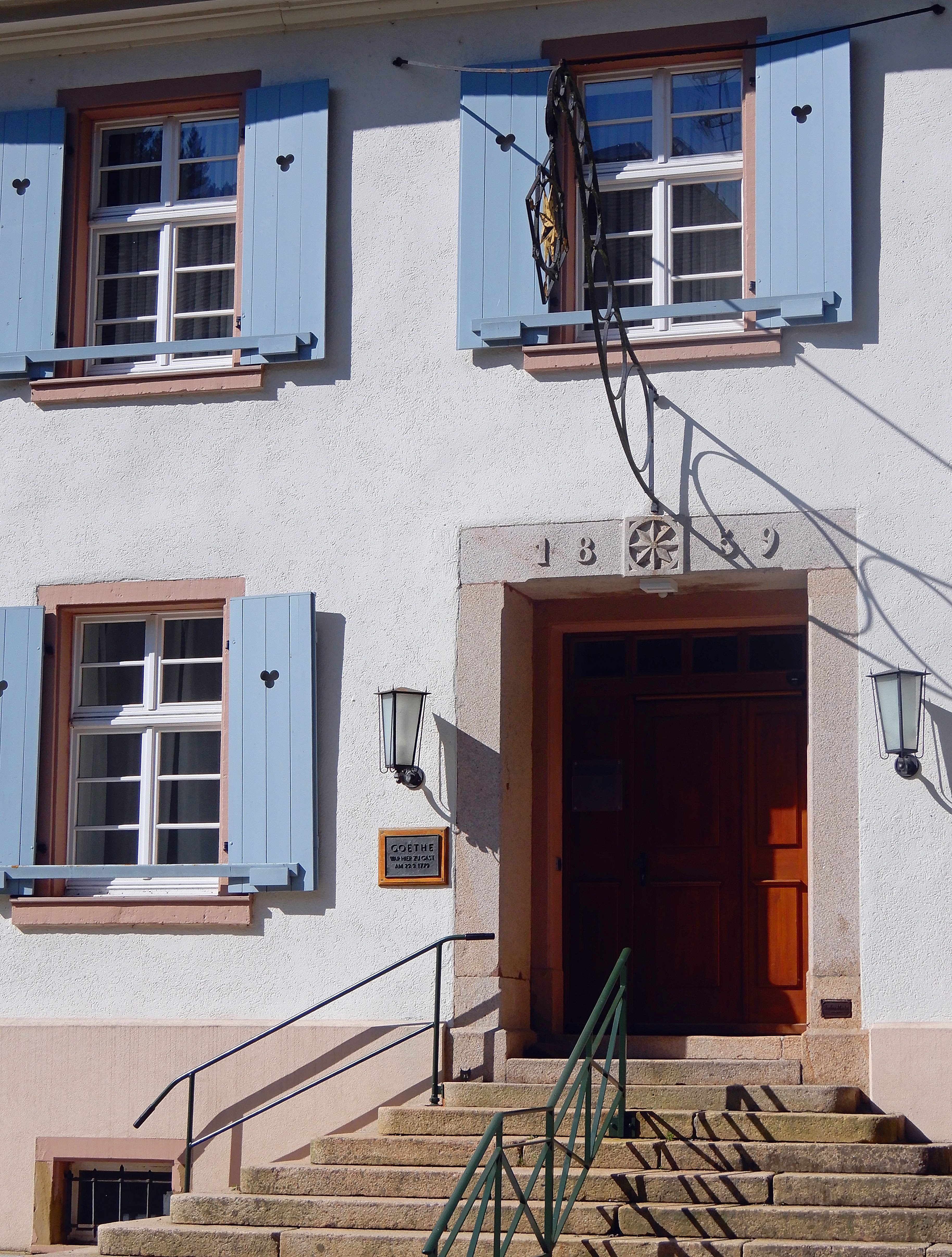
Other buildings were less impressive and/or photogenic to my eye. A building Goethe once slept in (lived in temporarily?) couldn’t be photographed well due to all the intervening people. I had better luck when I got closer.
Goethe House, Black Forest village. August 2025.
Typifying a traditional village in the Black Forest, this made-for-tourists village leaned in to the central reason for such villages: commerce. A quick in-and-out of the glass shop sufficed. I didn’t want to break anything worth hundreds or even thousands of dollars. Another building proved more eclectic: a $5000 bicycle with a handmade frame of spruce or fir; steins taller than my wife; cooking utensils of all sorts; knives; Christmas decorations; and fine spirits. We purchased a set of nice flat Christmas decorations which could transport home easily.
Upon our return to the ship for lunch, we discovered a second Viking ship had docked to ours, and now our veranda literally had only four inches between it and the other ship’s veranda. We had known this could happen, and I wonder if a person could book to avoid it. I’ll detail the considerations in case others might be considering a cruise like this:
Our voyage started at Basel and ended (supposedly; more later) at Amsterdam. Thus, we were traveling downstream.
Other than this first docking, our captain turned the ship around every time it docked. Significant rain had fallen in the weeks before our cruise; the Rhine therefore had risen much higher than normal and the current was particularly strong. Pointing the bow into the current meant the ship wouldn’t be knocked around as it would if the basically flat stern were facing the current.
The ship always docked on the east/north side of the river. Even the stop labeled “Strasbourg” in the brochures actually occurred at Kehl, Germany.
Our ship always docked first. Whenever two Viking ships were docked in tandem, the other ship was the one on the outside, furthest from the shore—not ours.
Putting the previous bullets together, our cabin on the port (left) side of the ship meant we always faced the shore with no other ships in our way…except the first stop. We only were docked two (or was it three) times with another ship en tandem meaning we were unlucky the first docking, but lucky all the dockings thereafter, and the ship docked more than once per day sometimes.
Your mileage may vary: we likely would have faced the river all the time if the water flow had been low. If rains haven’t fallen, it’s possible the ship cannot clear the bottom of the river when it comes to certain sections. In those cases one must re-pack all the suitcases, get bused to a different ship, and carry on with the cruise. That would be extremely time-consuming and eat into a leisurely but short and expensive cruise. The same can occur if too much rain has fallen, and the river runs so high the ship cannot clear the bridges it must go under. It’s a crap shoot and a fairly expensive one. We were affected by one of these unplanned events. It should have been planned, and I’m glad it worked out okay. Stay tuned for the end of the cruise.
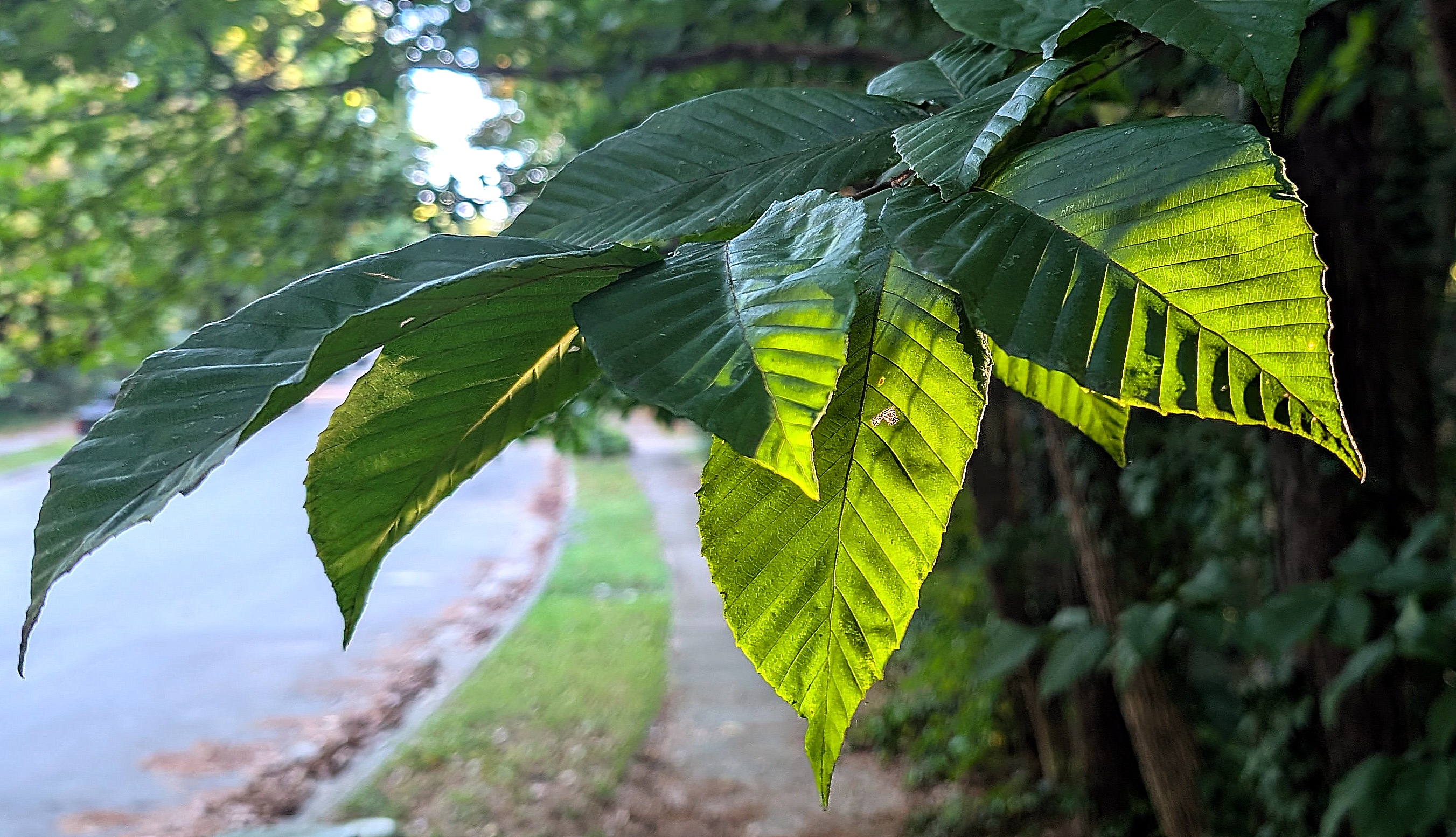
Morning sun strikes leaves of American (Carolina) beech–at least that’s what my plant ID app says. The temp was cool but not brisk around 8:00 a.m. September 2025.
Our weather this summer has been a bit topsy-turvy to me. June’s usual onslaught of highly humid, hot days which normally starts after my birthday on the 8th, arrived instead in the final days of May. July, a month that has seen weeks-long streaks above 100 was hot again but avoided the triple-digits. The official high temps, nevertheless, hit the 90’s every day but two, and we started to collect our normal rainfall (in fact, a little extra).
August, though, should have continued the hot weather and brought some brushes with tropical storms. Instead, the month opened with a high or 86, then 79, and high temps stayed in the 70’s six more days after that. We collected over 5.33 inches of rain in the first 11 days. The entire month easily bested our normal rainfall total 7.99 inches versus 4.71 inches. We saw the 90’s only once, on the 17th, when the thermometer got to 92 while we were in Belgium. The weirdness continued when the humidity broke weeks early—usually it’s the second week of September—and overnight lows descended into the 60’s and 50’s never to rise above 70 again as I write this on the 12th.
As mentioned, September normally sees the departure of high humidity and the extension of lovely days in the 80-85 degree range. Instead, we started with lows in the 50’s and high’s in the 70’s except for a four-day streak of 84-94. Things dry out in the rainfall department normally, too, with the usual rainfall being about two inches. We’re on pace for that.
Even the tulip poplars think it’s weirder. Normally they start to get stressed in July and drop a lot of yellowed leaves. This year, only a smattering fell then and continued through August. When the way cooler temps of September came, they acted as if we’d crossed the equinox, nights were getting crisper, and large numbers began to fall: not yellowed this time but a leathery brown. IT’S NOT FALL YET, I want to scream at them, but by most measures we are crossing that threshold now, not in early to mid-October per my observation of usual.
I had thought the broad strokes of climate changes meant an accented version of our normal curve: hot months would be hotter, cold months would be a little more mild, and we would see more rainfall here in the American Southeast. I did NOT expect we would just take all the normal readings, throw them in a hat marked “Your Weather,” and pull them out randomly!
At least the blossoms have come out on the roses of Sharon, but they are later this year. Contrary to the wishes of my native plants landscaper, I will not be removing all of these beauties, aggressive invaders though they be. (Honestly, they’re growing under a porch, behind the garbage bins, anywhere and everywhere.)
Rose of Sharon. September 2025.Rose of Sharon. September 2025.
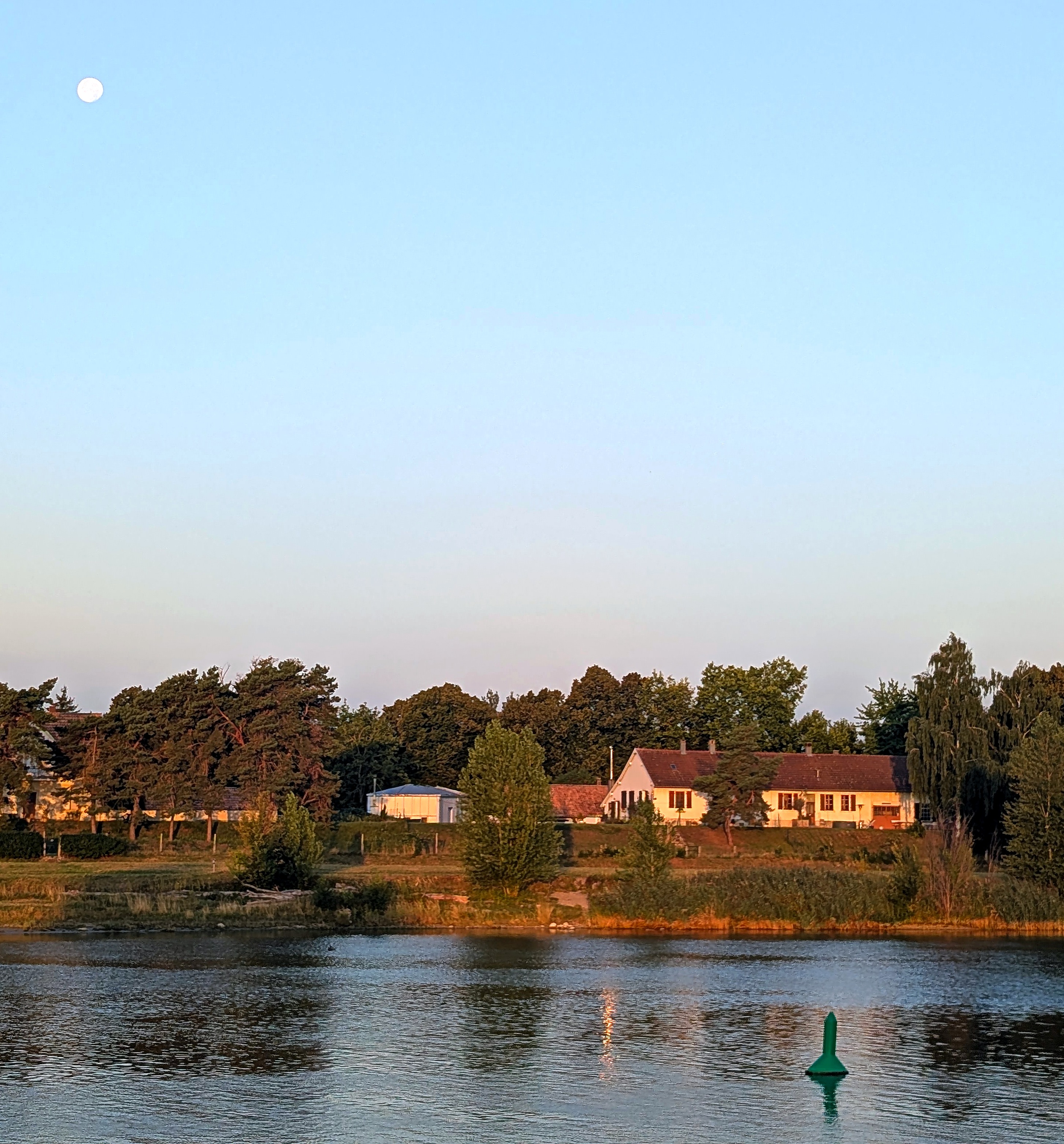
Good morning, France! (From the German side of the Rhine River). August 2025.
Our first morning aboard the Viking Hlin, I woke early. Apparently three evenings of my patented jet lag adjustment routine (copious amounts of beer, large amounts of food, and moderate exercise) had done the trick. I left my barely awake wife in the stateroom and wandered the early dawn on the top deck. Something about boats and trains indulges the romantic. He wakes happy that someone else has navigated the vessel to a new location while he slept. His sleepy dreams continue when the curtains are drawn: what will I see? Where am I? This occurs in a manner no plane will ever match with its tube-through-time approach to travel.
Turning to the starboard side of the deck, the barely risen sun illuminated a nice cathedral in Breisach, still mostly in shadows.
Breisacher Münster St. Stephan Roman Catholic Church. August 2025.
After realizing our definition of ‘breakfast’ would forever be altered by our onboard experience, we headed out on a bus ride to and through the Black Forest. Its history was narrated capably by our erudite and dryly humorous guide, Johannes, raised in the Black Forest. It reminded me of certain challenging terrains in North America where high foothills exist prior to the Rocky Mountains or the North Cascades (primarily on the lee side of the mountains). Unfortunately, the polarized windows of the bus, and the fact my wife sat in the window seat, made photography impossible.
The valiant yellow rose on my daily walk. September 2025.
My daily walks haven’t been very “daily” since we returned from our Rhine River cruise. Today a familiar friend caught my eye. For the several years now when I’ve been walking regularly, a forlorn yellow rose has bloomed where it’s been planted next to a mailbox. Every year it shows little foliage, yet it always has one beautiful yellow blossom. I don’t recall ever seeing more than one at a time. I don’t know if someone strips the leaves purposefully, if deer or something else eat the leaves, or if this just represents the nature of this variety of rose. I do know, however, that it seems almost defiant to me to bloom that lustily when surrounded by bare, thorny stalks.
Even though we may be mostly thorns and difficult to handle, remember to blossom at least once today.
Our first night on the Viking Hlin, we went through a series of locks en route to Breisach, Germany. Having started with beer prior to our shuttle ride to the Hlin before 3 p.m., by nighttime I could properly be called “loaded.” I had, after all, discovered what selections would be available on board, sampling most. By the time we were going through the locks, I snapped a few photos and collapsed happily into bed. (Our stateroom more than met our standards: a decent-sized bathroom and plenty of storage; very surprising.)
And you know that you’re over the hill When your mind makes a promise that your body can’t fill.
“Old Folks Boogie” by Little Feat
I’m sure someone got excited when they received this offer in the mail from AARP. September 2025.
The American Association of Retired Persons (which only wants to go by AARP now for fairly obvious reasons) sent a fundraising request to me yesterday. If I send their foundation a paltry $12, I can get that nifty clock/calculator thingy pictured above! Oh, however will I resist? I don’t know what would be handier than to tell someone on the phone, “Just a minute, young man, I’m going to get my calculator to see if that Nigerian property is a good deal! Hold on, I just have to put this phone down. The cord doesn’t reach that far,” and off I’ll shuffle. (We shuffle because of course all old people shuffle.) It will be a long trip because the clock will reside on my nightstand at the other end of the house. Then of course I’ll have to shuffle back, make all those scruffly noises as I fumble the phone up to my ear, drop the receiver again, and while muttering “oh my…” make all those noises again. Presuming the nice young man is still on the phone, we’ll have to start punching the numbers. Oh, I do hope I can hear him okay! It’s such a bother when we have to start all over because I didn’t hear right, or when I accidentally press the Clear button on the calculator.
If only someone would invent something that just had a phone, a clock, and a calculator in it! And while they’re at it, maybe it could be, …oh, I dunno, ….cordless?
[Full disclosure: I’m 71 years old as I write this. How old does someone have to be to think, “wow, that’s a pretty slick lookin’ little calculator-clock!”?]
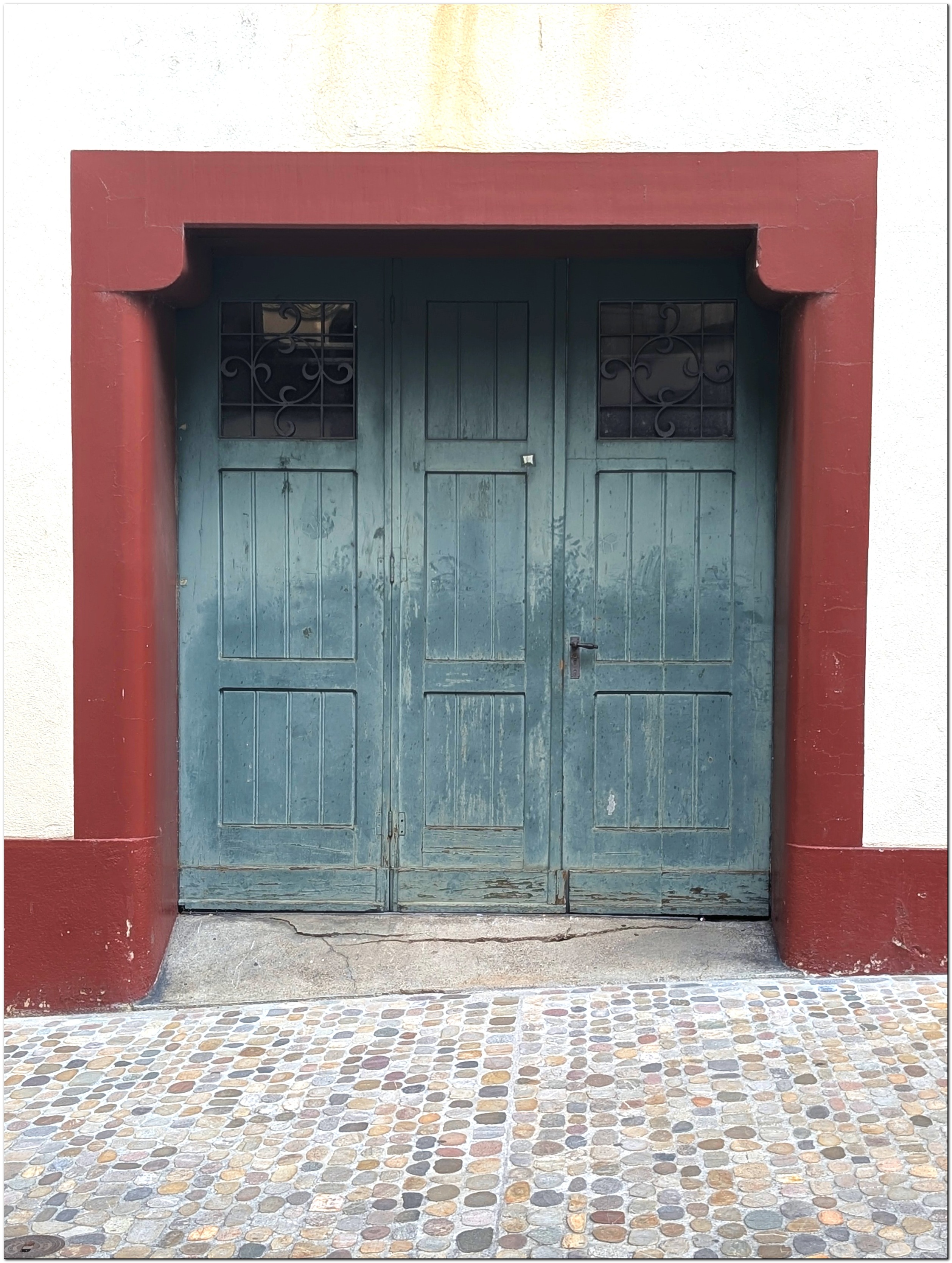
I’m fascinated by doors, windows, and any other portal between Inside and Outside. Part of it’s architectural, but over years I’ve learned I have a near obsession with any door or window which says “different” or “sturdy” or which carry an emotion perhaps symbolic of the wall it pierces. And if our eyes are windows to our soul, what then are a house’s windows?
Our first full day in Basel began with the sumptuous breakfast buffet I’ve come to expect from upscale European hotels. Afterwards we embarked on a walking tour of the historic part of Basel, reached via a short trolley ride from in front of the hotel. Several hours later I had collected six or seven dozen photos. On our second day, we wandered a little park across the street from our hotel, and trolleyed into Basel again where we visited a small but good botanical garden. So many strange doors and windows! (including these…)
Residence, Basel, Switzerland. August 2025.Converted carriage door to residence entry. Basel, Switzerland. August 2025.Clashing architecture. Basel, Switzerland. August 2025.Upscale residence (backs onto the Rhine River). Basel, Switzerland. August 2025.Overlooking the market square, Basel, Switzerland. August 2025.Entrance to a cylindrical chapel in a little park across from our hotel. Basel, Switzerland. August 2025.
OR, “I’M STILL WORKING ON MY COLLEGE READING ASSIGNMENTS!”
Literature anthology texts, college and otherwise. July 2025.
College literature texts resemble the reading equivalent of eating at an upscale buffet restaurant. You know the food will possess decent quality, but you don’t expect one of those “oh, wow, go get the chef!” moments. On the other hand, you know it isn’t Golden Corral, there won’t be questionable entrees and a lack of things which resemble lovingly prepared food. It’s therefore a safe, pleasurable experience you look forward to, but not too much. So too the literature anthology, usually targeted to college freshman and sophomores, aims higher than 50 Romance Stories For The Modern Lover but the reader doesn’t usually expect anything challenging or inclusive. There can be exceptions which prove pleasant. Sometimes, particularly in those early college years, one experiences surprises less pleasant: “But I thought that was a great story, professor!” ran through my mind a few times when my instructor somewhat condescendingly told us a piece we’d just read “was at best, B literature…good, but not great.” No matter. Turn the page. There’s something potentially better at the next station of this literary buffet.
As I’ve ditched books along the way, including texts which seemed useless for the future me, I’ve clung to nearly every anthology I’ve come across. In fact, as a teacher of English for 8th graders from 1983-1992, I accompanied my then-wife to garage sales specifically buying the college texts of other people to flesh out a reference library. In the days before e-books and a true Internet, I either had to seek these texts out from various bookstores and mail order outlets (at full price) or pounce on jewels sitting in the dross of some middle-ager who realized, “why am I carting this book around anymore?” I’m not sure, but I think I’ve only cut the ties with one, The Sagas of Icelanders, and technically it’s still in my house so have I really let it go? It’s categorically called “Purged” and fair game for donating/selling.
Let’s discuss what’s on the shelf above:
Quality Paperback Book Club rescued me when I found myself in Colville, WA, in 1983, a city of 10,000 souls 75 miles from any true city of note, and yet the largest city to the east or west for hundreds of miles. One of the final books I purchased from them before bowing to the Power of the Internet was the QPB Book of Irish Literature (copyright 1999). Beginning with Edmund Spenser and Jonathan Swift, it runs through “The Sheridans,” “The Wildes” (yes, including Oscar), and “The O’Faolains” while picking up George Bernard Shaw, W. B. Yeats, and James Joyce along the way. The latter is represented by the full inclusion of “A Portrait of the Artist as a Young Man.” Samuel Beckett has three entries including a slice of the play Waiting for Godot. A nice touch for a modern anthology was the inclusion of Nobel Prize-winning poet Seamus Heaney. I’ve selectively read throughout the 900+ pages.
The Norton Anthology of English Literature remains one of the classics for this genre, and I had to have it when I found it. My college text is two books more to the right, The Norton Anthology of American Literature. The condescension of a country with about 2000 years of literary achievement can be seen here: I have only Volume 2 of the English literature, but the shorter work, American Literature, represents all of what the Norton editors consider representative and worthy.
Between the two Norton collections lies a silly conceit, fifty great short stories, a humble paperback which I’ve never read. So sue me.
Another book I’ve never read, but have consulted, is Adventures in American Literature which appears to be volume 2.
A Handbook to Literature caught my eye because it isn’t an anthology, but an alphabetical listing of literary criticism terms and themes, genres, theaters, and poetry scansion terms. Unfortunately for this book, I now realize it’s as useful as Benet’s Readers Guide which is “not at all” in this day of AI and the Internet. This book will not be rejoining the shelf. Sad.
The observant person in looking at the above photo will have noticed there are two books with the same title and author: Literature: Structure, Sound, And Sense by Laurence Perrine and in the case of one, Thomas R. Arp. The white-spined edition, the third, guided me through more than one course at Eastern Washington University which seemed to have taken pity on the budgets of its students and used it for both prose and poetry courses…or maybe my memory is faulty. I find it difficult to believe I’ve lost track of the text we used for the poetry class. The wine-colored is Perrine’s 6th edition, this time in collaboration with Arp. Not only does it have a significant number of different selections, but the best part for me? It was bound upside down! One looks with a slight smile at the cover, proud to have purchased one of the first texts ever in what will, of course, be a glorious college career, and then opens the book. Okay, we knew we purchased a used book, so Marc’s name inside the cover is okay. Wait, what’s this? The final page of the index? Upside down? Oh yeah, I would’ve bought the book even if I had no other interest in it.
The two black-colored spines toward the right end of this display belong to The Oxford Anthology of English Literature. In my world, both then and now, if it says “Oxford” it’s an immediate buy. Ironically, I’ve read not a word of either. I took a course in Medieval English literature at the University of Washington which had us buy individual copies of those significant works; reading the Oxford would be redundant. Plus, I’ve recently purchased J. R. R. Tolkien’s translation of Beowulf (and other works) which will take precedence in my hierarchy of reading. Perhaps I will one day compare the works in The Restoration and the Eighteenth Century to The Norton Anthology of English Literature to see what differs. Or not. There are hundreds of books to read, after all.
Which brings us to our final volume, The Treasure of American Short Stories. I’ve read selectively from this book, but it’s mostly redundant to the Norton one on American literature.
Part of our satisfaction for holding onto these types of books—and I know some of you didn’t even question that statement—lies in the combined meaning of memory and potential. We look at these books and they evoke our time so long ago when we sat in uncomfortable chair-desks, taking notes (or not), and experiencing aspects of literature for the first time. Decades later, discarding those memory-tokens seems almost sacrilegious. We turn then to the argument of potential: “I think I might still want to read some of these.” Hence their place still on my shelves, 40-50 years after I purchased them.
If I understood our guide correctly, all of the fully-green-shuttered buildings are a high school. Although she claimed Friedrich Nietzsche and Carl Jung attended it, Nietzsche appears to have been schooled in Germany (Prussia). Jung may not have attended here either, but he at least spent some of his youth in Basel. Basel, Switzerland, August 2025.
I’ve visited Europe only twice, and I’ve already learned to dislike the flights over and back. Flying to Basel started off with annoyance before we even left home: whether because our United flights were actually mostly on Lufthansa or because they were booked through the Viking Cruise company, I couldn’t print the boarding passes. Instead I encountered a endless loop where I was shunted from United’s website to Lufthansa’s and then back to begin the process again. Thus, we arrived at the Raleigh airport far too early to accommodate my fear it would take a lot of time to sort out after waiting in a long line. Neither supposition proved true. Our Raleigh-Washington, D.C.-Frankfurt-Basel tickets in hand we whiled away the first hour by walking the full length of the terminal twice which allowed me a moment of irritation when I saw this sign:
When quicker isn’t the way you’re going. August 2025.
Our flight to Dulles departed at 3:10. Obviously this flight would get into Frankfurt prior to ours which would leave Dulles at 6:10 p.m. for the same city. Why Viking wouldn’t book this escapes me. And as it turned out, our plane from Dulles left the gate 60 minutes late, then spent 30 minutes on the tarmac for reasons I no longer remember. We therefore landed in Frankfurt at about the same time our connecting flight took off for Basel. Our worries were minimal because we knew this would be Viking’s problem, not ours, and indeed, a Viking rep handed us new tickets as soon as we cleared the gate upon landing. Our new flight would be on Air Dolomiti, an Italian airline. The least pleasant of all our flights over and back.
Despite the comfort of our seats (premium economy with no seats in front of us, only an emergency exit and about 15 glorious feet of space), we slept fitfully and as I suspected arrived fairly tired to Basel. My first impression: “Wow, we’re landing in France!” I had not noticed Basel sits at the juncture of France, Germany, and Switzerland. Suburbs from the city lie in the other two countries—our guide lived in Germany “so I can have A/C which I can’t get in Switzerland.” Exiting the controlled area, one follows large arrows to either France or Switzerland. A stop by the Viking desk in the airport, a short wait for two other parties (who didn’t arrive), and we were shuttled the 15 minutes to our hotel close to the Rhine River, but in a newer part of the city.
I then educated my wife on my coping strategy for the six-hour time jump: drop off your luggage, find the bar, quickly enjoy some of the best beer you’ll never see in the United States, and follow it with a full, preferably heavy meal. Guaranteed to put you to sleep quickly and jump start your rhythms to the new time zone. Accordingly….
The three beers of most interest entering the bar. We started with the Schweizer Helles on the right. Hyperion Hotel, Basel, Switzerland. August 2025.An old friend from 2019, Grimbergen. This is the amber or “double amber” as it was called on our cruise. Hyperion Hotel, Basel, Switzerland, August 2025.
Perhaps now we should warn the teetotalers: there will be many references to beer in this series. It’s Europe, the cruise docked on the German side of the river, and we ended our vacation in Antwerp, Belgium, one of the most beer-obsessed countries on the planet.
Suitably sated, we toddled off to our room, marveled again at a completely computer-driven elevator system, and acquainted ourselves with a few vagaries in European plumbing (such as the toilet being on the opposite end of the room as the sinks and the shower).
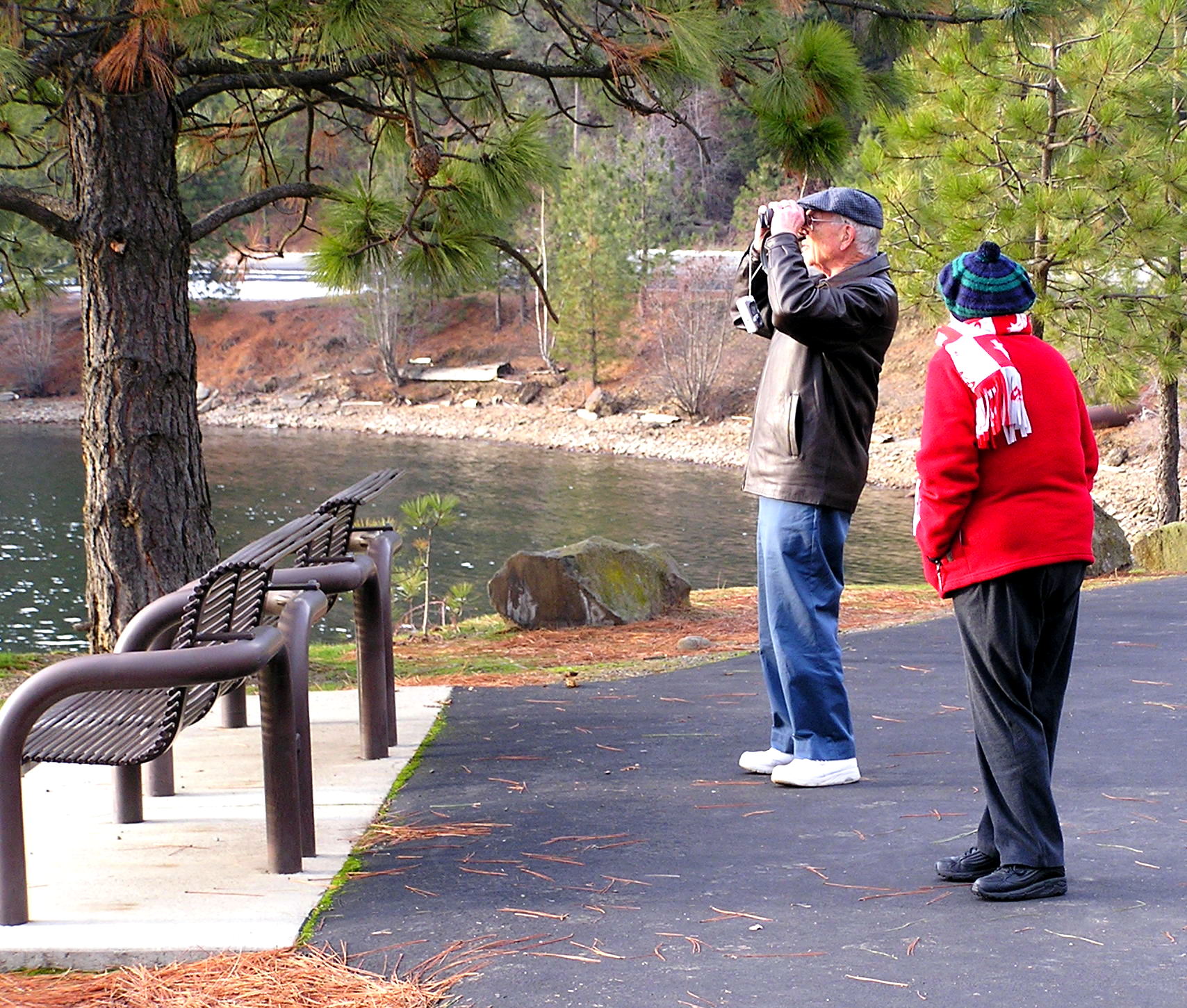
In this photo from the end of 2006, my father attempts to count all the eagles we’re seeing at Lake Coeur d’Alene, ID, while my mother wonders what the heck he’s doing. December 2006.
Our parents shape our lives. Even those who abandon us leave indelible marks on our psyches. Wonderful, painful, soothing, agitating, perplexing, satisfying, loving, and even the hatred—all of our reactions to them mold us. By the time we realize this fully, chances are they’ve departed our physical lives, living only in our memories and those of others. When I reflect on my father, I’ve come to realize he formed me more than any other person. One aspect of that recurs multiple times in a day when my mind ‘blinks’ and spits out an arithmetic calculation or it juggles a jumble of letters seemingly without conscious thought and spits out a perfectly spelled word. Patterns and numbers, numbers and patterns, all a gift, a curse from my father.
My father, Howard Bliss Pilcher, loved numbers. More than that he loved doing things with them, and he did them quickly. He inherited this from his mother, and he bequeathed it me for which I’ve (mostly) been grateful all my life. This pattern-recognition talent allowed me to move from career to career doing things I had no training to do. Yet there I was. My father never fully realized that aspect of it though I think he could have. I brought dreams and abstraction to his gift, seeing patterns in just about everything. His fixation with patterns and numbers remained in the concrete, the defined, the specific.
Numbers make patterns as do letters and words. Again, my father dwelt on how the letters made words yet never scaled the heights (plumbed the depths?) of how words make sentences and sentences make Writing. Not that he couldn’t write well, but his writing never would have challenged anyone in a writing club. It’s as if playing with the nuts and bolts was so much fun, why become a mechanic? He would delight in words with odd combinations of letters or how words tripped off of the tongue. He adored knowing arcane and niche words such as triskaidekaphobia (fear of the number 13). He once stumped us all (Mom, my brother, and me) at the game Probe by playing the word eleemosynary. This word describes things related to charity including being dependent on it. In Probe, played a bit like the paper game Hangman, contestants choose words by putting letters face down on a tray with 12 spaces. If the word is smaller than 12 letters, one fills the extra spaces with blank cards. Each player takes a turn guessing specific letters of their opponents. In that way it also resembles Wheel of Fortune. My brother and I were about nine and eleven, respectively. We expected and understood that our parents would use words with which we would be familiar. We had very good vocabularies due to hanging around them and from our incessant reading. As you might surmise, however, we were unfamiliar with eleemosynary. Heck, my mother didn’t know it! When all players of Probe have had their words revealed except for one, the remaining players each have two turns to guess the word. We never came closer than thinking it was elephant. I remember nearly sixty years later being so upset as to be near tears that he would think we’d know this word! He apologized, grinning awkwardly, sputtered something about charity—but he kept the points.
But doesn’t everybody?
Around this time we learned from our Uncle Gordy, my father’s brother, that he (and maybe their parents) had teased my father for his repeated incredulity that someone didn’t know something or do something that he did. “But doesn’t everybody…” became a way to slightly dig at his recurring belief that everyone could do what he did. This caused him to try to teach me to do long division in my head when I was 8, and before it had been taught in school using paper and pencil. On top of it all, we were weeding the garden at the time. That episode ended with me crying. Some other cases in point:
Every year in the arid West the pine trees drop needles and cones. Thankfully these events do not occur simultaneously to the best of my memory. Spokane might be the capital of the Lawn Nazis, those people who will semi-innocently ask you if you need help with lawn “because I noticed it’s getting a little long” or “I see you’ve had a bit of difficulty getting to your needles.” One did not leave needles and cones lying around on the lawn! I hated raking needles which my father always seemed to pawn off on his boys. Picking up cones, however, somewhat delighted him because as he picked them up, he would count them. “We got 103 cones this year from the front yard. That’s a new record I think!” and off he’d go to check. Yes, he kept track. When we were long gone, I could tell he still did this because the new neighbor across the street knew exactly what we were talking about decades later.
Our family vacations every summer involved driving for up to two weeks to visit scenic wonders and relatives. By the time I entered high school I had visited most of the national parks in the West, though getting further south than the Grand Canyon remained for my adulthood. On these vacations my mother rarely drove (and when she did it was with white knuckles—hers, not ours). My father kept car records on a 5.5 inch by 8.5 inch piece of stock on which he manually drew lines and columns. Each gas fill-up required the date, an odometer reading, the number of gallons purchased, and then while the attendant filled up the car’s tank (ah, those were the days) he would calculate the car’s gas mileage since the previous gas stop.
On any drive, vacation or not, we would at intervals be treated to his light double-tap of the horn and announcing to the car’s passengers, “that’s fifty thousand miles!” or “look! All fives!” Yes, he celebrated when the odometer read 55,555.5 miles. Or when he got 12345.6 miles. There were many possibilities. (Unfortunately this rubbed off on me a little bit. I routinely wake during the night and say to myself, “Oh, it’s one-two-three-four” when the clock reads 12:34 a.m.)
He particularly fixated on license plates. It feels wrong to say he memorized them. My father saw license plate designations as others do names they want to remember. He didn’t know only the plates for our two cars. He knew all of his friends’ plates, too. Though usually no more than a parlor trick—”hey what were you doing downtown last night?” he could say to someone whose car he saw on the way home—once this came in handy. A family friend called one evening: “What’s the license plate on Pete’s car?” A family emergency had occurred while her husband Pete was driving across the state to Seattle. She needed to tell the state patrol his car’s license plate number so they could find him and tell him to turn around. My father dutifully answered her, and Pete returned home as quickly as possible.
My father easily multiplied two two-digit numbers in his head. I remember an evening when I made him take me to an Amway meeting to see if this would be a way to earn money for college. We both realized quickly this definitely wasn’t for me, but we were too polite to get up and leave because we had sat in the front row. At a certain point the speaker began to illustrate how much money a person could make, citing X number of units on which a person would earn Y amount of profit. Before the speaker could punch all the numbers into his calculator my father piped up with the answer. After a few such examples, the speaker quit trying to use the calculator and just turned to my father for the answer.
Typos and misspelled words irritated him. He couldn’t fathom how a person possibly would fail to see the incorrect pattern. One of his favored word games was printed in the newspaper, buried in the classified ads. (If you’re younger than 40, classifieds were really small type printed at the back of the newspaper and somewhat like Craigslist.) The game was called Jumble and ran for decades; I remember seeing it in the past 20 years. Five (four?) words were jumbled up. Playing the game required one to unjumble the words, then take certain letters indicated by circles and use those to form an answer to a tongue-in-cheek question. “Why the sculptor disappeared”; “He was BUSTED” My father didn’t do these frequently because he instantly saw the words, working more or less like a lexicological hot knife through butter.
He counted everything, knew the patterns and sequences of most common things. If he bought a rack of Presto-logs (his preferred way to burn a fire in the fireplace), he knew soon how many stood in the rack. He knew what day of the week a certain date fell on…27 years ago. He knew how many lightbulbs were on the strands of his Christmas decorative lights, how much he weighed every day, where his stock prices ended yesterday, the number of feet from here to there, and the number of miles he had driven if you asked him point blank in the middle of sun-blasted Nevada. Once we were digging around in his dresser—certainly we weren’t supposed to?—and found a slim memo book small enough to fit in a shirt pocket. It dated from his fraternity days at Washington State College. In it, he had recorded the scores of every single ping pong game he had played against his frat brothers. More interestingly, there were three pages at the end with only the first names of women and a number after them! Since we cannot fathom my father being that much of a ladies man—there had to be three or four dozen names!—we’ve been baffled what the numbers meant. Kisses? Number of dates? Both strain credulity. A rating system? Even more unlikely. He certainly got embarrassed, though, when we made a big deal about it. Maybe…maybe… He never revealed what the numbers meant, but we noted he never threw the notebook away either.
When my family celebrated the gift-giving which happens at birthdays and Christmas, we always laid gifts out on the hearth of the fireplace. When my mother turned 64, her grinning husband led her to the hearth where she found a cubical box wrapped in plain paper. It measured nearly two feet on each dimension. Every face of it had a large numeral “4” drawn on it. Baffled, she looked at him quizzically. My father said, “Well, you’re sixty-four today!” She just scrunched her brows a little bit more. “You know,” he explained, “you’re sixty-four. That’s four cubed!” His grin must have been nearly ear to ear. My mother didn’t share his enthusiasm.
Sadly, I found after his death that his obsession with patterns did not extend to how he kept track of his financial information. Files were in disarray, his migration to using spreadsheets had been less than successful, numerous lists of critical information existed but they contradicted each other, and the trivial received thorough documentation but the important didn’t always. As an example, without understanding what his accounts were and where, I didn’t know for sure how much money my parents had in their investments. Seven years after he died, and one year after my mother had joined him, my brother and I found a certificate of deposit in their safe deposit box. Nothing indicated whether it had been received into their normal cash flow when it matured, or if it might be sitting somewhere waiting to be collected. We never could track down the company which sold it to them, and decided it must have been collected—but 25 years after maturity, the CD paperwork sat in the safety deposit vaults.
When I partially wake at night to stumble toward the bathroom, I idly look at the clock. Instantly, and whether I want to or not, my mind cranks out the amount of time since I turned out the light. I remember all the times I wake to do that or to feed cats, then regurgitate them to my wife in the morning. “Well, I was up at 4:37 feeding the boys.” My father lives in me at those moments. He whispers like a schizoid voice and makes me count the cars I see on a lonely stretch of highway. He makes me frown disapprovingly when I read yet another grammatical error in what passes for our newswriting these days. He laments that I don’t figure my car’s gas mileage, stares in disbelief when I search my brain for my own car’s license plate number, and smiles when I record the amount of rainfall for yesterday. I don’t tell him it’s only because I need to know when to water the yard. And I hope he’s proud of me for all the new ways I’ve used his gift to see the numbers and patterns in quality systems and manufacturing results. He never really said one way or another while he lived.










 all the voices in my head