On June 22, 1925, my father was born in Lansing, MI. Back then I presume he and his mother stayed in the hospital for at least a week. Remember that, it will come up later. His father, the Rev. Howard Pilcher, had taken what I think was his first job after seminary, supporting youth ministry at a Baptist church there in the Michigan capitol.
In 1989 my father retired in May, shortly before he turned 64. Certain waves move through the business world, and computers had transformed his workplace in the 1980s. He had not bothered to join The Movement, his life at work was getting to be a grind, and frankly, he had struggled with the interior conflict of being a minister’s kid full of ethics and morality while he worked in business. That he worked for a nominal non-profit (a Catholic nun-supported hospital) didn’t seem to make enough of a difference. When he figured that 64 didn’t make that much difference from 65, he bailed.
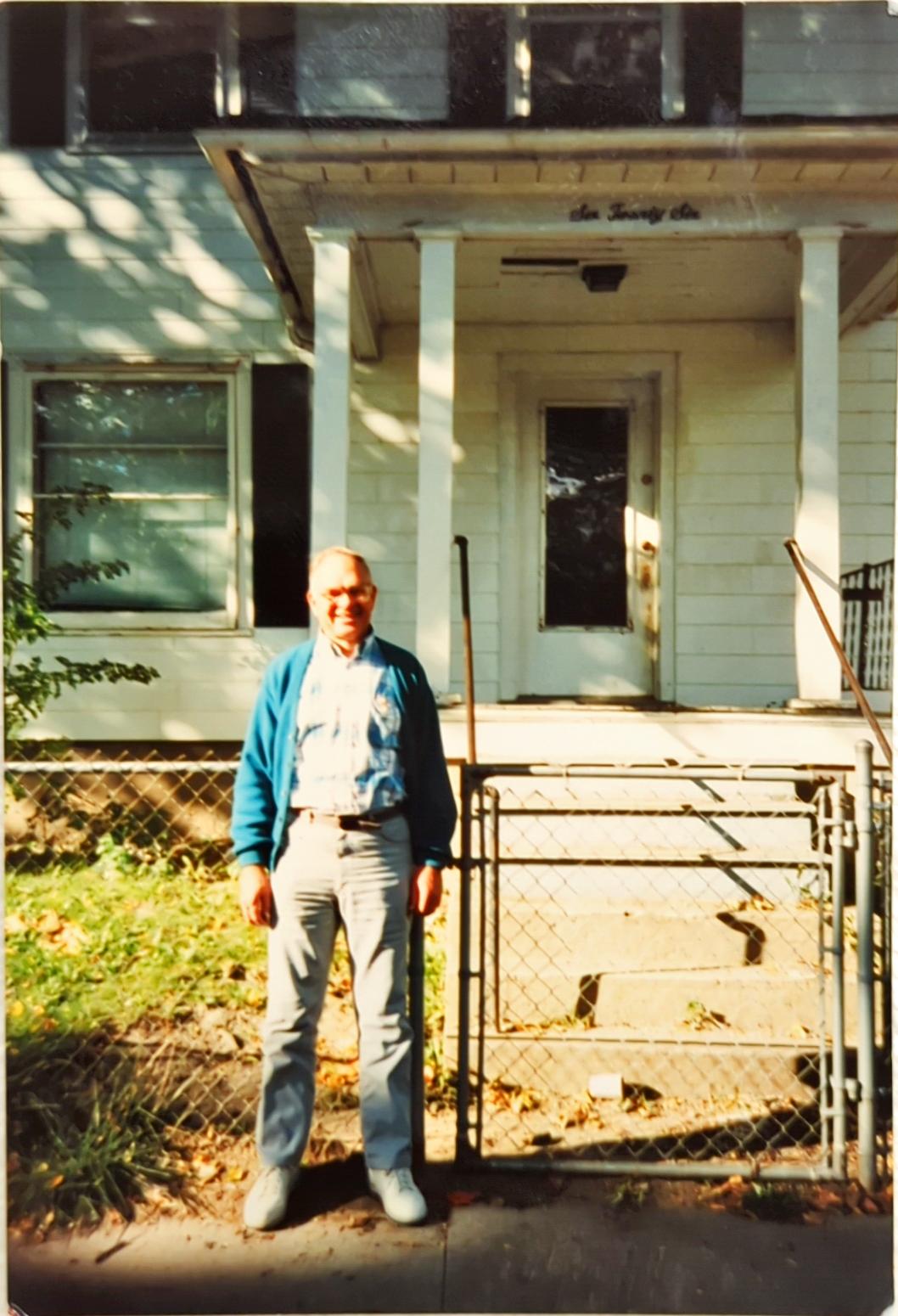
And only four months later, he found his way to the street he had ‘known’ as a newly born infant. He had my mother take this photo:
Howard Pilcher, Jr., in front of his first home. September 1989, Lansing, MI.
In 2013 my father died in December. My mother died in 2019. It was then I inherited all of their photos. Despite common sense saying in a whispered scream, “No! Just throw them away!” I instead sorted through every one of them last fall, noting the ones which documented salient events and/or salient people in our family lives or of my parents’. I ran across the above photo at that time, and smiled when I saw the address written on the back of the photo. Since we were talking about a trip to Michigan, I thought, “why not recreate the photo?” And thus in July 2023…..
In front of my father’s first house. July 2023.
I take a weird satisfaction in knowing it sometimes was weeks before a baby went home with its mother in 1925, and therefore, I stood in front of this house almost exactly 98 years after my father was carried into it. It’s funny how much stock is placed in this house since my father was moved at the age of 3 and never saw it again (to the best of my knowledge) until he was 64. I don’t know the address of his home in Edina, MN, where he lived from 3 to 14, nor do I know exactly where he lived in Havre, MT, during high school–I have a pretty good guess since they were always living in a parsonage provided by the local Baptist church.
As a side note, the resident of the house acted very graciously for all of the photos which were taken. (My wife didn’t understand the framing I wanted when she took the first set.) I went to the door to explain why someone would be doing such a weird thing. I couldn’t tell if he merely relaxed to know it wasn’t anything nefarious, or whether he just didn’t care.
This morning we visited New River Gorge National Park & Preserve. We had only a few hours, though, and this park lends itself to a segmented number of visits: there are four distinct areas, none connecting to the other. We chose the Thurmond area where an abandoned town thrived through the early 1900’s then slowly withered away as steam-powered trains no longer needed West Virginia coal.
Here’s what once was a thriving bank:
The bank looks out to a pair of still-in-use railroad tracks–we had to wait for a freight before crossing to this main street of the town–and then to the New River, barely glimpsed through the trees.
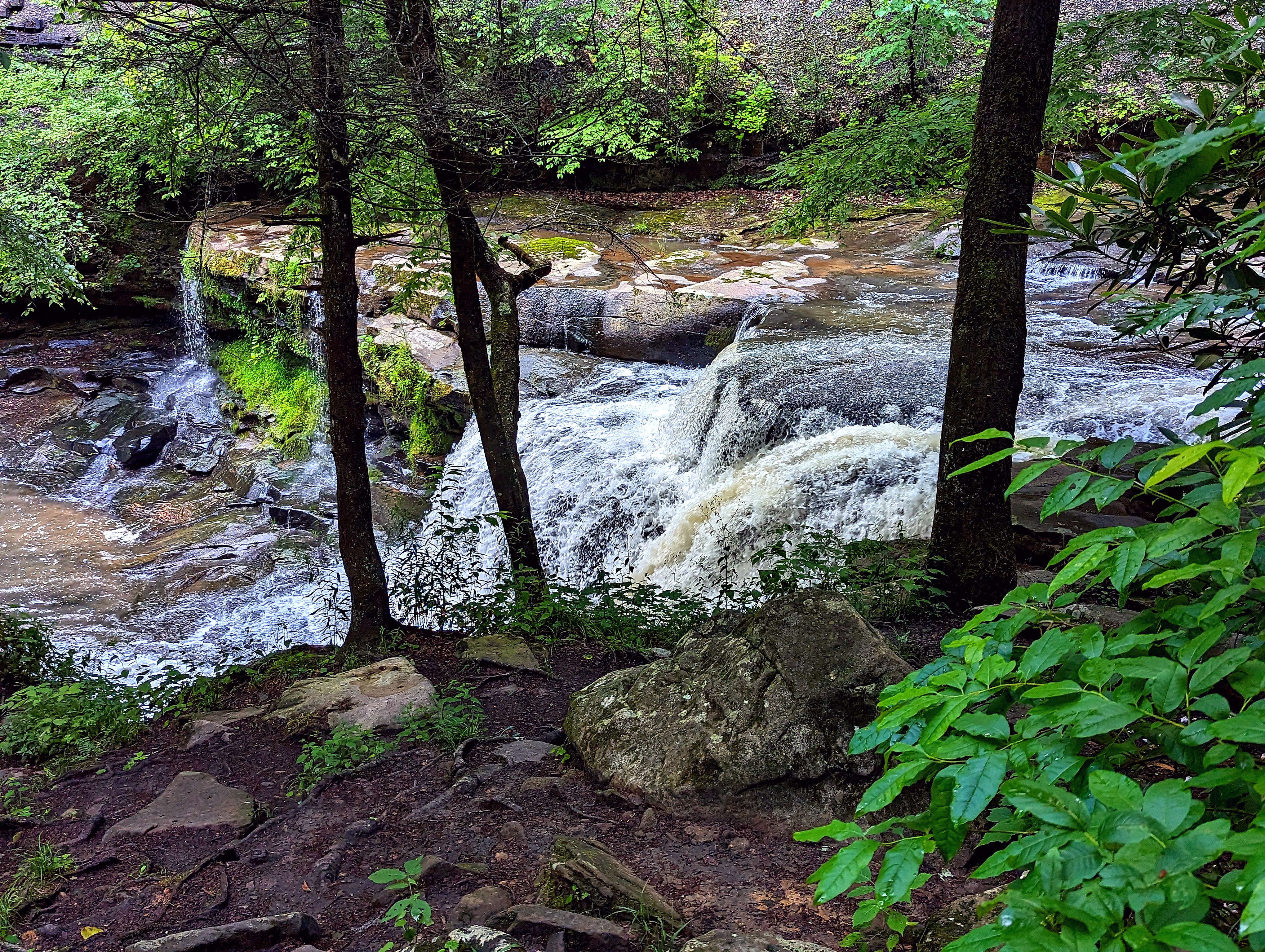
On the way back we stopped at a vehicle turnout beside Dunloup Falls to lunch on the leftover steak from dinner last night, stuffed into some soft rolls (also from dinner):
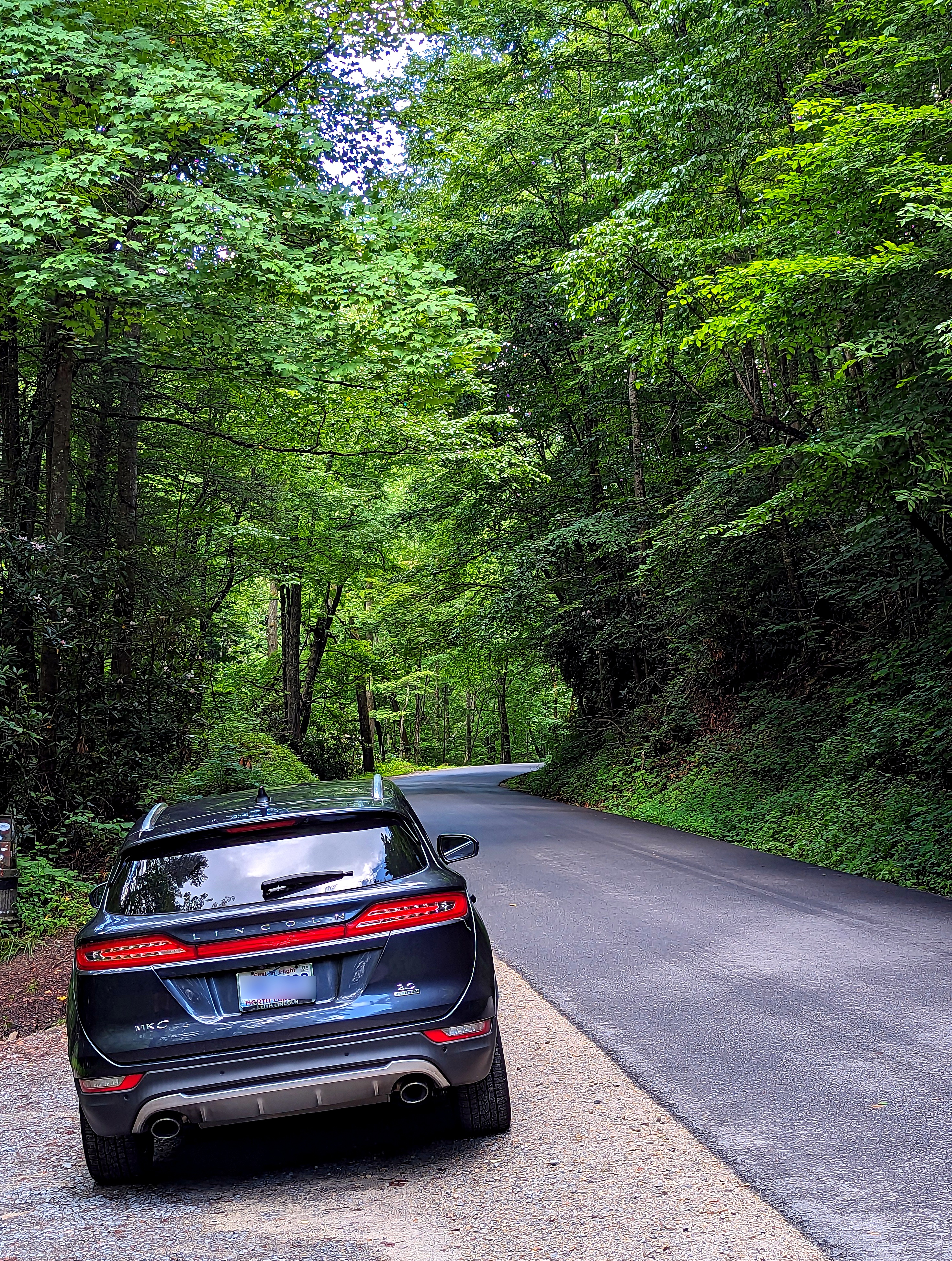
We then pointed our vehicle along the canopied road, joined the USA’s interstate system and motored to Cincinnati.
I’ve been pondering (to quote one of my new favorite bloggers) that I stand on the threshold of 70 and I’ve only 10-15 years of travel left in me. This starkly scares me. I usually figure two or three significant times of travel per year. Twenty to forty-five seems like a goodly amount, but it’s that lower end that makes me wonder: if I’ve only 20 trips left, and I want to go to Europe more than once, to Hawaii, to places in the USA, to just experience certain periods of unfettered wandering…how much is left in me?
It’s funny. You think for much of your life, “hey, there’s plenty of time for that,” because you’re 35 or 45 and decades stretch out before you. Then you get up toward retirement, and frankly you’re just thinking about that retirement. There are a lot of channels to negotiate to retire: income when you’re not working, riding herd on the expenses, and the projects you always thought you’d do but you just didn’t have the time or the money to do them. You negotiate that when suddenly a little global pandemic kinda s-t-r-e-t-c-h-e-s that whole process out. When the world comes to, everyone removes their masks (assuming they were wearing them in the first place), and you realize, “crap, I’m almost 70. How much time is there?”
This clarifies things but in a brutal way. When someone comes at you with a knife, your options suddenly are VERY focused. When life comes at you with a knife…… Didn’t the Fates snip a man’s life thread and end it?
Fog at the mouth of the Columbia River sets a standard for fog. Fog defines where Oregon and Washington share its outlet to the Pacific. It also defined my nascent and up-to-then non-existent career as I drove to Ilwaco, WA, and my second job interview of that early weekend in December 1977.
Car-less at that point of my life, my folks loaned me a 1968 Ford Galaxie 500. Though only nine years old, one could see already why it had been handed down. I piloted this coffin on wheels toward the southwestern tip of Washington through a typically drizzly early winter day in the western part of the state. “Man, talk about wet!” I muttered. At the same time I thought this, I drove my 1968 Ford Galaxie 500 into a fog bank. Until that point of my life–all 23 years of it–I don’t think I had ever realized what the phrase “bank of fog” meant. Within 100 yards I drove from a gray, drizzly day into a shroud of bright nothingness. I could barely make out the highway signs along the shoulder of the road.
How had I gotten here?
Simple. In mid-December 1977 I found myself in imminent need of a job. The University of Washington School of Communications planned to foist me on society with a degree. I had trained, in a mediocre fashion, for a job as a reporter. I realized I wouldn’t get any top-tier jobs at the dailies of Washington State, Idaho, Oregon, and I wasn’t plugged into destinations further away. (No Internet, no networking skills, no time spent learning about how to get jobs pretty much anywhere.) The state association of independent weekly newspaper publishers had to do. For one thing, the association headquartered itself in Seattle just a couple miles from the University campus. I figured, correctly as it turned out, they would be desperate (in a relative sense). Our corner of the US hadn’t experienced the stagflation of the Carter Administration, and talented graduates don’t seek jobs with weekly newspapers. Neither do most graduates want to head to the hinterlands to report about social teas, high school sports, and local city council meetings. It sounded easier, and I was all about easy, then and now.
Shortly after finishing my final final, I traveled to my parents’ home in Spokane. Once there, I gorged on home cooking, spoke to them as little as possible, and grabbed their old Ford for some serious job hunting.
My first stop that early December weekend was in Moses Lake, afairly strange place if you’re from outside of the state. To us it merely offered a respite in the cross-state drive. I met a married couple who owned and managed two newspapers. One was a weekly in Ritzville, WA, which is a small farming-oriented community at the northern edge of the Palouse wheatfields where it enjoys a location on the main east-west corridor through the state, I-90. They also published a paper in Cle Elum, but I do not remember if it was the Miner Echo or the Northern Kittitas County Tribune. I tend to think it was the former.
The owners were salt-of-the-earth, don’t-give-me-shit small business owners in a small community, a class of person I soon was to become deeply knowledgeable about. They didn’t make the job sound attractive. And they offered $125 a week. (Keep that figure in mind.) I told them I was interviewing elsewhere, and I would let them know. Notice they offered me a job on the spot. My alarm was sounding, but not loudly: I had kinda figured this wouldn’t be extremely difficult. A theme of my life to that point, and for a goodly part of my life from thereafter, was to flow into the path of least resistance.
This was a Saturday. I continued after the interview to drive westward, arriving at my dorm sometime in the late afternoon. (What a “thrill” to park a car in the student garage like all the kids that had more money than I did!) On Sunday I got myself up at a non-student, responsible hour, got in the car again, and headed to Ilwaco where an interview at the Chinook Observer awaited me.
My encounter with the fog bank said, “Welcome to Ilwaco.” It continued, growing more dense as I got into town. I found the office and parked outside. Upon knocking on the door, I was met by a pasty-complexioned man who owned the paper. He seemed ill at ease, hesitant, insecure. I immediately wondered how a man could own a weekly newspaper, the klaxon of any community, the polestar of community ire, and have a personality like this. We had a milquetoast interview and he offered me my second job in two days, also at $125/week. He seemed upset when I said I already had one offer on the table and another interview pending.
The Skykomish River near Monroe, WA, at dawn. There is a river there. And trees on the far bank. Almost as foggy as the mouth of the Columbia River near Ilwaco. Sometime in 1979 or 1980.
On Tuesday two days later I headed to Monroe, WA. Only 15 miles east of Everett and about 30 miles from my dorm in Seattle, Monroe was the gateway to the North Cascades via US Highway 2. Tuesdays, I learned later, was publication day which meant that the paper was being “put to bed” while I interviewed with the owner. I omit his name in case I say something which might get me in trouble.
This interview started out weird and stayed weird. The antithesis of the Ilwaco publisher faced me. He’d served as motorcycle courier in World War II in Europe, and he carried that hard-bitten attitude with him. He revered John Wayne. He kept Cutty Sark in his desk drawer. He ended the interview thusly: “So…I can start you at $150 per week. When can you start?” I trotted out my now-practiced “well-I-have-other-offers-on-the-table” speech and he said, “Well, call them and tell them you’ve accepted this position!” I was caught off guard. He asked, “Do you want this job or not?” I thought (quickly) about $25 more per week. He was offering $7800 per year. In 1977 more than 25% of Americans earned less than this. I was young. Earning less than the median American ($13,572) didn’t sound that awful. I would be working as a reporter. I told him yes, I would give those others a call. He said:
“We’ve got phones, I’ve got an extra office. You can call from there.”
So I wound up on a Tuesday in mid-December sitting in what was definitely not an office but more a glorified cube (and would soon become my cube), calling the other two publishers and telling them that I had accepted an offer elsewhere.
Because we were at this point looking at the issue which would come out right before Christmas, we agreed it would make the most sense for me to arrive right after Christmas and start work on Monday the 27th. I got in the old Ford Galaxie, drove to my dorm, cleaned it out, and drove to Spokane. I celebrated Christmas with my family, including my brother, home from a separate university in the state.
On Sunday the 26th I drove across the state for the fourth time that month, the old Galaxie towing a U-Haul trailer with all my possessions. I got to my mother’s childhood home in Seattle very late afternoon, when it was dark. There my grandparents bequeathed me a chair and some other odds and ends, some of which–like the chair–I own to this day, more than 40 years later. I pulled into the parking lot for the Monroe Motel later that evening, checked in, and reported to work the next morning.
Fog defines my entire job interviewing process and my newspaper work thereafter. I’d no idea what I really wanted to do other than write. I couldn’t discern which job sounded better until the last publisher just plain told me. I stumbled through my first year until I managed to trust that all those empty inches would somehow be filled by Deadline Day. Less than four years later I drifted into something else.
Four Sundays have passed since last I posted, and more than a month since anything of significance graced (?) this blog. Let’s catch up and be witty about it (I hope). In mostly reverse order….
Red oak with tree trimmers. Raleigh, NC. June 2023.
In the photo above a local tree-trimming service prepares to limb the dead branches out of this fine red oak in our front yard. Most of the branches overhang the street or sidewalk and thus pose a safety risk for anything/anyone who happens to be beneath them. I could try to describe where they are in that photo, but only one is distinct. It’s in the upper, left-center of the photo, a dark silhouette against the light green pines behind it. No, not that one. The one snaking down away from it. In all, the two-man crew lopped four main branches and about a half dozen minor ones. The thick end of the branches measured six to eight inches, and I got a nice box of firewood out of it all. This company has given up cutting trees down (losing 30% of their revenue stream in the process), focusing instead on maintaining the health of the ones we still have on this planet. Further, they offer to return your yard to a natural meadow state (for a pretty hefty fee), something we are seriously contemplating. They use organic, natural substances for maintaining shrubs and trees. They help support the native plants and help eradicate or tame the non-natives. I’m pretty stoked about it–if we go the full makeover route, I may give them free advertising by mentioning their name!
Backyard bird feeding station #2. Raleigh, NC. June 2023.
“Month of Sundays” continues: I’m embarrassed to put up such a mundane photo, but I’ve yet to take any good ones. Last Sunday we sat to enjoy this new bird feeding station erected the day before. The squirrel/raccoon baffle works, at least for squirrels anyway, and by including mealworms in the feeder on the right I’ve managed to entice the bluebirds to feed once again. (Haven’t seen them since I quit offering mealworms about nine months ago–long and boring story.) I’m excited to use a Nikon app to link my camera to my phone and take photos of the birds without being anywhere near either them or the camera. It should be good. (It may not work at all, but permit me my optimism.) Installing this pole system proved serendipitous: the same day I planned to install the new pole system, I found the nice, squirrel-proof feeder which normally sits on the pole in the background nearly torn off, likely by something big, like a raccoon, perhaps a possum. Three of four nut-and-bolt fasteners were gone, and it hung sideways by the final remaining one.
Makin’ tortilla chips. May 2023.
Not exactly another Sunday back: the penultimate day of May I spent preparing what I call Deconstructed Nachos. It starts with taking all those fading tortillas which we never can keep up with and turning them into chips. We had several avocados at peak ripeness; they became guacamole. Some heirloom beans (Buckeyes, I think) from Rancho Gordo received the Mexican-flavored cooking I favor, using a recipe from a book I’ve carted around for 45 years. Using the same cookbook, I turned them into a bean dip. Then we just dip the chips instead of piling the ‘stuff’ on top of the chips. Sometimes I’ll make a picadillo, but we skipped it this time, and indeed skipped the melted cheese on top. Goodbye May! You were delicious!
In the past two months there has been baking….
Poppy rolls from the book From Scratch by Michael Ruhlman, baked in a cast iron skillet. They held lots of shredded pork and coleslaw and were dressed with Lexington BBQ sauce. May 2023.Hearth bread from The Bread Bible by Rose Levy Beranbaum. May 2023.
There was altogether wa-a-a-ay too much of this…
A fine grain-and-hop concoction in one of the new Teku glasses purchased from Victory Brewing Company in Downingtown, PA. I’m thinking it’s a Belgian-inspired brew from Haw River Farmhouse Ales. May 2023.
…and too little walking and exercising. If there had been more, perhaps I would have encountered more of these while walking….
Deer crossing where the City of Raleigh has built a drainage pipe under the road just north of our house by a couple hundred yards. This allows an unnamed creek to flow to Haresnipe Creek. May 2023.
I’ve now marked the first ten days of my 70th year on this planet. I’d like to think it’s time to get serious, but why start now? Seriously, I need less serious and more lighthearted enjoyment. Apologies for a rambling travelogue through my past two months. We’ll get back to Serious Stuff again. You’ll see.
Many an evening an inspiration strikes, and I dutifully grab a pad and write it down. About 90% of the time I read it the next morning and say to myself, “WTF?” This morning this is what I read:
Social Wallpaper
–you divert the attention from ME
sincerely recorded by brain-addled me
All I remember is saying this to my wife in the context of me pontificating (as I am wont to do), and exclaiming to her, “Wow! I’ve got to write that down!”
Cannonballs at the Tryon Palace, New Bern, NC. May 2009.
or, “To all who run toward the open field”
Not all are called to priesthood;
...to teach,
...to heal,
...to defend,
...to right wrongs,
...to lead,
...to agitate,
...to write
The Great American Novel.

Some of us pursue
not purpose but
meaning in being,
in "job well done",
in talents exercised,
in immediate
gratification for
problems solved,
purposes fulfilled, in
greasing wheels for
others, serving those
we do not know to
accomplish what we also
do not know. To add one
rock to the pyramid
being built by us all.
(a first draft with apologies to Whitman lovers everywhere)
I sing the keyboard Selectric,
The keyboards which I loved and those few which loved me,
They will not keep up with my fingers nor respond to them,
But IBM corrupted me, charged me full of longing for the charge of the ball.

Who could doubt that once corrupted, we would conceal ourselves?
If once defiled, we would not attempt to defile others?
If the up-and-back could not salve our soul?
If the jittering ball were not our soul itself?

The love of its inky black nothingness of a ribbon, we scarcely balk to account,
That of the ball is perfect, and that of the ribbon is perfect.

The expression of its typeface balks account,
But the expression of a well-made page appears not only on the paper,
It is in the slight indentations felt on the paper's reverse, it is curiously in the non-smearing type left by supple wrists,
It is in the ball's walk, the absence of carriage, respondent to flex of wrists and fingers; cover does not hide it.
The strong black strokes jump from the rag cotton carrier,
To see it conveys the best poem, perhaps more,
You linger to see what life it might bring back to dead prose.

Bridge from Underwood to cathode ray tube, to green dots pointillistically imbuing meaning in blackness,
The thin dark lines of letters stringing meaning, the meaning within you and me,
The exquisite realization of print;
O I say these are not the parts of prose only, but of the writer's soul,
O I say now these black lines are that soul, meaning.
Intracoastal Waterway, Bogue Sound, NC. November 2016.
Did I say,
"nailed by meaning?"

Sometimes
your lines suck
my lungs dry,
replacing my
oxygen with
amniotic,
fluidic meaning,
sustaining me
more than I
knew I needed.