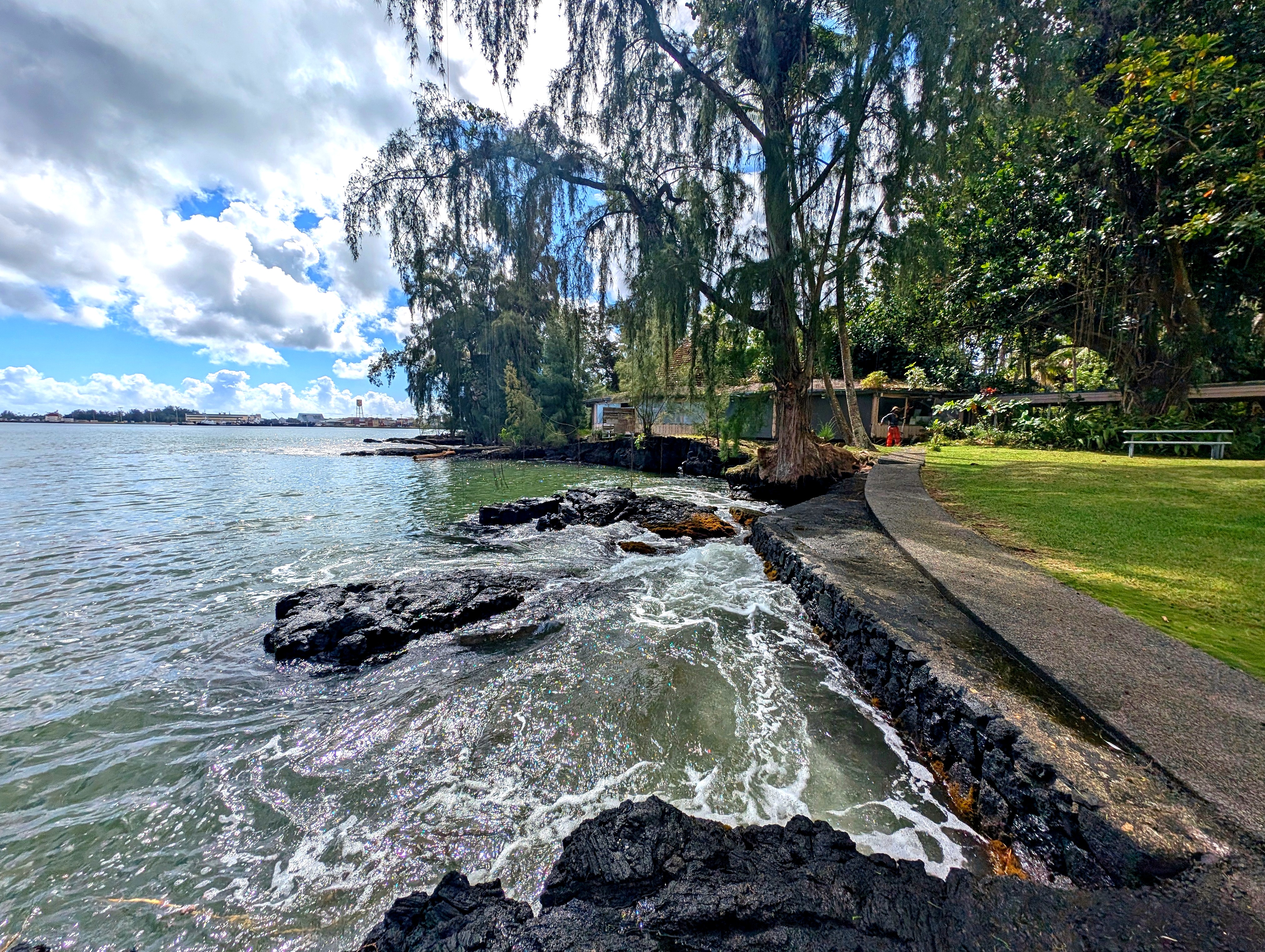
One of our many islets in the waters around our hotel. Big Island, HI. September 2024.
Our first full day in Hawai’i on the Big Island, we woke to mostly cloudy skies–not surprising considering we were on the rainy side of the island and we’d arrived to Hilo Airport under a solid overcast. As is our wont, we spent our first morning lazily, eventually venturing forth to explore our near surroundings. Here, it meant taking a walk around the western half of Waiakea Peninsula. Our hotel sat on the northernmost tip of the peninsula, situated on pretty grounds, so we started there.
Grounds of Grand Naniloa Hotel, looking east. Big Island, HI. September 2024.Grounds of Grand Naniloa Hotel, looking north. Big Island, HI. September 2024.A flower-cluster on one of the plants around the grand Naniloa Hotel. Big Island, HI. September 2024.Looking northwest from the northern tip of the peninsula. Big Island, HI. September 2024.
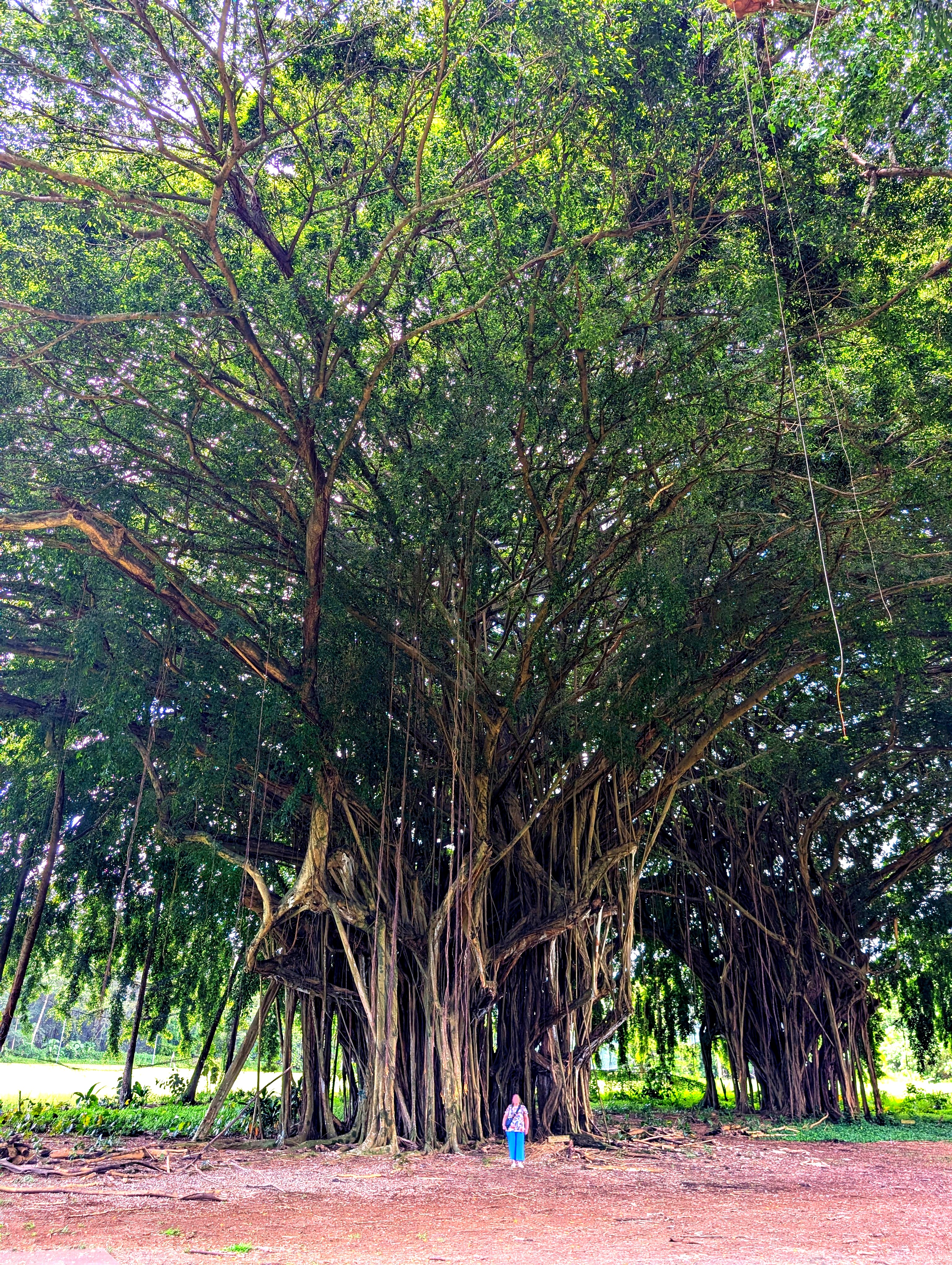
After touring the property, fencing forced us to the road in front of the hotel, Banyan Drive, so-called because 75-90 years ago a bunch of folks planted banyan trees to line it. Every time we drove in and out of the property we traveled Banyan Dr, making it one of the cool pieces of Hawai’i for me. Banyan trees are huge:
Typical banyan tree on Banyan Dr, Hilo, Big Island, HI. September 2024.
Our perambulations took us to a small park which culminated in Coconut Island, a spit of an island which took it in the teeth when a tsunami hit in 1960. (The somewhat famous Tsunami Clock is located nearby.) By now I had started cursing my brother who talked about the gloriously comfortable weather where humidity gets balanced by near-constant breezes. Our shirts were getting soaked. Temps were running close to 90 as the clock approached noon. As North Carolinians we’re very experienced with gray, overcast skies accompanying warm, humid conditions. We learned later this weather pattern wasn’t normal.
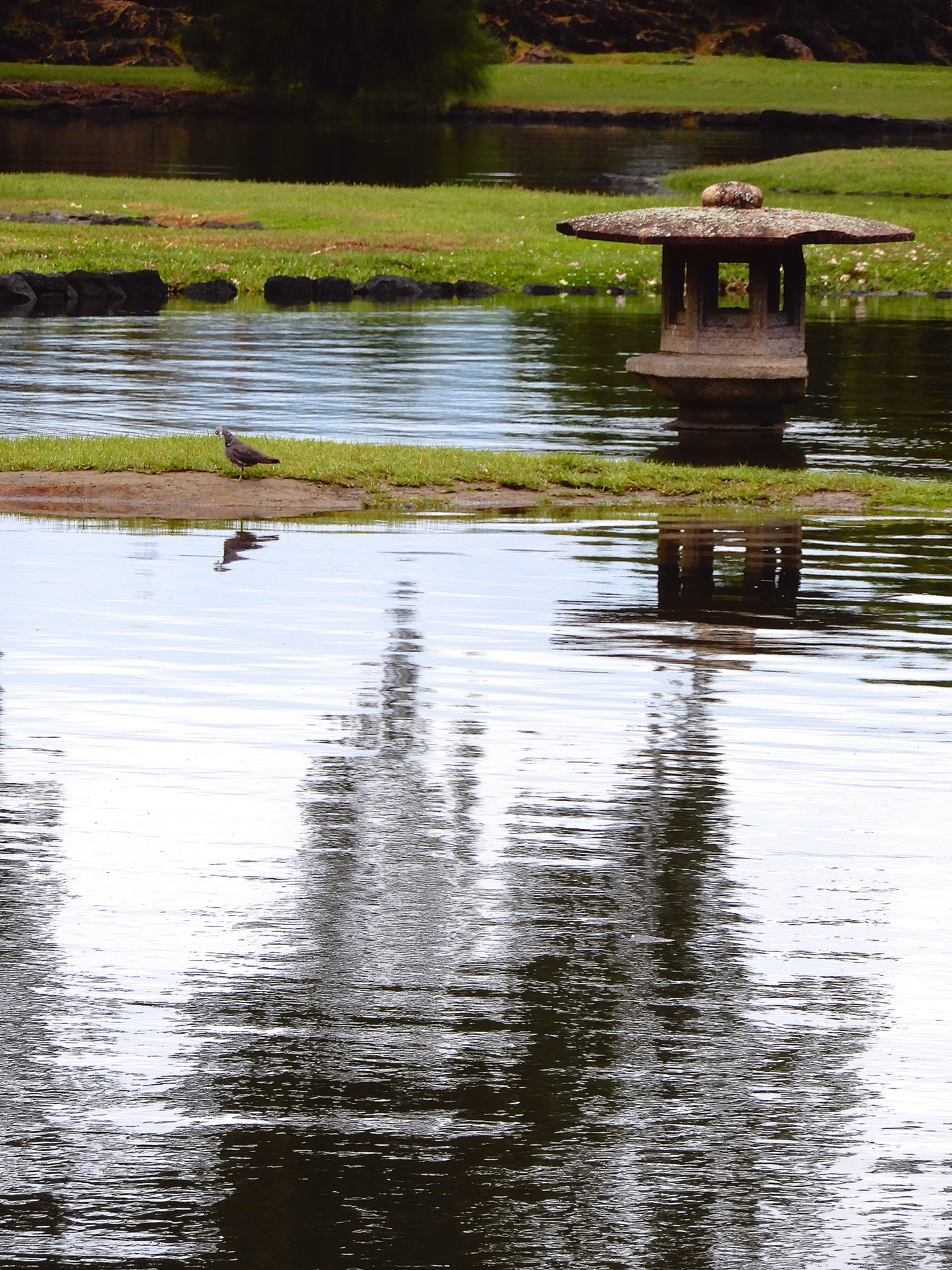
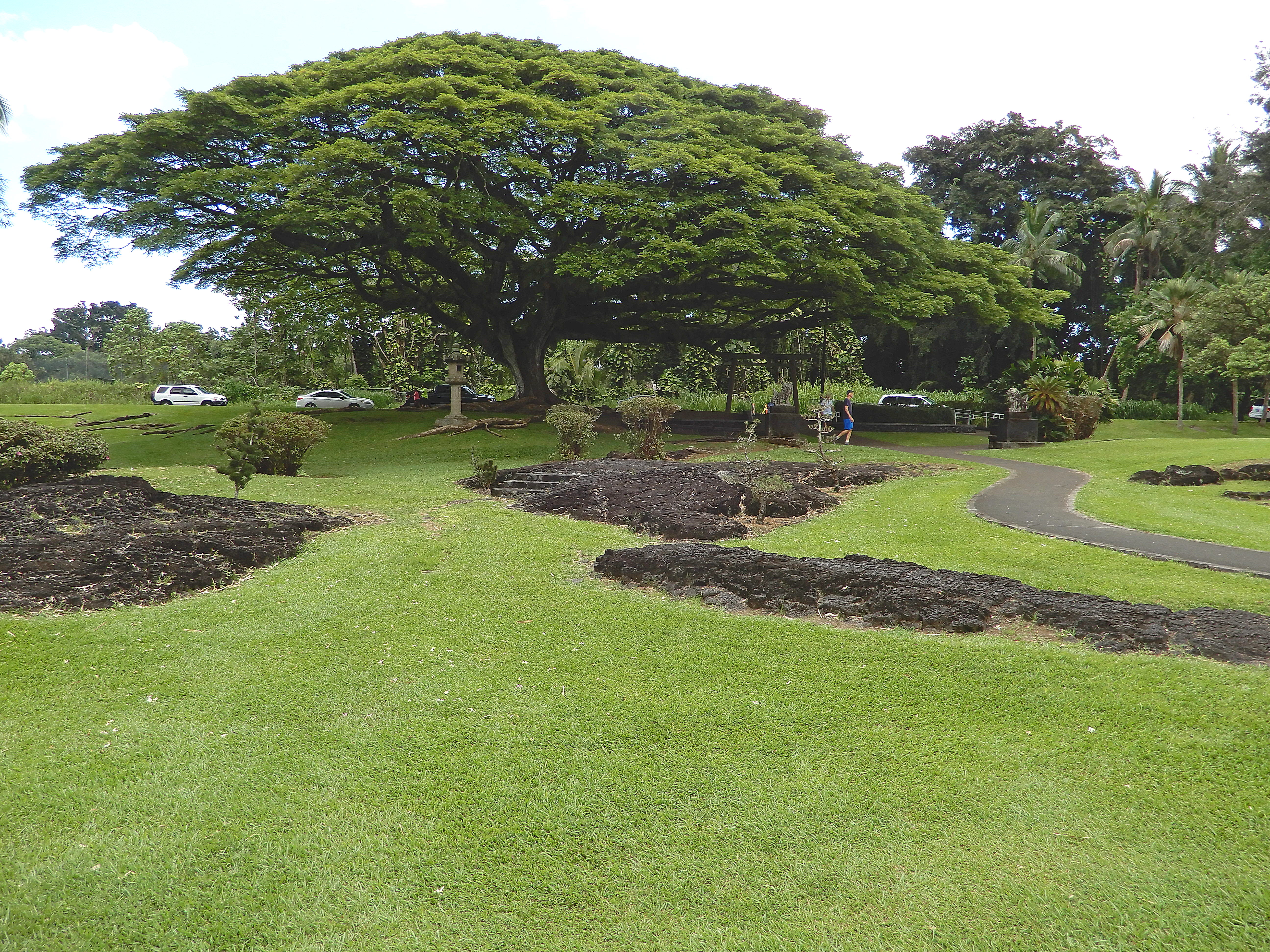
Our last stop consisted of wandering Lili’uokalani Gardens, a Japanese-style layout with plenty of Hawai’ian flora–at least I took it to be native. Who knows? Asking around later, I learned the park lies so low, so near Hilo Bay, that Waihonu Pond and other low-lying areas fill with extra water from the high tides. It prevented us from walking some of the paths.
At low tide one apparently can walk to and over this nice little Japanese-esque bride. Lili’uokalani Gardens. Hilo, Big Island, HI. September 2024.A Nene goose, Hawai’ian native. Lili’uokalani Gardens, Big Island, HI. September 2024.Yes, it really was that green. Lili’uokalani Gardens. Hilo, Big Island, HI. September 2024.
While meeting with a representative from the company which recently installed a natural front yard for us, we watched a red-shouldered hawk sitting in our white oak tree. It sat there five minutes, flew a small circle through the neighbor’s trees, and returned for another ten minutes. Unlike my usual luck–it flew that circle just as I returned with my phone–after it returned, it remained there so long I grabbed a half dozen photos, finished with the landscape rep, ran downstairs for my 50x zoom, and captured another couple shots on that camera. I’ve yet to download it.
I get confused between Cooper’s and Red-shouldered hawks, but noted that Cooper’s don’t have the mottled white pattern on the wings that this one does. Also, all those skreeeee’s I hear aren’t Cooper’s, according to Audubon. If that’s the case, most hawks I see around our little copse of trees are Red-shouldered.
Like so many things in the American South, the arrival of autumn takes its own sweet time. I should say “fall” also because at two syllables, both of which have a “u” in them, “it “autumn” just seems a bit pretentious here. Our first inkling summer is nearing its end (besides a simple look at the calendar) occurs when “someone turns the humidity off” as a former boss of mine put it. (He was from Michigan.) Humidity levels build quickly in early June, and by mid-month your A/C chokes on the amount of water it’s removing from your indoor atmosphere. Around Labor Day a similarly rapid decline in humidity takes place. It seems even quicker than the ramp up because the lack of humidity means heat no longer lingers around all night, ready to leap into action at dawn. Instead of staying in the high 60’s and low 70’s suddenly one’s body registers temps that are downright cool at dawn. What follows seems like a coda to the summer, a time of 72-80 degree weather, mostly sunny weather, and dawn temperatures in the low 50’s.
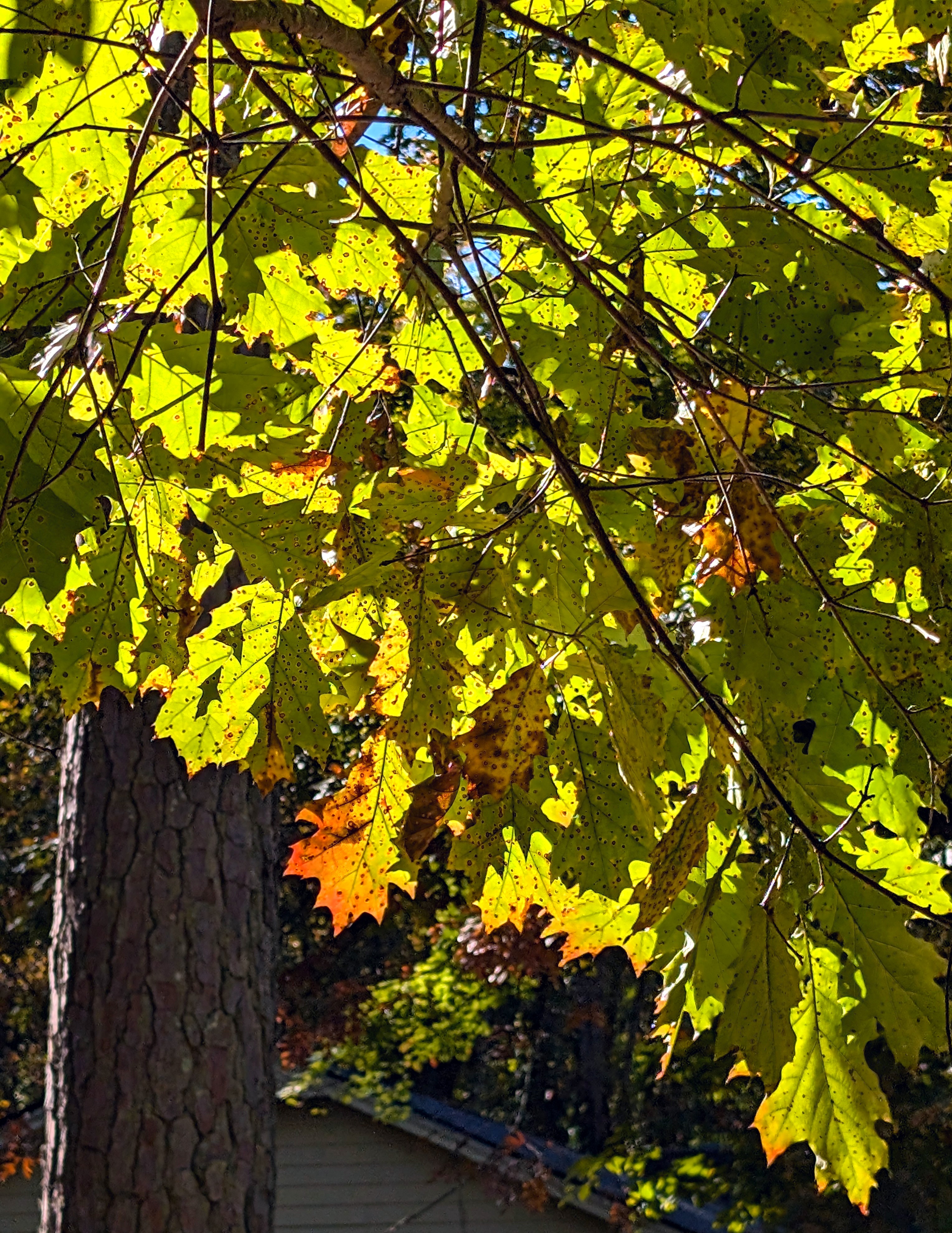
For me fall can be said to be truly here when leaves start to turn color. Except for stressed trees and shrubs, this usually occurs around the second to third weekend in October. Even then it’s a slow, drawn out affair. This cluster of leaves seemed representative to me. We’re in the last week of October, and the trees reluctantly turn various colors dependent on species.
Fall in Raleigh, NC. October 2024.
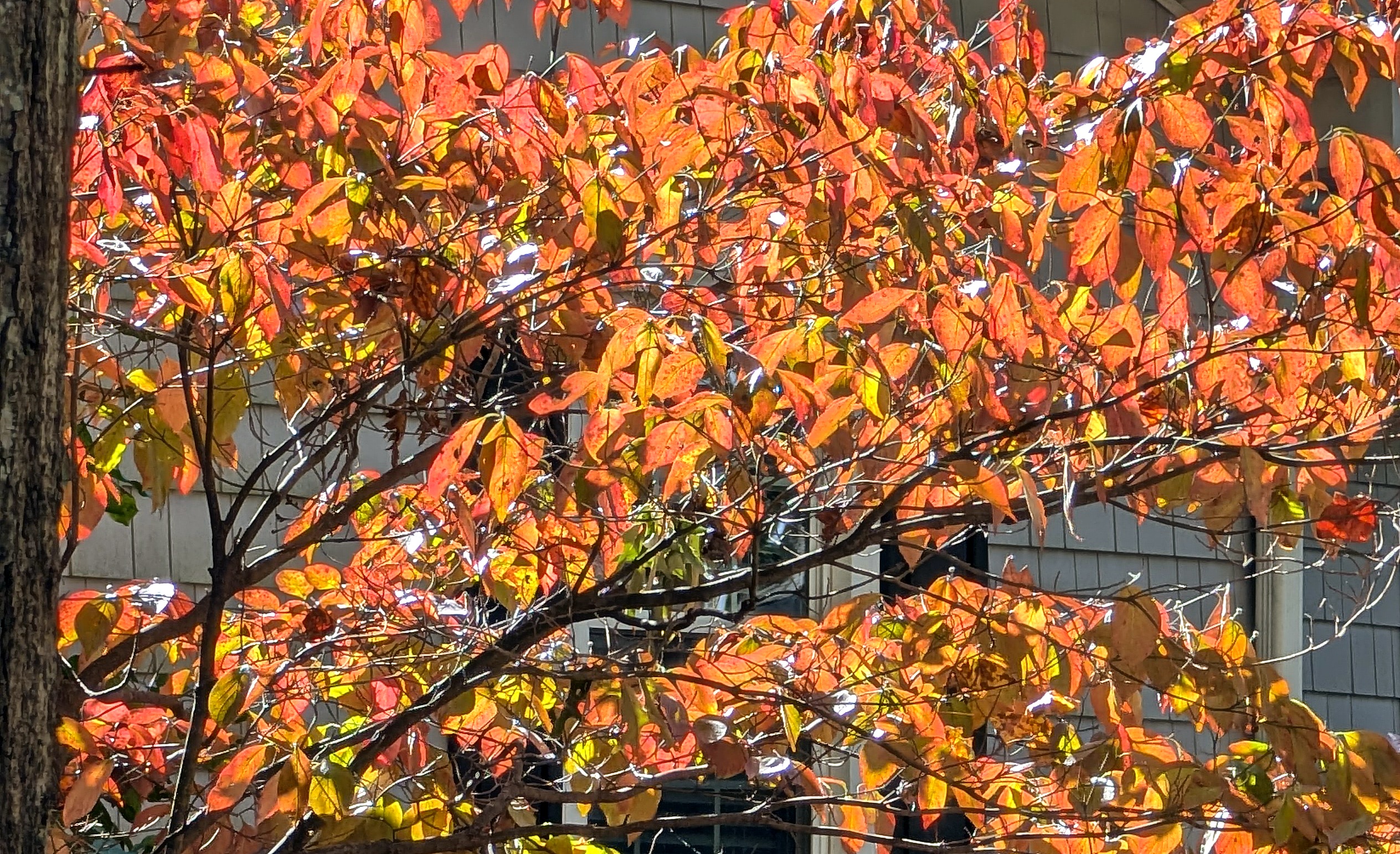
We arrived home Monday after a quick dash north for a wedding, when I realized, “Hey the dogwood is really turning color.” One of the first to herald spring with its blossoms, and one of the first to leaf out, it’s also one of the first to say, “Nope, gettin’ a mite too cold. Goodbye.”
Front yard dogwood. Shaded trees in back a more dusky red. October 2024.
And finally this photo to illustrate the sadness of invasive species. The Virginia creeper is native to central and eastern North America. It knows that it’s fall here. The English ivy isn’t native to North America at all. The latter will hang around nearly all winter, and in milder winters I believe I haven’t seen it turn colors at all. It chokes out most undergrowth if allowed, and it adds weight to trees if allowed to proliferate. It creates an eco-desert.
Tree with ivy and creeper, L foreground; tree with mostly ivy center. October 2024.
Over the past weekend we attended a wedding in the nexus region for our family: greater Philadelphia. Google maps failed us at least once on our northerly journey, when I disregarded a patently stupid suggestion which turned out to be… not so stupid. Regardless. There are times when silence is the best soundtrack. The rest of the time was spent thusly (in no particular order):
Greetings from Asbury Park by Bruce Springsteen
Steve Goodman by Steve Goodman (highlight: “Riding On The City Of New Orleans” which he composed and sang for Arlo Guthrie)
Sunshine on Leith, The Proclaimers
Get On Board by Taj Mahal & Ry Cooder (a bit too rootsy for the moment)
The Color of Love by Ronnie Earle and The Broadcasters
Live from the Ryman, Vol. 2, by Jason Isbell and the 400 Unit
Promise by Sade
Orleans by Orleans
Oh Brother by Dawes (Just as good the second time, and my wife loved it)
Ode To The Village by Bearcat (but not at all like the first album and we abandoned it)
Legends Live In Concert by Ry Cooder (but again, too hillbilly for the suburbs of Washington, D.C. Ry Cooder has so many different styles across his career. He produced the classic album Buena Vista Social Club of old Cuban musicians, and I have an album of his where he collaborated with Indian musician V.M. Bhatt on A Meeting By the River)
Blessings and Miracles by Santana
Try It…You Might Like It: GA-20 Does Hound Dog Taylor by GA-20
I’m conflicted. I enjoy casual birding, and when I visit Hawai’i and can suddenly see many new birds, I should be thrilled. I did thrill to bright, different birds. Then I learned that virtually every bird I saw had been introduced to the islands in the past 150 years or so. It seemed none of the common ones (the birds hopping around parks and following the tourists around) could claim they were indigenous to any island in Hawaii. Still…they are quite different to commonly spotted birds where I live.
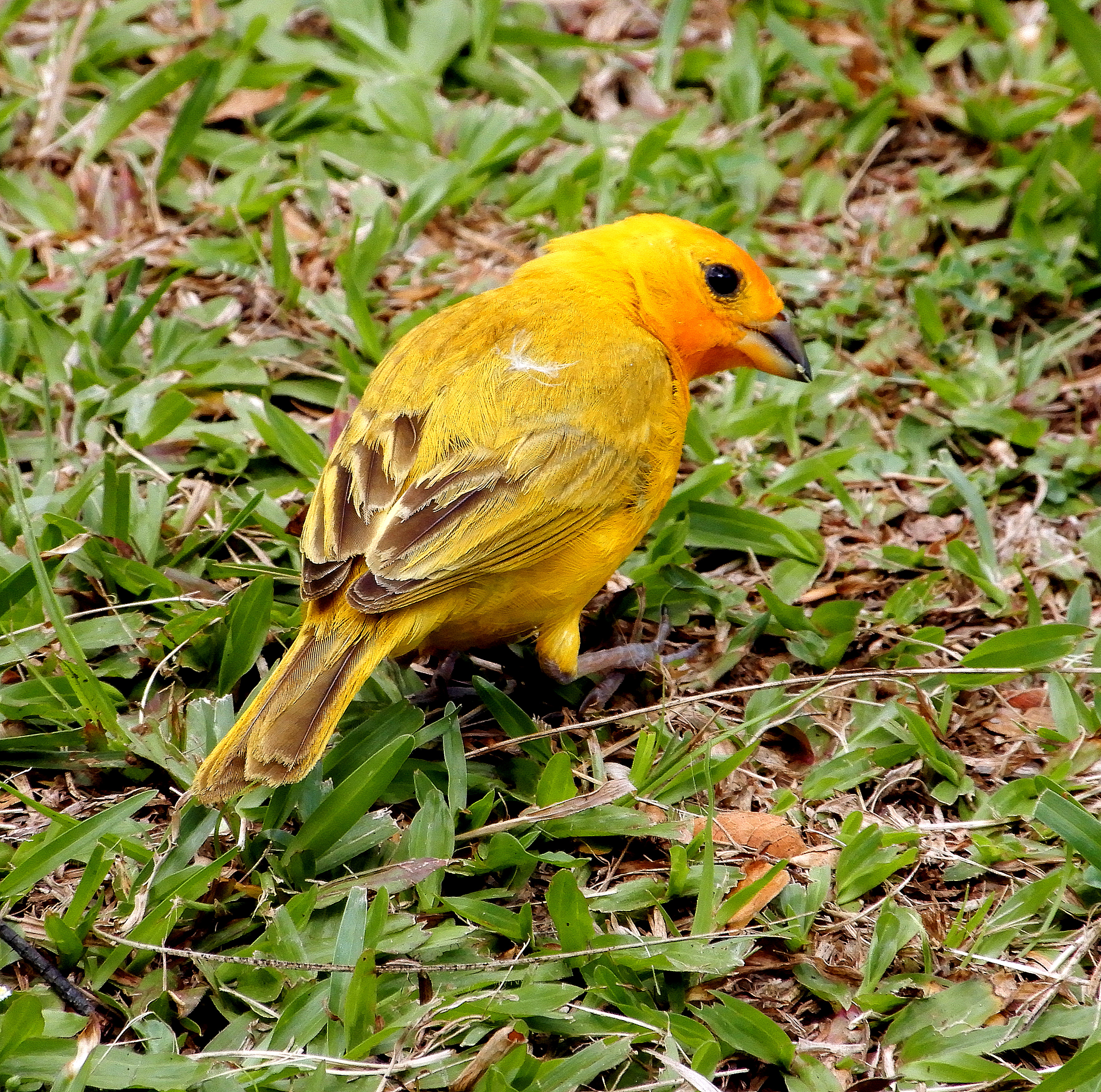
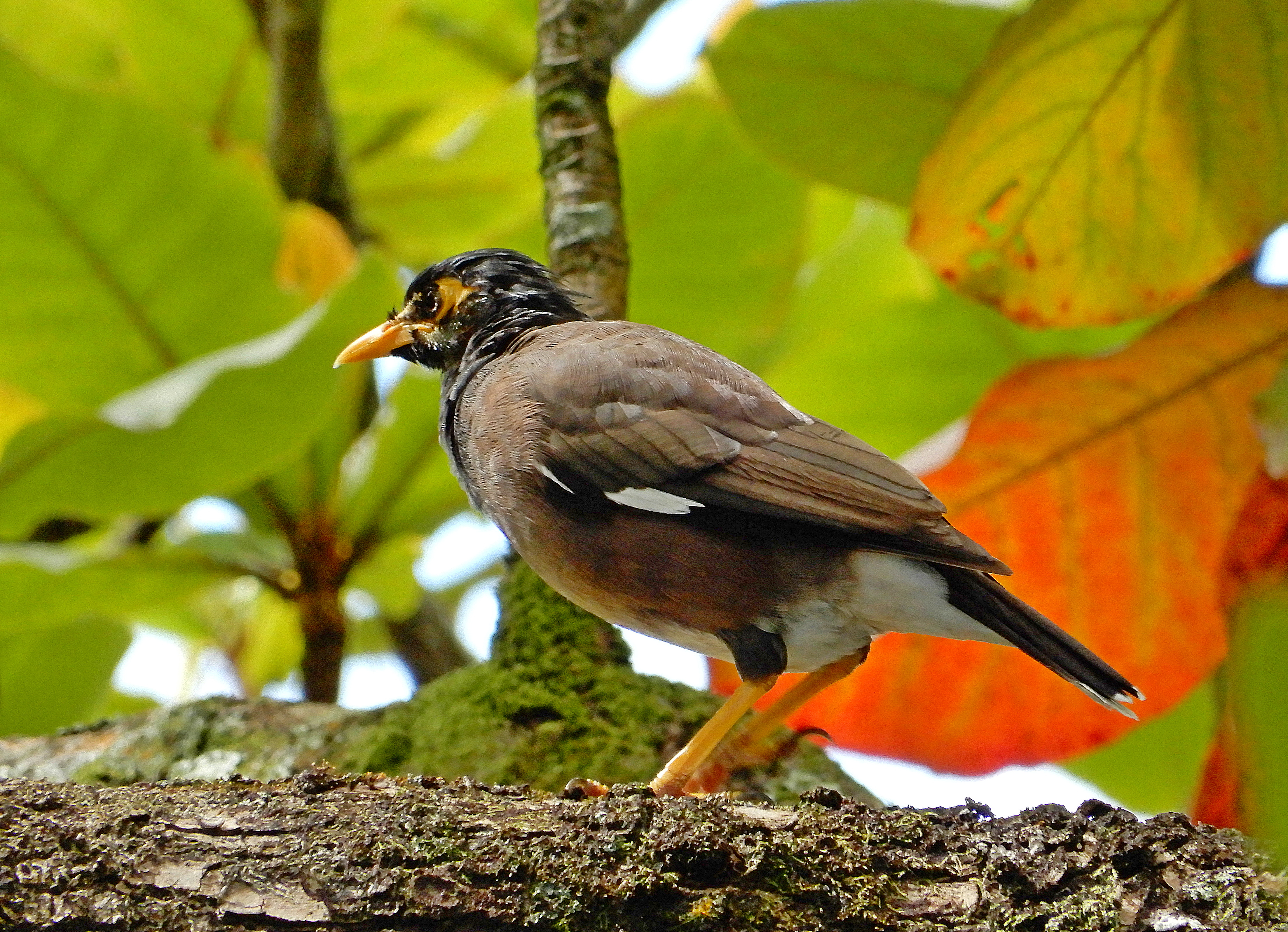
A Saffron Finch. Lili’uokalani Gardens, Hawaii, HI. September 2024.The Common Myna. Outside our hotel, Hilo, HI. September 2024.
The Common Myna appeared everywhere on Hawaii and Maui. It’s native to Asia, but has spread so much it qualifies as “one of the world’s most invasive species,” according to the IUCN Species Survival Commission which listed it on its 100 of the World’s Worst Invasive Species (one of only three birds on it). When we first landed on the Big Island, and I heard this incessant chattering, I thought Starlings had made it to Hawai’i. It’s a noisy bird, and it looks a little bit like a Starling until you get close enough to see the yellow eye patch, the more brown body, and that it moves rapidly on the ground when it wants to.
The Saffron Finch comes from South America. It’s been on the Big Island (Hawaii) only since 1960. We only saw these in the Lili’uokalani Gardens and around our hotel, both of which are on a very small peninsula on the east edge of Hilo, Mokuako.
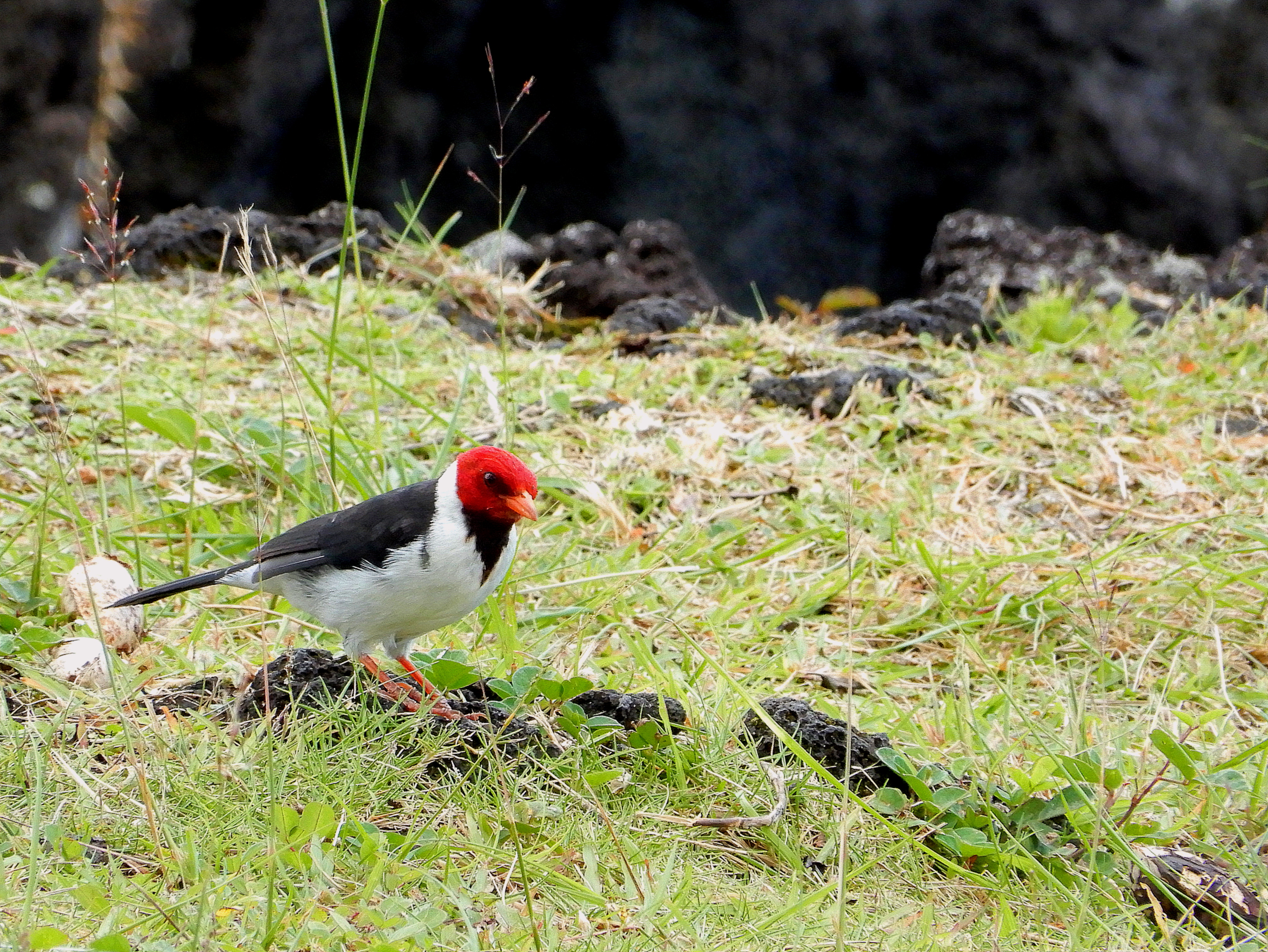
A Yellow-billed Cardinal. Seriously–see below. Outside our hotel. Hilo, HI. September 2024.
There are three common cardinals in Hawai’i, and none of them are native. One of them isn’t even a cardinal! We saw two: I photographed only the Yellow-billed but we also saw the Red-crested. They both originate in Brazil, but the former has a wider range into Paraguay, Bolivia, Uruguay, and northern Argentina. Thankfully we didn’t see any Northern Cardinals. I see plenty of those at home, and it would have been very depressing. Because I have no photos of the Red-crested, I’m including one from Wikimedia Commons.
My biggest consternation regarding birds wasn’t the Northern Cardinal. It was the onslaught of House Sparrows which assail one in every open restaurant, marketplace, park, and you name it. The fearless critters even hopped into our room in Hilo on several occasions….
“G’morning! Could ya take this peanut-bread-Cheeto whatsit off my bill?” Our first morning waking in Hilo, HI. September 2024.
Though we saw plenty of spotted and zebra doves (both introduced from SE Asia), I failed to take a good photo of one. It remained until we traveled to Maui before I saw a bird endemic to the Hawaiian Islands…
This is the tail end of a family of Nene geese, the state bird of Hawai’i. Maui, September 2024.
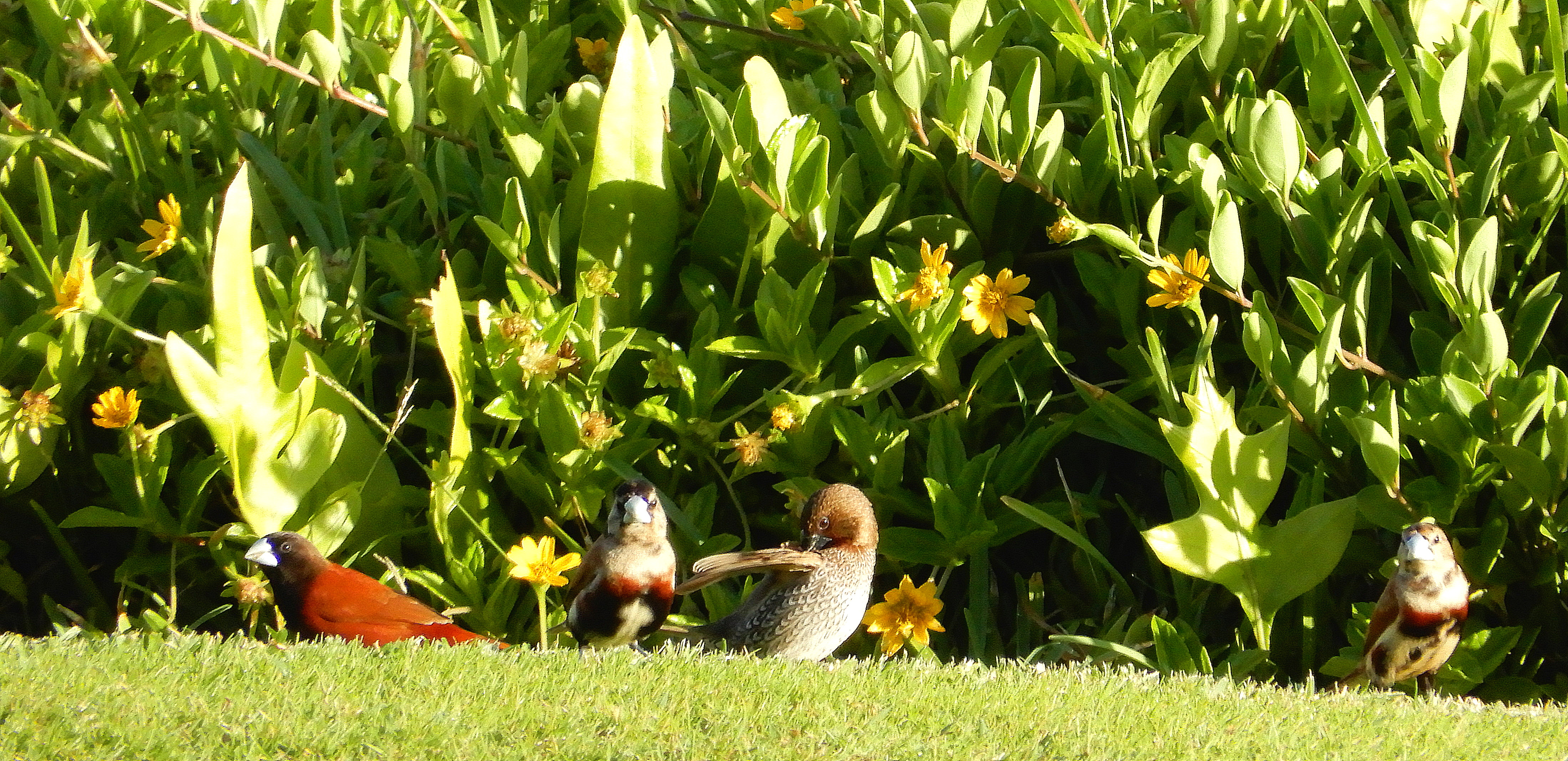
Sifting my photos for birds proved beneficial when I tripped over one, and only one, photo of a different group of birds. The Chestnut Munia isn’t native to Hawai’i (of course), but it’s a pretty cool-looking bird nonetheless. In the photo below, the bird on the left is a classic, I’m-sure-it’s-a-Munia example. Moving left to right, birds #2 and #4 appear to be Munias but they’re not supposed to have breasts like that. (Males and females are supposed to look about the same.) Photos of immature birds don’t look like those two. Bird #3? I’ve no idea what that is, but I find it difficult to believe it would just hang out in this group without being one of them.
Chestnut Munia (L) with friends. Kapalua coast, Maui. September 2024.
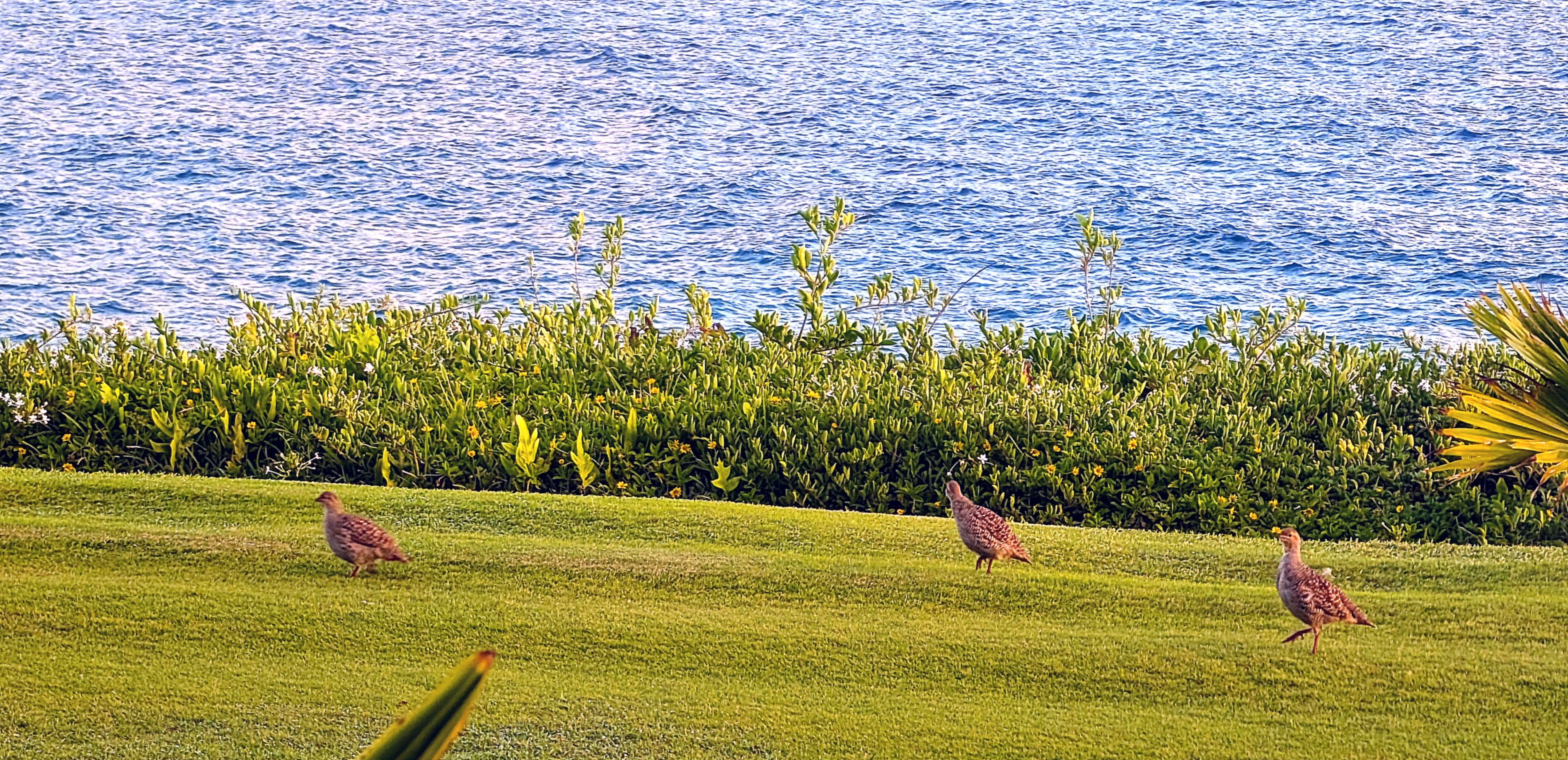
And in Maui I finally got a photo of one of these long-legged things which had bedeviled me on the Big Island. (Blurry photos? Sure, I’ve got ’em.) I don’t try to identify long-legged birds like this because they are so diverse and so similar. I don’t even know if this one is the same species as the ones which ran around on the rocky coasts of Hilo Bay.
Hello Mr. Long Legs. I’ll ID you one day. Kapalua coast, Maui. September 2024.
I would be remiss not to include a photo like the one below. Chickens. Yes, chickens. They’re not exactly everywhere but they’re darn common running around many areas where you wouldn’t expect to see them. They apparently are “wild” in the sense they don’t go to a coop and get fed by humans. They hang around the cities and towns, though, so…what is “wild” anyway?
The parking lot outside the Maui Aquarium. I think this guy met me ten minutes later at the nearby gas station. Maui, September 2024.
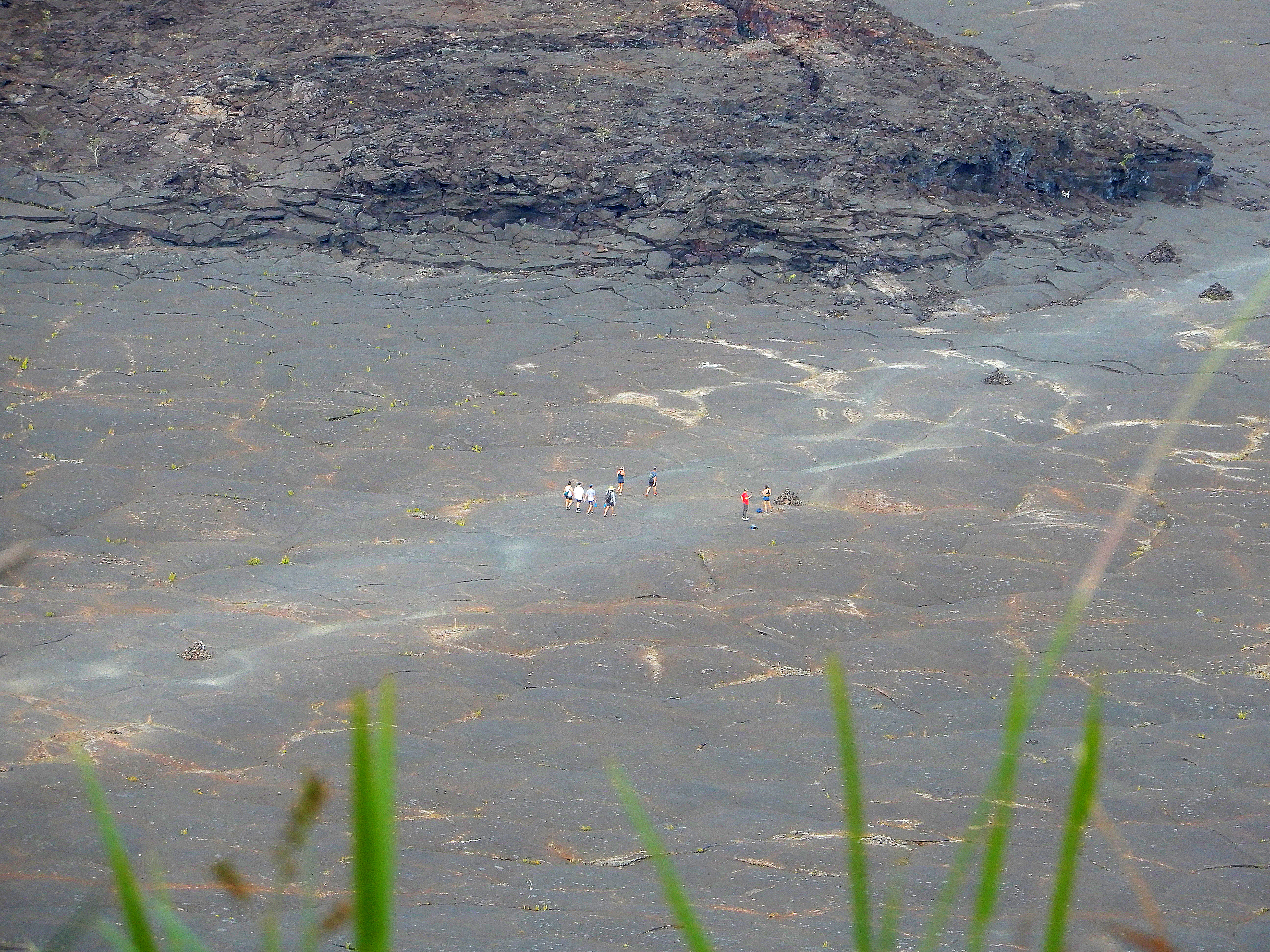
Sunday fun: “Let’s walk across a real volcano!” Or…why not kick back with some great tunes? Hawaii Volcanoes National Park, HI. September 2024.
Moondial by Pat Metheny
I Trust You To Kill Me by Rocco DeLuca and The Burden
Carney by Leon Russell
“Für Elise” by Jon Batiste (apparently from an upcoming album?)
“While My Guitar Gently Weeps” by Lucinda Williams (almost surely from a forthcoming album entitled Lucinda Williams Sings the Songs of The Beatles from Abbey Road)
Oh Brother by Dawes
You Should Be So Lucky by Benmont Tench
Mudcrutch by Mudcrutch
One of the great things about music streaming services (mine is Tidal), at least for old folks, rests on the opportunities for music discovery. I appreciate that Tidal doesn’t just pop the usual “because-you-listened-to…” stuff, but also just flat suggests stuff from across many genres. (Although it might be because I listen so eclectically. Hadn’t thought of that.) Today’s playlist reflects that. Saturday I listened to Moondial because it showed up on a recommended albums list. Today, a couple tracks on the 5-track “Recommended new tracks” list caught my eye: the Jon Batiste and Lucinda Williams tracks listed above.
The Dawes album appeared on a different list, “Suggested new albums for you”. I cannot believe I’ve gone 15 years without hearing of this group, since they fit comfortably into one of my favorite musical areas where intelligent lyrics and innovative musical lines collide with folk, rock, and jazz. This newest of albums from the group is like Paul Simon meets Jackson Browne meets the Eagles with just a dash of musical thoughts of Iggy Pop. (Yeah, I heard a line in there that I swear is a near rip-off of one from Brick By Brick.) Maybe they listened just a little to They Might Be Giants? Barenaked Ladies? This latest album is the only one I’ve listened to but I’m cueing up more in my near future.
While reading about Dawes on Wikipedia, I ran across the name Benmont Tench and finally separated him mentally from Bobby Tench, a vocalist on a couple of old Jeff Beck Group albums, Rough and Ready and Jeff Beck Group. The band Simon Dawes broke up and out of it came the new group Dawes. They played a bunch of jam sessions which included one with Tench, who’s a pianist/organist and vocalist. Because Tench joined Tom Petty in the group Mudcrutch which later evolved into Tom Petty and The Heartbreakers, this led in turn to learning about Mudcrutch which reformed in 2009 (the same year that Dawes formed–huh). Which completes the musical journey that underlies the playlist above.