Truly caramelized onions readied for the freezer in handy half-cup portions. November 2022.
Today, for reasons opaque, I look at onions:
Sweet by any name: Because a ubiquitous marketing campaign has proved once again that Marketing Is Everything, many folk here in the eastern United States don’t realize the Vidalia onions of Georgia aren’t the only sweet onions, and they aren’t the progenitor of (most) of the others. Quoting from Oregon Live, a website for The Oregonian, “The Vidalia sweet onion was first grown, completely by accident, in 1930 by a farmer named Mose Coleman.” In contrast, the Walla Walla sweet onion came into being when Peter Pieri immigrated to the United States from Corsica in the late 1800’s, bringing “a bunch of onion seeds from Corsica” when he did so. Sweet onions aren’t any sweeter than ‘regular’ onions, but they have only half the pyruvic acid of the typical mild onion, the yellow. Sweet onions thus have less bite (by half!). They’re planted in the fall in low-sulfur volcanic soil–hence another celebrated sweet onion, Maui Sweets. Because sweet onions are juicier, i.e., they contain a lot more water, they’re softer which means they have to be picked and processed by hand, and their shelf-life is short.
I’ve never had a Maui sweet onion, but I’ve had both Walla Walla’s (hey, they’re grown only 160 miles from my boyhood home) and Vidalia’s, and I prefer the former. The Vidalia’s just don’t seem as sweet to me. The linked article in the previous paragraph notes the Walla Walla’s hit the palate with sweetness first followed by pungency, whereas the Vidalia do the opposite. Maybe that’s it. All I know, is I know how to caramelize an onion thanks to Vivian Howard’s book This Will Make It Taste Good which emphasizes the lengthy period of time necessary to caramelize them, and the need to overload the skillet to use the moisture in the onions to steam them as they caramelize.
A final onion note (a thoroughly intended pun): here’s a great onion novelty song from 1966, the year I left elementary school. May your tears be of joy or at least may they promise a tasty near-future.
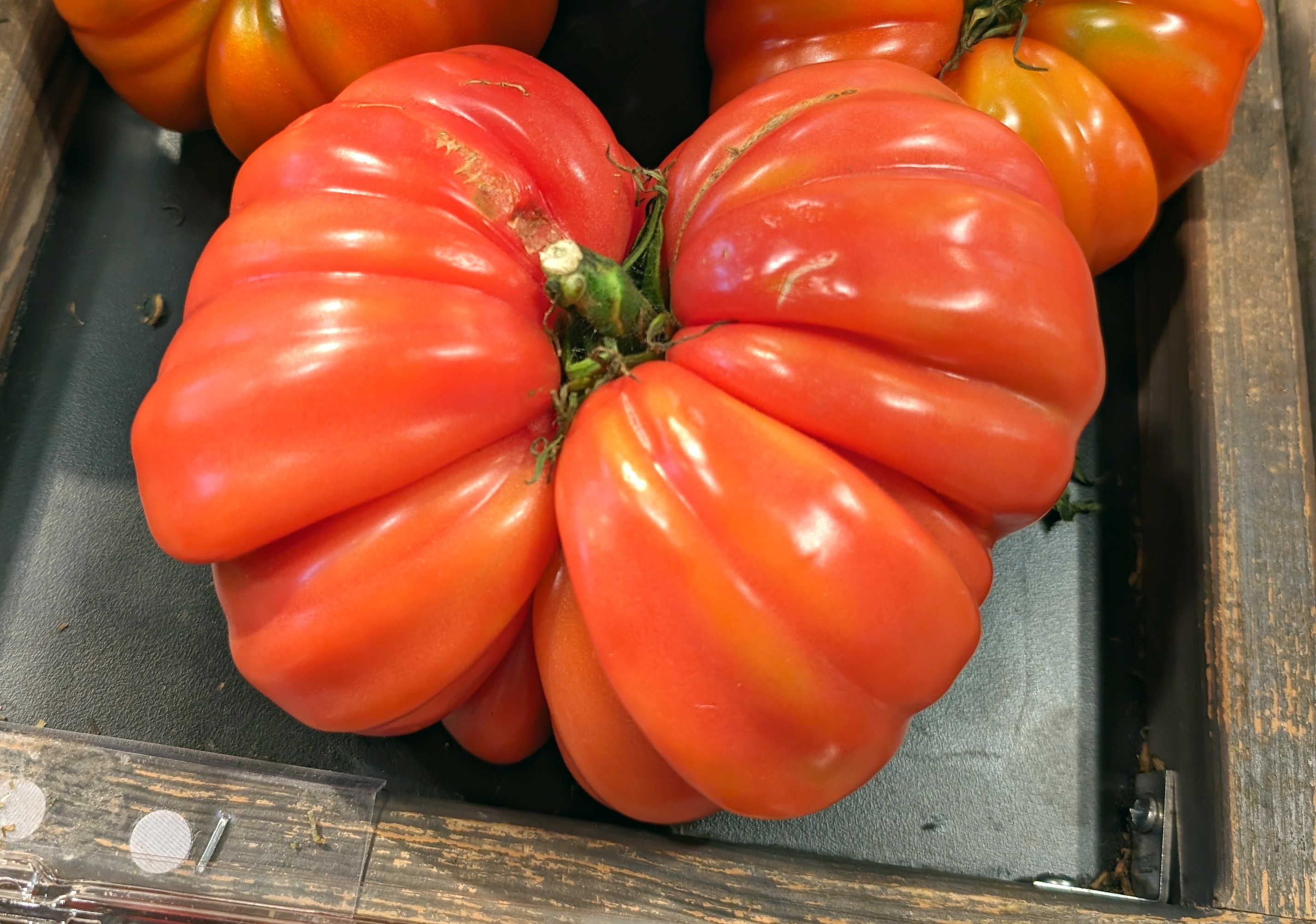
I shop produce first, even when the store doesn’t shunt me there with its layout. Friday, barely into the nearest Whole Foods, I spotted this heirloom tomato, all 2.25 pounds of it. I wandered the store getting things for the list, but couldn’t shake the idea of thing. I texted my wife and a couple friends about it, and they said, “buy it!” For scale, I can just comfortably get one hand around each half; it takes two hands to hold it. It looks like conjoined twins–I guess it’s offensive now to use the older, more common name. A bit hard–we’ll give it a few days to ripen up and then what? My wife’s vote is for stuffing it. I was thinking a stupendous, feeds-a-family-of-four Caprese salad.
Maybe my purpose simply lies in imitating Charlie: hang out at the bar and drink a half gallon dry? May 2024.
I’ve several pieces of writing sitting on the shelf in a to-be-born state. Some even sit at the front edge of the shelf, just waiting to be taken down, polished, exhibited. This beckons now, however. It underpins the others.
I’ve too often settled for what I can do instead of striving for what I want to do. This blog and its recent lack of activity exemplifies that. There exist but a handful of activities which bring me as much pleasure as posting photos, essays, poems, and other pieces of writing here. Why the weekslong gaps?
At the age of 13, as inchoate as any such a creature, I became focused by two things: my Language Arts teacher said (using a bit of poetic license), “Damn, Pilcher, you can write! You should consider being a writer!” The other event occurred in the same year when a partner and I debated some topic which I now forget in front of the entire 8th grade class, all 300-400 of us. I got a glimmer into my innate bent toward logic and reasoning, both inductive and deductive. Our duo lost the 8th grader vote, but we won the teacher vote, similar to winning the electoral college but losing the popular vote. I considered myself a Writer and a Debater from that point forward. I did not know they were sometimes mutually exclusive.
In high school my teachers redirected my interest in writing. I learned they placed little emphasis on writing creatively, focusing instead on the expository writing of the essay, the critique (book reviews), and the like. Can one function in society where business letters rule the day? (At least they did then. If those teachers could only see today’s society…alas, most are dead.) I therefore looked to the available outlets, enrolled in Journalism, and joined the school paper (an elective class). In my senior year the two points of view in C. P. Snow’s The Two Cultures collided. All that expository writing reached new heights when Senior Humanities brought me the two-hour essay as a substitute for a test. But…the loosening of curricular philosophies brought me the elective of Creative Writing. Suddenly I wanted to go back to the latter. Yet already I had applied to the University of Montana because it had an excellent School of Journalism.
To shorten this up: I did attend the U of M, but enrolled in an experimental education program instead of journalism. I spent one year there. There followed a year of earning money, a two-year stint at a regional college learning to be a recording engineer—no, wait, a radio-TV newsman—no, wait, a weird combo of that with Economics—before I enrolled in journalism (again) at the University of Washington, determined to make my way in that field because, “if I don’t focus on something, I’ll never do anything!” And I did work in newspapering for almost four whole years.
Pause. This supposedly promised to be about how he couldn’t focus his desire to write into the pursuit of WRITING. He settled for what came to hand, taking the path of least resistance, doing what he appeared to be reasonably talented for. Compress the next twelve years: convenience and aptitude led to a ten-year teaching gig. Divorce and early-onset midlife crisis led to One Last Attempt to Be A Creative Writer. It failed in less than a year. (Insert all the comment you want; I/we know our psyche. I/we did what seemed necessary to maintain mental health.) Through a series of events which defy a bad Hollywood script, I wound up analyzing data and writing scientific reports for the world’s largest pharmaceutical manufacturing company at that time. I did well. I spent a quarter century at it, eventually as a consultant, and retired.
WAIT! WTF? I THOUGHT THIS PROMISED SOMETHING ABOUT HONOR AND ALL THAT?
What is honoring thyself? Youth #1 has innate talents for playing baseball, thinks “I really like buying and selling stuff” but goes into baseball because his/her innate talent take them that way. They succeed as expected, then coast for the rest of life realizing passive income from the insane amount of money earned as a ballplayer. They neglect to build a business empire based on that initial desire to be a capitalist. Youth #2 loves baseball despite having mediocre talent at playing it. He/she works every waking moment for years to make this dream come true. They are drafted into professional baseball, succeed despite what their projected ceiling is, and spend the rest of their life in baseball as a coach or a manager or a consultant developing young talent.
Which one honors themselves? The one who leaned into their innate talent? Or the one who ignored who-knows-what talent to pursue a dream? Youth #1 drifted into baseball on talent. Youth #2 ignored talent to pursue a dream which consumed the remainder of their life.
And for the religious among us, which one is pursuing their God-given path? Youth #1 made the most of their innate talent. Not #2.
How can I be nearing 70 years on the planet and still wonder which one of these I am, and what the answer is to that question about honor?
When I volunteer to write a database/listing application for my church choir, am I fulfilling my innate talent, or am I defaulting on my dream? Ditto for ditching teaching to write business reports that pretty much anybody could write. To make it more mundane, when I derive great joy and satisfaction in planning a set of weekly menus, selecting good recipes, and cooking them, am I dodging my greater dream, my greater desire to Be A Writer?
Is Being A Writer just an ephemeral dream, a wisp of wanna in a wind of reality?
Deep down I think I fear that though I have a talent for crafting language, I have nothing to say with it. I need to be explaining something, reacting to something, pontificating upon something. (I’m doing it now.) Avoidance mechanism or recognition of doing what I truly want to do? I fear it’s a bit of both.
I intended to end this with a promise about upending my approach to the day, the week, my life. To declare, “I will write FIRST, I will read FIRST, and only then will I tackle the mundane!” (“Dear, have you emptied the cat boxes yet?”) I cannot do that. I’m sitting here thinking about the monks with writing skills who eschewed them to pray aloud and work the fields. Of soldiers skilled in various practical skills who instead served on the front lines. Of women (and a few men) who gave up promising careers to raise children. What is a Calling and what is a desire?
In the end I come back to this: you have done what you wanted to do at the time. If more high school guidance counselors—do they still have those?—had told this to their junior and senior clients, a lot more of them would have been able to pursue what they were drawn to. I know I would have.
There will be no end to this piece. Not until I reach my death bed and give you the answer, and likely not even then.
The piece I wrote last night isn’t quite ready, my tasks outpaced my time available, and I really want something to be posted. Ergo….
THOSE WHO DAWDLE MUST STAND ON CURB
I guess the two on the curb are crossing guards. May 2024, Raleigh, NC.
One of the best blues-rock live albums of my lifetime: “LIVE” FULL HOUSE by J. Geils Band, released 1972. “Whammer Jammer, lemme hear ya, Dickey!” and Mister Magic Dick on the lickin’ stick takes off with some serious Southside harmonica work. (YouTube also has a 1979 video of the band performing this onstage–worth it for Magic Dick’s bush of hair alone.)
Ideas I will never write (feel free to steal):
I was only hunting moonbeams/But my eyes got in the way
The scariest monsters don’t lurk under your bed. The scariest ones climb into bed with you and pretend to love you.
“He’ll worry all about the bugs on the windshield but not about the car coming at him in his own lane.” Not sure where that is from. Was it me?
Many people will travel the world on a regular basis but will be unfamiliar with the land and culture within a 300-mile radius of where they live.
The oak-leaf hydrangea has recovered from the complete devastation of the squirrels two years ago. Though only one stalk remains, it has leaves on it as big as a small dinner plate, and this lone but lovely bloom cluster. May 2024.
Guilt motivates, terrifies, handicaps, and depresses us. It informs, too. My guilt about not posting more than weekly here tells me I want to write more, photo more, pour myself into creative pursuits more than I have been. It also informs me other things must carry higher levels of guilt which trump my Creativity Guilt. Taking on a project, though, motivates me. Therefore, I’m tasking myself to write daily/frequently about what’s blocking the blogging.
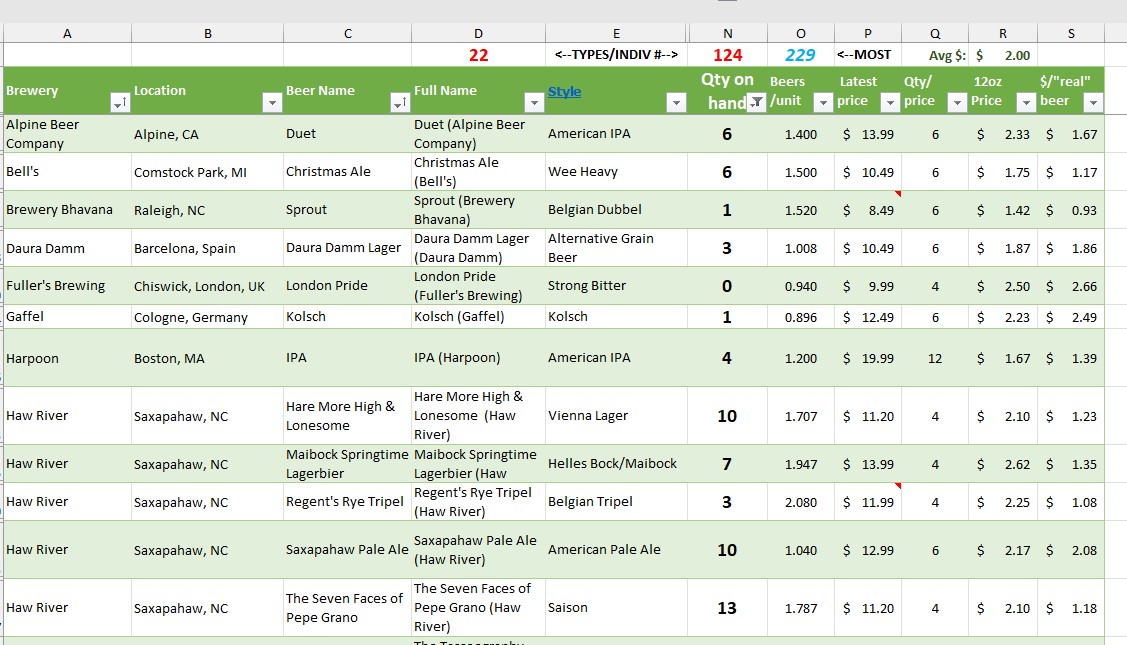
A partial inventory of our beer fridge. April 28, 2024.
Take a look at that spreadsheet screenshot above. One would think I created it to keep track of the approximately 22 kinds of beer in the beer fridge. Sigh. I wish it were so, and it remains a side benefit of the real reason I created it: that “Beers/unit” (Column O) feeds another sheet in the same workbook which is used to calculate how much I drank yesterday. Every morning for the past decade I make a short entry in my Health Log, maintained in Microsoft Excel. These days it’s simple: record my weight, make sure the meds I took yesterday is complete and accurate, and write 3-6 sentences about my general health mental and emotional. Examples? Life’s slings and arrows manifested as aching hips, arthritis starting to develop in my fingers, whether my collapsing ankles have caused any more ligament damage, and the condition of twitchy back. Lately it gives a couple terse lines about what happened yesterday, a sort of bulleted journal entry. I began adding these more and more in retirement.
More consistently than anything else, this log daily has tracked my ongoing battle to Not Drink So Much. It unflinchingly has recorded for the past decade the exact amount of beer I drink (I don’t drink wine or hard liquor anymore). It has done so with graphs illustrating rate of consumption, with 7-day and 14-day moving averages, with tables that project how much more the next beer will cost me, with histograms–and not one bit of it has made much of a difference in my rate of consumption. I had thought simple awareness would make a difference, much like cigarette smokers are told to record how and when they smoke. Awareness has made no difference whatsoever, even when I have done it in real time, as I’m drinking. The snippet of the calculating worksheet is shown below. Columns D, E, and F are the ones which look to the inventory sheet, multiplying the Beers/unit by the quantity drunk.
How to calculate a medically-defined beer. April 2024.
Columns A and B record odd-quantity beers, which usually occur when ordering at restaurants. I’m not going to go into all the calculations for what a medical beer is; you can see the definition at the top there and do the math yourself. Although I quit (finally) graphing the daily intake, I still list it in the health log entry. And now the beer-rating sheet gets maintained all the time. Filter the quantity on hand to ignore “0” and you can narrow the 400+ beers to a handy beer list to print out for when your wife says, “What’s in the fridge?”
This isn’t a cry for help. It illustrates the premise of the introduction: setting up these interlocking worksheets takes time. There are five other worksheets in this spreadsheet file that I’m not describing. And this is but one application. There’s a monster financial one which I think I could’ve sold back in the day I roamed the country as a self-employed consultant and needed to keep track of hours, rates, contracts, bills, accounts receivable, and how they drove our personal budget and finances. I just updated a Google Sheets app to plan music for our weekly masses and to show our choir what the music will be for a given Sunday–hymn numbers, responsorial psalm number, and the name of the anthem. It’s not a listing tool, like electronic paper. It requires the music director to pick the liturgical name of a given mass (such as the 5th Sunday of Easter) which then causes the application to pick the correct psalm information. The choir list looks to the planner. The printout for the cantor to use is driven from the planning sheet and the liturgy sheet. And etcetera for other things in my life.
In short, I analyze. I might read some political thing about the imbalance of power inherent in the two-US Senators-from-every-state part of the Constitution and go down a rabbit hole to compare the ratios of state populations in 1792 versus 2020 just to see if they’re markedly different or not. (I stopped myself on that one, thank goodness.) I might spend two or three hours to make some points about baseball like I did 18 months ago on this blog. This stuff happens all the time, and….
That’s one reason I don’t get to my writing like I think I want to.
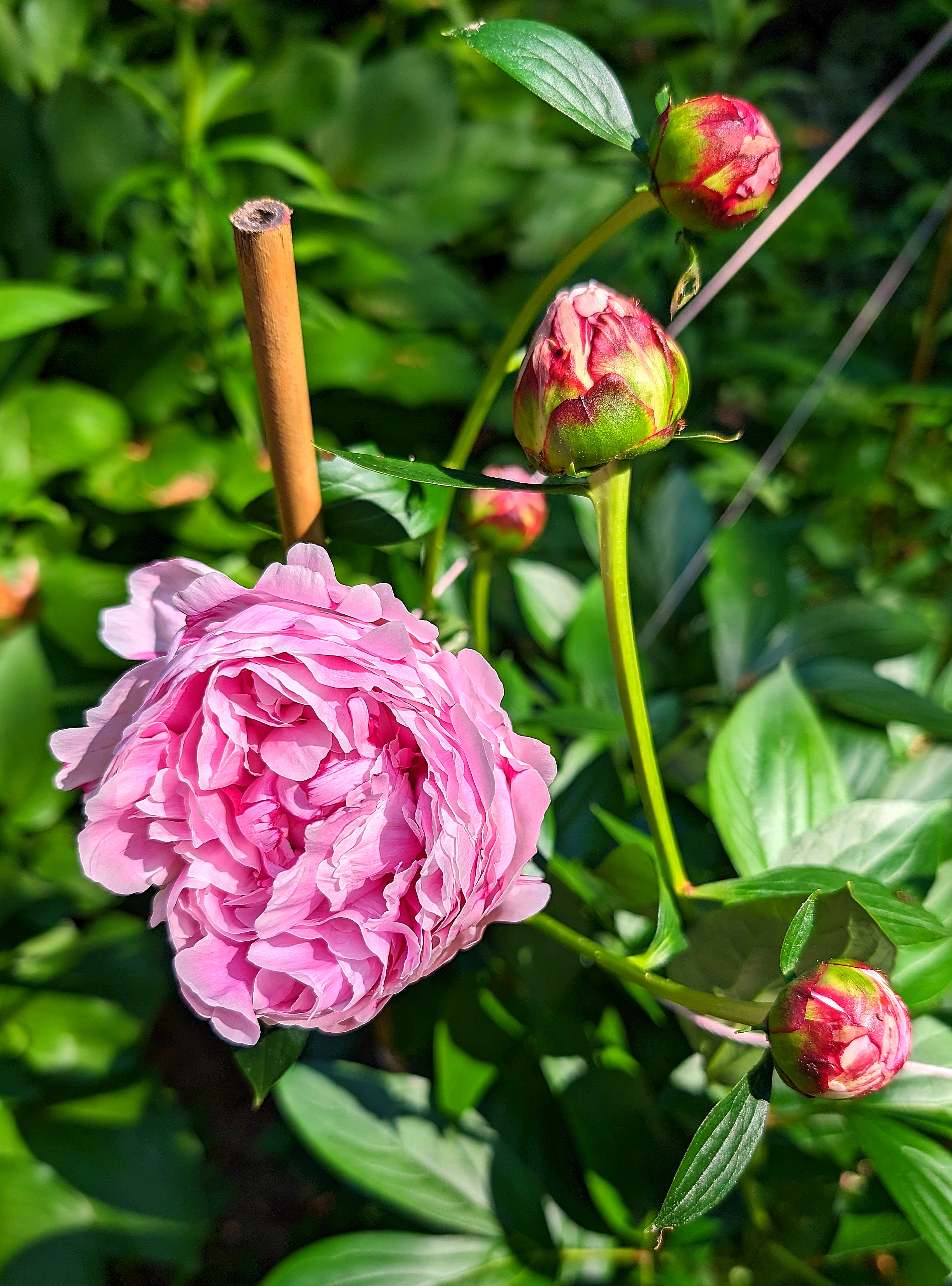
Symbolically, this peony represents why I haven’t been posting. It’s two days ago, I’ve got about 30-45 extra minutes in the late afternoon, and I think, “Hey, I better get that peony tied up before it blooms, and for sure before those hard rains hit that are forecast for tonight.” My two peonies will fall right to the ground as soon as they bloom fully. The rain didn’t materialize, but this photo, taken yesterday, shows many blooms are on their way and it’s supposed to rain tomorrow “for sure” and…you get the idea. The idea that I could instead get something posted never entered my mind.
I wrote a very lengthy essay last weekend the first of a series to explain from various points of view explaining what I think is more important than writing. Though sober (a good way to write!), I left it overnight to review in the morning, and decided at that point it just was too personal. My desire to be a writer and accept that a writer needs to write where the words will take him conflicts with my desire to be liked by at least a few people and with my desire to not expose every piece of my soul and psyche.
There won’t be many posts in the near future either, but I keep saying I’m ‘going to do better’ and maybe this time I mean it. Hey, I finally started going back to the gym after a six-month hiatus, didn’t I? And that’s for something I don’t really want to do!
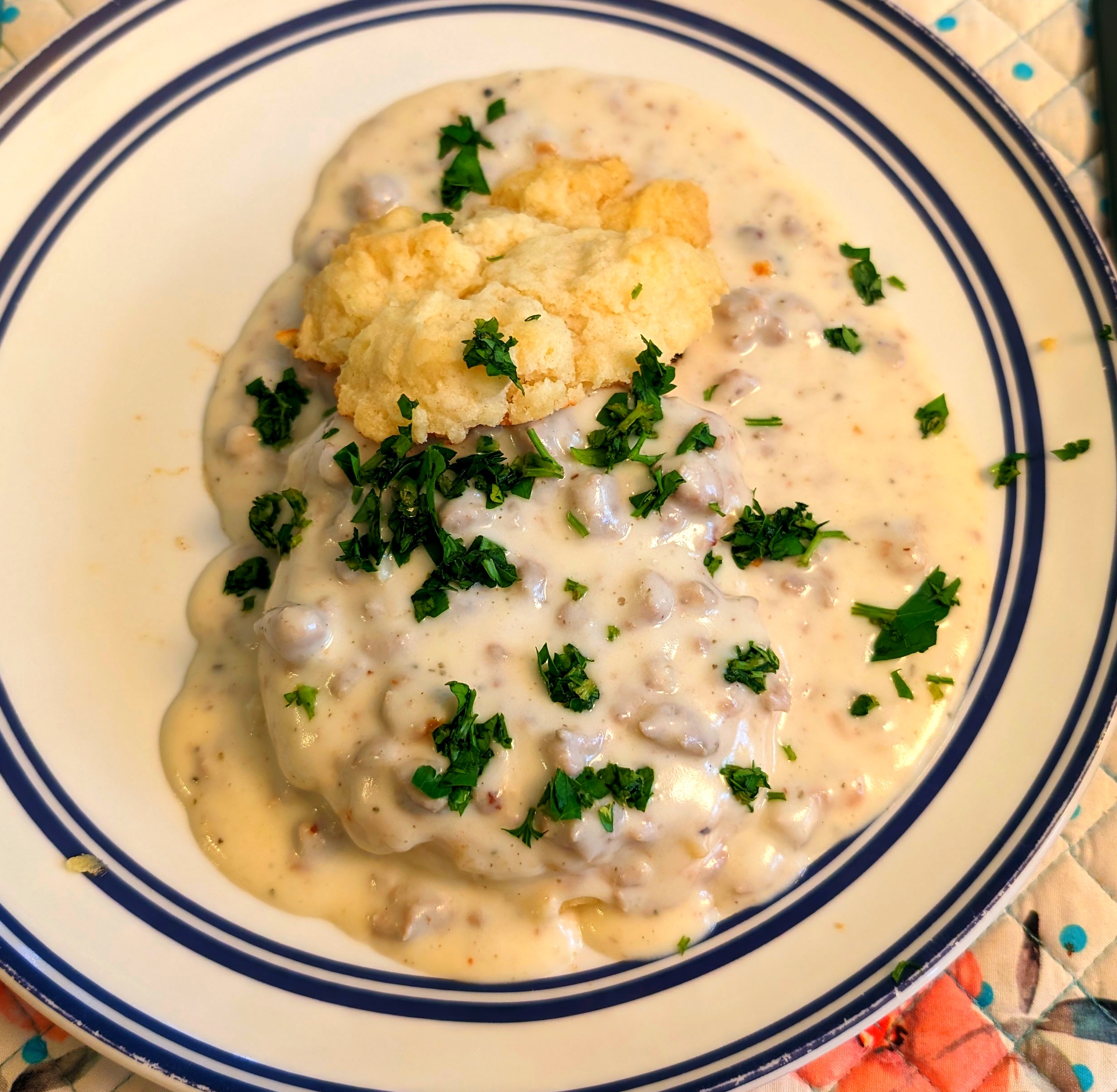
Buttermilk Kitchen’s Sawmill Gravy on O.G. Biscuits. March 2024.
At the risk of offending multiple food groups (in the sense of those of us who eat food), let me offer up one of the more satisfying meals I’ve made in the past year. About six weeks ago I purchased Welcome To The Buttermilk Kitchen a cookbook by Suzanne Vizethann who operates a restaurant in the Atlanta area called Buttermilk Kitchen. The above photo is of a Southern staple: sawmill gravy over biscuits, i.e., “biscuits and gravy.” The gravy can be of several varieties, but the most common is a béchamel-type base with sausage in it.
It works like this: take five frozen sticks of European butter (the kind with a higher fat content than American butter); grate it coarsely. Whisk flour, sugar, baking powder, salt and then fold in the grated butter “until mixture resembles sand.” My patience level has never achieved this standard. Add 2.75 cups (1.33 pints) of “high quality, full-fat” buttermilk. Drop them on baking sheet with a 4-inch ice cream scoop and bake.
I use Michael Ruhlman’ From Scratch to make my own breakfast sausage. (If you’re into cooking, I heartily recommend this book. It takes 10 basic meals and riffs off of them with dozens of recipes for each one. For example, the sausage recipe–ridiculously simple–is in Chapter 2 which is “The Omelet”.) The Sawmill Gravy recipe starts off like a basic béchamel, veers this way: 5 cups of chicken stock and 2 cups of heavy cream. The “4 dashes of Tabasco” is perhaps not in your béchamel either. The rest is obvious. Split a biscuit. Ladle gravy over it. Sprinkle with parsley if you’ve got it. Eat. Retire to porch/living room/deck. Loosen pants. Snooze.
A door by any other name. Stained glass lighting of the ordinary. March 2024.
Among the plethora of button-pushing statements to set me off is, “Today is the first day of the rest of your life.” No. Shit. The sentiment behind it? Okay, sure, don’t drag yesterday’s baggage into today. Yet who among us feels wise enough to know every single one of the elements from the past which represent baggage (versus valuable life-informing lessons)? I’m a Jacob Marley sort. I drag a long, long chain of emotional bondage behind me, all the little boxes filled with guilt, remorse, sorrow, and pain. I’ve been blessed/cursed with an excellent memory so all of that stuff remains instantly retrievable. (My family: “How do you remember all of that?”) I’ve been blessed/cursed with an exactitude which drives me to excel and drives me to repel. And I’ve been taught by my father to dwell on failure, hold it close, never let go, and fixate on the darkness behind instead of the light ahead. This works especially well if one can punish oneself for some splitting-hair issue which no one else can perceive.
With that in mind, it’s perplexing how much of an optimist I am, and to that end, over the past week or so I’ve felt yet another “new” beginning in my life. Maybe it’s caused by looking ahead 70 days to the eve of my 70th birthday. (Huh. That’s numerical coolness right there!) More likely it’s just the relief of warmer temperatures coming to join the much longer, much brighter days. Whatever. I feel the same soul-searching and goal-setting vibes as I do at the beginning of Advent or the New Year. I’m getting in shape! I’m rededicating myself to my scriptural studies! I’m planning a cool getaway that’s been on the books for over a year! I’m getting back to writing more, photographing more, and posting it all here! Yes! Yes! It could happen!!
Perspective says, “No, you know it won’t happen that way. You’re going to light a birthday-cake’s worth of hope-candles which will be snuffed out quickly in the winds of your ever-changing mind and the vagaries of life. You’ll move on. You’ll declare a New Normal. You’ll dive, you’ll soar. It will be Life As Usual.”
Okay then. I’m leaning into life as usual, but I’m redefining usual! So there, Perspective!
And speaking of perspective, this last thought: I recently told a friend in his mid-80s that I had been dwelling on “how much time do I have left” and it saddened me that I had so little time remaining to study the underlying scholarship to the Bible. His immediate reaction: “Why would you do that!” He noted I likely wasn’t ready to pursue the studies until I did. Generalizing from there: one does what one does when one does it. Would I have had a different life if I had listened to my inner voice of reason in 1992 and said, “no, I’m not moving to Philadelphia just to pursue a fling with a young woman?” Sure. Your life flows through the geology of existence, creating a channel called My Life. I’ve tried to choose the most natural, easiest path on the theory it represents what’s best for me at that time. It led to many wonderful things, but I can’t say any one decision made differently wouldn’t have led to many other wonderful things.
Perspective–it’s a bitch. That’s why old folks are so bitchy–we have more perspective.







 all the voices in my head