
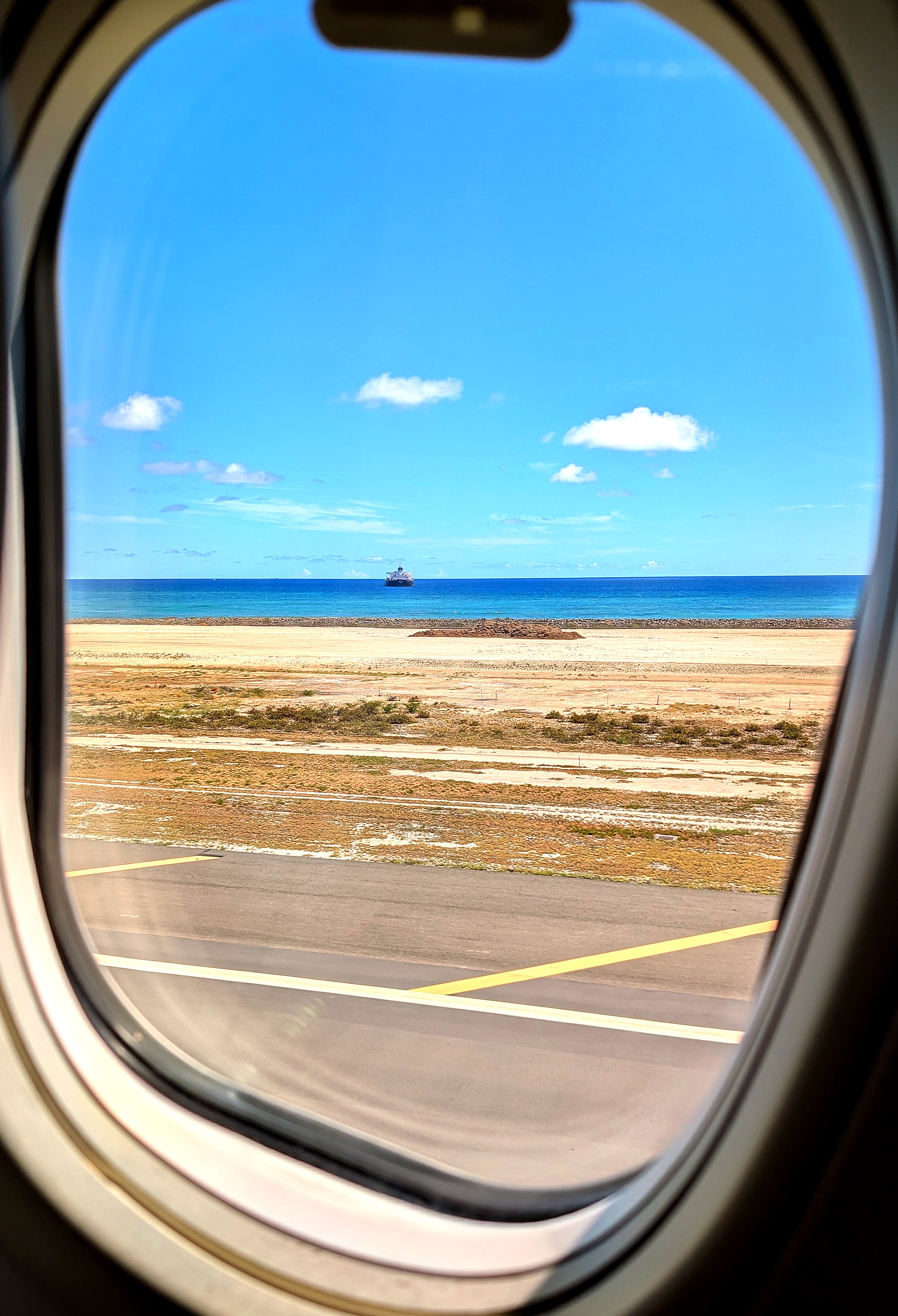
Just over 49 hours after our plane took off from Maui Monday morning, I’m sitting here trying to make sense of it all. Not the time there. That’s easy: it delivered in ways unanticipated, surprised almost hourly, relaxed me more than has occurred in years (decades?), and sated our senses. Translating to TikTok language, it was “awesome.” No, that’s not it. The sense I’m searching for has to do with much more than that.
I’m 70. When I marked my 37th birthday I had only the barest of inklings that less than two weeks later my marriage would end. I’d been working on sprucing up our former house, a recent rental being prepped for sale, and I looked forward to a vacation to Honolulu, Hawaii, in about a month’s time. I learned my life would take a different course about 10 days after my birthday. A couple of weeks after that, my soon-to-be-legally-ex-wife convinced me to cough up my travel vouchers for her close friend so that they could go to Hawaii. (I stubbornly had thought I would still go: traveling in a chilly, no, frosty silence on the plane and finding separate lodgings. I guess I’m thankful she convinced me not to.) She enjoyed Hawaii, I had a hollow experience at a regional blues festival. Don’t read into this too much. She wasn’t a horrible person, just a helluva lot more pragmatic than I. Many signs pointed to the ultimate demise of our marriage. I just didn’t want to acknowledge them.
This experience plus a relocation to the Eastern US Coast put Hawaii into a “maybe someday” category. I watched as my brother and his family visited time and again, including the year of my second marriage in 1995. After five, ten years, it seemed everyone had been to Hawaii but me. That was unfortunate, because then my contrarian nature kicked in. I’ve been contrarian since childhood. I didn’t attend popular movies precisely because they were popular. Everyone’s going to Hawaii? Well, not me!
My new wife wanted to go, though. A financial impossibility by the time we moved to the West Coast, it continued to be so after we returned to the East Coast. By the time we maybe could have afforded it, my job precluded it. Then I retired at the end of 2019, and 2020 being our 25th anniversary, we set our sights on Hawaii. But 2020 wasn’t kind to us or anyone else. We spent that Silver Anniversary eating take-out pizza and watching TV. Sad. As we emerged from Pandemonia, I studiously ignored the idea we could go to Hawaii. Then 2024 arrived. Our mantra became, “just book the trip.” Instead of equivocating about a possible trip, just figure out if you can afford it and if you can, book it! We did. A few logistical glitches will be discussed in future entries, maybe, but we flew there as planned, and actually stayed an extra day due to a bit of poor planning on my part.
Those weren’t my only issues with traveling to Hawaii. If we’d consummated a trip to Puerto Rico in February 2022, I would have resisted Hawaii. But PR had smarter, more restrictive Covid protocols than the mainland US, and that year I doubted we could meet them given the logistics of a Covid testing thing. We approached 2024 and its mantra of “just book the trip” with the knowledge that this year marked the 30th since we met, and the threshold of our 30th anniversary in 2025. So I came through: I booked a European river cruise for 2025 and booked Hawaii for this year.
At 70 I’ve had more than 60 years of thinking Hawaii is a lush, tropical chain of islands. It’s not–not the lushness part. The Trade Winds blow SE to NW which coincidentally aligns with the main islands of Hawaii. The Big Island takes the first shot of those winds and their weather. The east side of the island, anchored by Hilo, catches constant fog/mist and gentle rains. It measures its rain in feet-per-year. To a lesser extent, this pattern extends to the other islands. The east coasts catch rain, the rest of the island is semi-arid grasslands ranging from a lush grassiness to a dry volcanic scabland I knew well from growing up in eastern Washington State. Oddly (to me), the destination vacation spots are on those semi-arid sides of the islands.
Thankfully, I’ve harbored a strong desire to go to the Big Island since the 1970s when I knew Betty Nahoopii as a young reporter in Monroe, WA. She and her husband organized trips to the Big Island, and she gushed about all the amazing and weird stuff one could see there. This was the island I had to visit. Here’s where the Fates kicked in. One of my cousins lives on Maui. I planned to visit her and that island for a few days, then we would shuttle over to Hawaii and spend a week there. (“We’ll get a taste of Maui, four or five days, and then we’ll relax into the Big Island,” I said.) When I found out I couldn’t fly directly out of Hilo to the mainland (thanks, Southwest), I begrudged the day we would lose to fly to Honolulu and then overnight there to catch the next morning’s flight to the mainland. Therefore, I flipped the trip around because I could fly directly out of Kahului, Maui. We were tethered to Southwest because of all the points I built up as a consultant over the Twenty-teens. Another stroke of fortuitous luck: Southwest only flew into Hilo–not Kona. Virtually every other airline flies into the dry side of the island where Kona is located. For a week, therefore, we got a true tropical experience. Our room:
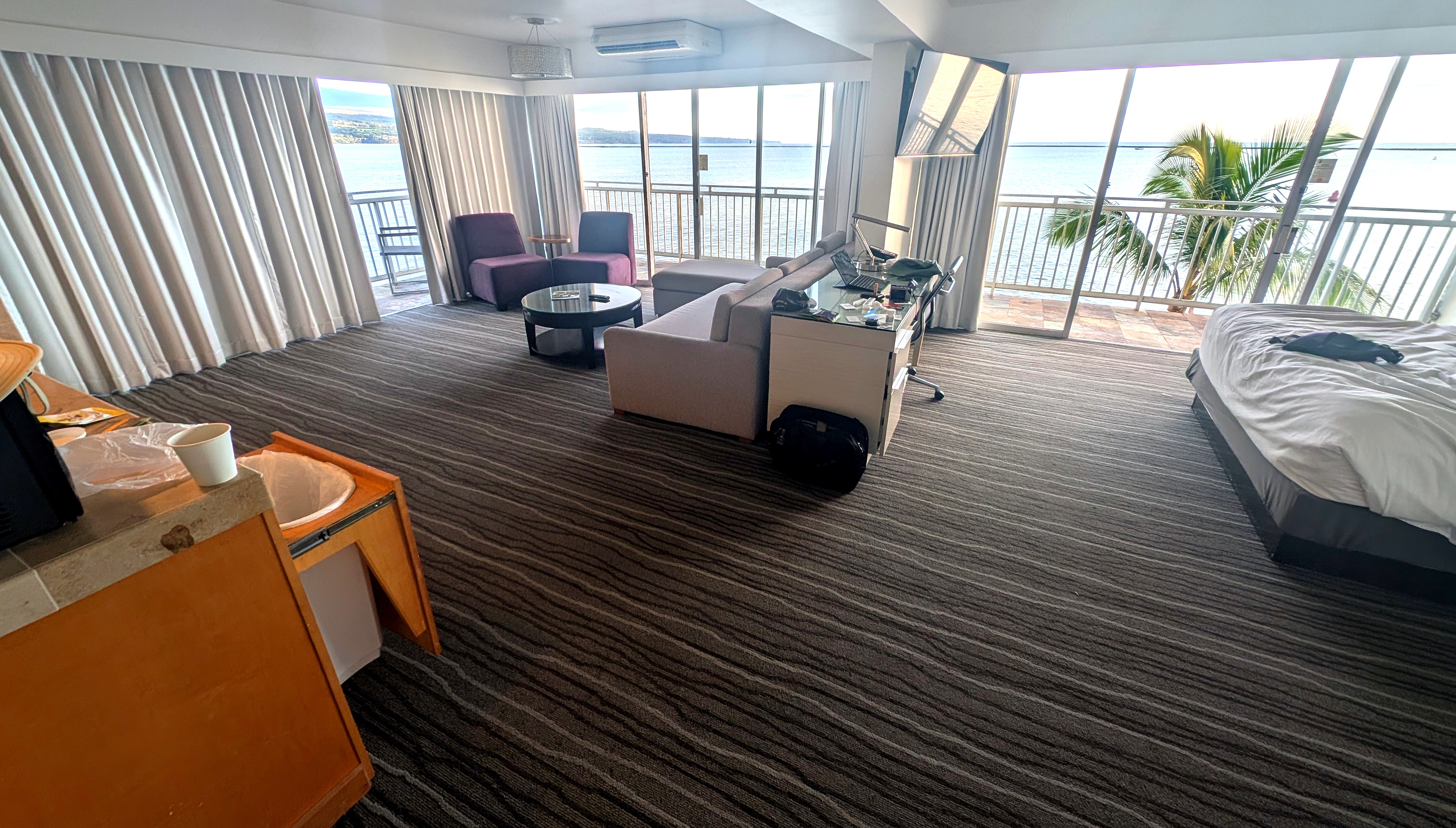
Our definition of “fortuitous” lies in spending most of a week in an established city on the biggest island of the archipelago. We drove to the west side of the island and Kona on our final full day on the island. Kona proffers the worst of resort-oriented vacationing. We could discern no true center to the “city” and all that seemed to be there was hillsides covered by vacation houses and condos, marinas full of boats, and more American Standard Fare shopping centers in a few square miles than we saw in almost all of Hilo. A semi-pathetic National Historic Park offered the only draw for us. We sweltered in the dry heat, gassed the car, and beat a quick retreat to the east side of the island.
Maui brought the opposite, in the sense we found ourselves in a copy of Kona. After flying in around 4:30 p.m. on a Tuesday, I discovered Google Nav hadn’t lied. We were in for a one-hour drive to our condo on the extreme north end of the resort coast of the western, resort area of the island. It resembles Kona in many ways, though a bit more lush. We had to drive an hour back the very next day to meet my cousin and her husband for lunch the next day. Returning from that delightful reconnection with her (after 50-ish years!), we resolved to hang out on the quiet resort coast of Kapalua and so we did.
I know this: “Hawaii” means a different thing to the large majority of people who aren’t us. Ocean stuff? We’re not going to snorkel, dive, sunbathe, surf, fish, jet ski, kayak, or anything else related to any strenuous activity. We’re going to look at it, hike along it, sit on the beach and marvel at it, poke into tidepools if allowed, and if none of that works out, we’ll drive along it and take photos from on high. Our idea of a vacation doesn’t extend to reserving a pickleball/tennis court, doesn’t include (usually) any guided tour, doesn’t include a helicopter ride into a volcano, and sure doesn’t get defined as “hanging out at the pool under a cabana for a week while waiters bring us drinks.” We’re not going to spend all our time fixing our own meals in a condo.
What does Hawaii and by extension “vacation” mean to us? Stay tuned. I’ve not decide how to present everything, but I know that I’ve got about 750 photos to back it up! Here’s one:


 all the voices in my head