

My yogi

Last October we paid to have our back yard replanted with plants native to North Carolina, the American Southeast, and the Atlantic seaboard. As in colder climes, the vast majority of native plants drop their leaves and enter dormancy for the colder winter months. We also “leave the leaves” which allows them to decompose into the soil as they should, creates cover for the little creatures to stay warm (and avoid hawks), and supports the lives of little bugs which in turn provide food for the ground-feeding birds. Thus, the predominant color of our back yard and our front yard is brown.
Our neighbor’s yard represents most yards around us. The green of English ivy covers the ground and the trunks of the trees. Saplings of non-natives take advantage of the warmer winter weather much as sunbirds head for Arizona or the coast of the Gulf of Mexico. Some keep their summer foliage—no need to drop leaves and protect a plant conditioned to far colder climes. It’s not that leaves fall only in our yard; there’s an oak or two and some poplars over there. It’s that the ivy manages to conceal somewhat the leaves in my neighbor’s yard.
In winter, therefore, brown is good, and green is at best questionable. (Before my southern readers chime in, yes, there are plenty of Southern evergreens, but not many around here consciously cover their yard with them.)
Our natives, once established, should have staying power also. It’s kind of defined by the word “native” is it not? I will need to wage constant war, though, on the ivy, the Virginia creeper, the japonica, and the various saplings which will inevitably attempt to broach the property line. It’s a battle I freely take up. For the time I live on this speck of the Earth, it will bring forth those plants which grew here naturally and nurtured the birds, mammals, insects, reptiles, and amphibians which depend on them for healthy populations.
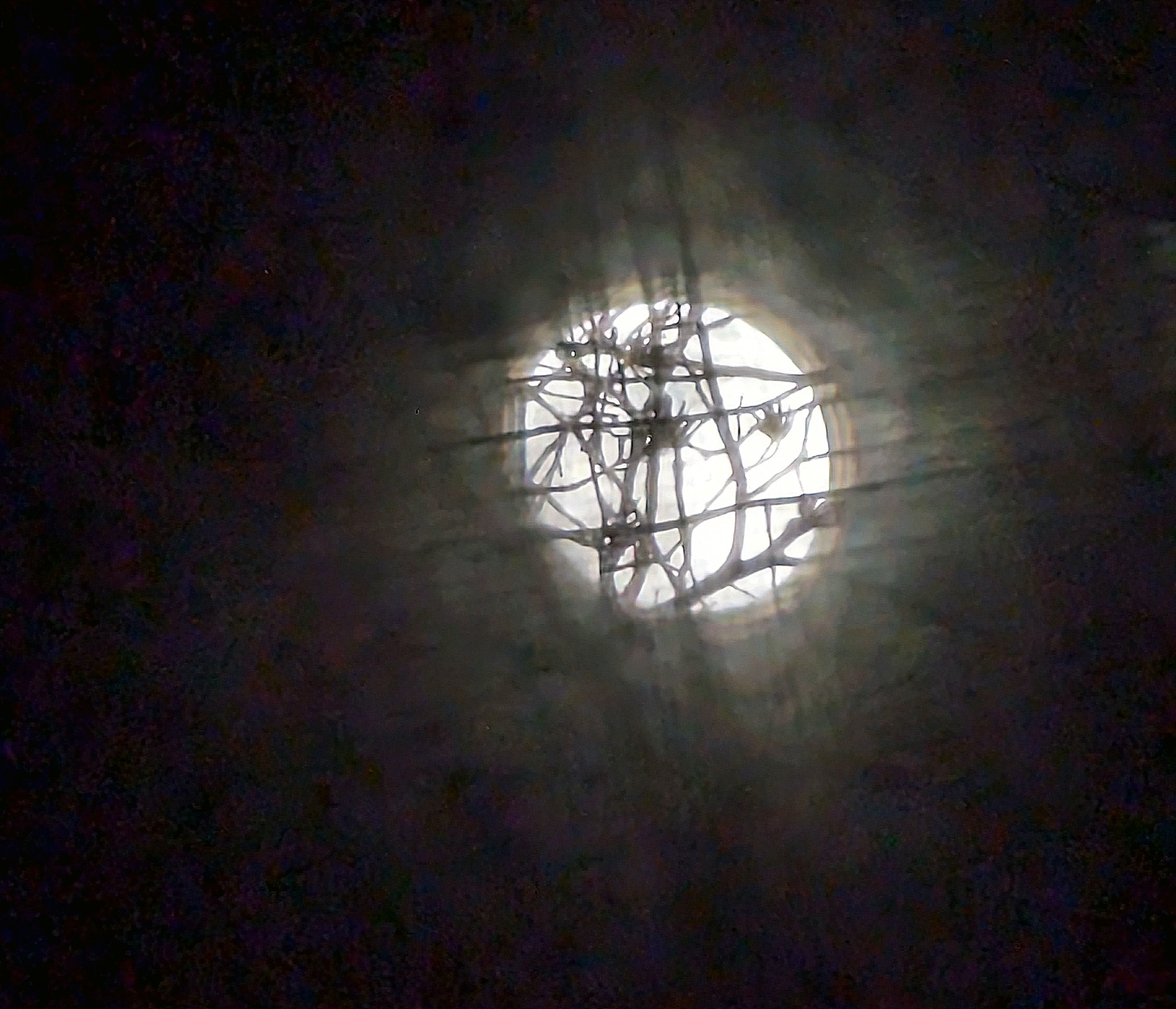
We gathered with friends to welcome the New Year with simple Southern fare: ham, boiled potatoes, boiled cabbage, biscuits. After loosening our creaky social graces with applications of Belgian beer, my Southern brother of a different mother lit up his new chiminea and we talked of things ponderous and trivial. The moon stared us down, afraid to blink for missing our ephemeral lives. Oak hissed and crackled in the fire.
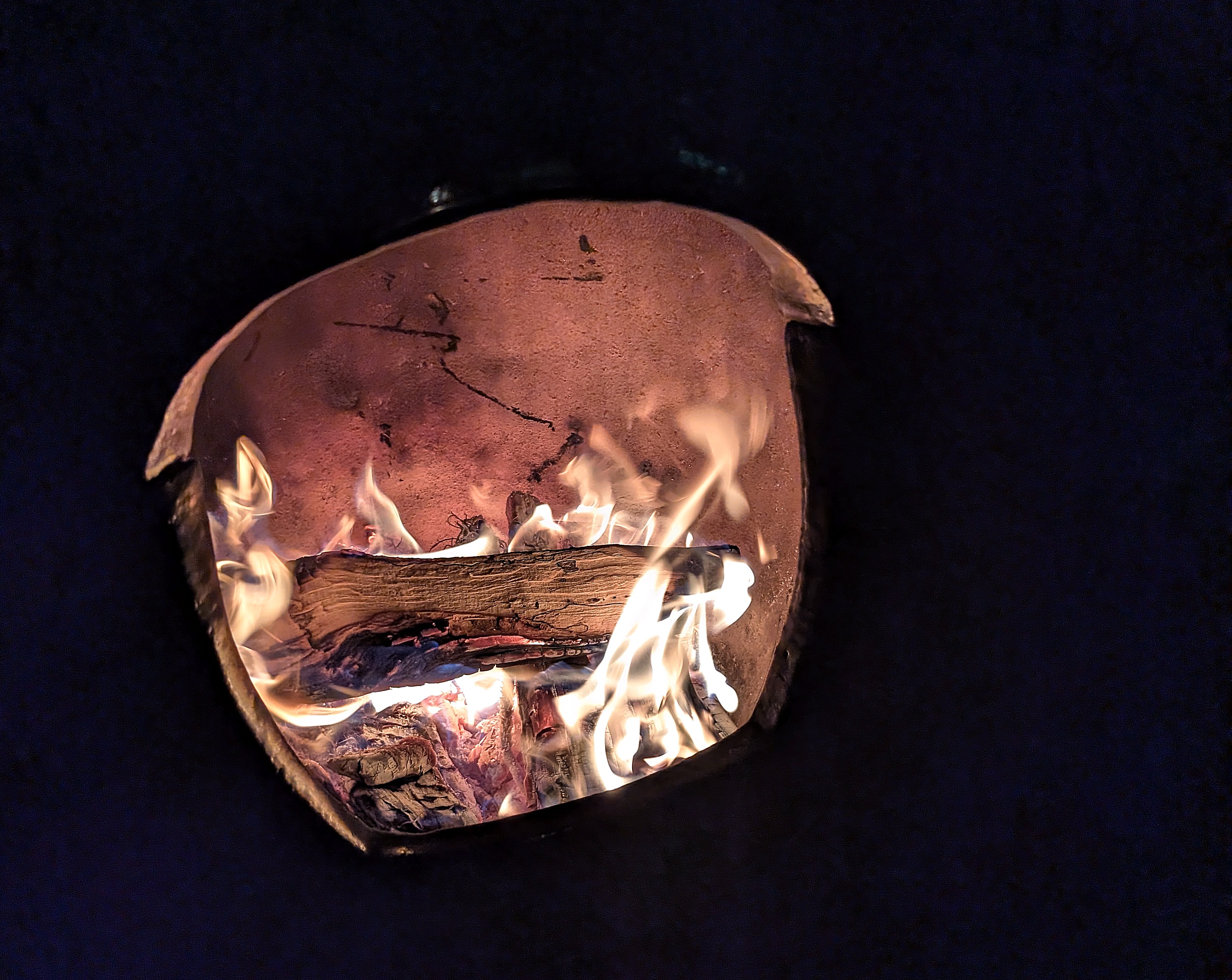
At one point we paused to look at the pretty effects of his neighbor’s light pollution…


Finally we admitted our backsides were too cold and our frontsides were getting quite toasty. We headed indoors, while tarted up versions of the trees danced in our heads…

“Oh my! I don’t usually have more than one, but it is the holidays….” [cue hysterical laughter]
Merry Christmas, y’all! I wish you all the meaning of the day. For the Catholics, and the similarly aligned, we look forward to the 12 Days of Christmas beginning today. To our fellow Christians, we celebrate fraternally, the incarnation of God, the Creator of the Universe. To the rest of America and those who choose to throw in with us, this represents a time vaguely associated with the Solstice that causes the Northern Hemisphere to contemplate the brightening of days, the eventual advent of spring, and a time where we think about love of our fellow humans, the idea we may achieve peace on Earth, and that individuals will find the emotional connection we all seek. (I’m sorry, Southern Hemisphere. I haven’t got anything for you on this one. The days will grow shorter. The warmth will fade away. And in your coldest times you will not have the bright spot of Christmas to look forward to. I’m feeling your pain.)
Our personal Christmas has been especially meaningful to me. My best friend in the choir, a bass like me, died 18 days ago. An ordained priest who left the clergy to pursue a ‘worldly life’, he never stopped being what priests aspire to be (if they are true priests): the lowly shepherds who gather the sheep who stray and return them to the fold. I suppose he never will be venerated, beatified, or sanctified, but he established a spiritual North Star for me, and his death so close to Christmas has rocked me emotionally and spiritually. That I say this day’s mass proved especially moving to me makes me think that the last time I felt this way occurred in 2019 exactly two months after my mother died (and I retired). It’s funny how we imbue meaning into the same annual ritual liturgy.
I approach my faith through music and musical ministry. Thus, the Midnight Mass this year meant I dwelt in the choir loft yet again despite thinking, “How much longer can I stay up until 2 or 3 a.m.?” I reference my comment to my recently departed friend from the bass section who last year at 84 found it a requirement to be in the loft on Christmas Eve, preparing for the first hour of the birth of Jesus. He could not stand for more than 10-15 minutes. He exerted himself to climb the steps to the top riser where the basses reside. Contrary to offering complaint, he climbed with a smile on his face. I kept thinking about him, about my slight musical retreat from participating in what my vocal gift allows me to do, and about how this night above most others enriches the spiritual experience for those who attend but Christmas and Easter.
We presented 45 minutes of music from a brass quintet (plus tympani), two organists using our CB Fisk Opus 147 pipe organ, and the two dozen voices of our choir. I invite you to follow that link to the page describing the organ. It inferentially mentions our cathedral space which remains one of the largest Roman Catholic cathedrals in America, providing space for about 2,000 worshippers.
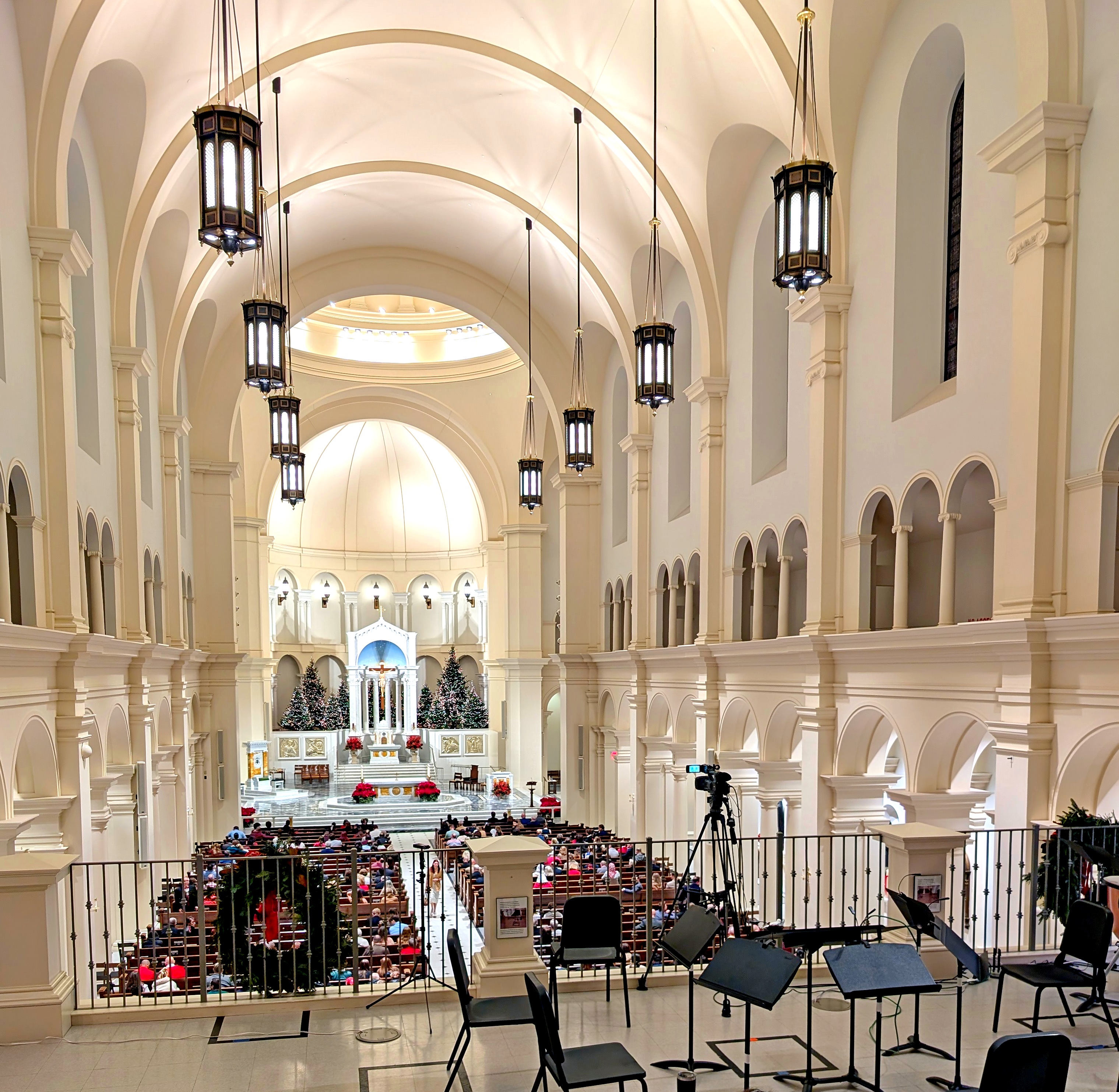
Not unusually at Christmas, parishioners packed our cathedral.
Here’s a not-unusual detail for folks like me:
There you have it: a raw, day-after download of what this (and many other) Christmas has meant to me. I wish you and yours the merriest of the day. Here on the east coast of the United States, about eight hours remain on Christmas Day. I hope however many you have (or had), they will be/were meaningful.
perhaps a three-week hiatus demands a post about Three
Every morning after I’ve got pants and shoes on, I grab “stuff for my pockets” which varies depending on whether I anticipate going out and needing a wallet. Sometimes I don’t think I’ll need American coinage either, but I always grab a lip balm stick and three coins:


This ritual, this grabbing of physical reminders, has existed from before the morning prayer time I started recently. Because I am who I am, I consider the smallest coin first. For a period of time when people held postal mail in higher regard than now, and the Internet hadn’t become the ubiquitous realm where we encounter one another, I received a regular marketing mailer from some religious publishing house. Or maybe it was a charity looking for donors. Regardless, every mailer had affixed to its mail-in card a cheap metal coin with an angel embossed on it. “This is your Guardian Angel! Take this gift as a token of our appreciation!” the card said. And one day when yet another of these things showed up, I did. I don’t pretend to understand the exact nature of a guardian angel, but I can say with certainty there have been many times when something bad should have happened to me or when I for some reason refrained from saying something incredibly stupid, and I think a higher power might have influenced things. The coin reminds me there are forces greater than me at play in the universe, and I would do well to give them a few seconds each day to stop and appreciate them.
I picked up the middle coin in February 2013 when we visited Kissimmee, FL, spur-of-the-moment. I had a suddenly empty work calendar in my new line as contract-professional-for-hire, and Florida promised to be warmer than Raleigh. In most ways that count, it remains one of the two best times I’ve had in my half dozen or so visits. Due to the sudden nature of it, I planned little. We just schlepped around and on our final day discovered The Basilica of the National Shrine of Mary, Queen of the Universe:


Moved, I sought a small reminder of my experience there; hence the coin. In Roman Catholicism, the Marian tradition provides an important link for humans with God. As Mother of the Son of Man, God Incarnate, Mary becomes our symbolic mother just as Jesus is our brother. Thus our reverence for our mother, just as we revere our earthly mothers (hopefully). The coin reminds me of this link, of the powerful Family of God of which I am a wayward son, and of my brother-and-God, Jesus. Powerful stuff…and all in a few seconds!
My final coin (because it’s biggest) reminds of something far less religious, but no less meaningful. My father had an eclectic collection of coins he kept in a small metal box shaped and decorated as a 1940’s suitcase complete with travel stickers on it. He popped the occasional coin into it which he thought would be “worth something someday” or just out of curiosity. The U.S. Mint first struck an Eisenhower dollar in 1971 which likely explains why my father set this one aside. It also happened to be the first dollar coin minted since 1935. To me, however, it stands in for my father. I grab that coin and think about the oddity of putting 15-20 coins in a little kid’s bank and then doing nothing with it: he never took them out and looked at them, he never spoke about them, nothing. Only when he allowed my brother and me to dig around in his chest of drawers would we get to see what this little metal box held. In a larger sense, I see that profile of a bald president and think about my father in his final 20 years. I say a little prayer that he has found peace in the afterlife, a peace which eluded him here.
These few seconds…the little things we do which ground us.
I seem to be on a leaf and garden kick. Though two short cold snaps have sent 99% of the plants into dormancy (unless they’re evergreen), a few brave stalwarts instead focus on the above-average warm weather to pop one last bloom out. November 3-9 ranged 65-75F with just a dash of rain the final two days. And then the 12th through 16th blessed us with sunny days of 64-73F. Look at these little troupers:

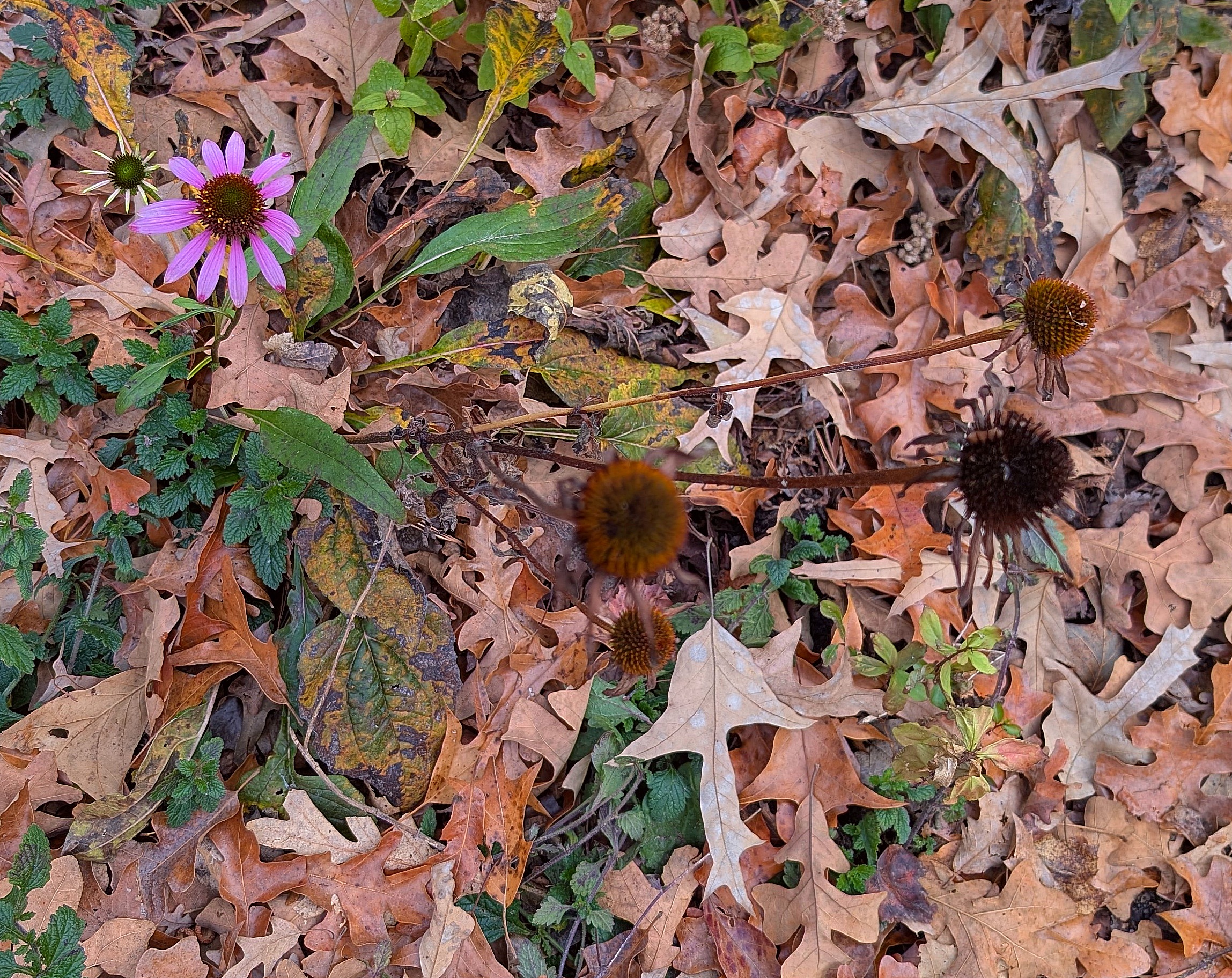

I took a walk this morning as the newly risen sun filtered through the tops of trees. The ethereal lighting isn’t quite captured here, sadly. Nice to see the natives doing well.

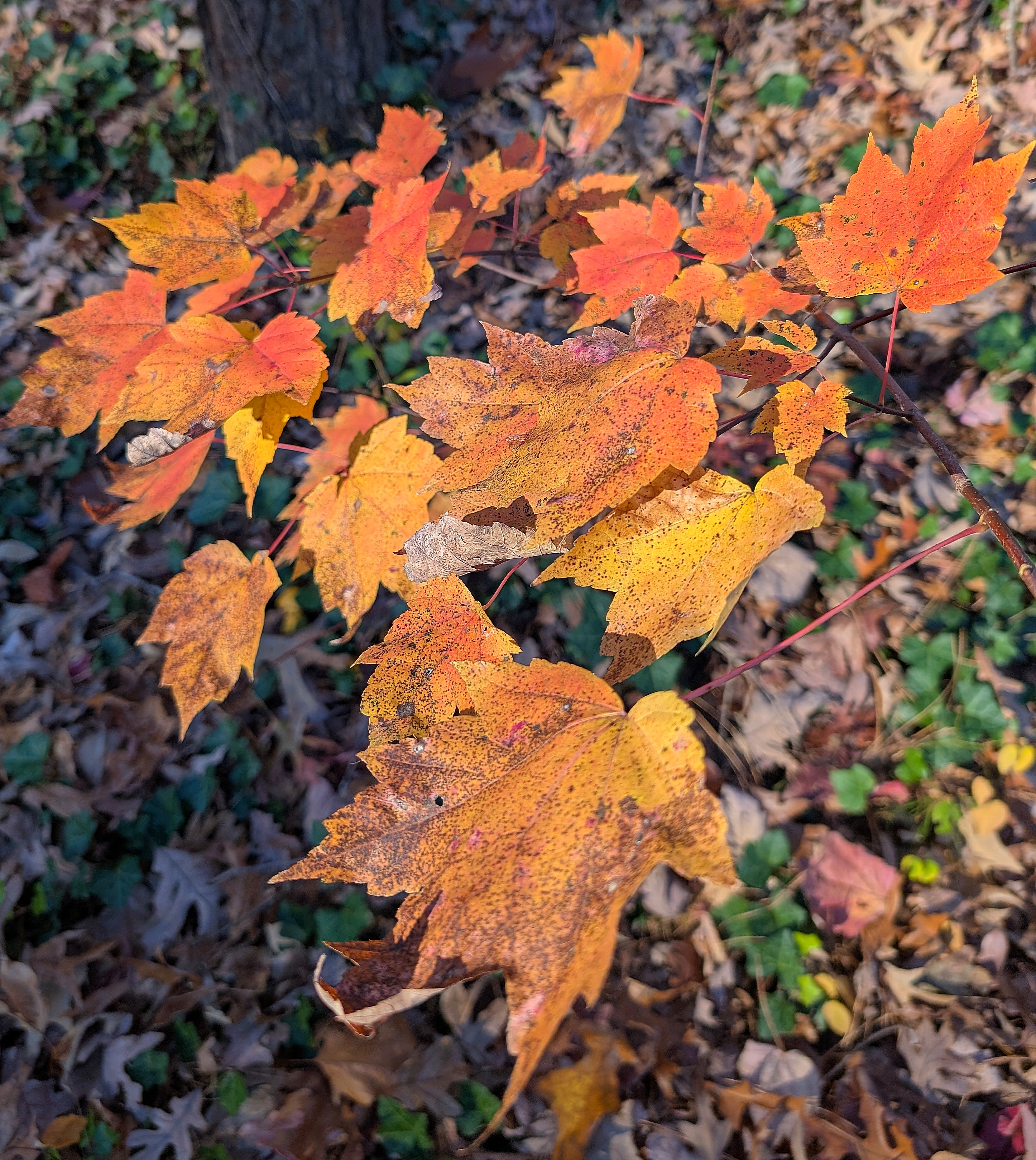
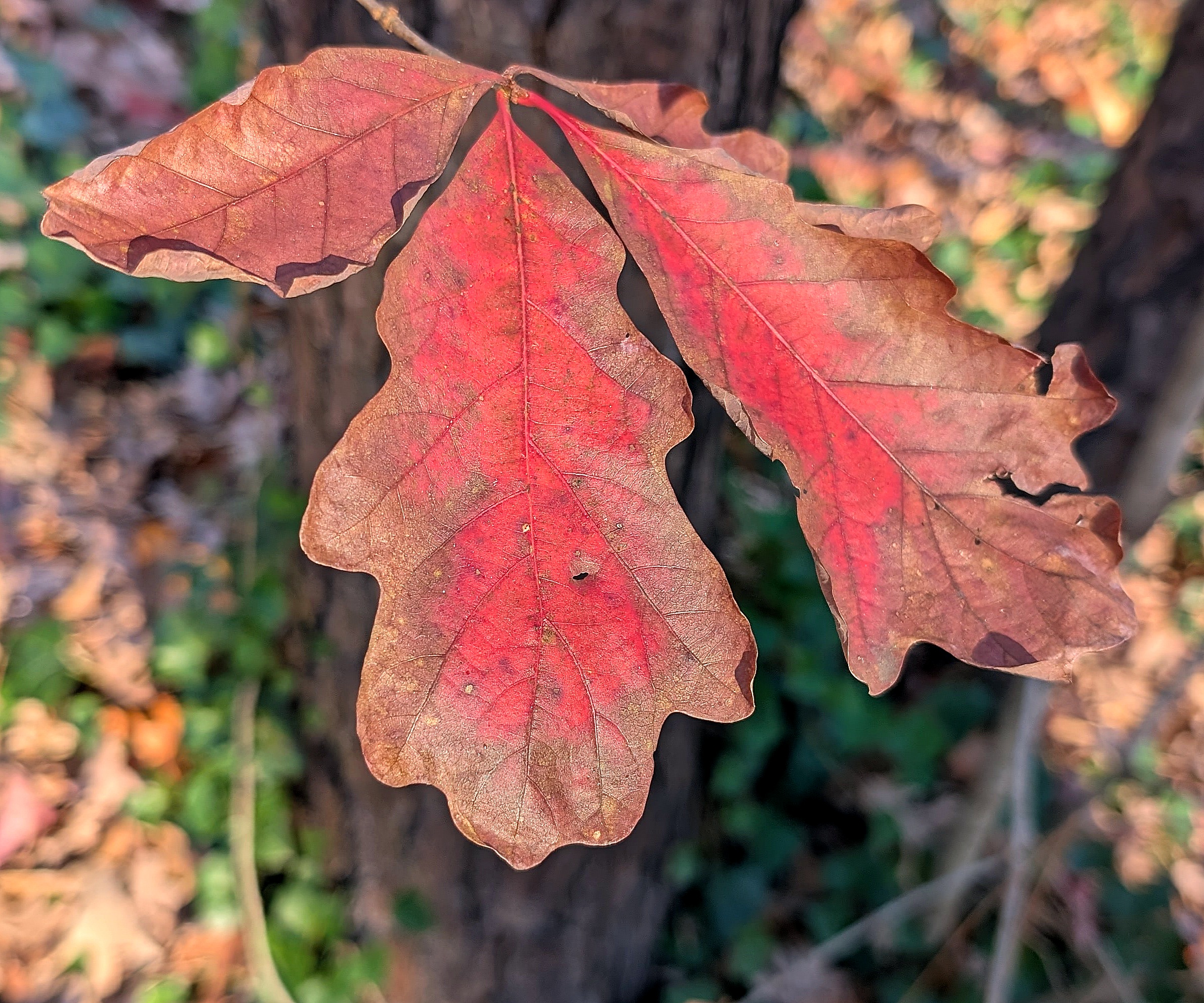

Unlike most years here in central North Carolina, temperatures have been colder than normal and our first hard frost occurred this morning. The above photo from November 24th last year, shows the glory of our lone non-native tree to survive The Culling, a.k.a., the landscaping project of 2024-25. This year it still retains red leaves but they are dulling. Dogwood, which in years past held onto their dusky maroon-colored leaves, now stand bare, attesting to the weather with a solitary leaf here and there. Plants closer to the ground now are yellowing and soon will follow the trees.
On the personal front, fall seems an apt term the past two years. At this time last year we were winning our battle against Covid, entering our third week in its grip. This year a Covid-like virus laid me low all of October 26th through November 2nd, and its nasty little cousin showed up yesterday, an intestinal thing. (“Detestinal” thing?)
Dry, sunny weather accompanies these low temperatures, providing a yin to the biting yang of it. Our bird world changes almost overnight: the year-rounders come back to the feeders to start bulking up, others disappear, and soon birds of prey will become more prominent on their leafless perches. Last week a raven lingered in front of the house, a surprising sight.
This year brought an unusual amount of treework in our near neighborhood. Trees and large limbs fell frequently during unusually rainy weather this summer. Fearful homeowners culled trees simply because they stood near the owners’ houses. A red oak ‘shared’ with our neighbor—it has managed to grow across the property line—dropped a limb the size of a small tree onto the neighbor’s driveway in a spot which had held a car until a week or two before the limb fell. Our good friends around the corner were not so lucky, losing a vehicle when a limb fell on a minivan about six weeks ago.
NC weather continues its wonderfully contrarian ways, at least to born, bred, and experienced Northerners (a.k.a. “Yankees!” as the Southern epithet is uttered). Temperatures promise to level out and this coming weekend will rise as high as 76. Any day after Halloween which promises temperatures in the 70’s (let alone the 60’s) seems to be a gift, even after living here nearly 20 years. And the most anticipated weather event for the coming months? The knowledge that someday in our near, winter-weary future, a singular weather pattern will convince a 70+ degree day to appear in late December or January. Always a welcome respite, even if its appearance always remains a cameo.


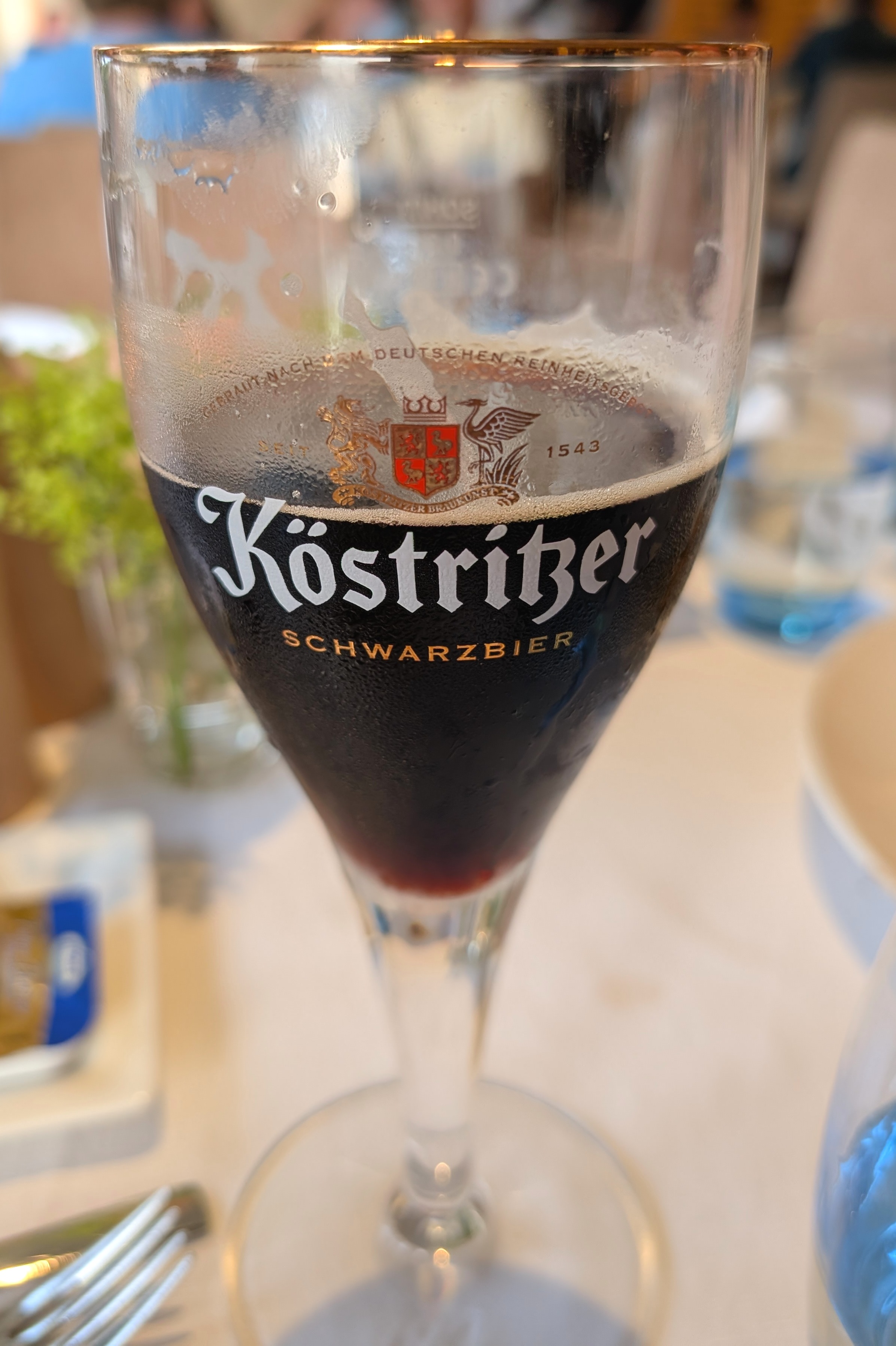
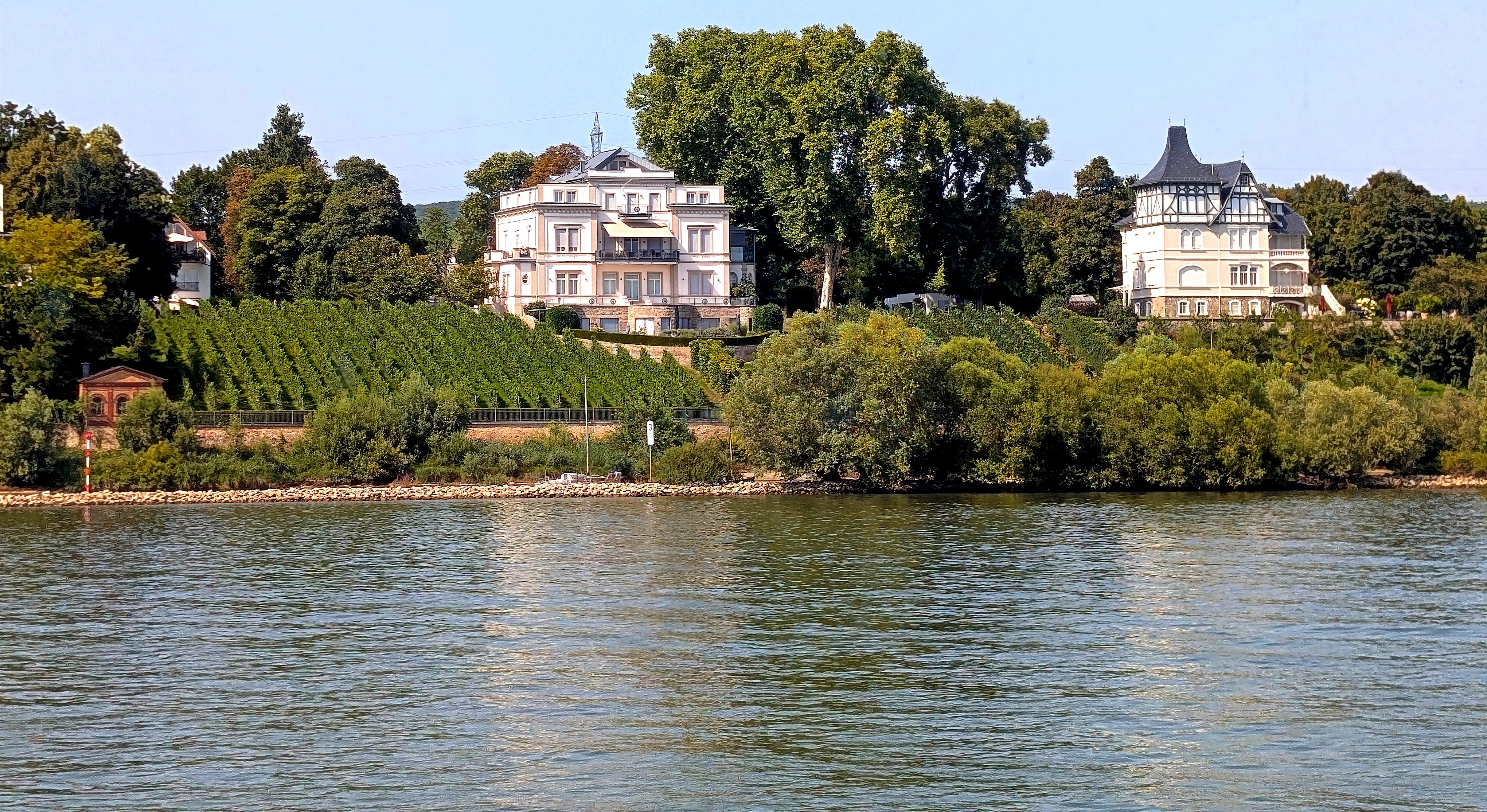
River cruising resembles train travel: you journey from Here to There but don’t have to do the driving yourself. One thus experiences the journey. (Flying lacks this: one experiences only the point of departure and the destination. The experience of travel disappears, lost in abstract non-motion at 30,000+ feet.) Our afternoon cruising capped our morning in Speyer, just right for my still-recovering wife. Once moored at Rüdesheim, we chatted with the local ducks and enjoyed fine beverages. For me, that included this delightful Schwarzbier from Köstritzer.
…or Spires if you want the English name, presented a much-needed comfort level after the unanticipated end to our “Strasbourg Buildup” of expectations. Only 50,000 folks live in this city on the west bank of the Rhine. Yes, we now saw Germany on both sides of the Rhine. Midway through the night’s cruise to Speyer our ship had passed the point where the pentagonal border of France had turned to the northwest and left the Rhine behind. For the first time since Basel, we docked on the west bank of the river. We had the worst guide of the trip there, but a lovely time nonetheless—we simply ignored him and tried to stay within shouting distance of the group. (“Worst guide ever” equates to having him leave a third of our group at a crosswalk where the light had turned against us. He continued with the tour, and then admonished us when we saw a break in the traffic, crossed against the light, and ran to keep up with his idea of pacing a tour!)
Speyer’s cathedral dominated the city both in its placement on the edge of the bluff overlooking the river, and simply because its size completely outstripped any other building around it. I need two photographs to show all of it:
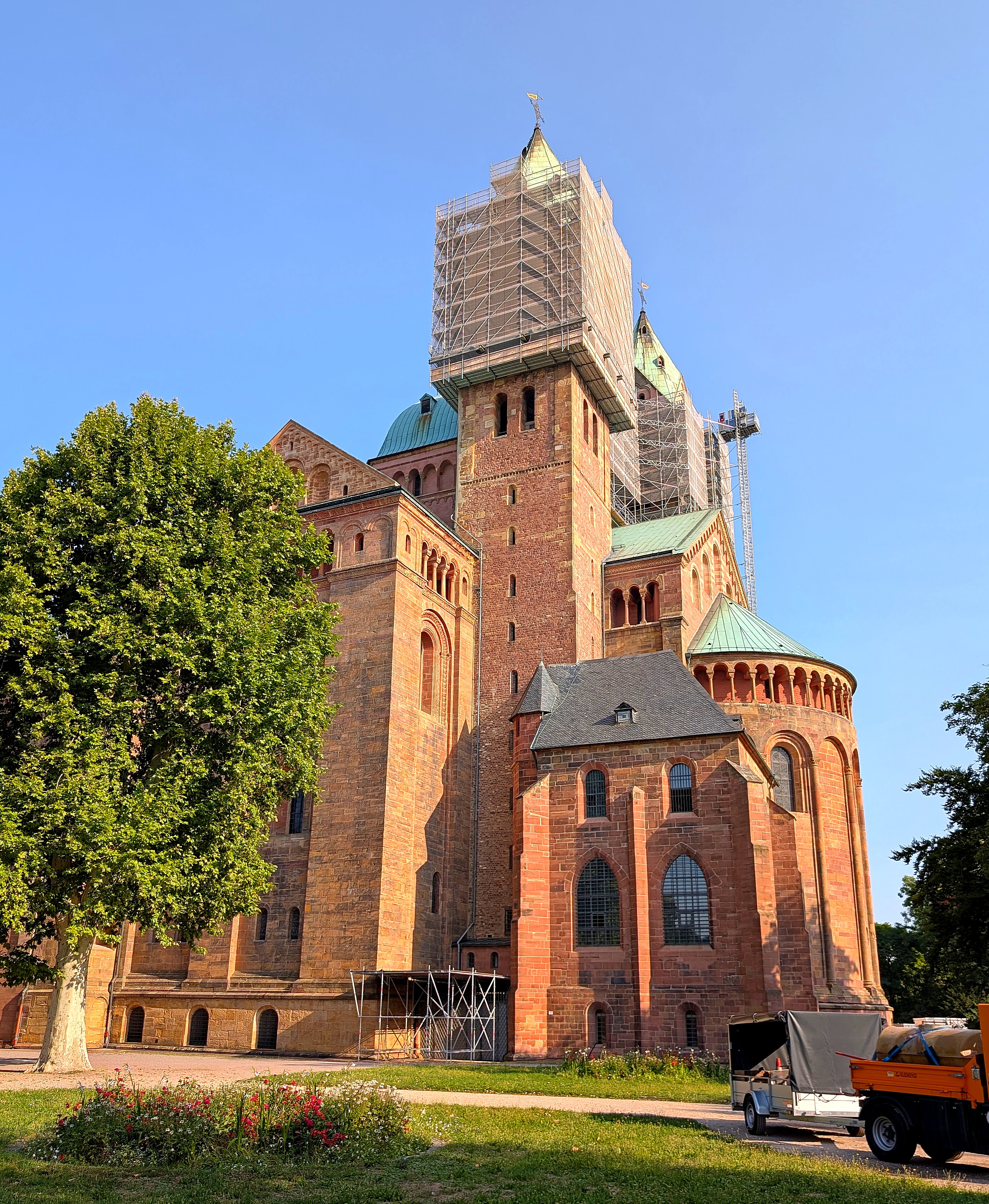

Parishioners built the cathedral in several distinct phases. Though our guide dryly and boringly explained it to us, I concentrated on photographs to his exclusion. I therefore can’t give you much history about the building’s timeline. I do remember that like all “touristy” cathedrals you will ever see, this one was the biggest in some category or other—I think “biggest at the time it was built.” If I remember correctly, the middle part of the building (seen in the second photograph) predated either end. Part of it had to be rebuilt after WWII, also. Look on the tower in the second photograph and you’ll see stones laid much more hodge-podge on the lower right of it. The rest gets a more uniform, geometric treatment.
Our guide left us no time to go inside the church. Instead, he took us into the center of the city, a small area of just a few blocks which extend westward from the church. As we turned westward from the cathedral, he noted (for our safety) an oddity I’ve not seen anywhere but Speyer: a city street routed through the plaza, marked only by regularly spaced concrete posts. It struck me simultaneously as beautifully quaint and dangerous.

Our guided trip into town proved blessedly short, after which we broke free and wandered at will. We quickly encountered a beautiful Orthodox church…I think.

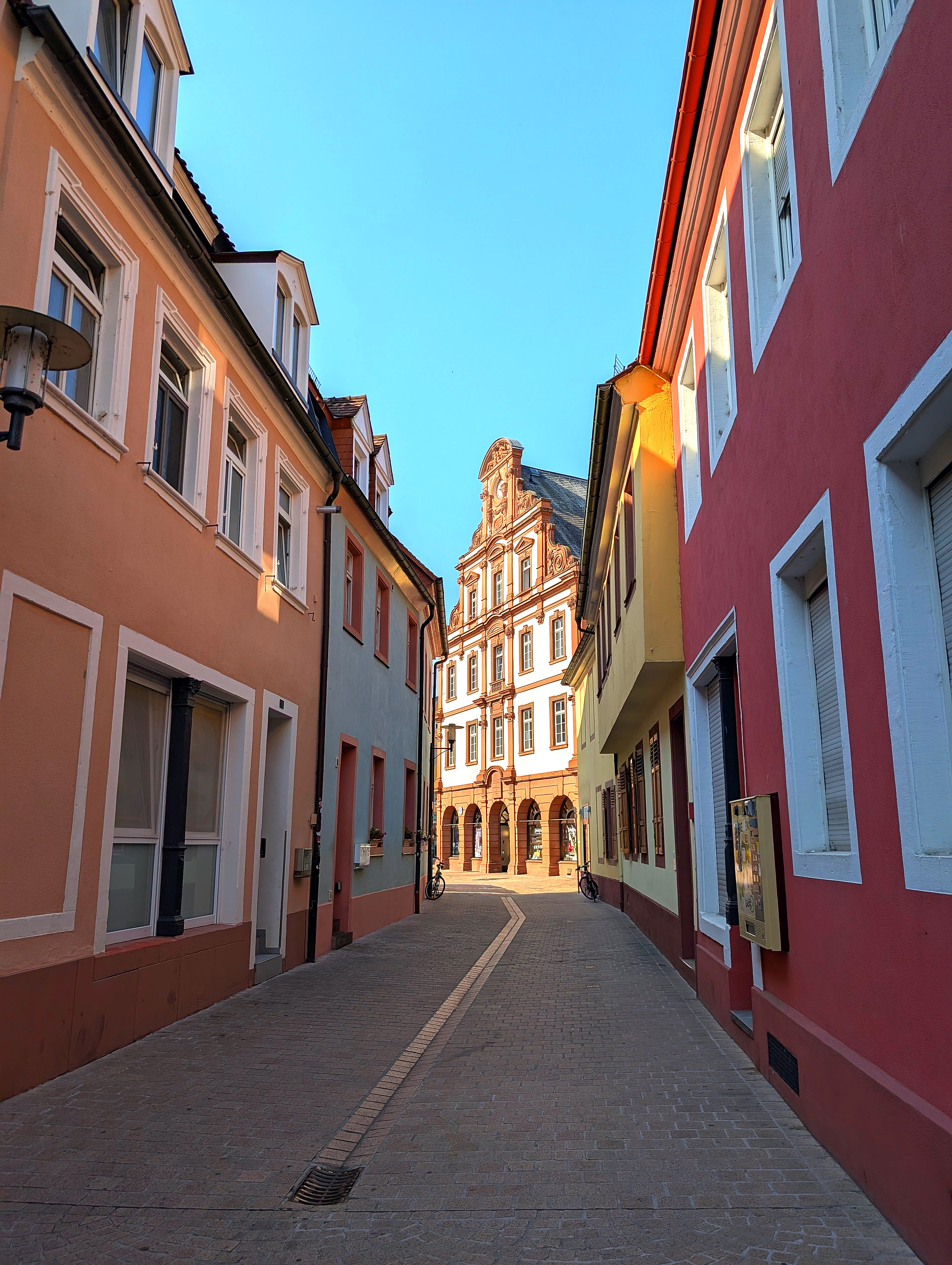
We struck off from the main street through the city center and found little plazas tucked behind several other buildings. One hid a strikingly designed school of drama, if I read the German correctly. The streets off of the main drag lived up to my fantasies of narrow, old, and quaint. A sign informed us that many of these buildings were associated with the Jewish community. Speyer and the nearby cities of Worms and Mainz have been recognized as UNESCO World Heritage Sites. Near the photo on the right (below) we passed an old synagogue.

Walking back toward the cathedral to meet up with our group for the walk back to our buses, we finally had time to enter the cathedral. We made a good decision to allow time for that.

Speyer’s cathedral offered a delightful blend of modern furnishings contrasting with the centuries old structure. The minimalist lines of its furnishings complement the austerity of the stonework. It had several altars. I surmised different ones get used depending on the size of the congregation at that particular service. Perhaps at least one stands there for historical reasons. The most modern one sits far forward. The candles flanking it, both those on stands and the votives to the side, were displayed on modern metalwork which evoke the baroque in a minimalist way. The bishop’s chair sat halfway back in the sanctuary (altar area), to the right in the photo below. The next photo gives a sense of the depth of the sanctuary/chancel.


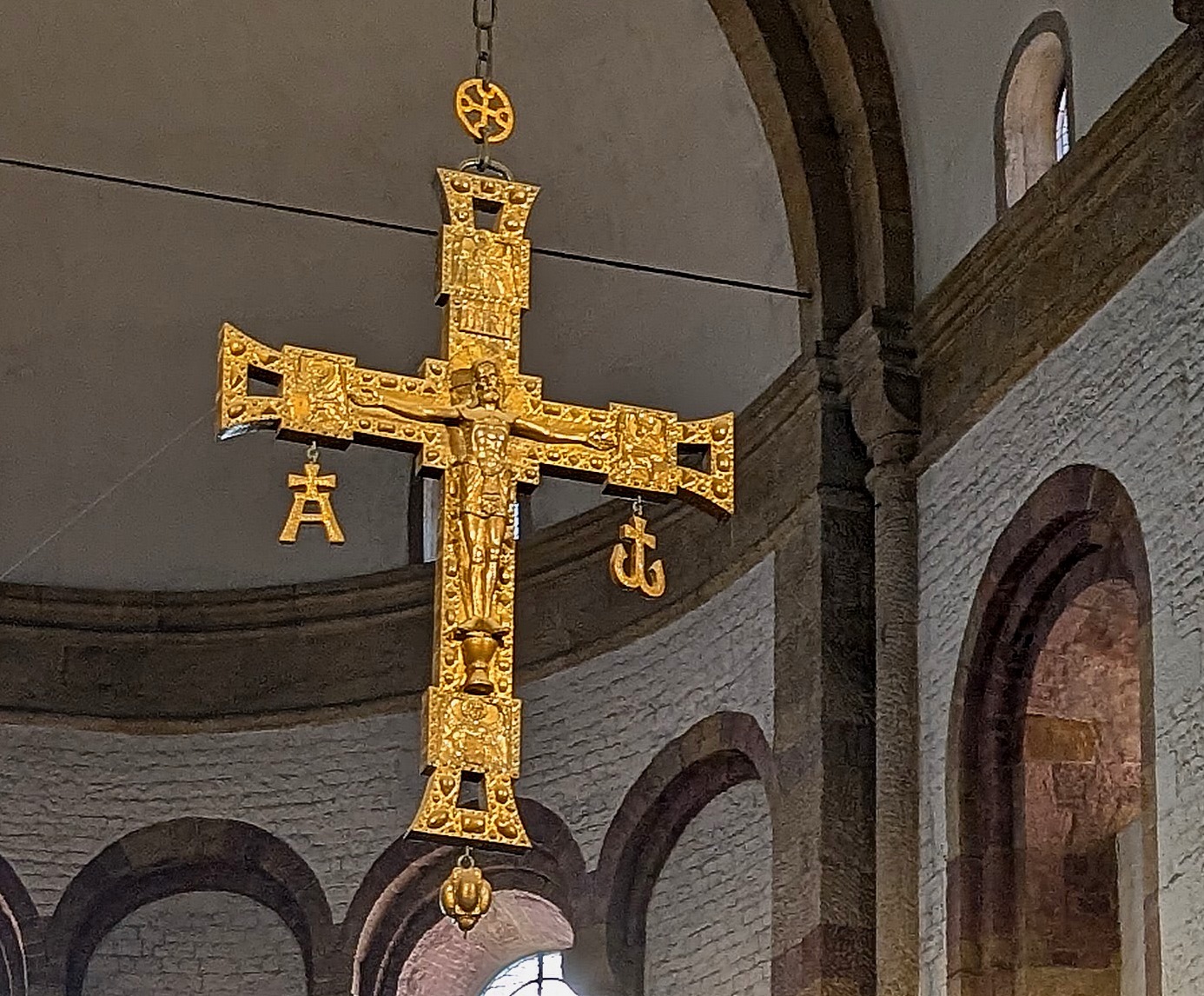
When looking at the photo above, you’ll remember the bishop’s chair is to the right of the first altar. In the lower right corner, note the raised floor. This is for the second altar. Light shone into the cathedral from many angles. At the top of the photo is the lowest tip of a suspended cross, caught in sunlight which casts a shadow on the back wall. See detail, left.
Our several tour groups boarded buses for a short trip to Worms where the good ship Hlin had tied up after getting a head start on the afternoon voyage to Rüdesheim. We couldn’t seem to take enough photos as the historical buildings glided past us. That evening we stayed aboard. Others had purchased one of two different dinner packages (one at a fort high atop an overlooking bluff).
 all the voices in my head