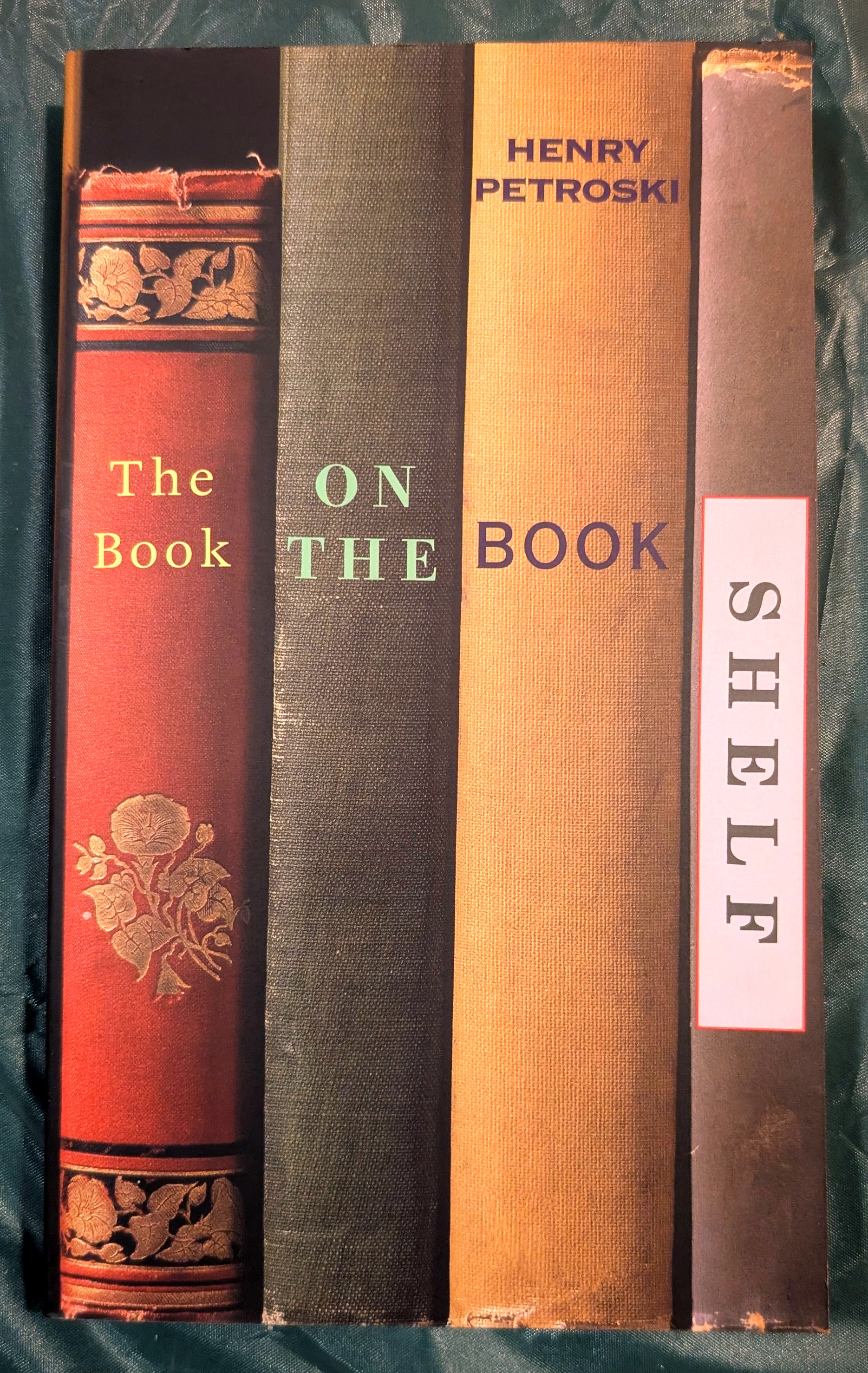
People who truly, truly love books, love books about books. One of the most unique of these appears above. Henry Petroski’s book The Book On The Bookshelf traces the history of books from their earliest inception as scrolls through the Middle Ages when they were chained to the shelf, and proceeds in its history to the present day. It’s a lovely read. Petroski winds up the book with a chapter about bookshops, another on the shelving of books, and a final one about the care of books.
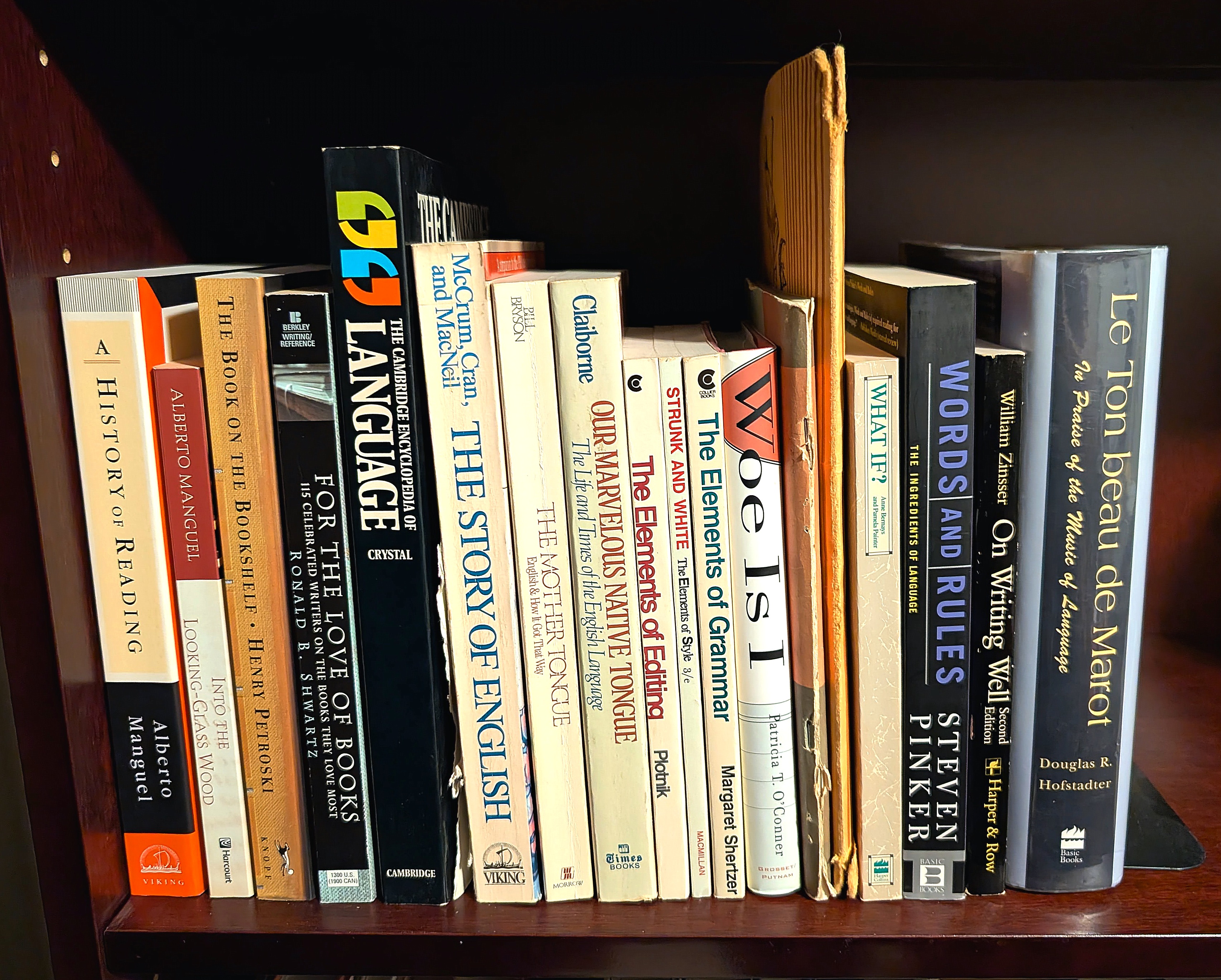
The phrase “books about books” includes those about reading them. My original photo for this Bibliophilia subplot is repeated here:
Books about books, language, grammar, and linguistics. July 2025.
In the semi-arbitrary manner I use to organize my bookshelves, books about books (and reading them) precede those which address English and languages. Alberto Manguel, an Argentine-Canadian writer (and translator, editor, essayist, and director of the National Library of Argentina) has two entries, both wonderful. A History of Reading celebrates the reader. With chapters such as “Being Read To” and “The Missing First Page” Manguel explores all of the aspects of the author-reader experience. Manguel divides the book into two sections: “Acts of Reading” and “Powers of the Reader”. I particularly liked this second section with its chapters of “The Author as Reader” and “The Book Fool”.
Manguel’s other book, Into The Looking-Glass Wood contains essays about books and reading. These range more widely than his History of Reading. Essays include reviews, reactions to other authors, browsing for books, essays about wordplay, and other more wide-ranging topics.
Ronald B. Shwartz’s book For The Love Of Books gets included here, simply because it’s on the shelf, and I can’t bear to part with it despite its shortcomings. I’m not one for the types of books which sample a range of acclaimed artists about a certain topic. This book gets the subtitle “115 Celebrated Writers On The Books They Love Most”. Yeah, so? What makes their opinion better or even equal to the critic for the New York Times Review of Books? Or any literature professor at dozens of highly regarded universities? Or, frankly, me? Regardless, I succumbed when I saw the authors cited include Joyce Carol Oates, Michael Ondaatje, John Irving, Bruce Jay Friedman, Doris Lessing, Norman Mailer, Witold Rybczynski, Kurt Vonnegut, John Updike, and Gay Talese. (Actually…I’m not sure I’ve ever completed this book! It still captures my imagination, and thus, it remains on my shelves.)
There you have it, books about books. If we can happily descend into the depths of books about books, how dare we deplore those who delve into the backgrounds of various oeuvres such as Tolkien’s Lord of the Rings? A nerd is a nerd is a nerd…
Le Ton Beau de Marot, purchased in a shiny-covered form.
Having published a book review just an hour ago, it seems fitting to revisit my Bibliophilia series with what amounts to another review. Le Ton beau de Marot: In Praise of the Music of Language by Douglas R. Hofstadter impressed me to such an extent that I purchased another when I lost the book to a less-than-responsible work friend. For nearly a decade it bothered me that I couldn’t pick it up and show it to people when I said, “you’ve got to read this!” Finally, having purchased Hofstadter’s Pulitzer Prize-winning Gödel, Escher, Bach: an Eternal Golden Braid (which has proved so dense I’ve never finished it), I tracked down a used version of Marot from a bookstore in Santa Fe, NM. (I necessarily bought it used because it apparently was out of print.) It’s inching its way up the Read Me list, probably gaining the top position in 2026. But why gush about it? To answer that, I must detour to 1999.
In July 1999 my wife received news that the lump in her breast was a benign cyst, nothing to worry about. A little over a month later she received word that the tests had been mixed up and that she actually had cancer. This occurred on her birthday. After three surgery procedures in September, we took a vacation to the Oregon Coast just one week prior to her beginning the chemotherapy regime. We stayed in a wonderful condo on Yaquina Bay at Newport, OR. When we left, we took a leisurely drive up Highway 101 along the coast all the way to Astoria before turning east the next day toward home. Shortly before we arrived to Astoria we stopped at Seaside when a largish bookstore caught our eyes. There I found Hofstadter’s book. Loving language, I read the flap, learned it took up the challenge of translation, and that it also touched many other topics. From the flap:
…he not only did many of his own translations of Marot’s poem, but also enlisted friends, students, colleagues, family, noted poets and translators—even three state-of-the-art translation programs!—to try their hand at this subtle challenge.
The rich harvest is represented here by 88 wildly diverse variations on Marot’s little theme. Yet this barely scratches the surface of Le Ton beau de Marot, for small groups of these poems alternate with chapters that run all over the map of language and thought.
Not merely a set of translations of one poem, Le Ton beau de Marot is an autobiographical essay, a love letter to the French language, a series of musings on life, loss, and death, a sweet bouquet of stirring poetry—but most of all, it celebrates the limitless creativity fired by a passion for the music of words.
What the flap only hints at I learned later. During the time Hofstadter gathered his many translations by consulting all those people, his own wife was dying of cancer. Thus, his “musings on life, loss, and death” dive deep into his soul and therefore ours. Add to that my own wife’s tussle with cancer—she won, unlike Hofstadter’s wife—and the work compels. As I worked my way through the book, I found it dealt with language at a very basic level some of the time: how do we mean things? How does one language differ from another? How does cognition play out in word choices? And on, and on…
When I finished it, I felt Le Ton beau de Marot had been one of the best books I’d read because it didn’t just deal with language or cognition or love or translation or meaning or any other of those things mentioned above. It dealt with all of them! I loaned the book to a co-worker whose daughter was headed off to college to pursue a degree in English and who wanted to be a writer. I undoubtedly didn’t make it clear enough that one day I expected the book back. When I handed it off, though, I held back my gloss notes, which instead of writing into the book I had written out on fine paper. (They were too extensive to write into the margins anyway!) The book meant so much that I still have the notes a dozen or more years later. Here’s one:
[p. 138-139] I would side with Frost, that poetry is what’s lost in translation. Not that it can’t be re-discovered in the new language, but it’s not the same poem. Thus the poet-translator is intent on supplying a twin, not the real thing.
Hofstadter’s work combined with my college readings on communication, media, and meaning to form my personal philosophy and understanding of all types of translation. I “see” the issue of meaning more deeply than many I engage with when discussing how a work translates from one language to another, how people in different cultures perceive things, how books become movies and vice versa, even in how Superman or Batman is translated every decade by a different director all of whom seemingly work from the same “text”. I even see the problems of translation as one of the issues currently plaguing United States politics.
Hofstadter’s book satisfied on so many levels, engaged so many pleasure neurons, that I can’t do it any justice. You’ll simply have to read it yourself if you love reading about language and the problems of translation…and cognition…and…
Artists differ from most of the rest of humanity. Artists tap emotions and experiences others prefer to hide or, at best, to reveal carefully to select individuals and audiences. Unlike the careful revelation practiced by most, artists display their work on the public walls like graffiti in subways. Wedged between “For a good time, call ###” and obscenities, the artist inserts a portrait, often rooted in pain or struggle and rendered in words, brushstrokes, sculpted metal, or other media. Where most humans rush to clothe their naked feelings, the artist drops such obscurations to the ground and invites the errant passerby to look, but more than that, to judge. This is how they differ: they invite comment upon creations rooted in their own psyches, their own souls.
Humans hurt. We all hurt. We bear our wounds heroically, badly, simperingly, stoically, resentfully, and sometimes all of these and more depending on the time of day. Authors live with the uncomfortable knowledge that their wounds, their innermost thoughts, beliefs, prejudices, emotions, and most of all, memories, will bleed out—must bleed out—onto the pages they write, an emotional, psychic wound which perversely will not staunch without being exposed. It’s analogous to being handed a bite bar and hearing, “this is gonna hurt but you’ll thank me later.” Authors bleed out into their words and wait for the comments, but in truth, their healing began when the words gelled, the pages were printed, and the books displayed.
Commenting in any manner on such courageous behavior feels wrong. There cannot be a wrong way “to art.” As a teacher of English, though, I learned there exist many wrong ways to connect with an audience. And ultimately, anyone who publishes a book expects an audience to react to it. I’ve followed Kay’s blog Bridgette Tales for several years. Her personal revelations in that space represent why blogs need to be written. Done honestly and well, a blog sends joy and pain and struggle and hope out to the world, asking only to be heard. In the process, blogs show others, “Look! I hurt like you, love sunsets like you, see little clumps of moss like you, and I revel in it, even the painful stuff.” They build the global community. It came as a relief, then, when I discovered the stories were actually good. I’ve seen many a near-breathless author hand me something with excitement in their eyes and words, only to find upon reading it that the author hadn’t a clue either about constructing a story or writing one.
Don’t read Watering Words expecting John Cheever. These stories are not “high literature”—they instead represent what most readers look for: engaging stories with whimsy, a little magic, humor, and told with style. These stories speak less to the human condition than to one human’s condition. As one who has followed her blog, I see the pain, longing, fears, insecurities, joy, laughter, righteousness, sadness, glee, and maturity I’ve sensed in her near-daily posts. Two of the early stories stand out.
In the first story, “Waiting For The Bus”, every author will resonate with Kay’s personification of all those fears and excuses with which we keep ourselves from writing. The narrator’s ultimate triumph echoes Kay’s, I’m sure. And in “Final Goodbye” I invest my supposition that Kay writes of a home in her past (at least symbolically). I detect references to tragedies mentioned on her blog, but leave them for others to discover.
Read this book. Read it not for “high” literature but for “hi” literature: an author reaching out and saying, “Here I am. I’m saying it as best, as entertainingly as I can. Do you see me? Do you feel the same?
OR, “I’M STILL WORKING ON MY COLLEGE READING ASSIGNMENTS!”
Literature anthology texts, college and otherwise. July 2025.
College literature texts resemble the reading equivalent of eating at an upscale buffet restaurant. You know the food will possess decent quality, but you don’t expect one of those “oh, wow, go get the chef!” moments. On the other hand, you know it isn’t Golden Corral, there won’t be questionable entrees and a lack of things which resemble lovingly prepared food. It’s therefore a safe, pleasurable experience you look forward to, but not too much. So too the literature anthology, usually targeted to college freshman and sophomores, aims higher than 50 Romance Stories For The Modern Lover but the reader doesn’t usually expect anything challenging or inclusive. There can be exceptions which prove pleasant. Sometimes, particularly in those early college years, one experiences surprises less pleasant: “But I thought that was a great story, professor!” ran through my mind a few times when my instructor somewhat condescendingly told us a piece we’d just read “was at best, B literature…good, but not great.” No matter. Turn the page. There’s something potentially better at the next station of this literary buffet.
As I’ve ditched books along the way, including texts which seemed useless for the future me, I’ve clung to nearly every anthology I’ve come across. In fact, as a teacher of English for 8th graders from 1983-1992, I accompanied my then-wife to garage sales specifically buying the college texts of other people to flesh out a reference library. In the days before e-books and a true Internet, I either had to seek these texts out from various bookstores and mail order outlets (at full price) or pounce on jewels sitting in the dross of some middle-ager who realized, “why am I carting this book around anymore?” I’m not sure, but I think I’ve only cut the ties with one, The Sagas of Icelanders, and technically it’s still in my house so have I really let it go? It’s categorically called “Purged” and fair game for donating/selling.
Let’s discuss what’s on the shelf above:
Quality Paperback Book Club rescued me when I found myself in Colville, WA, in 1983, a city of 10,000 souls 75 miles from any true city of note, and yet the largest city to the east or west for hundreds of miles. One of the final books I purchased from them before bowing to the Power of the Internet was the QPB Book of Irish Literature (copyright 1999). Beginning with Edmund Spenser and Jonathan Swift, it runs through “The Sheridans,” “The Wildes” (yes, including Oscar), and “The O’Faolains” while picking up George Bernard Shaw, W. B. Yeats, and James Joyce along the way. The latter is represented by the full inclusion of “A Portrait of the Artist as a Young Man.” Samuel Beckett has three entries including a slice of the play Waiting for Godot. A nice touch for a modern anthology was the inclusion of Nobel Prize-winning poet Seamus Heaney. I’ve selectively read throughout the 900+ pages.
The Norton Anthology of English Literature remains one of the classics for this genre, and I had to have it when I found it. My college text is two books more to the right, The Norton Anthology of American Literature. The condescension of a country with about 2000 years of literary achievement can be seen here: I have only Volume 2 of the English literature, but the shorter work, American Literature, represents all of what the Norton editors consider representative and worthy.
Between the two Norton collections lies a silly conceit, fifty great short stories, a humble paperback which I’ve never read. So sue me.
Another book I’ve never read, but have consulted, is Adventures in American Literature which appears to be volume 2.
A Handbook to Literature caught my eye because it isn’t an anthology, but an alphabetical listing of literary criticism terms and themes, genres, theaters, and poetry scansion terms. Unfortunately for this book, I now realize it’s as useful as Benet’s Readers Guide which is “not at all” in this day of AI and the Internet. This book will not be rejoining the shelf. Sad.
The observant person in looking at the above photo will have noticed there are two books with the same title and author: Literature: Structure, Sound, And Sense by Laurence Perrine and in the case of one, Thomas R. Arp. The white-spined edition, the third, guided me through more than one course at Eastern Washington University which seemed to have taken pity on the budgets of its students and used it for both prose and poetry courses…or maybe my memory is faulty. I find it difficult to believe I’ve lost track of the text we used for the poetry class. The wine-colored is Perrine’s 6th edition, this time in collaboration with Arp. Not only does it have a significant number of different selections, but the best part for me? It was bound upside down! One looks with a slight smile at the cover, proud to have purchased one of the first texts ever in what will, of course, be a glorious college career, and then opens the book. Okay, we knew we purchased a used book, so Marc’s name inside the cover is okay. Wait, what’s this? The final page of the index? Upside down? Oh yeah, I would’ve bought the book even if I had no other interest in it.
The two black-colored spines toward the right end of this display belong to The Oxford Anthology of English Literature. In my world, both then and now, if it says “Oxford” it’s an immediate buy. Ironically, I’ve read not a word of either. I took a course in Medieval English literature at the University of Washington which had us buy individual copies of those significant works; reading the Oxford would be redundant. Plus, I’ve recently purchased J. R. R. Tolkien’s translation of Beowulf (and other works) which will take precedence in my hierarchy of reading. Perhaps I will one day compare the works in The Restoration and the Eighteenth Century to The Norton Anthology of English Literature to see what differs. Or not. There are hundreds of books to read, after all.
Which brings us to our final volume, The Treasure of American Short Stories. I’ve read selectively from this book, but it’s mostly redundant to the Norton one on American literature.
Part of our satisfaction for holding onto these types of books—and I know some of you didn’t even question that statement—lies in the combined meaning of memory and potential. We look at these books and they evoke our time so long ago when we sat in uncomfortable chair-desks, taking notes (or not), and experiencing aspects of literature for the first time. Decades later, discarding those memory-tokens seems almost sacrilegious. We turn then to the argument of potential: “I think I might still want to read some of these.” Hence their place still on my shelves, 40-50 years after I purchased them.
This month LibraryThing provoked me with its monthly newsletter. It contained a link to an ongoing discussion topic (months-long): “What is the most disturbing book you’ve ever read?” (If like me, you find library cataloging software and sites lacking, you might want to look at LibraryThing which offers a version for running small libraries. For a control freak like myself, who also needs much more data than a site like Goodreads can provide, this has been a godsend.)
When I read that question, I immediately thought of One Day of Life by Manlio Argueta. I read this book in the first half of my 30’s; it came as part of a four-volume set of Latin America writers from Quality Paperback Books. I enjoyed them, great works all: 100 Years of Solitude by Gabriel García Márquez; Aunt Julia and the Scriptwriter by Mario Vargas Llosa; Dora, Doralina by Rachel de Queiroz. But the fourth one, One Day of Life by Argueta haunted me then and haunts me whenever I think about it, and that’s more often than you would think despite its detailing the lead up to the El Salvador Civil War in the 1980’s and despite the fact I never re-read it.
The book’s matter-of-fact, simple prose details horrors the same way any war-zone child would. It just happens. It is what has happened. It is their life. Though it covers a single “day of life”, the flashbacks offer more detail, all of it disturbing. This was the time of the death squads where people were tortured and executed at the hands of faceless men.
[SPOILER COMING UP]
Though I haven’t read the book since the mid-1980’s, it’s seared into my brain. All I had to do was read this synopsis of the end of the novel, about the central character, Guadalupe Guardado and the novel came back to life. Guardado’s granddaughter, involved in the protests of the time, is Adolfina:
At the end of the novel, the authorities bring a beaten man to Guadalupe and Adolfina who had said the name “Adolfina” after being severely beaten. Adolfina does not recognize the man, but Guadalupe recognizes her husband José. On his previous advice, she denies knowing him, and he is taken away.
Wikipedia entry “One Day of Life”
There’s a horrific beauty contained in vessels such as this which exquisitely contain the pain, the despair, the sadness, the very twisted ways of life which the mainstream hopes to avoid. Argueta’s novel reminds me of another version of the same thing, a song by Rubén Blades, “In Salvador” on the album Nothing But the Truth released in 1988. (I’m unable to find a YouTube video of the song although you can watch a “complete album” video of the album. It’s the 7th song.) Although Lou Reed, Elvis Costello, and Sting contributed songwriting efforts to this album (Blades’ first in English), this song is not one of those. Critics have knocked the fact that Blades sings with an over-enunciated English but to me, it makes the album more honest. We’re hearing his description of what life is still like in El Salvador, and we’re hearing someone from Central America (Blades is Panamanian) speak to us. We wouldn’t expect to hear someone speak fluid English when it’s a second language. The refrain:
“No one can protect your life in Salvador. Judges that condemn you have no name. Could it be the gentleman who lives next door? Or the guy who goes with you to work?
transcribed from the album Nothing But The Truth
There are several other disturbing songs on the album in varying degrees. “The Hit” describes how a young Hispanic male violates the main law of the street that “you don’t double-cross the ones you love”. He’s gunned down. “Letters to the Vatican” describes a woman who’s lost a good chunk of her mind, but finds support in the bar scene where the patrons remember how she was “before she got this way”. In “Ollie’s Doo Wop” Blades sings about the cultivated ignorance of Ronald Reagan to Ollie North’s nefarious doings. I get a very personal meaning from “Hope’s On Hold” where Blades sings of all the things that inhibit falling in love, which leads to “hope’s on hold”.
If we go into the beauty of ugliness, of disturbance, I would offer up Lou Reed’s Berlin which has a semi-rock opera construction. It’s about speed freaks living in Berlin. You can imagine the seaminess of it.
Raw emotions of any type remain more true to me than than the equivocal nature of living in polite society. For this reason, I rarely tell anyone, even my wife, what is going on inside my head. As a creative, we entertain the un-entertainable, the unappreciated, the unapproved. We shed the mundane memories which frankly hamper our movement in polite society. We accept all, winnow it, and feed it back to our world, hoping that if we do it in a meaningful manner, it will illuminate rather than obscure.
Read Argueta’s book. It remains pertinent because the horror merely moved to different countries. It’s the same visceral, hateful viciousness which fuels America’s cultural and political battles. It blossoms in central Africa, in Singapore, in India, in the Europe. It sustains all ideologues on right and left.
Or if you need the short course: listen to Rubén Blades’s song.
Sometimes, poetry is not good,
rejuvenating long-dead memories
when one graded The Poetry Assignment
as written by thirteen-year-olds.

Sometimes, the poet shoots
invisible needles of meaning,
millions of them, ripping, zipping
through me, nailing me
to where I sit.
[once again grabbed by the poetry of James G. Piatt as featured on Ephemeral Elegies]
I’ve just finished entering my latest e-book purchases into my preferred library cataloging software, LibraryThing. Entering new books into the library brings joy, frustration, smug self-satisfaction, and fills me with an urgency for and desire to read. I’ve noted before my acceptance for “owning” books which I will never read, that in essence I spend minor amounts of money to reserve a book, for it to sit on my bookshelves real or electronic, to tantalize me and inspire me to read. But why?
Today I’ve 422 unread books. I suppose I’ll live another 20 years. That’s 21 books per year, and frankly I’ve disappointed myself with my slow pace of late. (On the other hand I’ve read 661 books on those shelves. I’m still ahead, right?) The combination of time remaining and still to be read has changed my reading habits. No longer do I tolerate and read mediocre books. I give them a suitable audition then cruelly call “Next!” to them. The definition of mediocre has changed too. No longer does this word represent quality, but rather suitability: perfectly respectable books which just don’t grab me get tossed aside. A good example is Ben Okri’s The Famished Road winner of the Man Booker Prize for literature in 1991. It purported to be the type of book I like, a meaningful fiction filled with magical realism. Yet it became tedious (likely by design) as I endured dream-chase sequences again and again. Finally, after a much longer audition than planned (four weeks), I read a plot summary and realized little of note was going to happen which I hadn’t encountered already. Goodbye, Mr. Okri. Thanks for the entertainment.
I’ve gone through a spate of this. Gore Vidal’s Inventing a Nation proved a sad disappointment after reading Burr and Lincoln, two other books in his loose series on American history. Though I peer dimly through the decades since I read Washington, D.C., from the same series, I remember it with admiration also.
I’ll use a random number generator to select ten unread books from my library to illustrate some points. But first let’s confess to liking some of the children less than others: books are categorized as “To read” but the ones I really want to read also sit in the “To read ASAP” category. Books to consider for my next read get special billing: “The Short List” whose members change with the whims of this reader.
Our first candidate is Gap Creek: The Story of a Marriage by Robert Morgan. It interests me little. I didn’t purchase it (my wife did), it boasts of inclusion in Oprah’s Book Club–not a kiss of death, but smacking of the detraction of populism for sure–and, sadly, because it is a physical book. Nearly all of my books of interest now are e-books, a whole ‘nother topic for ‘nother day. In its favor? According to The New York Times, it’s a “Notable Book” written by a professor of English, and this blurb from the New York Times Book Review intrigues: “At their finest, his stripped-down and almost primitive sentences burn with the raw, lonesome pathos of Hank Williams’s best songs.” (Let us pause and thank the NYT Book Review for properly writing the singular possessive form of Williams.) Chances of being read before I die? Around 25%.
Book #2: A Handbook to Literature assembled by C. Hugh Holman. Another physical book, likely picked up at a garage sale in the 1980s. This is not an anthology of literature as one might suspect from the title, but instead a type of reader’s encyclopedia. In this digital age, virtually superfluous. The fact I own Benet’s Reader’s Encyclopedia kills any chance I would have of reading anything in this book. (Why is it still on my shelf?)
Book #3: Empires of the Word: A Language History of the World by Nicholas Ostler. It promises to dish out a history of all of “the world’s great tongues”. I remain equally an amateur linguist and student of literature. It sounds interesting but one must consider the reading menu. Chances I read it? About 25%.
Book #4: Northanger Abbey and Persuasion from the Oxford Illustrated Jane Austen, volume five. Intellectually I want to say, “sure, I’ve read Jane Austen.” In truth I never have. Just didn’t get assigned in college courses, didn’t break through certain barriers I had as a youth when I read just about anything, and now fights against so many more modern and personally relevant books. On the other hand, I’ve read books from the 1800s to great enjoyment. Why not Austen? I don’t know. We’ve got the entire six volumes of it, plus I snagged Sanditon as an e-book. The chance I’ll read this particular book instead of Pride and Prejudice or Sense and Sensibility or Emma? Pretty much zero.
Book #5: Between Two Worlds (The Lanny Budd Novels Book 2) by Upton Sinclair. Tellingly, I react with, “Oh. That book.” Based on a well-written blurb once, I started collecting the entire 11-book series whenever one would be offered on sale. It seemed like a good idea. Not until I had all eleven did I read book one, World’s End. How disappointing. It made me want to cry or hit someone because instead of writing a story, Sinclair wrote a narrative about a story. Don’t tell me; show me. I’m still trying to figure out how this series could ever be considered as highly as it apparently was about 75 years ago. Chances of being read? 1%, based on the perception that “maybe book two is better than book one…even though I bailed on book one before I was done with it.”
Book #6: Antimony by Spider Robinson, a science fiction anthology of his short stories. I enjoyed reading his Lady Slings the Booze, but he has a tongue-in-cheek style of writing which is clever, not good. Watching someone settle for the easy, quick, and stereotypical would bother me now. The chances I’ll read a bunch of his short stories? About 10%.
Book #7: Writing Down Your Soul: How to Activate and Listen to the Extraordinary Voice Within by Janet Conner. It’s the first book here marked “to read ASAP” because it’s Amazon review quotes at the top, “I am a writer. Today I write.” This grabbed me when I couldn’t ignite this writing life. Now that I’ve done so (thank you, WordPress), I’m kinda turned off by this book. The author “discovered how to activate a divine Voice by slipping into the theta brain wave state…while writing.” Yeah, no. I’m out. And I’m dropping the ASAP designation.
We’re down to the final three contenders and nothing much to show for it…but here’s one at #8: The Ghost Road (Regeneration Book 3) by Pat Barker. The first book in this series, Regeneration, was nominated for the Booker Prize. Ms. Barker felt she had been typecast as a feminist writer so she undertook this trilogy about the First World War. It purports to weave history and fiction with doses of poetry, to throw real and fictional characters into the mix, and to address how war can be terrible yet valuable all at once. I’ve categorized it “To read ASAP”, and I’m looking forward to reading it, 100%.
At #9 we have…a quite intriguing book: My Grandmother Asked Me to Tell You She’s Sorry: A Novel by Fredrik Backman, translated from Swedish by Henning Koch. This is another “read ASAP” book. In this book Backman imagines a “different” 11-year-old girl who connects only with her crazy grandmother. Grandmother dies, leaving letters apologizing to people she has wronged. The granddaughter carries out her grandmother’s wish to have these delivered and experiences the connection between real and fable, experience and stories. I made that up, obviously since I’ve never read it, but I feel as if I have in an abstract sense. I yearn to read the details which underpin this story’s arc. Chance I’ll read it? 100%
Here we are at #10: New American Short Stories 2: The Writers Select Their Own Favorites edited by Gloria Norris. I can tell this physical book has sat on my shelves for 30-35 years as I’ve moved nearly a dozen times. Will I read it? The chances are a bit less than 50% because I’m not a big fan of short stories anymore unless they’re illustrative of a great writer.
There you have it. As a 27-year-old I was challenged by a professor well past her retirement age to consider the judgment of time regarding the “greatness” of an author and of a work. I slowly came around to her idea as I put more years behind me–I know several works which smacked of greatness back then now seem merely good. That’s not to disparage them, but they seem embedded in their time, incapable of providing the illuminating experience which truly great works command. Some recent (past 100 years) authors exist there already: Jose Saramago, Carson McCullers, Italo Calvino, Lawrence Durrell, Jim Harrison, Ernest Hemingway, and Gabriel Garcia Marquez to name but a few. Some contemporaries–F. Scott Fitzgerald, Donald Harington, Hortense Calisher, Annie Proulx, Neal Stephenson, John Irving, and the just mentioned Fredrik Backman–must wait until the jury renders its verdict, likely not in my lifetime. We read, though, for our own enlightenment, our own enjoyment, and our own sense of needing to connect with more than we are. We write for those same reasons. We need make few, if any, excuses for reading or writing the works which will do that for us.
After setting aside three works to which I did not measure up, I’ve picked up a tried and true author (for me), Jose Saramago. Two days of reading Journey to Portugal has set my world aright. Fine writing will out, and regardless what others may say, most works are not fine. In this book’s case, exquisite writing offsets its meager “plot”. But I’m only into its beginning pages; perhaps it develops in time.
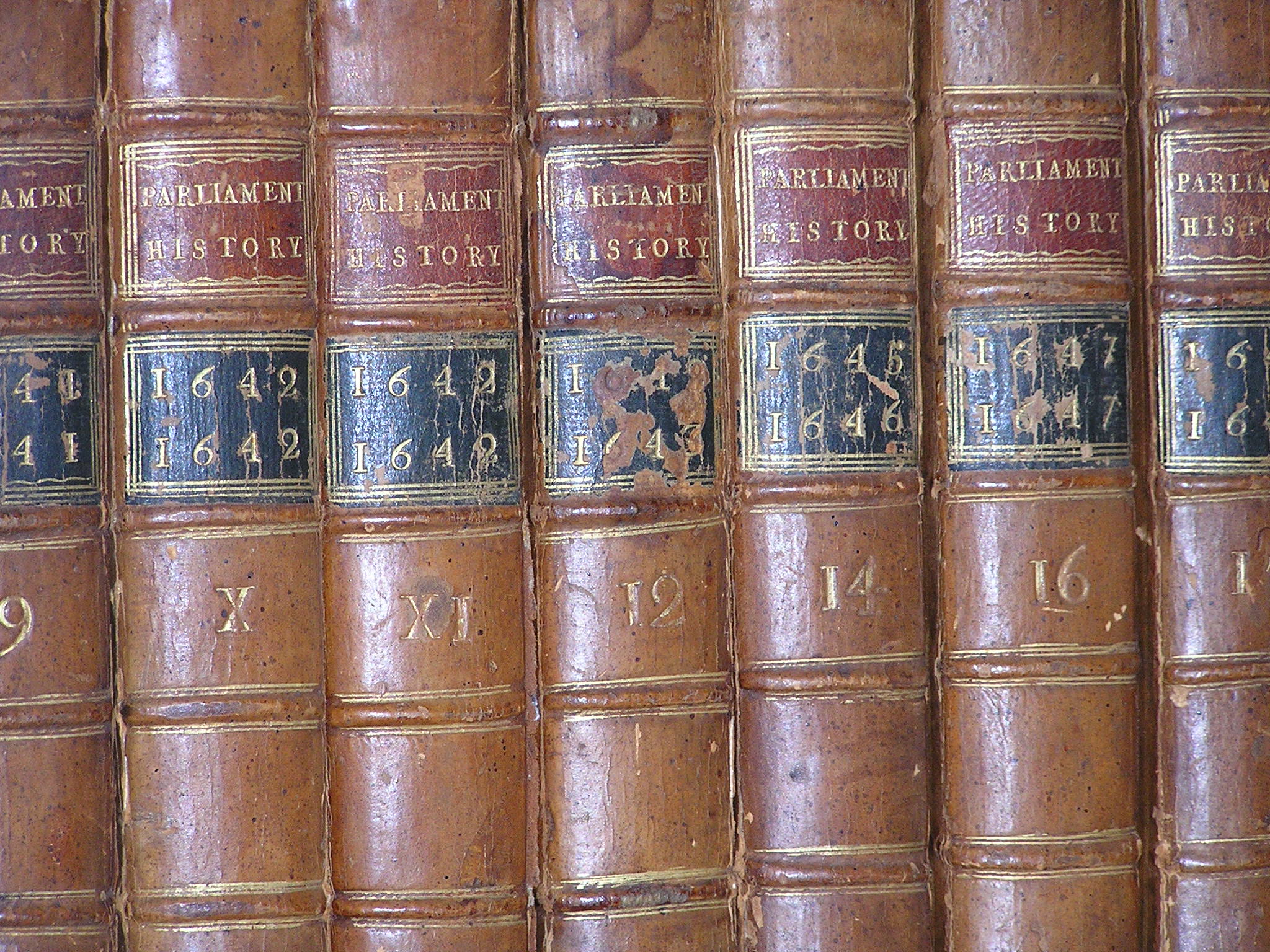
Volumes in the Schuyler House, Albany, NY. September 2004.
I’ve just been perusing my library. (I curate it through LibraryThing, not GoodReads or the like. It’s an obsessive need to categorize every ‘thing’. I have mentioned this before. ) I’ve periodically jettisoned books which I presume I will no longer want, yet approximately 1500 books remain. Of these, 422 are unread. Another couple dozen are in various stages of being read: books I put down but mean to pick up again; books which are anthologies of marginal interest; but mostly books which are collections of works by favorite authors of which I have read but one of the works.
More importantly, of those 422 books, I have tagged 72 of them as “to read ASAP”. So, one in six. I do not read quickly. I subvocalize which slows down the reading pace but makes it more enjoyable for me. I don’t subvocalize when studying because I get bored with required texts no matter how interesting. It’s amazing how quickly you can work through a nonfiction text when you are just trying to get the gist out of it. This actually is the reason I rarely read works about sociopolitical topics. They state their case in the first few pages and one can just scan the rest of the work to see the supporting arguments–it only takes 15-30 minutes. But back to the library, and my point…
Due to this subvocalizing habit, I (sadly) read only 12-20 books each year. Books which are “good for me” but not written well take longer because late in the evening when I am most likely to read, they fail to capture my interest. Then too, my devotion to computers and smartphones has rewired my brain such that I expect instant gratification from a book. I generally have a rule to read at least 50 pages of a book before bailing on it. With Umberto Eco’s Foucault’s Pendulum I gave it 100 pages since it was so incredibly long. (And I’m glad I did.) Lately I’ve had to increase all books to 100 pages because I lack the focus I once had. Right now I’m reading The Cold Millions by Jess Walter. I was ready to bail after 50 pages, but now I’m into it and will finish. But so what? There are those 422 books…
When I peruse the titles of those books, particularly the ASAP list, I want to read them all. NOW! The next book in Donald Harington’s collected works? Absolutely! Lawrence Durrell’s semi-travel-oriented work Prospero’s Cell? I must!“I can’t finish his autobiography without reading what he wrote at that point of his life!” Pat Barker’s Regeneration trilogy? I’ve been waiting years to read that! But what about the nearly one dozen unread books I have by Jim Harrison? Or the half dozen José Saramago books which I haven’t read yet? And how about what is likely the final book of Gabriel Garcia Marquez which I will ever read? What about all those one-offs that sound so good, which friends have recommended, which critics laud, which any literate person would have read by now?
I need that Matrix thing plugged into the back of my head to enjoy them all, NOW, before my literary ambitions explode within me. I need a thousand-track brain. Except…
Just because there are 422 books representing perhaps as many as 35 years’ worth of reading at my tortoise-like reading pace, and just because I have but 20-25 years remaining on this mortal coil, why should I worry about checking all those books off of the list? Isn’t there joy in the anticipation of pleasure? Doesn’t it heighten the overall enjoyment?
Some highly literate person, a writer and reader–I cannot bring his name to mind nor find it in my books–had just moved to a new house in Paris. The move consisted mostly of boxes and boxes of books. One of the movers asked, “My goodness, have you read all of these books?” And his reply was perfect:
“Of course not! That’s why they’re there.”
For us, the literate and always-reading, an optimistic, pleasurable future is measured in the books we’ve yet to read. As with so many things in life, not jumping to a hasty decision to read them as soon as we hear about them has helped us to avoid the casual, gee-I-wish-I-hadn’t-done-that feeling which marks the impetuous commitment romantics make with each new date. The elderly professor who guided my Junior Colloquium gently disabused me of my first choice of study for the colloquium: “Well, Steinbeck is an acceptable choice, but don’t you want to choose an author whose reputation is undisputed at this point?” This was 1982. Steinbeck wrote The Grapes of Wrath in 1939. I was 28 years old, and I didn’t understand that my advisor had actually lived through the events described in Steinbeck’s book. She had been about my age when Steinbeck published it. We settled on Machiavelli’s The Prince and the Discourses. I’ve taken her lesson to heart. Works which speak to generations, which command respect, which make a forceful commentary on human existence need decades to be sorted out.
I could whittle down the list to an acceptable number for the remaining years I have left, leaving a bit of room for books which enter my universe day to day. But I don’t want to “tidy up my affairs” before the end of my life. I want to leave a messy, tangled knot of good intentions and half-finished projects, and that includes my reading list(s). I want on my deathbed to say, “shit, I never got to read…..!” followed by an explosion of titles. I would like the names of these books to be whispered with urgency as I expire. I want to be still in the process of living.




 all the voices in my head