Book review: Watering Words

Watering Words: 52 Short Stories by Bridgette Kay.
Self-published 2025. ISBN: 979-8-218-58862-5

Artists differ from most of the rest of humanity. Artists tap emotions and experiences others prefer to hide or, at best, to reveal carefully to select individuals and audiences. Unlike the careful revelation practiced by most, artists display their work on the public walls like graffiti in subways. Wedged between “For a good time, call ###” and obscenities, the artist inserts a portrait, often rooted in pain or struggle and rendered in words, brushstrokes, sculpted metal, or other media. Where most humans rush to clothe their naked feelings, the artist drops such obscurations to the ground and invites the errant passerby to look, but more than that, to judge. This is how they differ: they invite comment upon creations rooted in their own psyches, their own souls.

Humans hurt. We all hurt. We bear our wounds heroically, badly, simperingly, stoically, resentfully, and sometimes all of these and more depending on the time of day. Authors live with the uncomfortable knowledge that their wounds, their innermost thoughts, beliefs, prejudices, emotions, and most of all, memories, will bleed out—must bleed out—onto the pages they write, an emotional, psychic wound which perversely will not staunch without being exposed. It’s analogous to being handed a bite bar and hearing, “this is gonna hurt but you’ll thank me later.” Authors bleed out into their words and wait for the comments, but in truth, their healing began when the words gelled, the pages were printed, and the books displayed.

Commenting in any manner on such courageous behavior feels wrong. There cannot be a wrong way “to art.” As a teacher of English, though, I learned there exist many wrong ways to connect with an audience. And ultimately, anyone who publishes a book expects an audience to react to it. I’ve followed Kay’s blog Bridgette Tales for several years. Her personal revelations in that space represent why blogs need to be written. Done honestly and well, a blog sends joy and pain and struggle and hope out to the world, asking only to be heard. In the process, blogs show others, “Look! I hurt like you, love sunsets like you, see little clumps of moss like you, and I revel in it, even the painful stuff.” They build the global community. It came as a relief, then, when I discovered the stories were actually good. I’ve seen many a near-breathless author hand me something with excitement in their eyes and words, only to find upon reading it that the author hadn’t a clue either about constructing a story or writing one.

Don’t read Watering Words expecting John Cheever. These stories are not “high literature”—they instead represent what most readers look for: engaging stories with whimsy, a little magic, humor, and told with style. These stories speak less to the human condition than to one human’s condition. As one who has followed her blog, I see the pain, longing, fears, insecurities, joy, laughter, righteousness, sadness, glee, and maturity I’ve sensed in her near-daily posts. Two of the early stories stand out.

In the first story, “Waiting For The Bus”, every author will resonate with Kay’s personification of all those fears and excuses with which we keep ourselves from writing. The narrator’s ultimate triumph echoes Kay’s, I’m sure. And in “Final Goodbye” I invest my supposition that Kay writes of a home in her past (at least symbolically). I detect references to tragedies mentioned on her blog, but leave them for others to discover.

Read this book. Read it not for “high” literature but for “hi” literature: an author reaching out and saying, “Here I am. I’m saying it as best, as entertainingly as I can. Do you see me? Do you feel the same?

“Do your wounds match mine?”

Bibliophilia: the vagaries and joy of English

If my self-defined word bibliophilia means both a love of books and a certain madness about them, what then describes a certain madness about books written by others about that very madness? A madness for madness? Is that a thing? Where and when does it stop? Ever? (Death would be a safe bet.) Of those who love to read, there exists a subset who thrill, not to be reading, but in anticipation of reading. Cue Carly Simon. People in this subset feel a fevered, shaking promise when entering a funky bookstore in the middle of nowhere and the first ten titles they see scream “READ ME! NOW!!” And yet…

Within this subset of bibliphiliacs, a smaller, more exclusive sub-subset exists. These distinct suffers of bibliophilia feel an intimate rush when they espy that one volume probing directly into their literary, book-loving soul, purporting to deliver not just a few hundred finely written pages but promising those pages will satisfy not just their book-lusting souls but will simultaneously glorify the very building blocks which construct the objects of their obsessions. It’s a feedback loop not unlike the pleasure paddles given to rats which OD’ed on opiates. It’s as if one of their objects of desire shed all the clothing of characterization and plot or rhetorical structure and laid themselves bare for the reader’s ultimate satisfaction. No wonder we tingle all over and feel a slight loss of rationale thought when we see these titles.

My, my. Did it suddenly get warm in here? Let’s cover up and move on…

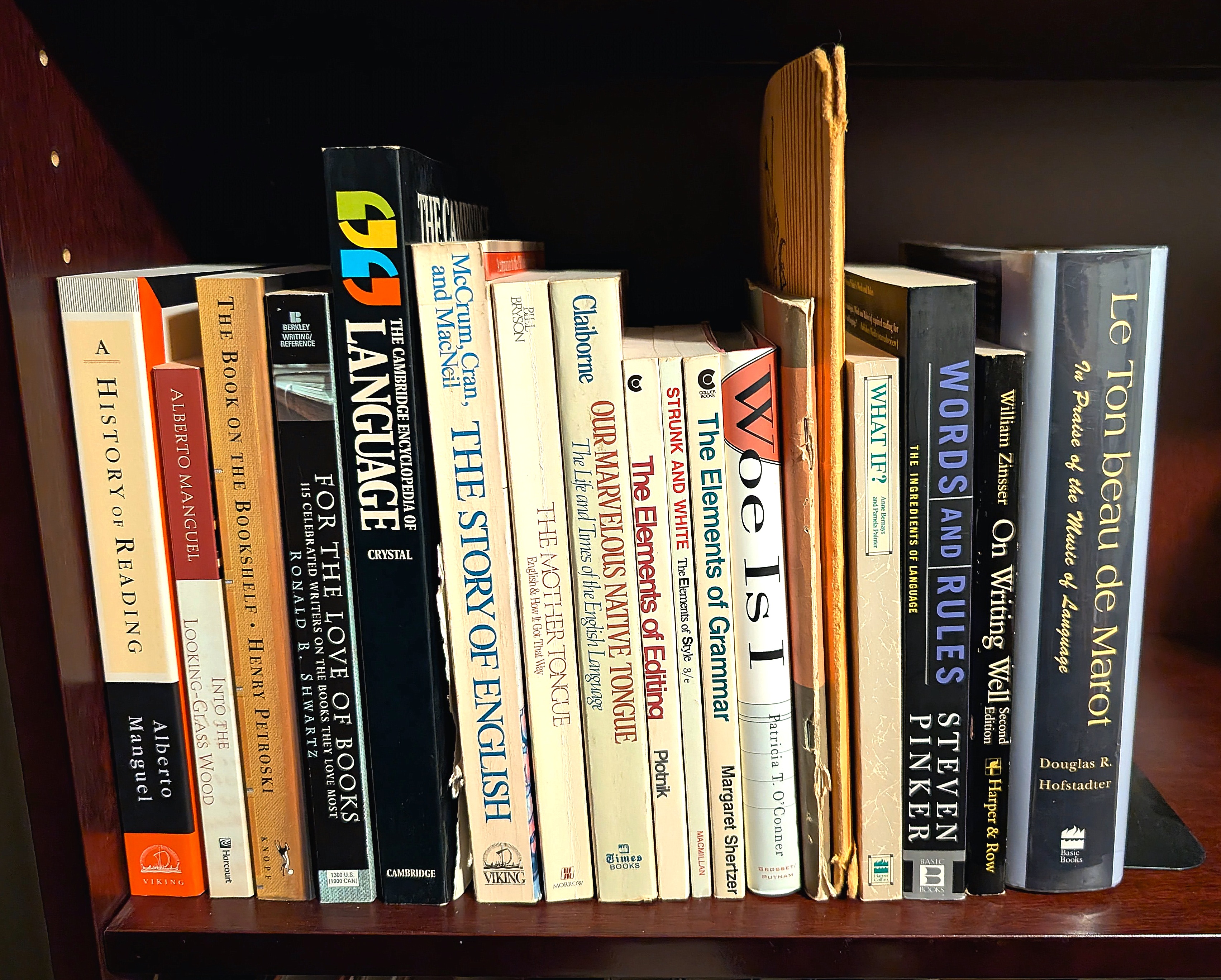
Language books that stood the tests of time and usefulness. July 2025.

Despite having degrees in both Communications and English, I possess a scant half-shelf of books about the language I use. Perhaps this relates to the Communications degree carrying a focus of journalism and the latter one a focus on literature. The English degree also had a few courses pared from it because of the additional classes I had to take to get the “.Ed” added to the end of it. Linguistics interested me until I encountered the arguments for Noam Chomsky’s innate grammar versus the classic thought that grammar remains culturally induced. I suppose this means something important to someone, but who really cares right now? All books I bought for linguistics possessed such rarified, dry prose to make them insufferable the moment I finished the class which required their purchase.

Other books departed for different reasons. Those which all claimed to be about “being a writer” fell victim to The Purge of 2020 when I removed about a third of the library to live in boxes designated for assignment to others…or to the trash. I determined at that time I will never be A Writer although I will write. A freeing decision. Joining those were books which celebrate the language of English and which I found only mildly amusing: volumes by William Safire, Willard Espy, and Richard Lederer all sit waiting to grace someone else’s shelves.

Nine “keepers” don’t appear on the shelf at all because they are points of data in Kindle form. Several lovely books appear in this group: Ella Minnow Pea: A Novel in L:etter [sic] by Mark Dunn, sadly prescient for our time, where a Council decrees the removal of letters one by one from all written and spoken communication; Alex & Me: How a Scientist and a Parrot Discovered a Hidden World of Animal Intelligence—and Formed a Deep Bond in the Process by Irene Pepperberg which I haven’t read yet but which looks great; Our Magnificent Bastard Tongue: The Untold History of English by John McWhorter, a slightly controversial book dealing with how certain aspects of English came into being; and The Professor and the Madman: A Tale of Murder, Insanity, and the Making of the Oxford English Dictionary by Simon Winchester, a true story about a murderer incarcerated due to insanity who nevertheless overwhelms the compilers of the OED with 10,000 entries. I’m looking forward to two more: Empires of the Word: A Language History of the World by Nicholas Ostler; and Kant and the Platypus: Essays on Language and Cognition by Umberto Eco.

Missing from the shelf because I loaned it ten years ago to a friend who I believe is “still getting around to it”: Don’t Sleep, There Are Snakes: Life and Language in the Amazonian Jungle by Daniel Everett. Though some revile him, the book fascinated me. Everett traveled to the Amazonian jungle to proselytize Christianity to the Pirahã mostly by learning their language and then translating the Bible into it. A trained linguist, he discovered the Pirahã have no counting system, no fixed words for color, no concept of war, and no personal property. I seem to recall they didn’t have all the temporal aspects of language (past, present, future and the permutations thereof). The title comes from their belief that evil spirits (and snakes) can only get you when you fall asleep, therefore they attempt to sleep as little as possible. They sleep communally and at all times several will be awake talking to each other.

I decided to take pity on you. Rather than a lengthy bibliologue through the shelf, left to right (because that’s how these things are done), I’m breaking things out for individual treatment. In my subjective view of the shelf, L to R, it breaks into books about books and reading them; books about English, including how to physically present it on the page; a few books I’ve retained which promise advice on writing; and one lovely volume which defies categorization but touches on the meaning of words, poetry, and translation, all while tackling the relationship of cognition to language and adding in the personal pain of losing a spouse to a killer disease.

Or am I delaying and stringing out this series to heighten my pleasure? (It’s getting warm again…)

Bibliophilia: literature anthologies

OR, “I’M STILL WORKING ON MY COLLEGE READING ASSIGNMENTS!”

Literature anthology texts, college and otherwise. July 2025.

College literature texts resemble the reading equivalent of eating at an upscale buffet restaurant. You know the food will possess decent quality, but you don’t expect one of those “oh, wow, go get the chef!” moments. On the other hand, you know it isn’t Golden Corral, there won’t be questionable entrees and a lack of things which resemble lovingly prepared food. It’s therefore a safe, pleasurable experience you look forward to, but not too much. So too the literature anthology, usually targeted to college freshman and sophomores, aims higher than 50 Romance Stories For The Modern Lover but the reader doesn’t usually expect anything challenging or inclusive. There can be exceptions which prove pleasant. Sometimes, particularly in those early college years, one experiences surprises less pleasant: “But I thought that was a great story, professor!” ran through my mind a few times when my instructor somewhat condescendingly told us a piece we’d just read “was at best, B literature…good, but not great.” No matter. Turn the page. There’s something potentially better at the next station of this literary buffet.

As I’ve ditched books along the way, including texts which seemed useless for the future me, I’ve clung to nearly every anthology I’ve come across. In fact, as a teacher of English for 8th graders from 1983-1992, I accompanied my then-wife to garage sales specifically buying the college texts of other people to flesh out a reference library. In the days before e-books and a true Internet, I either had to seek these texts out from various bookstores and mail order outlets (at full price) or pounce on jewels sitting in the dross of some middle-ager who realized, “why am I carting this book around anymore?” I’m not sure, but I think I’ve only cut the ties with one, The Sagas of Icelanders, and technically it’s still in my house so have I really let it go? It’s categorically called “Purged” and fair game for donating/selling.

Let’s discuss what’s on the shelf above:

  • Quality Paperback Book Club rescued me when I found myself in Colville, WA, in 1983, a city of 10,000 souls 75 miles from any true city of note, and yet the largest city to the east or west for hundreds of miles. One of the final books I purchased from them before bowing to the Power of the Internet was the QPB Book of Irish Literature (copyright 1999). Beginning with Edmund Spenser and Jonathan Swift, it runs through “The Sheridans,” “The Wildes” (yes, including Oscar), and “The O’Faolains” while picking up George Bernard Shaw, W. B. Yeats, and James Joyce along the way. The latter is represented by the full inclusion of “A Portrait of the Artist as a Young Man.” Samuel Beckett has three entries including a slice of the play Waiting for Godot. A nice touch for a modern anthology was the inclusion of Nobel Prize-winning poet Seamus Heaney. I’ve selectively read throughout the 900+ pages.
  • The Norton Anthology of English Literature remains one of the classics for this genre, and I had to have it when I found it. My college text is two books more to the right, The Norton Anthology of American Literature. The condescension of a country with about 2000 years of literary achievement can be seen here: I have only Volume 2 of the English literature, but the shorter work, American Literature, represents all of what the Norton editors consider representative and worthy.
  • Between the two Norton collections lies a silly conceit, fifty great short stories, a humble paperback which I’ve never read. So sue me.
  • Another book I’ve never read, but have consulted, is Adventures in American Literature which appears to be volume 2.
  • A Handbook to Literature caught my eye because it isn’t an anthology, but an alphabetical listing of literary criticism terms and themes, genres, theaters, and poetry scansion terms. Unfortunately for this book, I now realize it’s as useful as Benet’s Readers Guide which is “not at all” in this day of AI and the Internet. This book will not be rejoining the shelf. Sad.
  • The observant person in looking at the above photo will have noticed there are two books with the same title and author: Literature: Structure, Sound, And Sense by Laurence Perrine and in the case of one, Thomas R. Arp. The white-spined edition, the third, guided me through more than one course at Eastern Washington University which seemed to have taken pity on the budgets of its students and used it for both prose and poetry courses…or maybe my memory is faulty. I find it difficult to believe I’ve lost track of the text we used for the poetry class. The wine-colored is Perrine’s 6th edition, this time in collaboration with Arp. Not only does it have a significant number of different selections, but the best part for me? It was bound upside down! One looks with a slight smile at the cover, proud to have purchased one of the first texts ever in what will, of course, be a glorious college career, and then opens the book. Okay, we knew we purchased a used book, so Marc’s name inside the cover is okay. Wait, what’s this? The final page of the index? Upside down? Oh yeah, I would’ve bought the book even if I had no other interest in it.
  • The two black-colored spines toward the right end of this display belong to The Oxford Anthology of English Literature. In my world, both then and now, if it says “Oxford” it’s an immediate buy. Ironically, I’ve read not a word of either. I took a course in Medieval English literature at the University of Washington which had us buy individual copies of those significant works; reading the Oxford would be redundant. Plus, I’ve recently purchased J. R. R. Tolkien’s translation of Beowulf (and other works) which will take precedence in my hierarchy of reading. Perhaps I will one day compare the works in The Restoration and the Eighteenth Century to The Norton Anthology of English Literature to see what differs. Or not. There are hundreds of books to read, after all.
  • Which brings us to our final volume, The Treasure of American Short Stories. I’ve read selectively from this book, but it’s mostly redundant to the Norton one on American literature.

Part of our satisfaction for holding onto these types of books—and I know some of you didn’t even question that statement—lies in the combined meaning of memory and potential. We look at these books and they evoke our time so long ago when we sat in uncomfortable chair-desks, taking notes (or not), and experiencing aspects of literature for the first time. Decades later, discarding those memory-tokens seems almost sacrilegious. We turn then to the argument of potential: “I think I might still want to read some of these.” Hence their place still on my shelves, 40-50 years after I purchased them.

HBP: math and patterns

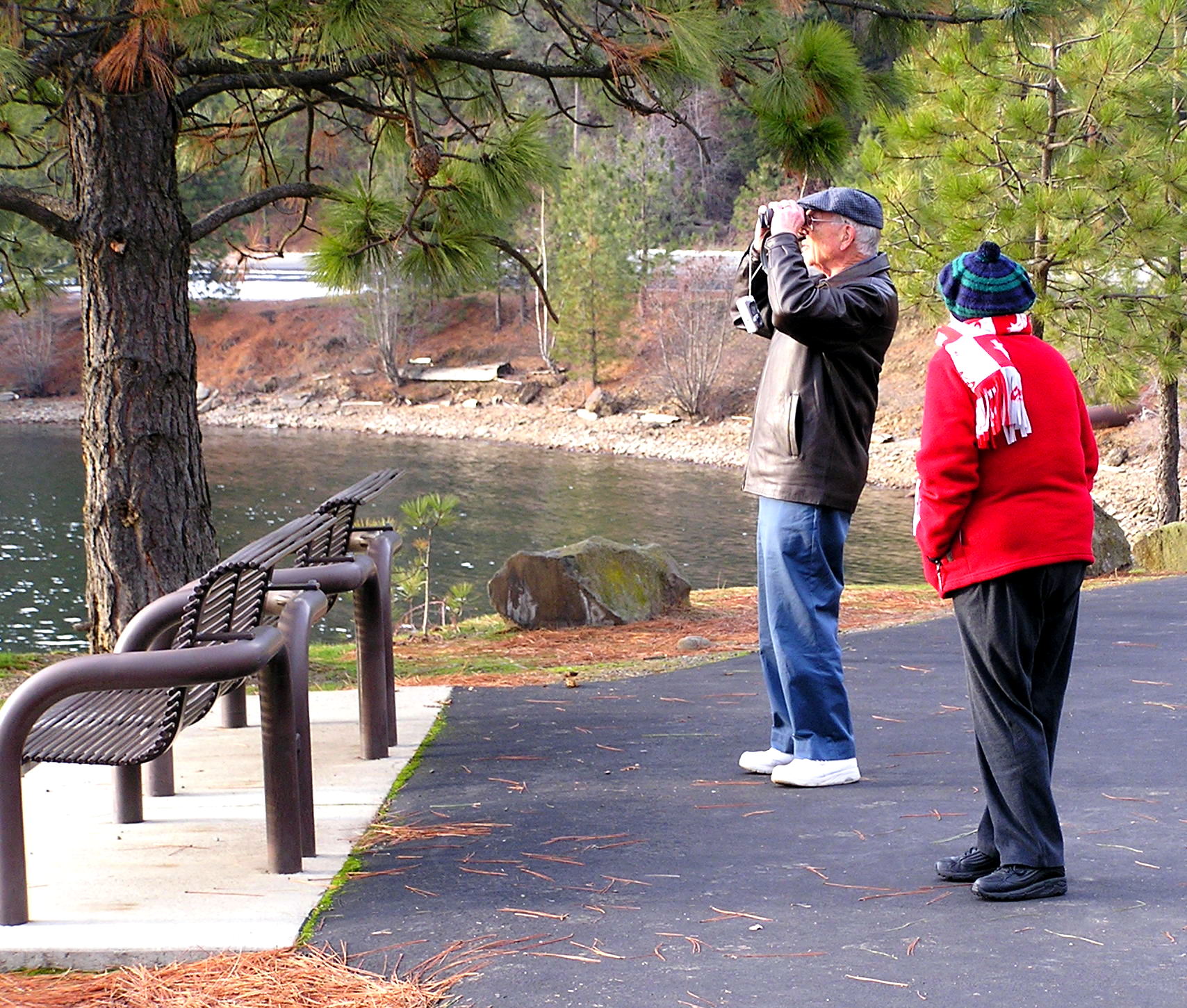
In this photo from the end of 2006, my father attempts to count all the eagles we’re seeing at Lake Coeur d’Alene, ID, while my mother wonders what the heck he’s doing. December 2006.

Our parents shape our lives. Even those who abandon us leave indelible marks on our psyches. Wonderful, painful, soothing, agitating, perplexing, satisfying, loving, and even the hatred—all of our reactions to them mold us. By the time we realize this fully, chances are they’ve departed our physical lives, living only in our memories and those of others. When I reflect on my father, I’ve come to realize he formed me more than any other person. One aspect of that recurs multiple times in a day when my mind ‘blinks’ and spits out an arithmetic calculation or it juggles a jumble of letters seemingly without conscious thought and spits out a perfectly spelled word. Patterns and numbers, numbers and patterns, all a gift, a curse from my father.

My father, Howard Bliss Pilcher, loved numbers. More than that he loved doing things with them, and he did them quickly. He inherited this from his mother, and he bequeathed it me for which I’ve (mostly) been grateful all my life. This pattern-recognition talent allowed me to move from career to career doing things I had no training to do. Yet there I was. My father never fully realized that aspect of it though I think he could have. I brought dreams and abstraction to his gift, seeing patterns in just about everything. His fixation with patterns and numbers remained in the concrete, the defined, the specific.

Numbers make patterns as do letters and words. Again, my father dwelt on how the letters made words yet never scaled the heights (plumbed the depths?) of how words make sentences and sentences make Writing. Not that he couldn’t write well, but his writing never would have challenged anyone in a writing club. It’s as if playing with the nuts and bolts was so much fun, why become a mechanic? He would delight in words with odd combinations of letters or how words tripped off of the tongue. He adored knowing arcane and niche words such as triskaidekaphobia (fear of the number 13). He once stumped us all (Mom, my brother, and me) at the game Probe by playing the word eleemosynary. This word describes things related to charity including being dependent on it. In Probe, played a bit like the paper game Hangman, contestants choose words by putting letters face down on a tray with 12 spaces. If the word is smaller than 12 letters, one fills the extra spaces with blank cards. Each player takes a turn guessing specific letters of their opponents. In that way it also resembles Wheel of Fortune. My brother and I were about nine and eleven, respectively. We expected and understood that our parents would use words with which we would be familiar. We had very good vocabularies due to hanging around them and from our incessant reading. As you might surmise, however, we were unfamiliar with eleemosynary. Heck, my mother didn’t know it! When all players of Probe have had their words revealed except for one, the remaining players each have two turns to guess the word. We never came closer than thinking it was elephant. I remember nearly sixty years later being so upset as to be near tears that he would think we’d know this word! He apologized, grinning awkwardly, sputtered something about charity—but he kept the points.

But doesn’t everybody?

Around this time we learned from our Uncle Gordy, my father’s brother, that he (and maybe their parents) had teased my father for his repeated incredulity that someone didn’t know something or do something that he did. “But doesn’t everybody…” became a way to slightly dig at his recurring belief that everyone could do what he did. This caused him to try to teach me to do long division in my head when I was 8, and before it had been taught in school using paper and pencil. On top of it all, we were weeding the garden at the time. That episode ended with me crying. Some other cases in point:

Every year in the arid West the pine trees drop needles and cones. Thankfully these events do not occur simultaneously to the best of my memory. Spokane might be the capital of the Lawn Nazis, those people who will semi-innocently ask you if you need help with lawn “because I noticed it’s getting a little long” or “I see you’ve had a bit of difficulty getting to your needles.” One did not leave needles and cones lying around on the lawn! I hated raking needles which my father always seemed to pawn off on his boys. Picking up cones, however, somewhat delighted him because as he picked them up, he would count them. “We got 103 cones this year from the front yard. That’s a new record I think!” and off he’d go to check. Yes, he kept track. When we were long gone, I could tell he still did this because the new neighbor across the street knew exactly what we were talking about decades later.

Our family vacations every summer involved driving for up to two weeks to visit scenic wonders and relatives. By the time I entered high school I had visited most of the national parks in the West, though getting further south than the Grand Canyon remained for my adulthood. On these vacations my mother rarely drove (and when she did it was with white knuckles—hers, not ours). My father kept car records on a 5.5 inch by 8.5 inch piece of stock on which he manually drew lines and columns. Each gas fill-up required the date, an odometer reading, the number of gallons purchased, and then while the attendant filled up the car’s tank (ah, those were the days) he would calculate the car’s gas mileage since the previous gas stop.

On any drive, vacation or not, we would at intervals be treated to his light double-tap of the horn and announcing to the car’s passengers, “that’s fifty thousand miles!” or “look! All fives!” Yes, he celebrated when the odometer read 55,555.5 miles. Or when he got 12345.6 miles. There were many possibilities. (Unfortunately this rubbed off on me a little bit. I routinely wake during the night and say to myself, “Oh, it’s one-two-three-four” when the clock reads 12:34 a.m.)

He particularly fixated on license plates. It feels wrong to say he memorized them. My father saw license plate designations as others do names they want to remember. He didn’t know only the plates for our two cars. He knew all of his friends’ plates, too. Though usually no more than a parlor trick—”hey what were you doing downtown last night?” he could say to someone whose car he saw on the way home—once this came in handy. A family friend called one evening: “What’s the license plate on Pete’s car?” A family emergency had occurred while her husband Pete was driving across the state to Seattle. She needed to tell the state patrol his car’s license plate number so they could find him and tell him to turn around. My father dutifully answered her, and Pete returned home as quickly as possible.

My father easily multiplied two two-digit numbers in his head. I remember an evening when I made him take me to an Amway meeting to see if this would be a way to earn money for college. We both realized quickly this definitely wasn’t for me, but we were too polite to get up and leave because we had sat in the front row. At a certain point the speaker began to illustrate how much money a person could make, citing X number of units on which a person would earn Y amount of profit. Before the speaker could punch all the numbers into his calculator my father piped up with the answer. After a few such examples, the speaker quit trying to use the calculator and just turned to my father for the answer.

Typos and misspelled words irritated him. He couldn’t fathom how a person possibly would fail to see the incorrect pattern. One of his favored word games was printed in the newspaper, buried in the classified ads. (If you’re younger than 40, classifieds were really small type printed at the back of the newspaper and somewhat like Craigslist.) The game was called Jumble and ran for decades; I remember seeing it in the past 20 years. Five (four?) words were jumbled up. Playing the game required one to unjumble the words, then take certain letters indicated by circles and use those to form an answer to a tongue-in-cheek question. “Why the sculptor disappeared”; “He was BUSTED” My father didn’t do these frequently because he instantly saw the words, working more or less like a lexicological hot knife through butter.

He counted everything, knew the patterns and sequences of most common things. If he bought a rack of Presto-logs (his preferred way to burn a fire in the fireplace), he knew soon how many stood in the rack. He knew what day of the week a certain date fell on…27 years ago. He knew how many lightbulbs were on the strands of his Christmas decorative lights, how much he weighed every day, where his stock prices ended yesterday, the number of feet from here to there, and the number of miles he had driven if you asked him point blank in the middle of sun-blasted Nevada. Once we were digging around in his dresser—certainly we weren’t supposed to?—and found a slim memo book small enough to fit in a shirt pocket. It dated from his fraternity days at Washington State College. In it, he had recorded the scores of every single ping pong game he had played against his frat brothers. More interestingly, there were three pages at the end with only the first names of women and a number after them! Since we cannot fathom my father being that much of a ladies man—there had to be three or four dozen names!—we’ve been baffled what the numbers meant. Kisses? Number of dates? Both strain credulity. A rating system? Even more unlikely. He certainly got embarrassed, though, when we made a big deal about it. Maybe…maybe… He never revealed what the numbers meant, but we noted he never threw the notebook away either.

When my family celebrated the gift-giving which happens at birthdays and Christmas, we always laid gifts out on the hearth of the fireplace. When my mother turned 64, her grinning husband led her to the hearth where she found a cubical box wrapped in plain paper. It measured nearly two feet on each dimension. Every face of it had a large numeral “4” drawn on it. Baffled, she looked at him quizzically. My father said, “Well, you’re sixty-four today!” She just scrunched her brows a little bit more. “You know,” he explained, “you’re sixty-four. That’s four cubed!” His grin must have been nearly ear to ear. My mother didn’t share his enthusiasm.

Sadly, I found after his death that his obsession with patterns did not extend to how he kept track of his financial information. Files were in disarray, his migration to using spreadsheets had been less than successful, numerous lists of critical information existed but they contradicted each other, and the trivial received thorough documentation but the important didn’t always. As an example, without understanding what his accounts were and where, I didn’t know for sure how much money my parents had in their investments. Seven years after he died, and one year after my mother had joined him, my brother and I found a certificate of deposit in their safe deposit box. Nothing indicated whether it had been received into their normal cash flow when it matured, or if it might be sitting somewhere waiting to be collected. We never could track down the company which sold it to them, and decided it must have been collected—but 25 years after maturity, the CD paperwork sat in the safety deposit vaults.

When I partially wake at night to stumble toward the bathroom, I idly look at the clock. Instantly, and whether I want to or not, my mind cranks out the amount of time since I turned out the light. I remember all the times I wake to do that or to feed cats, then regurgitate them to my wife in the morning. “Well, I was up at 4:37 feeding the boys.” My father lives in me at those moments. He whispers like a schizoid voice and makes me count the cars I see on a lonely stretch of highway. He makes me frown disapprovingly when I read yet another grammatical error in what passes for our newswriting these days. He laments that I don’t figure my car’s gas mileage, stares in disbelief when I search my brain for my own car’s license plate number, and smiles when I record the amount of rainfall for yesterday. I don’t tell him it’s only because I need to know when to water the yard. And I hope he’s proud of me for all the new ways I’ve used his gift to see the numbers and patterns in quality systems and manufacturing results. He never really said one way or another while he lived.

Bibliophilia: Whole Earth Catalog

Take a Sears-Roebuck catalog, cross it with the hippie ethos, and add a large dose of product recommendations. WEC blazed a new trail. Photo, July 2025. Catalogs, Summer 1972 and sometime in 1994.

When I headed off to college in 1972 my curiosity led me to enroll in an experimental education program funded by the Ford Foundation. I hope to write of that someday, but today we consider two peculiar residents of my library: two editions of The Whole Earth Catalog. Being 18 in 1972, I didn’t exactly participate in “The Sixties” which meant I hadn’t heard of The Whole Earth Catalog until it appeared on the textbook list for that experimental program I’d enrolled in. What is it and why am I making a big deal about it? Is this just some oldster nostalgia trip? Maybe, but I think it’s much more than that.

The WEC basically laid the groundwork for what today is Wirecutter and everything like it, except…what if Wirecutter had a hefty dose of social awareness ethos baked in? And what if there were no suspicions that Wirecutter and websites like it make decisions partially based on monetary reward? Before The WEC, I’m unaware how one could have gone to a single source for information, evaluations, and recommendations on a number of topics. Everything one needed know about consuming involved a physical trip to interface with salespeople. In certain cases one could consult a dedicated publication for audio equipment, say, or fashion, but sooner or later one needed to go to a store to buy something. If I wanted information about high quality stereo equipment, I went to Huppin’s Hi-Fi downtown where all the audiophiles (a.k.a., stereo gearheads) gathered and had all the information. When one wanted furniture, one headed to a furniture store or several and bought the best of whatever you saw. The same with clothes, garden tools, hardware, books, cars, pretty much anything. Who knew if it was good? Who knew if the price here was as good as there? If you ordered something, like a car with all the options in your favorite color, you started at a dealership. Everything filtered through the salespeople.

But the WEC gathered its recommendations for just about everything which interested the Peace Generation (or whatever you want to call us), told you why it represented the best you could buy, and gave information about how to get it. Or as the Function statement on the very first page of The Last WEC said , “The WHOLE EARTH CATALOG functions as an evaluation and access device. With it, the user should know better what is worth getting and where and how to do the getting.” This “last” edition didn’t have a table of contents. After page two told you how to get the stuff, and other tips, the third page launched right into “Whole Systems” and starting with the subsection Buckminster Fuller (anything dealing with Buckminster Fuller, a near-god of social planning). Other sections dealt with land use, industry, craft, community, nomadics, communication, and learning. These were loosely defined: subsections in Learning include “Thinking,” “Serendipity,” “Psychology,” and “Free Schools”. Additionally, the lower right corner of all right-hand pages from Page 9 onward contained the story “Divine Right’s Trip” where the main character, Divine Right, experiences many adventures of the time until he lands on the Whole Earth Catalog at the very end, a sort of gold-at-the-end-of-the-rainbow thing.

I could write pages and pages about the WEC to little effect on anyone who hasn’t seen it. In its way it picked up the tradition of the old Sears-Roebuck catalogs which allowed people living in the backwaters of America to buy through the mail most of the things they could ever want for their farms, their businesses, their personal health, and to clothe their bodies. (“Through the mail” • prep phrase describing movement of written communication and goods prior to delivery services such as UPS and FedEx) The S-R catalog fell onto hard times when everyone started to get electricity and cars made it easier to get to the merchants.

After navigating the remainder of the 1970’s and all of the 1980’s, issuing a few Supplements—the informal publications which came out between editions of The WEC—founder Stewart Brand and crew decided a new edition needed to be published. Those 20 years saw the introduction and rise of the personal computer, for one thing, and the starry-eyed, inchoate idealism of The Sixties had given way to a gritty, in-the-trenches attitude by the early 90’s. Most of the casual members of the Peace Generation had left the ranks, lured by money, security, and mere existence. The title page of The Millennium Whole Earth Catalog quoted Brand from 1969: “We are as gods and might as well get good at it,” before explaining that good things performed by governments and other large bodies were being obscured by “gross defects”; a rising personal power needed a guide to the new tools making this possible.

Two random samples from The WEC shall suffice, one from each.

Opening The Last Whole Earth Catalog to pages 36-37, I find myself in the middle of a five-page description of something called Liferaft Earth. I’ve no personal knowledge of this, and I’m not reading all five pages of very tiny print (looks like 6-8pt type; it varies because consistency was not a strong point for The WEC). It appears to be about making sure everyone on the planet has enough to eat. Here’s a snippet from the top of the second column of page 35…

The following five pages chronicles a week-long event sponsored and organized by the CATALOG in October 1969.

Richard Brautigan saw the end of it. The beginning of it was three days I spent alone on a train with excellent hash and Paul Ehrlich’s Population Bomb. Ehrlich had been a teacher of mine, back in his butterfly and my tarantula days, so I knew to believe him.

—SB

“SB” was Stewart Brand who created and led the WEC publication team. Incidentally, in looking for a formal description of his title/role, I discovered the entire Last WEC was composed using an IBM Selectric typewriter. I didn’t find his role.

I left a bookmark in the Millennium edition long ago. Opening to this page brought me to the Communications section/Writing subsection. An article preceding the tools for and about writing begins, “We are swimming in a great polluted sea of language, and we wonder why we can’t write.” How much more so now! It continues:

We wonder why we don’t want to read. Even worse, we cease to wonder; we just don’t do it. It’s as though it didn’t matter anymore.

As though hammers didn’t matter; as though air didn’t matter; as though horses and balloons had disappeared.

It’s not a hardware problem; it’s not a brain-wire problem. It’s a writing problem. It’s software, it’s soft words, it’s swampish bureaucratic slide-down of mush-mouthed ass-covering prose that promotes long term despair in humans.

—Jon Carroll

This appears on page 242 of 384 pages in a book measuring 11×14.5 inches in fonts rarely bigger than 8pt. You can see how one would get lost in there, and how part of him would never come back out. Which is why more than fifty years later they remain on my bookshelves despite the hundreds (thousands?) which have not withstood the journey.

Bibliophilia: dictionaries

How to look up words before the Internet. July 2025.

Today I needed to move two of my bookcases because I inconveniently parked them underneath the main water shutoff valve to my house. Downstream of that valve is the Pressure Relief Valve (Pressure Regulating Valve?) or PRV which will be replaced tomorrow. Books moved include the latter half of the alphabet for authors of fiction, plus poetry, essays, books about reading and language, literary quarterlies, literature anthologies, drama, and the stuff I call “books too big to fit anywhere else”. Moving these books renewed the love affair I have with them.

I cannot claim to have coined the word bibliophilia but my spell checker doesn’t like it. Obviously a primitive type of AI with all the words at its digital fingertips would sneer at such a word. I maintain it exists, nonetheless, and I further claim it describes a condition similar to addiction in that those afflicted with it do not recognize it as a malady. Rather they proudly lean into it right up to the moment it degrades their lives into sociopathy. I never had a lot going for me in the sociopathy-avoidance spectrum; it therefore has impacted my life little.

Though I read 99% of my books electronically now, I’ve developed no attachment to them the way I have to the physical ones. Perhaps it’s because I don’t have the history with them? No matter. I realized today what a wonderful paradigm for a series of posts! Forthwith:

I’ve carted around the above two dictionaries since 1978. They were ‘useless’ even then. The one on the bottom has a copyright of 1939 on it, with 14 more copyrights stretching back to 1903 on the reverse of the title page. In 1939 my mother was 10. This must have guided her through the end of elementary school and through high school. It undoubtedly felt the fingers of my grandfather paging through it as he sought a word for some of his reports and letters. He would have been in his 40’s at the time.

As with the bottom dictionary, the one on top reminds me of a relative also. When my mother was in her early teens around 1941-1943, her Uncle Dennis came to live with his half-sister (my grandmother) and her small family. He needed to establish residency in Washington State because he planned to attend the University of Washington. I’m not sure if he worked for a year or attended high school. This dictionary is copyrighted 1942, and its title I feel reflects his academic bent. (He went to work in an athletic supply store in Seattle after graduation, eventually bought it with one or two partners, and had a very comfortable life financially. The store was called Athletic Supply.)

All my childhood I stared at these dictionaries and pulled them out again and again, every time we visited my grandparents. I’m pretty sure where my brother and I slept is where my great-uncle lived for that year. Upon graduation I guess he figured he didn’t need the dictionary anymore. My grandfather had finished off the basement in gorgeous tongue-and-groove pine boards, and he built in next to his desk the bookcase which held these two volumes.

As I may have detailed before, I purged about 400 books from our library in 2020, primarily so I could use some of the shelves to display family memorabilia. Books I felt held no special tug on my heart joined those I felt wouldn’t be read again nor would they need to be consulted. It represented a Marie Kondo approach: if the book brought joy, it almost always stayed on the shelf. The rest were boxed up and shoved in a closet. One doesn’t just throw away books unless they’re an ignorant cretin which means they likely don’t own books in the first place. (Although there was that mother/daughter pair I saw once at a giant book sale who were buying a shopping cart full of books based on how they looked! Books as interior design elements! Horrific to think such people exist.) I’ve since found an outlet in a used bookstore/coffee shop/beer & wine cafe which gives me credit for the books I drop off. Imagine that! I drop off a half dozen hardbacks, and I get to buy three pints on half-price Wednesday!

Though 400 went to live in the closet, an even 1100 remain. I can’t believe that when I look at the shelves, but that’s what my library cataloging program says. Today, just pulling down about seven shelves of books inspired such joy and memories. There are the literary quarterlies I got from Eastern Washington University while teaching English. And there are the half dozen volumes of varying size I needed to buy for my Medieval Literature class. Oh look, there’s the best book I ever read on the slipperiness of translations (Le Ton Beau de Marot: In Praise Of The Music Of Language by Douglas R Hofstadter who previously had won the Pulitzer Prize for Gödel, Escher, Bach: An Eternal Golden Braid). Oh, my college literature texts! The glorious translation of Anna Karenina purchased on the first family vacation I organized just a couple years before my father died. And look there, the slim volume of fairy tales my parents and grandparents read to me when I and my brother were quite young.

Some of it is snob appeal. I make no apologies for that. If you can’t be proud of yourself for having read a goodly collection of great literature, if you think it a waste of your time, then I ask, why did you waste it? Didn’t you have something better to do? Like, I don’t know, trade it for a differently colored book which matches your decor better?

In the weeks ahead I’ll focus on particular books which spark that wonderful joy of reading…like the books about reading itself!

A slippery fish

Fish at Maui Aquarium. September 2024.

For several weeks I’ve written, re-written, and re-re-written a difficult piece about my father. Its point still eludes me. I fear several things: I’ve attempted to describe something, but I’m only describing it superficially; I’ve selected an inferior topic to one which begs to be heard; or perhaps what I’m writing about doesn’t rise to worthiness. This has delayed my promise to myself to post one piece of writing about my father every Sunday. It’s been like attempting to grasp a wriggling fish. I shall continue to rant to the air, to myself, to my wife—heck, to the birds on the grass—about this, and hope it gels in my mind and in my words.

Until then I’ll post a few photos, and maybe I’ll write something less weighty, something which elicits a few chuckles or wry reactions. Yes. That would be it.

Howard Bliss Pilcher: an introduction

Howard, 11 weeks; with his mother, Esther Dahl Pilcher. Lansing, MI, August 1925.

Howard Bliss Pilcher entered the world on this date 100 years ago. He died toward the end of 2013. In those 88 years, like most of us, he did nothing to affect the globe or any large portion of it. His impact, again like most us, accrued from those individuals he knew and perhaps from patrons of the two entities which employed him for 39 years. He most affected his wife and sons, Steven (my brother) and Kenneth (me). Seventy years later, to me he remains both enigmatic yet an apparently open book. Whether nature or nurture, his traits run through my being. Whether you knew him matters not. He might have subtly affected you too: every one of us amplifies his presence on humanity simply by interacting with more than one person and making an impression them; it ripples out to touch people we never knew.

Howard Bliss Pilcher—technically a Junior though never named as such—came into the world in Lansing, MI, on June 22, 1925. He moved with his brother and parents from city to city as his father, an American Baptist minister, moved from church to church. The younger HBP served in World War II, completed college, started his career, married, procreated, retired, traveled, and died December 16, 2013. He resembled thousands, millions of other men born around the same time. We each are unique, though, and this unique man fathered and raised me. If we are constituted from our roots, our times, and our experiences, then exploring those roots isn’t so much recounting their life as it is exploring our own. Therefore, we can’t call this biography. I haven’t the time or desire to research the nuances of his history, let alone the history of the times and regions through which he passed. (And thanks for that, too, Dad.) But there will be biographical elements to it, just as there will be aspects of memoir stemming from his inescapable impact on my life, and how the two remain intertwined even after his death. Perhaps reminiscence remains as the most accurate term.

A confession before we start: I’ve procrastinated all my life—a trait which will be explored through the telling of this tale—and this procrastination has left me too little time to complete this piece prior to deadline. My vision for it looms at far too many words to dash off in one or two sessions. Unlike the great gonzo journalist Hunter S. Thompson, I cannot lock myself in a hotel room for a few days, wire myself on pharmaceutical grade crank, and pound out a semblance of the piece this subject deserves. My physique won’t handle it, my psyche won’t handle, my marriage won’t withstand it, and I don’t see why after seven decades I should start caring about deadlines now. Okay. Let us begin. We’ll start with the thumbnail bio:

The senior Howard Bliss Pilcher, my grandfather, the one my grandmother called “Bliss,” came into the world in 1894 in Urbana, Illinois. The Pilchers traditionally lived in north central North Carolina in Yadkin and Surrey counties, up by the Virginia state line, but the “movin’ bug” ran through our branch of the family as far back as the early 1800’s. Bliss’s father, Wiley Pilcher (1861-1935), moved to Illinois where he fathered all three of his children. Wiley later moved to Fargo, ND, and finally to Libby, MT. All of this perhaps explains why, when he heard the call and enrolled in seminary, he became an American Baptist minister. American Baptists were at one time called Northern Baptists and trace church lineage through the Triennial Convention, the first Baptist convention in the United States of America. In 1845 a pro-slavery faction split off from the Triennial Convention to uphold the institution of slavery. It came to be known as the Southern Baptists. Without researching the topic, we may surmise that many Pilchers would not have been happy with my grandfather’s choice, particularly the majority of them still living in North Carolina. The decision to minister in that denomination reflects the equanimity which characterized my father’s upbringing, and which he instilled in me.

One year after my grandfather married Esther Dahl, my father was born. Lansing, the capital of Michigan, had nearly quadrupled in growth from 1900-1920. Not only were these the Roaring Twenties but this sizeable city (about 67,000) boasted all the activity inherent to a state capital. Thus, he started life in the thick of it: the capitol building stood about a half mile from their house. Not that this would have had much of an impact since by age 3 the family moved to Edina, MN, a suburb of Minneapolis. In between was a short stint in Dover, ID, an unfathomably small and remote place for a minister to travel, perhaps explained because Bliss stepped up from being a youth minister in Lansing to having his own church in Dover. The family lived in Edina for ten years more. At the threshold of my father’s entrance to high school in 1938, his father accepted a call to Havre, MT. (I’ve started to wonder if the “calls” were based more on wanting to stay reasonably close to his father, Wiley. Edina lies less than 250 miles east of Fargo; Havre is 350 twisting miles east of Libby.) Four years later my father graduated from high school. He attended the local college, Northern Montana, for at least a semester, but the reality of World War II loomed. The U.S. Army drafted him, placed him in the Quartermaster Corps, and sent him back and forth across the Pacific guarding supplies.

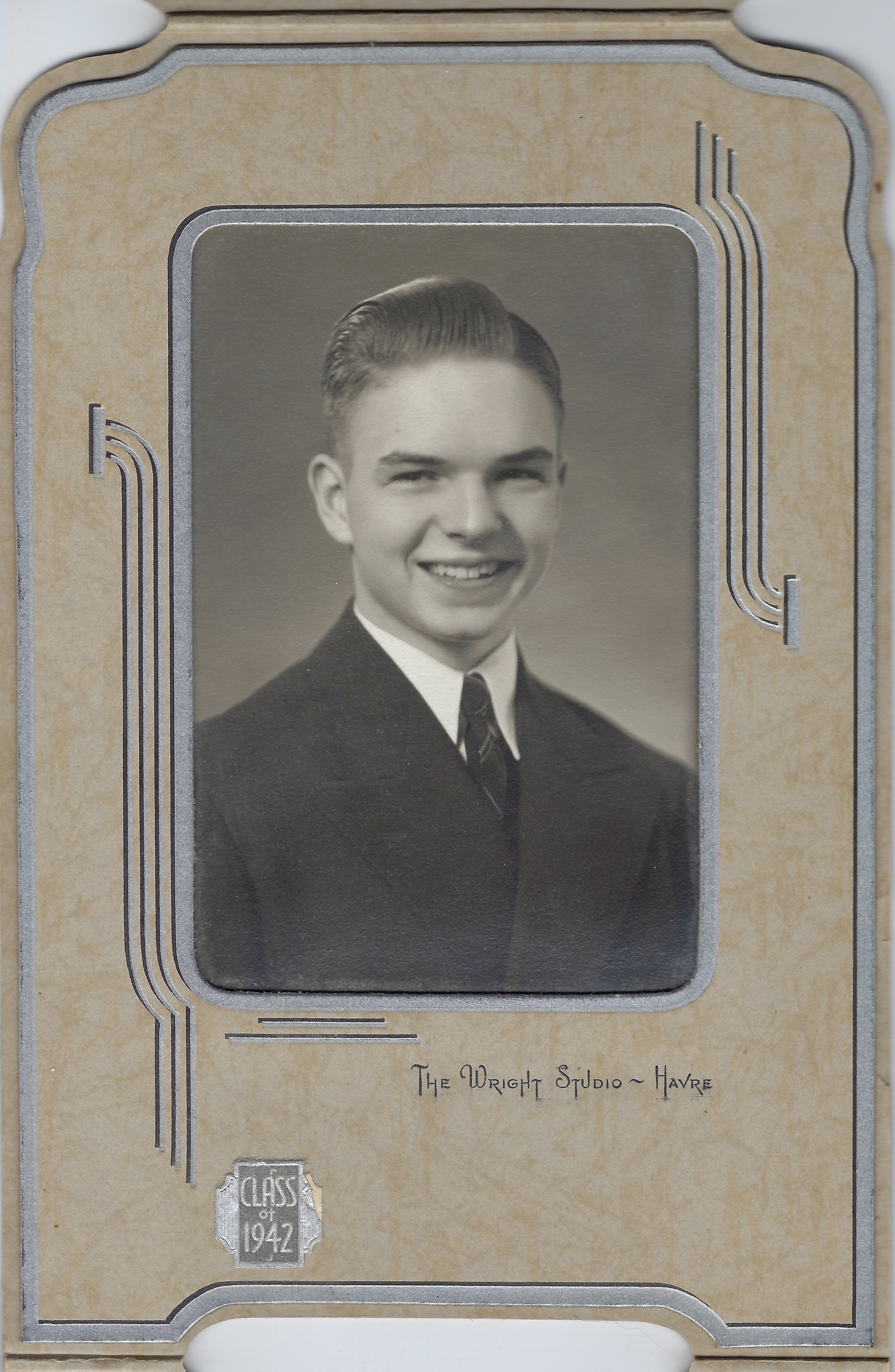
Howard’s senior photo from Havre High School. 1942.

At least, that’s what I surmise. My father didn’t want to talk about his time in the service at all. We did learn he made some grade of sergeant, but I only called him Sarge once. Let’s just say he made it very clear it would be the last time I called him that.

Howard mustered out of the service, enrolled at Washington State College (now WSU), hired on with the Carnation Milk Company in Seattle, married Louise Bach there in 1952, and they had a baby in 1954…me. We moved to Spokane, WA, when the Carnation Company transferred him soon after my first birthday. My brother was born there. My father accepted transfers back to Seattle (fall of 1962) then to Los Angeles (the beginning of 1964) before he made his dislike of Los Angeles and corporate life known. The company allowed him to go back to the same job he had left in Spokane just two years prior. We will revisit that career-killing decision. Four to five years later, as I approached high school age, he went through a personal crisis, quit Carnation, emptied out his profit sharing account, and maintained the family on that while he searched for a new career path. When a close family friend needed to fill a comptroller position at Sacred Heart Medical Center, he thought of my father who then began a very nice career managing financial matters for the hospital. As his mentor ascended the ladder of responsibility, so too did my father, eventually boasting the title Director of Fiscal Services. He retired after about 20 years of service to this medical center founded by the Sisters of Providence, a Catholic order of nuns.

In retirement he tended roses and indulged the Pilcher penchant for wandering by undertaking numerous road trips with our mother. There were a handful of trips by plane, but he fought claustrophobia for much of his adult life and those weren’t comfortable trips for him. Two trips abroad (England and Spain), a cruise package to Alaska, and near-annual trips to Hawai’i for a while rounded out the travel. They celebrated 50 years of marriage in 2002, quietly marked 60 in 2012, and he died after a sudden trip to the hospital in 2013 which saw him enter the hospital on a Tuesday and pass on the following Monday morning.

What did people think of my father? “That weirdo”? A “super nice guy”? “Honest as the day is long”? I know that he was loved. I know he withdrew toward the end of his life, and one by one most of the people he knew and loved died before he did. I know he worshiped my mother yet had a condescending tone toward her (which I adopted to my detriment). I know many, many superficial things. What I don’t know is the man he truly was, and what force ultimately took over the final five years of his life, making him mentally miserable at times. I know, too, it lurks within me and whispers that it just may do the same when my time nears.

This has been but a snippet, a dry telling of mostly factual matters, an introduction as stated in the title. To explore the man through reminiscence requires setting the stage. Much like reading your playbill before the curtain rises, you’ve now gained the background to enjoy the show (hopefully). In subsequent posts we’ll explore in no particular order and perhaps not under these self-same titles:

  • Ebullience, Positive Thought, and the Eleemosynary Ethic
  • Accruing Guilt: Understanding What Your Father Meant
  • On Humility and Perfectionism
  • Math versus Arithmetic, or Why I Skipped the CPA
  • How To Raise Two Merciless, Teasing Sons
  • …and others which do not yet leap to mind…

Fathers Day musings

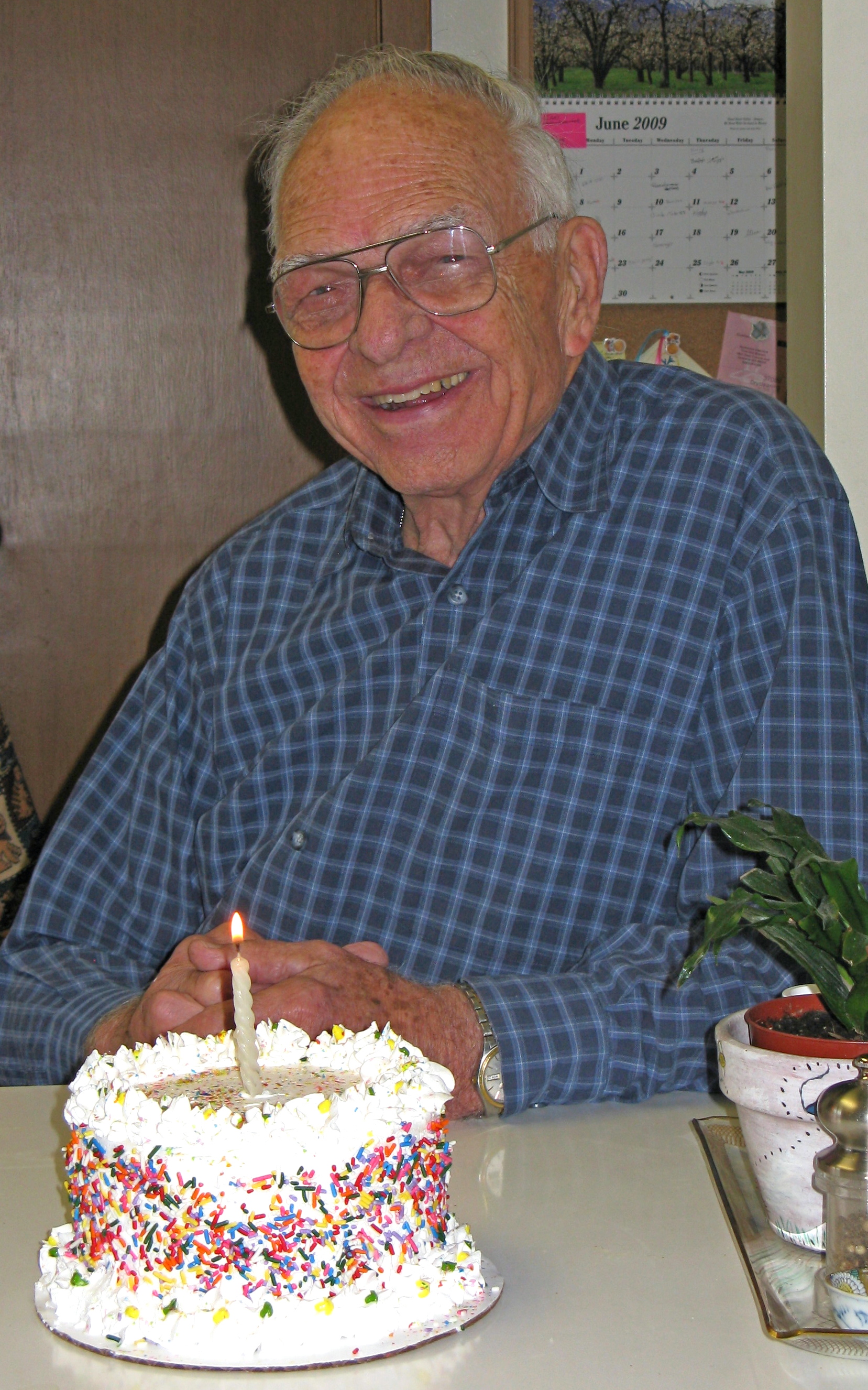
Happy 85th birthday, Dad! Spokane, WA, June 2009.

Father’s Day means less to me than many. My only children have been and are being cats. My relationship to the day runs one direction only, upward, to my progenitor. He left this mortal world more than a decade ago, but the memories remain vivid, accentuated by the passing of my father-in-law ten months ago. Life’s little irony, its bitter dessert: with every one of my years I understand him better; but this understanding always was for the Father in the past never for the Father of the now. Then he’s gone, and only the past exists. Unfairness salts this wound which never heals.

Growing up with this man my feelings differed, of course. How could they not? Once I became self-aware, our similar make-up combined with my contrarianism to make the sparks fly. This isn’t a truism. We argued and disagreed about everything. I remember these actual, real arguments, all of which went on for 20, 30 minutes, perhaps for an hour or more:

  • Does a body get colder or warmer immediately after eating? (I said colder, but neither of us had more than theoretical knowledge, and there was no Internet to solve things back then.)
  • If you learn a job applicant will be the second income for a family, should you favor the person who needs this job as the primary breadwinner? (He said yes, I said no. Back then the secondary income likely would be a woman’s, so the argument carried a deeper discussion about feminism and Women’s Lib.)
  • And one of my favorites: a yard should be allowed to go natural (said I); “you just don’t want to mow the lawn,” he said.

Father’s Day got diluted for him by the fluke of his birth date and the vagaries of politicians: it always occurred within eight days of his birthday. Take a look at that calendar over his shoulder. I used to hate Junes like that one. The third Sunday (and therefore Father’s Day) falls on the 21st. His birthday occurred on the 22nd. Two presents and two consecutive days I had to be nice to him. A year like this one, 2025, provided the maximum eight days of distance.

I used to commiserate with my brother (who took the photo above, I believe) about the monetary hit of birthdays and ‘parental recognition days’ in our family. Starting with his birthday on April 21st we ran through all the birthdays plus Mother’s Day and Father’s Day all by July 10th. In those 11 weeks he and I would buy five presents, an average of a present every other week. He especially hated June when my birthday (the 8th) smacked into Father’s Day (between the 15th and the 21st) and Dad’s birthday on the 22nd. And 18 days later came Mom’s birthday on July 10th. “The parade of presents, the meandering of money, the draining of dollars,…” —you get the idea. We didn’t have a lot of money back then; we bought our own presents, no help from Mom and Dad.

Despite this being my absolute favorite time of year with its leap into summer as the advent of June brings warm weather, the end of school and all the seasonal activities associated with it, and the chance to relax to a degree not permitted September through May, I run into these thoughts a bit more too. So many things become bittersweet with age. This continual discovery of more love for a man who’s gone remains one of the most important.

Where are we going in this handbasket?

The world is going to hell in a handbasket. This attitudinal shift remains a nearly unavoidable aspect of aging. We age and cast off following things for their own sakes. For example, fashion? Oh sure, we keep an eye on it, rotating neckties or jewelry to our favorite “it-will-come-back-into-fashion” location, but we pick and choose. Skinny, tailored suits? On this old beer-bellied bod? I think not. Hip-hugging jeans, says my wife? “I never wore them when they were in fashion decades ago!” And don’t get her started about wearing clothes which look more like lingerie than outer garments.

Everything’s going to hell. For us oldsters, new technologies get picked up as they’re convenient, and when they serve a purpose, not because they’re trendy. Consider: smart phones debuted (debatably) in 2006. I waited six years, until 2012, to get one. Even then I got it mostly because I needed a better communication tool when I started consulting. I might have picked up one eventually. I’m sure I would have been forced/enticed into it sometime before 2020…maybe. After all, I’m a techie; I like all the toys. About forty years ago I could hardly wait to upgrade my first desktop computer or for it to conk out and justify buying a new one. Now? I’m leisurely approaching the time when I’ll dig into my Windows 10 machine and tweak its registry settings to permit upgrading to Windows 11. Another old man thing: texting has proven to be a boon but it doesn’t replace email. And why trade clean, open texting for the closed gardens of WhatsApp, the-app-formerly-known-as-Twitter, or Instagram? I resisted Facebook for years, but joined ten years ago. I grew uneasy with a technology that demands everyone ‘talk’ all the time. Doesn’t someone have to listen? And how can everyone something important to say? The horrible year of 2020 pushed me to delete the account. Who wants to be sanctioned for being reasonable? (I understand getting attacked for being ‘out there’, but for being calm and objective?) My point’s drifting here, old man! It’s this: seven decades in, one learns it isn’t very important to follow every trend…or pretty much any trend.

These thoughts crept into my mind as it wandered from thinking about our church’s chorister program (elementary and junior high students who sing in the cathedral once in a while) to the pre-pubescent boys who sing at New College, Oxford, or in the Vienna Boys choir, until finally it came to rest on my own 5th and 6th grade experience of participating in All-City Chorus in Spokane, WA. This program met once or twice a week after school in the most centrally located public high school, Lewis and Clark. How did I get there? I took the bus. Due to its meandering route the trip lasted about half an hour as it drove the seven miles from my elementary school to LCHS. I can’t remember if I took the bus home, or if my father picked me up, since he worked less than a mile away and would have been leaving work about that time. My brother similarly took private clarinet lessons in an old building downtown. It housed a music store on the street level and housed offices on the second floor, one for his teacher. My brother also took the bus, catching it at the end of the block where we lived, and traveling the same amount of time and distance as I. This wasn’t unusual for 10-year-olds at the time. My mind kept wandering. I wondered how common that is now. I don’t know as a parent if I would rest easy letting my child do the same. I’m certain few if any modern parents would. Kids seem to be scheduled for most of their free time and driven by an adult to these activities. This illustrates my point, the one I wandered to this morning:

Old people experienced a different world. I don’t care which generation you’re considering, it wasn’t necessarily worse in their mind. We–any of us at any point in time–dealt with what we dealt with. Life presented itself, and we were up to date with it. We cling to some of the practices from back then, not because they’re antiquated but because they worked. We cling to the beliefs which those practices engendered. Let me explain, by way of an example, how life occurred and thus, how we think and thought. Consider the situation in which two parents decide to let their boys travel alone on a city bus after school. During the winter we left our respective music activities in the dark—Spokane lies a latitudinal degree further north than Duluth, MN, and almost three degrees further north than Bangor, ME. How could a parent allow this? First, we didn’t have two cars. Though we were comfortably middle class, it wasn’t that unusual for families to have only one car. My parents decided they could share it—Dad took the bus at least two days each week—and the money would be better saved for other things (notably our college education). Dad could have taken the bus on those music days, though, leaving Mom the car to shuttle her children.

But you see, that was just a strange notion back in the 1960’s. Kids gained in freedom when they gained in age and maturity. When we were very young, three to five years old, we were told where our boundaries were in the neighborhood. We respected them (mostly). We got to travel the block and only on our street. I got in severe trouble when I crossed the street at the end of our block and decided with a couple other kids it would be fun to roll rocks down the hillside. (It didn’t occur to me that there were cars on the road a hundred feet below us or what a rock the size of a teapot might do to a car.) When a county sheriff’s deputy delivered us to our parents, we caught a lot of hell. When we were in elementary school we wandered wooded lots, rode bicycles for miles away from our homes, and all we had to do was say, “Mom, I’m headed down to Mitch’s house!” As we neared and then entered junior high it was more like, “so where did you two wind up today?” from my mother. Our parents expected us to entertain ourselves, stay safe, and observe the behavioral rules they laid down. We did pretty good with that first part, fairly good with the second part, and…what they didn’t know didn’t hurt them, right?

Today therefore represents a path to perdition, always, for every old person. I stay optimistic generally (and the further I look into the future), but many things worry me about habits which younger people have acquired. I now can see that 100 years ago cars would worry a 70-year-old born in 1855. “Everybody scootin’ and tootin’ these infernal muh-SHEENS! T’aint nachurl! Next thing ya know, people won’t even live together cuz they can just drive to work!” with the word “drive” carrying all the distaste and disapproval an old man might feel.

Humans measure the world using an internal scale developed through experience. We slow our learning process with each passing year, experience becoming a boon and an obstacle to learning new ways. Fifty years later, we don’t even see the same world as younger people do. This is neither good or bad; it simply explains our attitudinal shift. Maybe you caught a bit of that here, but I fear I’m too caught up in it to accurately relay it to you. Everyone my age is nodding their head while everyone thirty years younger has made some derisive sound en route to dismissing the whole notion out of hand.

So be it. You’ll see.