
I’m having difficulties commenting on any blogs, so I’m checking to see if I can post.
I’m having difficulties commenting on any blogs, so I’m checking to see if I can post.

Warnings & Notes: This post contains a few graphic depictions of death, some examples of socially unacceptable behavior, and is just generally a downer if you look at it a certain way. Also, some of these observations have been made before. If you read this blog regularly (there’s only a half dozen or so of you), well, sorry….a little.
This year All Souls Day, November 2nd, marked the fourth anniversary of my mother’s funeral. It’s the day I most think back upon her life and death. The anniversary of her death, October 24, I barely note. Sometimes it even slips by me before I realize it. The funeral symbolizes my mother’s love, her life, and all those influences we spend a lifetime unraveling. In contrast, the date of her death represents thoughts I acknowledge but do not celebrate, and her passing is hardly something to celebrate in and of itself. I would rather focus on the entirety of her life and death: the funeral marked that, not the death.
My mother and I lived more than 2100 miles apart at that point. My profession had taken me to the eastern United States; she remained in Spokane, WA, from where she had encouraged me to follow my dreams wherever they led. Her parents had, my father’s parents had, they had themselves, so why shouldn’t their children? Still, it didn’t reduce my guilt much for not being more available to her in that last year, indeed that span of a half dozen years when she lived on after my father’s death. My brother lived nearly ten times closer in Tacoma but it took me only a few more hours to get there by plane versus him taking a drive across the state. He encouraged her to move to Tacoma. I half-heartedly supported him. She refused, saying her friends and neighbors were in Spokane. I strongly pushed that she could move to a “retirement community” there in Spokane where some of her friends lived. She demurred, then refused. Her best support network were the good neighbors she had. She was right. We were wrong. I saw one of those retirement homes at the end of her life. I was really wrong, and–
But I’m not going to rehash that whole period. I’ll just note this: I watched her steadily decline during the five years after my father died, visiting her more and more frequently. (The Fates blessed me in several ways when 13 months after my father died, I started traveling the country for work. It became just as easy to fly to Spokane as to Raleigh.) In December 2018 my mother learned she had Stage IV breast cancer. At 89 years, she recoiled from and declined chemotherapy, threw her lot in with hormone receptor treatment (a pill, nothing more), and for various reasons was in and out of hospitals, convalescent homes, and her new apartment in a “retirement community” through the fall of 2019. She celebrated her 90th birthday in that apartment.
I visited my mother a dozen days into October 2019 as she lived her final days. I returned home only to receive The Call two days later. It was a Thursday. Knowing my brother could drive there quickly, and emotionally exhausted from watching her exist in a morphine-induced stupor, I rolled the dice, told him I wouldn’t come until Monday, and I let him spend Friday through Sunday with her. I flew back on that Monday, and sat beside her bed a lot until she passed away on Thursday. My brother had returned to his home and job. Thus it fell to me to handle the first round of details.
From the moment a loved one dies, those closest to them experience a bewildering whirlwind of details thrust upon them which must be handled immediately. As the elder of two children, the most controlling of us, and frankly, just because I was the one there, it fell to me to make those arrangements. Again, I shall refrain from a step by step accounting of it. This is supposed to be an accounting of All Souls and a celebration, not a macabre dwelling on those days of death. One example shall suffice: on Thursday morning, the day she died officially at 10:22 a.m., I had to leave her to be at the bank when it opened at 9 a.m. The instruction manual entitled “What You Will Have To Do When Your Second Parent Dies” never made it into my mailbox, I guess. If it had, maybe I would have been better prepared than to learn in her final hours that her investment accounts would be frozen for disbursement when she died, and that as her executor I would be paying bills with whatever sat in that bank account for the foreseeable future. The bank account had less than $3200 in it when I dumped a huge amount in there. Take note if you’re ever in this position: for the next year, I had to pay bills from that account. If I hadn’t done that, my brother and I would have had to agree on splitting the bills. Really, take note.
My mother’s death came as a relief. I’m saddened to admit her death came as a relief. I know many have said this, but I feel as I feel. She had suffered with increasing pain from the breast cancer for a year. I doubt anything can prepare you to listen to your mother slowly drown and die, to realize the fluidic sounds of her breathing come from her lungs as they slowly fill, to watch from a removed perspective as your voice sharply criticizes the health staff which insists on turning a patient even when this obviously makes the breathing worse. Beyond prayer, I simply endured. I carry with me that immense relief I felt when I re-entered her room after a short phone call from her cousin and discovered my mother had died. I also carry with me the commensurate load of guilt for not being there at that moment. The part of me formed by social mores scolds me perpetually; the accepting, independent side of me simply says, “that’s the way it happened. There’s nothing which could have been done at the time, and there’s no shame in feeling relief.”
In contrast to the anniversary of her death, which represents a smorgasbord of feelings, few of them good, even fewer comforting, the anniversary of the funeral represents a day of love. It’s the day remaining friends and family gathered to mark how much they loved your mother and how much they would miss her. It’s the day you created all the little remembrances which would afterward become powerful symbols in your life. It’s the day you got to reminisce about all the times: mostly good, some bad, some funny, some sad. It’s the day when many told you “You did a good job by your mother,” even if they were lying a little bit. And it’s the day you closed the door, for just a bit, on all of those things which just have to be done. It’s the day when you looked forward to a few days where nothing about your mother’s funeral and estate needed to be accomplished: those things would wait a few days–with luck, a few weeks.
Each All Souls Day since that time refreshes all these memories. It’s the stem that gathers all the roots of remembrance and supports the branches of What Has Come To Be. For me, it’s inextricably bound up with my decision two weeks after her funeral to retire. Those twin events, her passing and my retirement, have become tied to those crazy years when a pandemic changed our society, or perhaps, when it revealed who we had come to be. All Souls Day, which exists quietly in the immediate shadow of its more important sibling, All Saints Day, and is heralded by All Hallows’ E’en, tells us it’s important to mark the passing of those we loved and to pray for them, to remember them, to honor them. By its existence, it says to ignore the ones who have been declared important, and that we must instead recognize the importance of each of us.
Mostly, though, All Souls Day reminds all of us of the death of those we loved. It picks at the scab of a wound which will not scar over and which has become part of who we are.
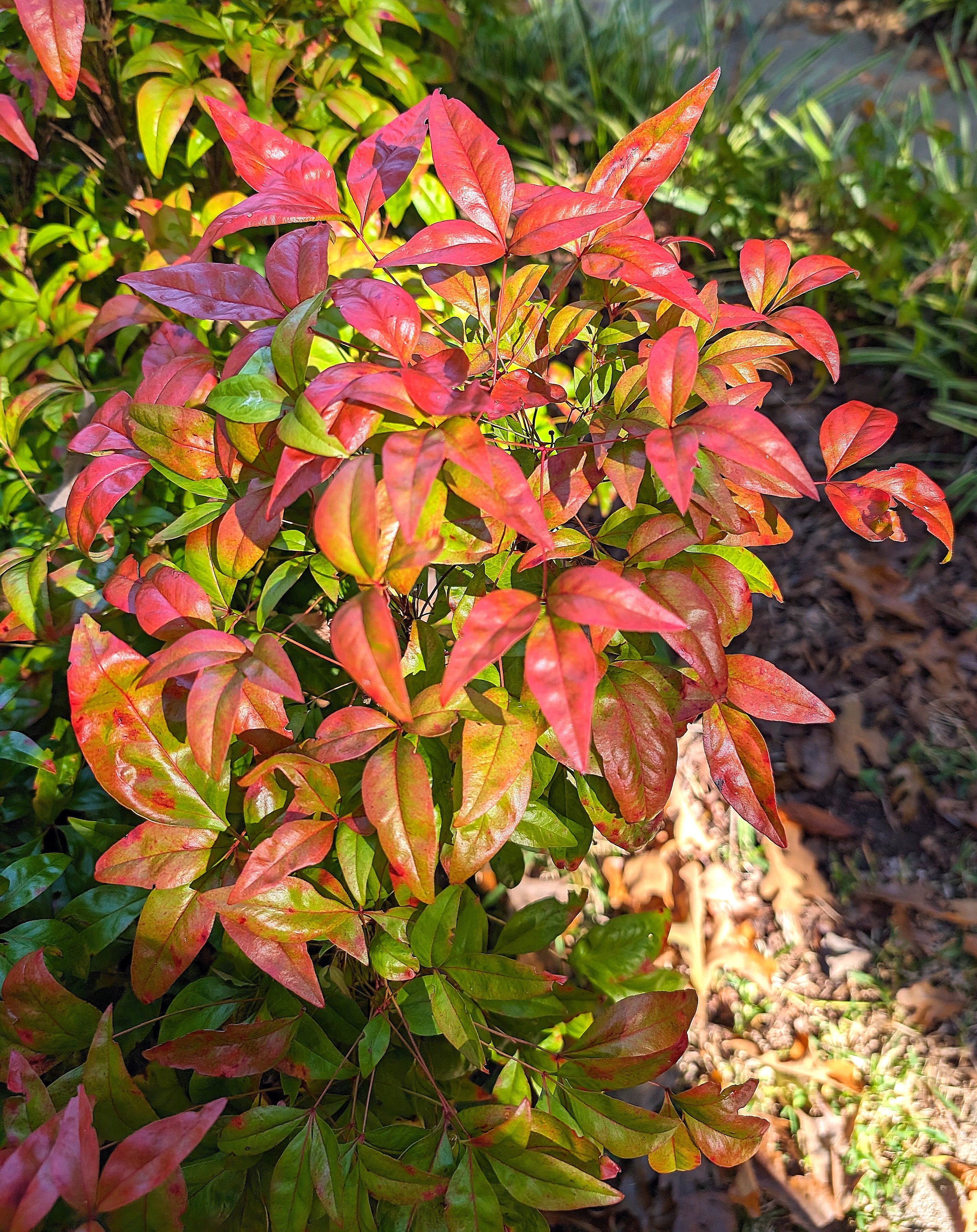
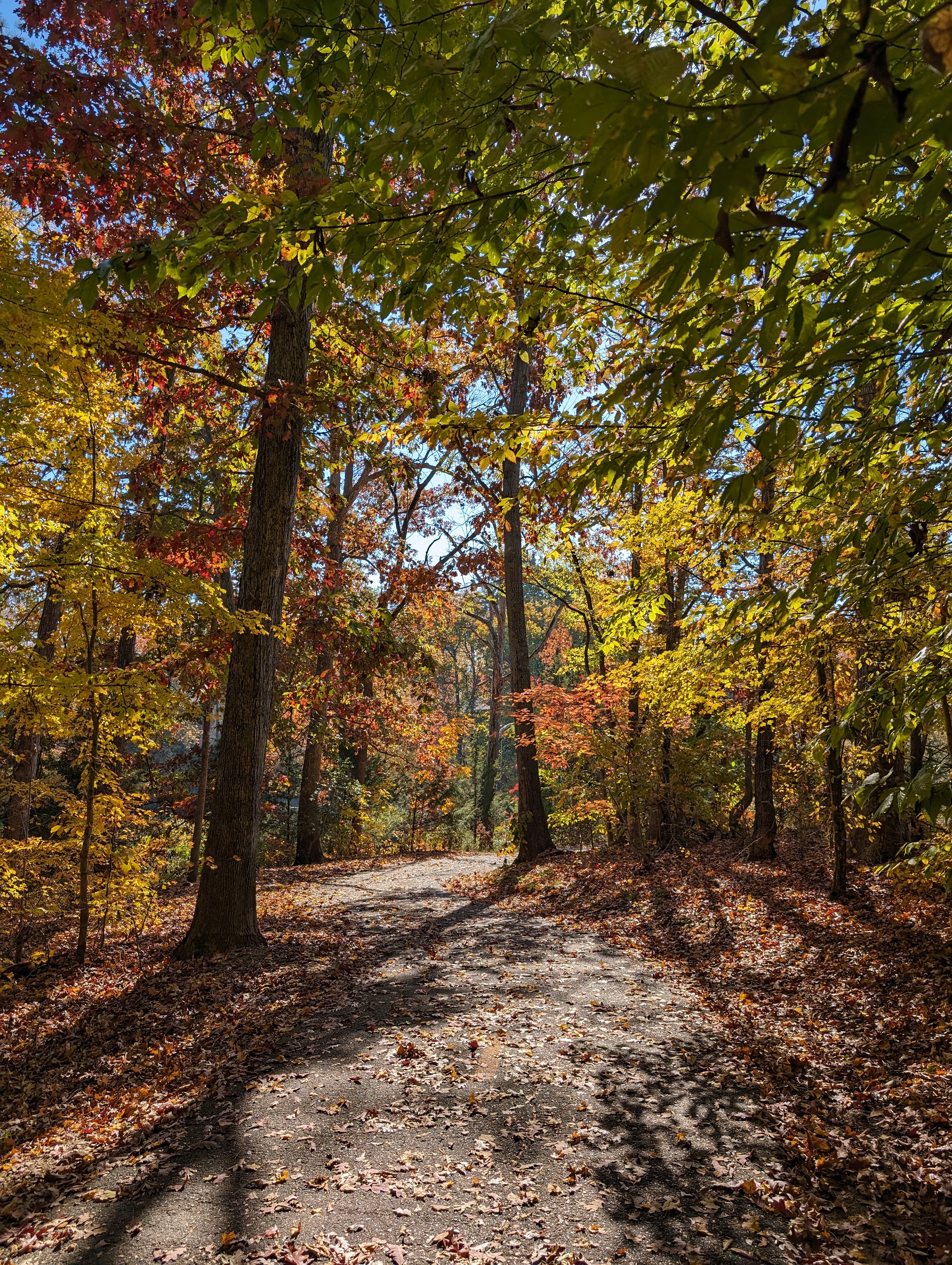
I’ve been laid up, figuratively speaking, from a lower back issue which has made standing up problematic. Little good has come from this, but today as a bit of therapy, I took a perambulation around our yard and the near neighbors. Here’s what early autumn looks like in Raleigh, NC. The shrub above does its thing along our front walk. I’m too lazy to look up what it is.
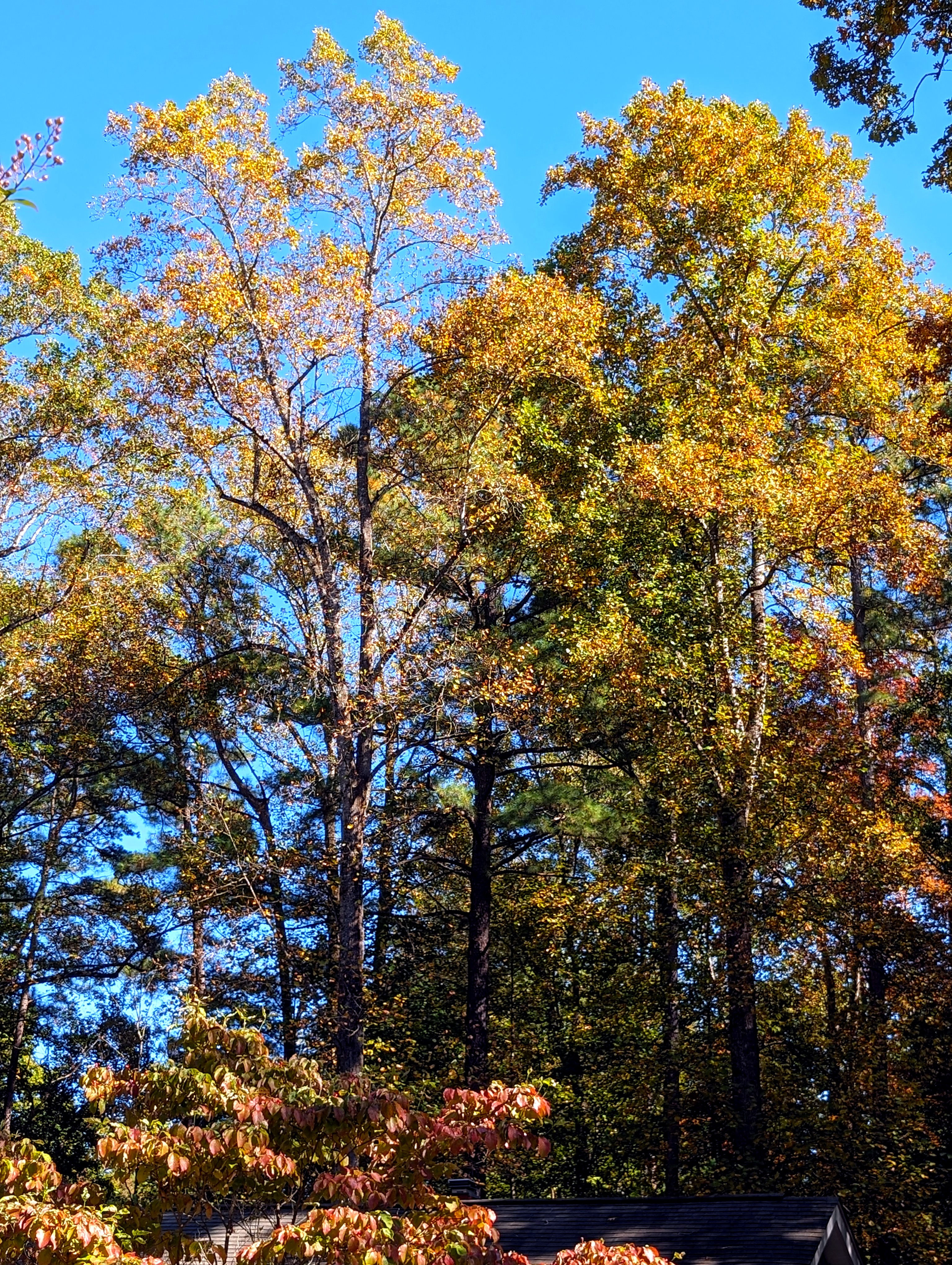
To give y’all perspective, about 75% of all leaves are still green. I know, this is different than Up North. The 2nd weekend of October always had the reputation for being the peak of leaf-peeping season when I lived in New York near the Massachusetts border. Here…it’s a little different. In the above photo, the two tallest trees which stand in front of the others, are two tulip poplars in our backyard. (The house roofline is visible at the bottom of the photo.) The one on the left is exposed more with no tall trees immediately around it. It starts dropping a few leaves in late July or early August because our heat stresses it (I guess). It starts dropping leaves before anything else, and at this point is 75% bare. The tree on the right sits further back, and is protected more as a result. It’s just now taken a decidedly yellow tone with most of its leaves. As you can see, many of the trees remain green. At the bottom of the photo are the upper branches of a dogwood. Not all of the trees remain in a green state, though….
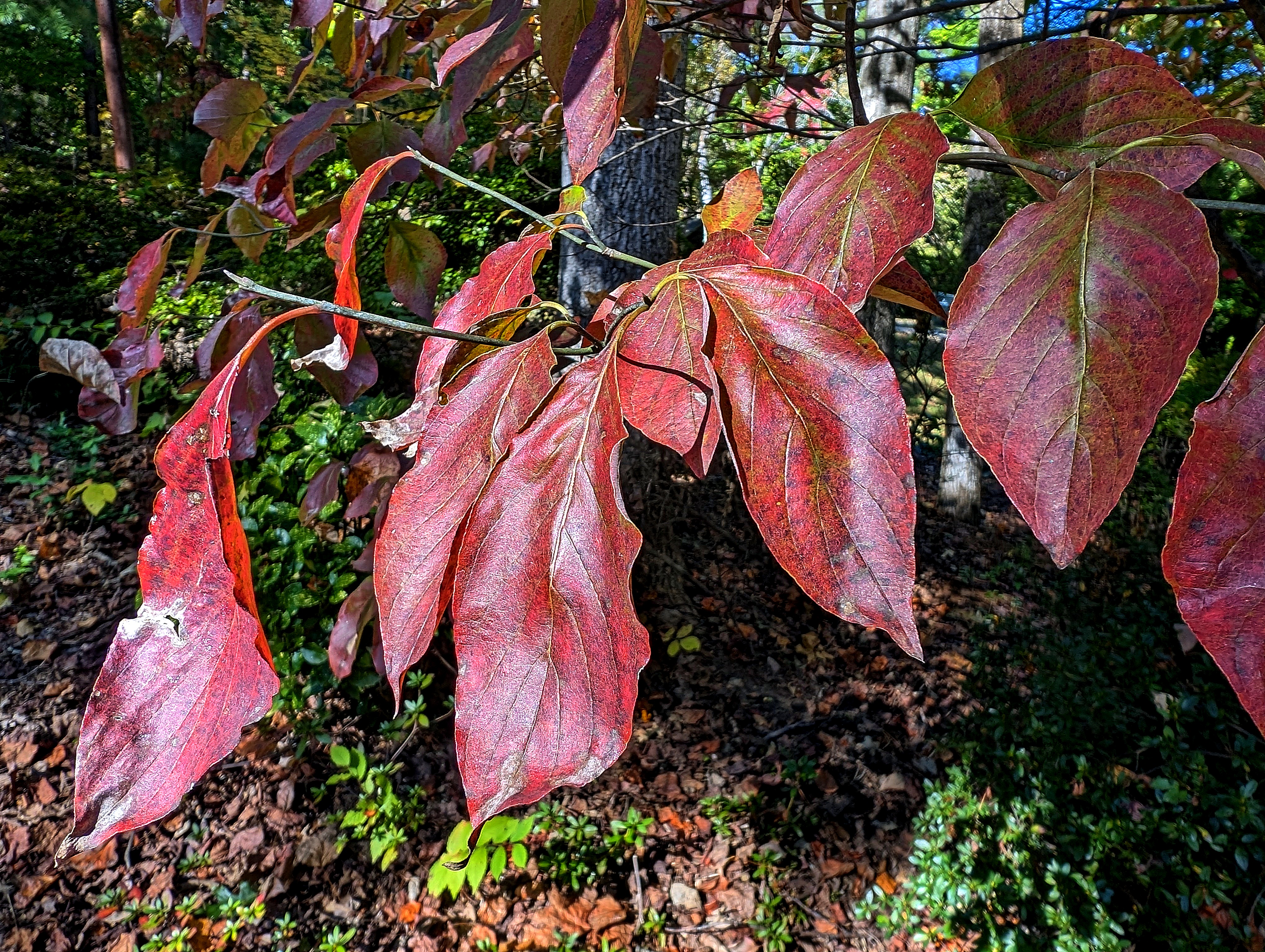
This is what all of the dogwoods on the property look like. We have six or eight. If they aren’t this red, they’re a mix of dusky red and green. Some trees around us are a bit further along…
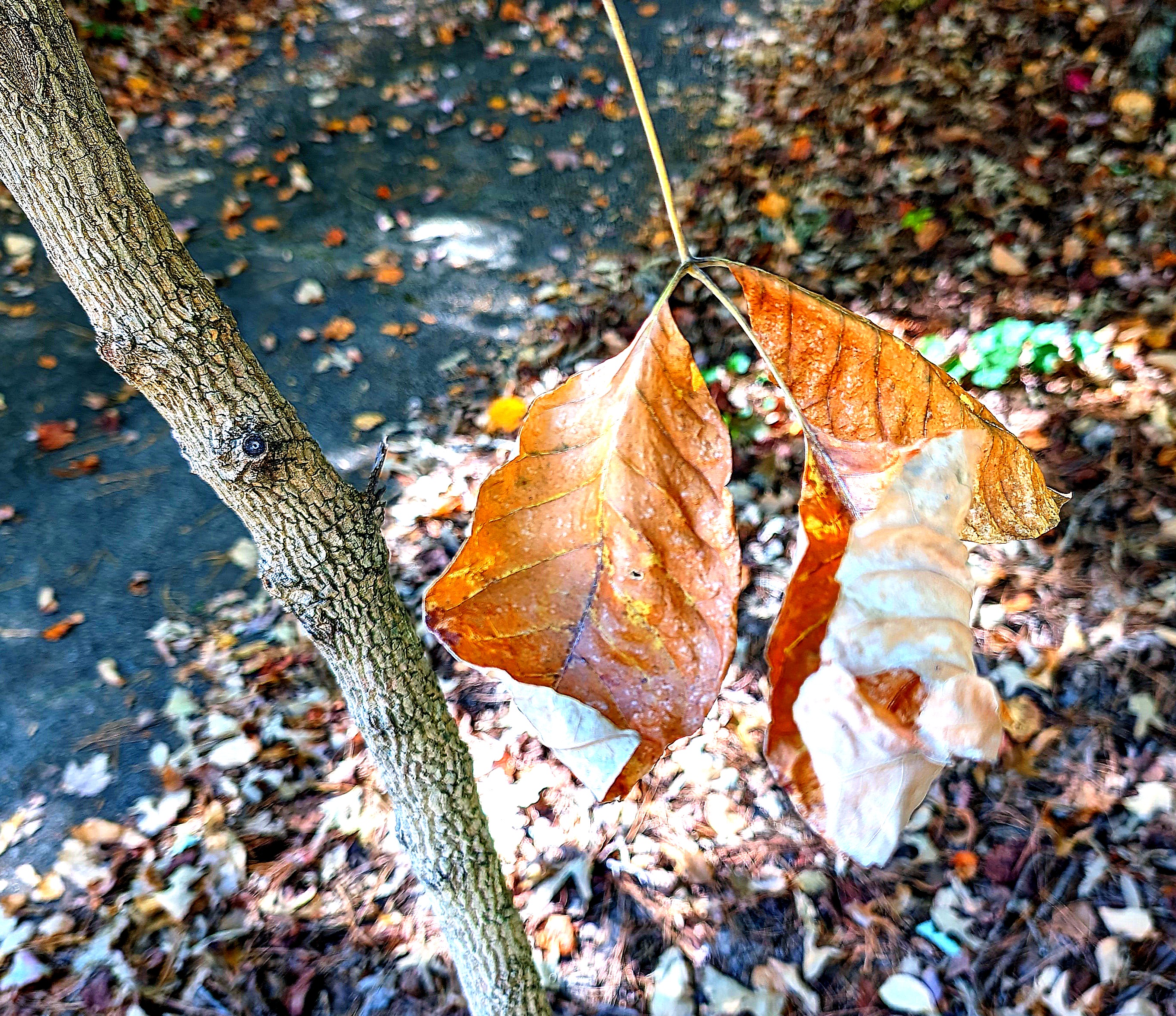
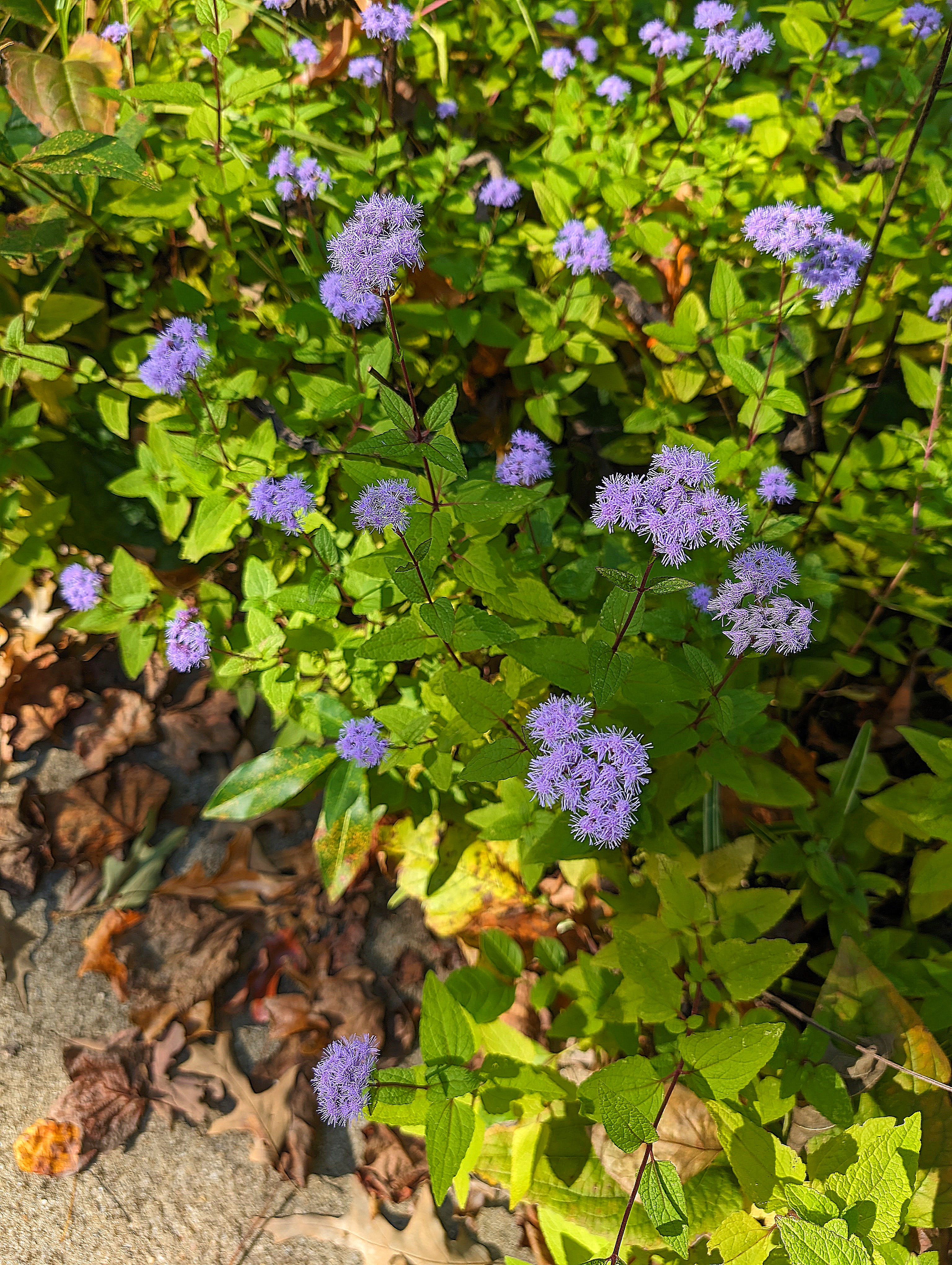
Chrysanthemums aren’t the only fall flowers. The above is blue mistflower and blooms somewhere around Labor Day. It stays beautiful until a really good frost hits. Fortunately, that shouldn’t happen for at least a week, so we’ll usher in November with these lovelies still blooming. They’re ‘volunteers’ as near as I can figure: they don’t look as if they were planted because they grow in several of our flower beds. The ones above appear along the walk to our front door, appearing when I most lament the end of the purple coneflowers.
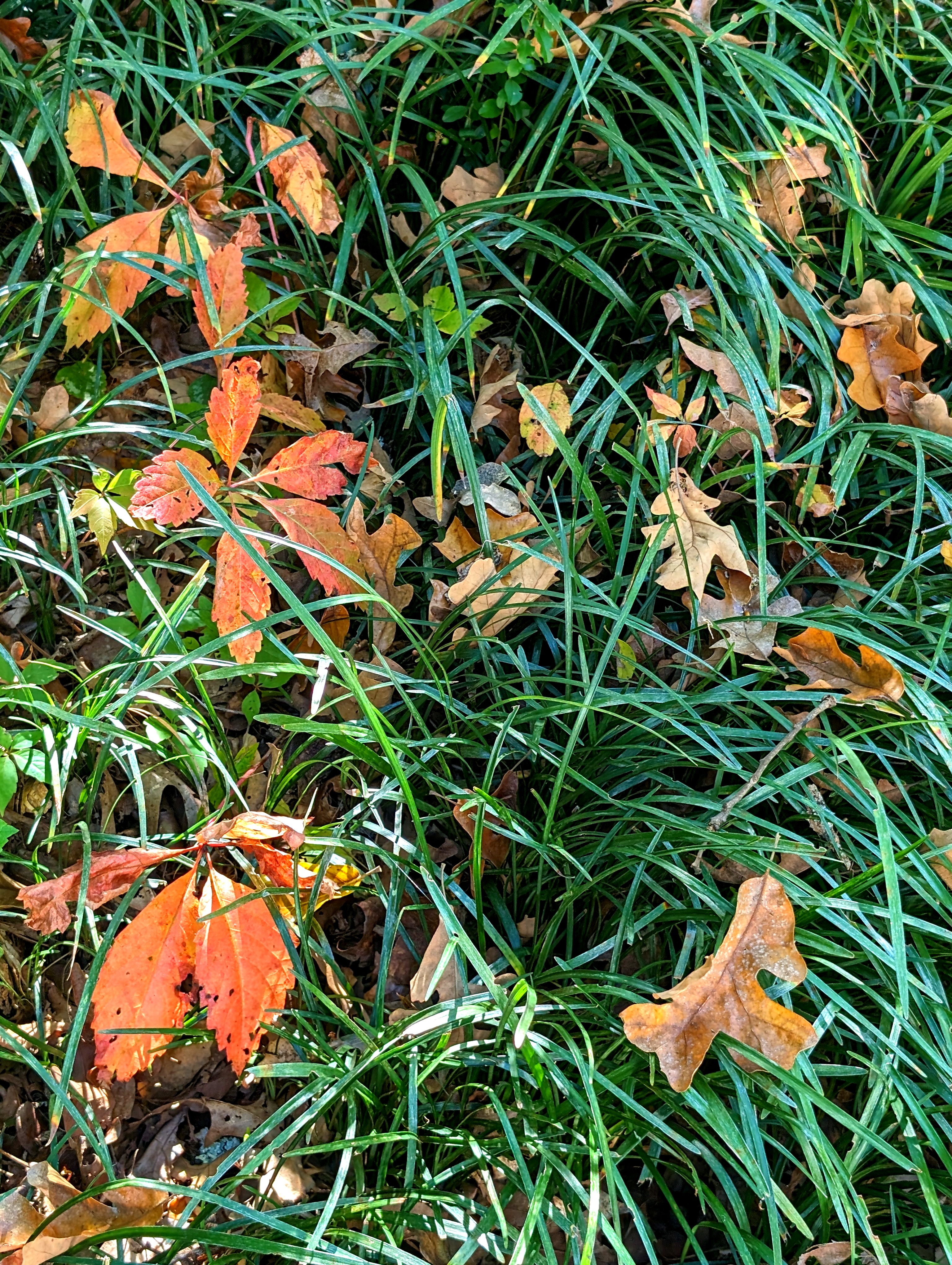
Sometimes autumn is just here and there…as are we…
Ciao, y’all.

I’m listening to Hackney Diamonds the new release by The Rolling Stones as fed to me by Tidal’s FLAC version. It’s stunning considering the age of the performers. I get a little bit of Black and Blue out of some of it, but several of the tracks just rock, straight ahead, ma’am, thanks. I hear a nice big fat and fuzzy bass on “Bite My Head Off” and whaddaya know? It’s Sir Paul McCartney on that one! I like that Keith Richards gets to sing “Tell Me Straight.” Lady Gaga joins them on “Sweet Sounds Of Heaven”…and Mick Jagger sounds just as good at bending a blues note as he ever did. (Reminds me a bit of JJ Grey & Mofro.) Look at the credits for this one! Stevie Wonder on piano? Ronnie Wood on guitar and backing vocals? Keith is playing bass? Oh HALE YEAH! And what a great tribute to their roots at the end of the album: “Rolling Stone Blues” by Muddy Waters, most of it performed with just an acoustic guitar and a harmonica.
When the album was announced, I read that this is the first studio album of original material since A Bigger Bang. “Surely that can’t be right,” I thought. “I listened to a new album in the last ten years or so.” Ah, but that was a bunch of blues covers, not original stuff (Blue & Lonesome, 2016). Shee-it. I was stuck in yet another unsatisfying job in 2005, the year that one came out. I had no inkling I was headed to North Carolina, that two more tension-producing jobs awaited, or that I would score a professional jackpot by entering the consulting world. Eighteen years is a long time, even for old people…like me and the Rolling Stones. (Maybe I should write a memoir called that–except I came to the Stones late.)
Whatever. It’s Rolling Stones Retrospective this afternoon. Streaming Aftermath which starts with these: “Paint It, Black”, “Stupid Girl” [the B-side to Paint It, Black if I recall correctly], “Lady Jane”, and “Under My Thumb”. There are signature movements in the music industry–Big Band, Rock N Roll, Hip Hop–and I’m glad to have grown up with one. Cheers, folks.
A Roman recipe from An Alphabet for Gourmets by M. F. K. Fisher from a collection of her works entitled The Art of Eating:
GARUM (400 B.C.)
Place in a vessel all the insides of fish, both large fish and small. Salt them well. Expose them to the air until they are completely rotted. Drain off the liquid that comes from them, and it is the sauce garum.
Kennedy Fisher, Mary Frances . The Art of Eating: 50th Anniversary Edition (p. 901). Houghton Mifflin Harcourt. Kindle Edition.
Or perhaps it is the cesspool of death that it appears to be…
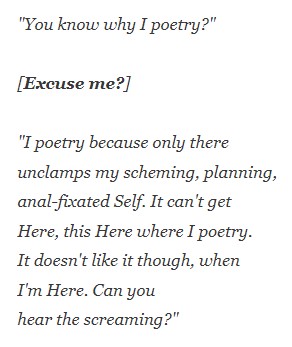
Something perhaps has changed with WordPress. I’ve been irritated to see that choosing the “Verse” setting for a block, which I thought yielded the above, doesn’t even come close on some devices. Here’s what my friend received in his email:

I knew that WordPress converted poetry to a monospaced font, rather liked it actually, because I follow a couple of poetry blogs which deliver the entire poem to my inbox. I’m pretty sure in the past that I saw the same thing on the WordPress website when I used my phone. Ah, but now there is Jetpack, newly changed for the…better? This is what appears on my actual blog when using an Android phone:
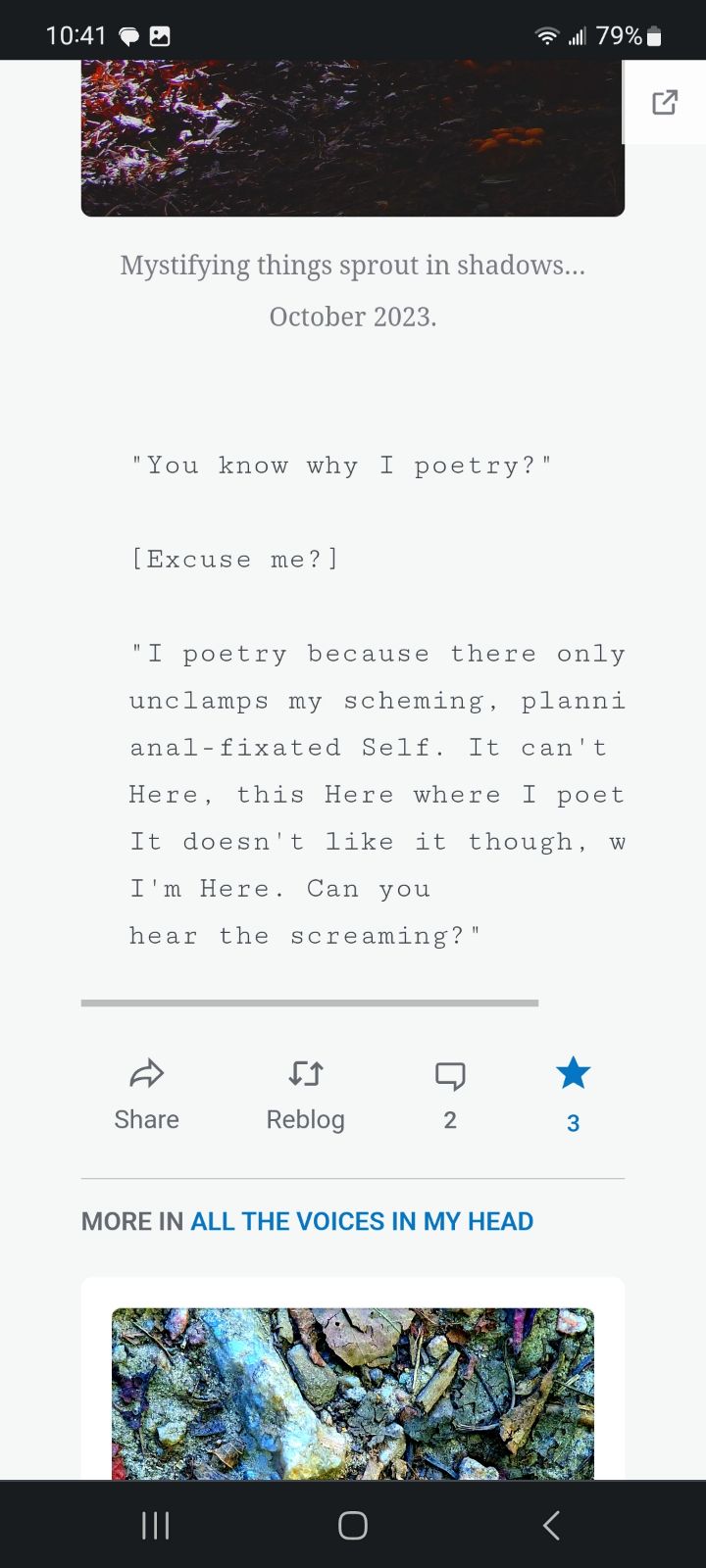
That’s not “verse,” WordPress, nor is it “poem.” That is called “paragraph” and “prose” and perhaps “simplistic crap” unless one makes a living as a stream-of-consciousness author, and even then one must establish a certain cadence and structure to ‘musically’ signal to the Reader that yes, this is something beyond prose. (Unless one is James Joyce, then nevermind.)
Canadian philosopher and communications theory god Marshall McLuhan invented the phrase “the medium in the message”. I’ve perverted what this means. He meant that content doesn’t really matter, that a children’s cartoon or a vicious slasher movie is all the same when broadcast identically on television. To me he meant the message of any communication effort takes its ultimate meaning from the medium by which it is delivered. Spoken words in a living room conversation take on new meanings when sung in a concert hall. More familiarly, books turned into movies tell a different story and cannot help do otherwise. Even if Peter Jackson had managed to control every reference in his Lord of the Rings movies, visual, aural, or what-have-you, the story still would have been just as vastly different than the books as they turned out to be.
For these reasons, it’s deeply unsettling to oldsters such as me to watch the different devices reformat and repackage the content of what purportedly is the same thing. I see this nearly every day as I follow Major League Baseball. MLB.com presents a side-by-side box score for both teams, but on the phone you must select one team or the other–never can you present them at the same time on your phone’s screen. Baseball-Reference.com displays a wonderfully useful tool when looking at any particular season for a baseball team: a histogram of green and red bars which tell the tale of the entire season, game by game, read left to right. Mouse over any bar and it tells you the date of that particular game, who this team played (and where), and what the score was. It also shows what the team’s Won-Lost record was when the game finished. On a mobile device (tablet or phone) this histogram tool disappears. It makes me wonder if certain features of a website are completely unknown to a majority of the younglings who stare into their phones for 90% of the time they’re awake.
Thus, we come back to my dilemma/consternation and the question posed in the headline. Have I delivered a poem at all when it looks like a short paragraph raising an offhand question? Does the trivialization effected by the mobile presentation indicate my poem lacked substance and can only stake a claim to poetry because of its window-dressed arrangement? (Believe me, I’ve thought some unkind thoughts about other’s postings which, if returned to a more prose-like arrangement, look like the musings of a teenager in a diary. Am I just as shallow?) Did McLuhan not go far enough? Does the message ultimately get defined by how the technology delivers it, even when it lives simultaneously in different media formats?
A light bulb creates an environment by its mere presence.
Marshall McLuhan from Understanding Media (as quoted in Wikipedia)
Ultimately I think McLuhan would argue each device configuration represents a medium. But I never signed up for this, WordPress! My understanding of the matter was this: you give me the tools to put my message together, and I pay for it by giving you ultimate ownership of my content (which I cannot believe I did, but there ya go). I expected a bit more, though. I expected a very nuanced difference to my content. Sure, I’ll accept McLuhan’s theory that those who read my stuff on a phone get a different message than those who read it on a big desktop monitor, but I would prefer to be left out of the “definition changing” part of the equation. You’ve made me a partner to it by changing my content not just the medium.
Which leaves me little closer to answering my question but has given me an excellent opportunity to rely on that first college degree and to prove yet again that old age clothes old men in curmudgeonly behaviors as surely as dogs become grizzled and oaks gnarled.

Things that have been bouncing around in my head lately:

Johnny boy, he's always propping up the bar
He sees life crystallized through his jar
He says he only lives for beer
But deep in his heart is a cry of fear

Give me a heart to hang onto
Give me a soul that's tailored new
Give me a heart to hang onto
A heart to hang onto

--Pete Townshend, "Heart To Hang Onto" from the album Rough Mix with Ronnie Lane
if you’re going to post poetry as if you’re a poet, for God’s sake, learn the damn language! It’s pretty easy to do that and still write bad poetry, but it’s impossible for you to write good poetry without a basic understanding of grammar, usage, and mechanics.
I’ve just completed reading My Grandmother Asked Me To Tell You She’s Sorry by Fredrik Backman. He’s the one who wrote A Man Called Ove which was made into the movie A Man Called Otto with Tom Hanks recently. It’s a tear-jerking adult fairy tale of a book which skirts the edge of formulaic, contains frequent self-referential passages (which I find tiresome), tells a well-worn tale without breaking any new ground,…and I gave the book a five-star rating. For one thing, I like a pathos-riddled book which adroitly brings tears to my eyes. Mainly, though it’s for two other reasons I gave it those stars. The book re-taught me a lesson about reading (and therefore about life a bit): when you dislike a book (or a person or whatever) because it isn’t what you thought it was going to be, then you’re not disliking it for what it is, you’re disliking it for not living up to your expectations. If those expectations were based on very little, as most of our snap judgments tend to be, then it isn’t the book’s fault. In this case, my expectations were built upon some not-very-specific blurbs which said what the book was ‘about’. I expected a different storyline. Once I accepted it wasn’t going to follow my imagined plot, I realized I liked the book very much. (Had I not, I would have put it down, but with the acknowledgement that I did so based on what it was rather than what it wasn’t.)
Since the blurbs I read led me to expect a book where an adult protagonist runs around Europe delivering letters from her now-deceased grandmother, here’s my blurb, only slightly more accurate and still very vague:
When the grandmother of the “almost-eight-year old” protagonist dies, the granddaughter is charged by her Granny to deliver a series of letters to people from her grandmother’s past. Through this device, Backman weaves together the competing narratives of being someone’s hero and being a shit, and teaches a young, precocious girl that Truth (and Life) lie somewhere between the two. Oh, and along the way he makes a good case for forgiveness and tolerance, fairytales, loyalty, courage, and that anyone can redeem themselves and become a hero.
Me
Other than that, I liked the book for its style which led to some lovely little quotes:
“Only different people change the world,” Granny used to say. “No one normal has ever changed a crapping thing.”
Backman, Fredrik. My Grandmother Asked Me to Tell You She’s Sorry: A Novel (p. 89). Atria Books. Kindle Edition.
Children know that time is just an emotion, so “now” is a meaningless word to them, just as it was for Granny. George used to say that Granny wasn’t a time-optimist, she was a time-atheist,…
Backman, Fredrik. My Grandmother Asked Me to Tell You She’s Sorry: A Novel (p. 231). Atria Books. Kindle Edition
Because life is both complicated and simple. Which is why there are cookies.
Backman, Fredrik. My Grandmother Asked Me to Tell You She’s Sorry: A Novel (p. 368). Atria Books. Kindle Edition.
I wish there were more quotes, but I became too involved in the novel to take time to highlight them. I’ve been gifted some alone-time what with my wife gone for a week, which led me to read hours yesterday and today, which I do too seldom much as I did before adulthood. (True, many would argue about calling me an adult, but I’ve shook them from my boots like the clods they were and kept walking.)
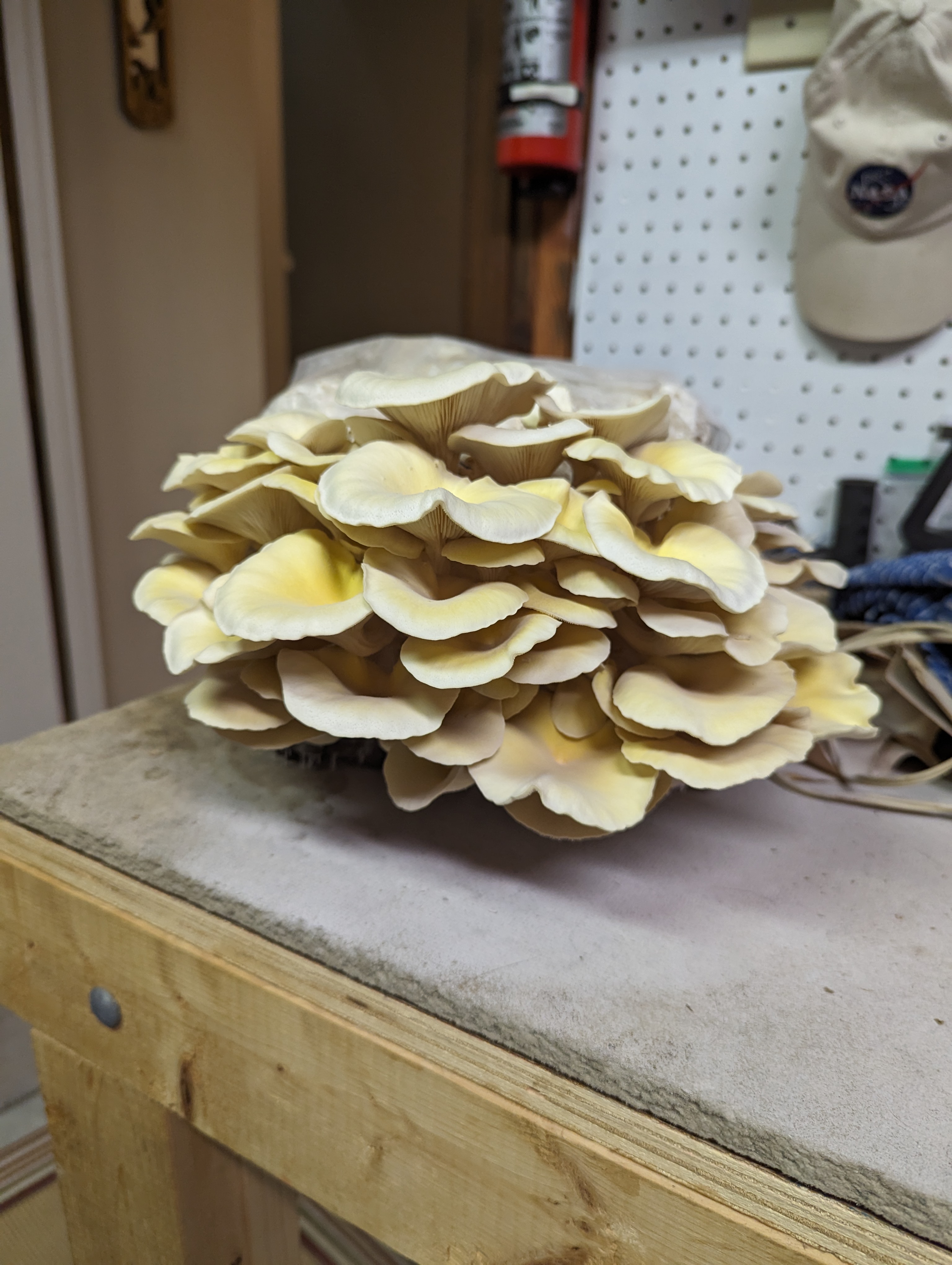
And now, because all posts deserve a photo, here are the mushrooms I’m going to sauté in an hour or two. After the fiasco of the first kit, my purveyors made good with one which burst forth in just seven days and has yielded these fully ripe, ready-to-harvest golden oysters in just 11 days:
 all the voices in my head