By our fourth full day in Hilo, the island attitude had taken over. Friday’s meandering around town (waterfall, museum, brewery, dinner) could’ve been followed by something energetic. Instead we took our time before heading downtown to visit the Farmers Market (photo above) and an equally large area where local crafters sold their wares. A few souvenirs were purchased, always with an eye to the minimal space in our luggage. (We pack light. A carry-on suitcase each, a large purse/bag for my wife, a soft attaché-style bag for me.)
After the market we wandered the downtown area. Hilo manages to look like my childhood of the late 50s and the 60s, except for the modern cars:
Downtown Hilo looking northeast toward Hilo Bay. Turn left from this position and one is smack dab in front of the KTA Superstore mentioned in the post about our first day on the Big Island. September 2024.Downtown Hilo, nearing the beachfront. In the foreground is Turn the Page, a bookstore. Like many of the merchants, it has no glass in the windows–those openings let the breezes (and birds) into the store. In the background and through the palms one can see the hotels on the peninsulas where our hotel stands. September 2024.
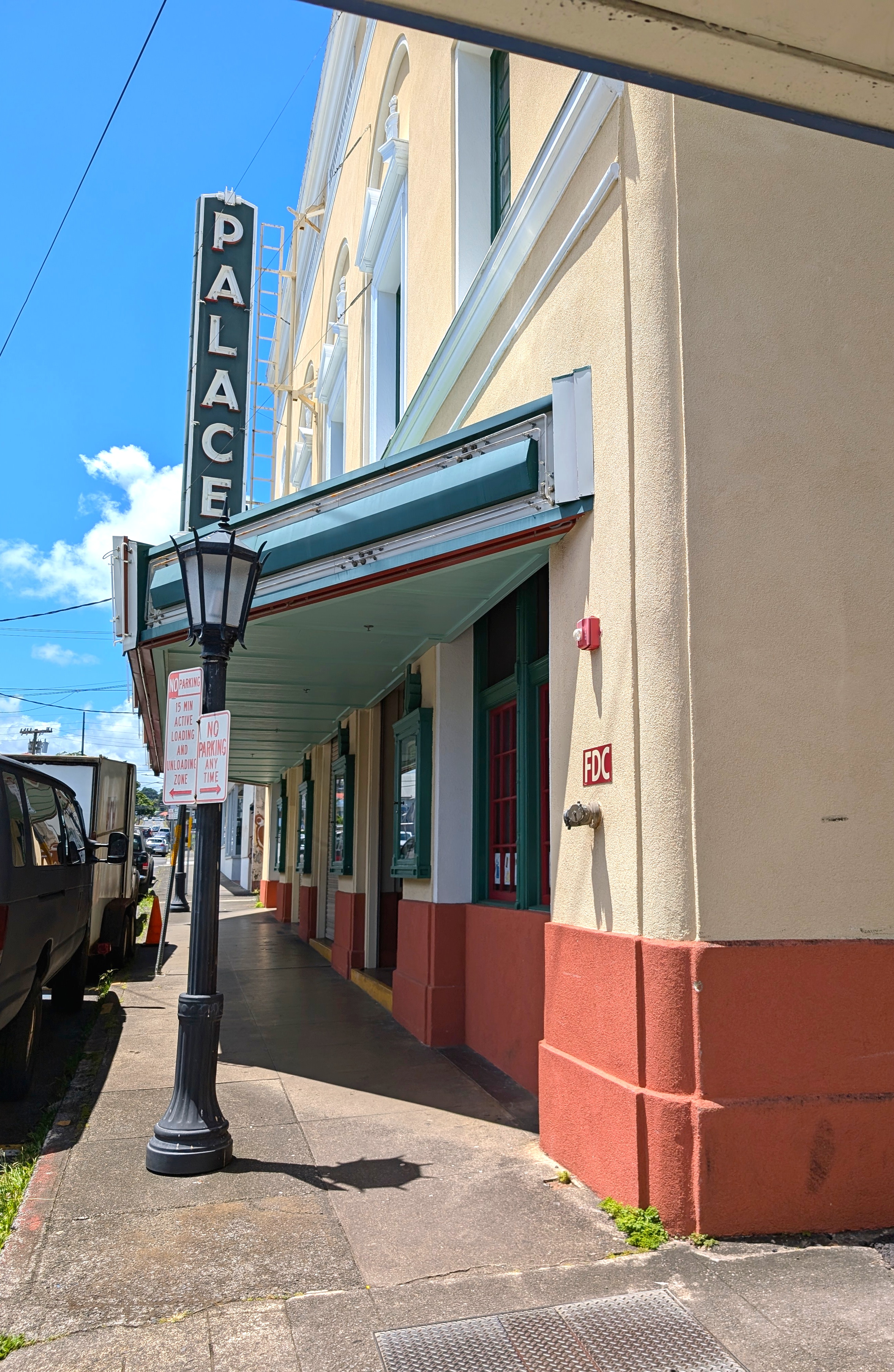
The Palace Theatre. Google shows it delightfully lit up at night. Hilo, HI, September 2024.
Eventually we ended up at Hilo Brewing Company which sits about a mile from the beaches of city center. It reminded us of the rough-looking ones around Raleigh and in San Diego County where all the work goes into the beer, all 4-6 kinds of it. We like that.
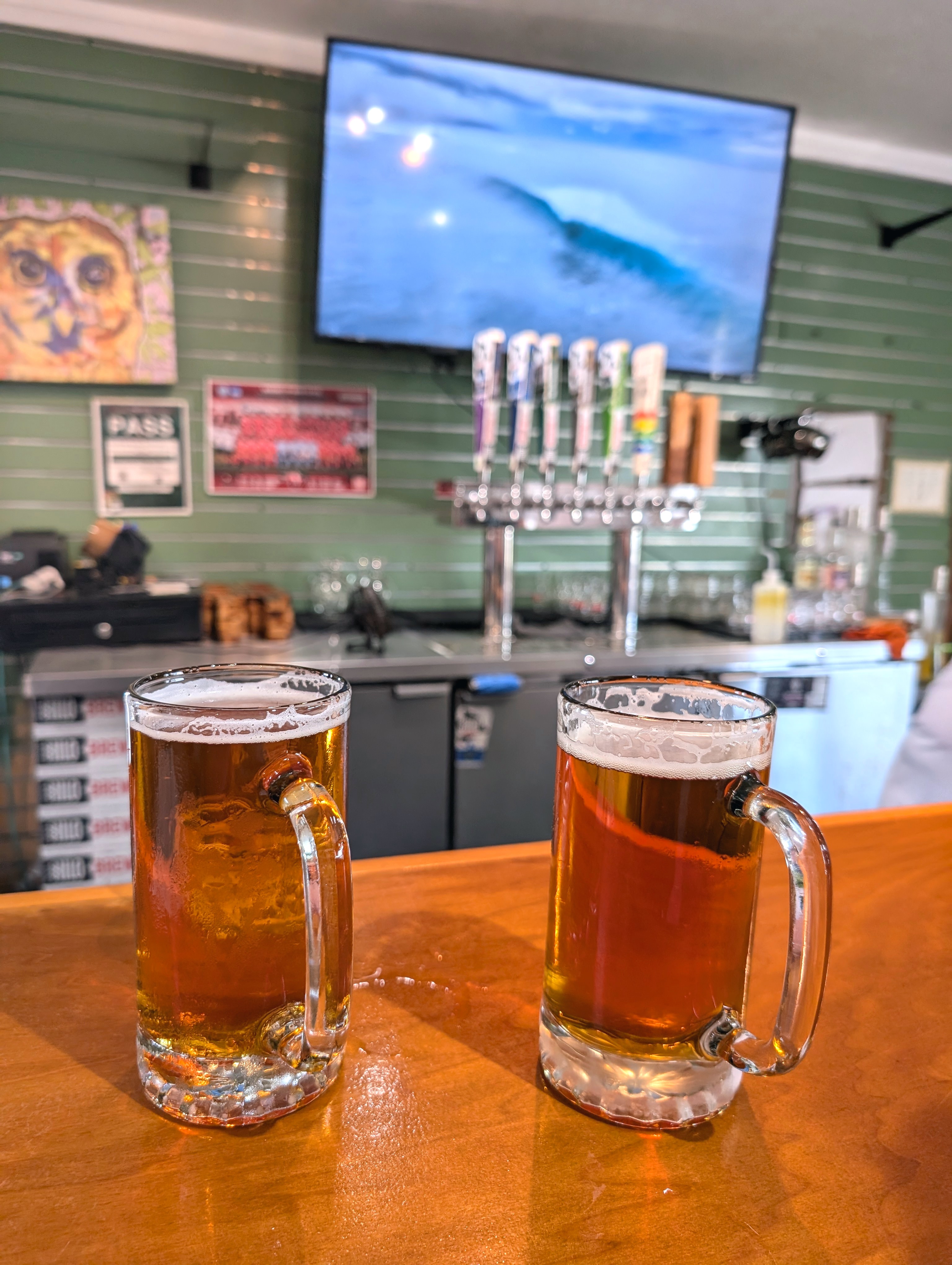
On the way to the restroom, aided by yellow footprints painted on the concrete and surrounded by brewing accoutrement. I’m sure this is up to code, right? Right? Hilo, HI, September 2024.A short wooden bar seating about six to eight. Surf documentary on the TV. Eight taps, several of which were tapped out. Through the open rollup door we gazed at other patrons talking and laughing at picnic tables. The brewer sits in a mixed industrial area. Think cyclone fences, cracked pavement with grasses growing in them, a kind of Quonset Chic vibe. Hilo, HI, September 2024.
From a story in today’s New York Times describing a veteran who was court-martialed for shooting an Iraqi in 2004.
Mr. Richmond shot the herder in the back of the head from six feet away as the man, who has handcuffed, stumbled.
—from “Veteran Who Was Court Martialed Gets 4 Years in Prison for Jan. 6 Attack”, New York Times, November 18, 2024
Error: “…, who has handcuffed,…” instead of “…, who was handcuffed,…”
Type of error rating: 2, because this seems to be a typo which wasn’t caught. (Although we should note the H key isn’t near the W key. Actually this is more a brain-fart than a typo.)
Author/editor rating: 4, because regardless of the minor level of error, a reader of the Times has a right to expect the author (or an editor) actually reads the copy prior to its being published, and even if it slipped by everyone on Nov. 18, it would be noted by somebody and corrected by the time I read it midday on the 19th.
Personal reaction rating: 1…It neither entertained or enraged. It jarred me a little, but my blood pressure stayed constant.
Bottom line: This error rates a 2/4/1 for a 7 out of 10 on the Reader’s Horror scale.
Discussion:
I’m going to need to see if all of these errors wind up being in the 7-9 range. The scale won’t mean much if so.
Writing something like this really puts one on his toes. I know I’ve corrected numerous errors in already-published posts!
[I wish there were a photo here. There isn’t because all the good photos I have about poor usage of written English are owned by someone else who likely would sue me. But, hey, we’ve illustrated the use of the subjunctive verb conjugation! That’s cool, right?]
In my email every day I receive a list of books which can be purchased in electronic format from Amazon for $1-$4. Each book is described in only two or three sentences, just enough to hopefully entice you to read the full description on Amazon and then buy the book. [See Caveats below regarding split infinitives.] Today a description of the book Girl by Alona Frankel contained this opening sentence:
In this “impressionistic memoir,” a world-renowned children’s author and illustrator offers a “truly moving and bravely rendered” account of her time as a Polish Jewish girl hiding as a Gentle in Nazi-occupied Poland (Kirkus Reviews).
A “Gentle”? Surely you meant “Gentile”?
Every day–not everyday as may be written ignorantly–I read something where the author and/or the author’s editor have recorded their ignorance of the written English language. After noting for several years how these blemishes have crept into what I consider to be prestigious sources–New York Times anyone?–I’ve decided to record all of the offenses, rating them similar to a fact-checking site. Not all offenses are equal. We will consider the source and the egregiousness of the error.
Time out for my GUM Guidelines. Grammar is how we know words mean something. “Ball he red the threw,” confuses a speaker of English because it’s out of order: “He threw the red ball.” Don’t go all Noam Chomsky on me. My definition will suffice for our purposes. Grammar is not class-based. Usage refers to the accepted way of saying something. People who say “don’t nobody know nuttin’ but me!” are deemed ignorant by the people who say “nobody knows anything except for me!” Usage is class-based. Mechanics refers to how spoken language is rendered in print. It’s a convention, neither class-based nor non-class-based. As a society we have come to an agreement that words will be written a certain way…until they aren’t. As such, mechanics change over time. Mechanics refer to punctuation, capitalization, spelling, and the like. Okay, back to our tirade of the day.
Me
At the bottom of the heap I will place graffiti, notes from friends and relatives, and other signs posted in haste. Everyone of us and every one of these examples have been written on the fly, often by persons who somehow passed through school while they regarded English classes as the scheduling version of a roulette wheel. Who knows where the ball will land? Maybe they were lucky on a certain day when final exams were given. Maybe the teachers just didn’t want to try teaching them one more time. Regardless, we can hardly damn ignorance when it’s being spray-painted on the side of a building or dashed off in haste on the back of a grocery store sales receipt. Occasionally one of these haste-lays-waste mistakes will crop up in what we read. We will sigh and rate these a 1.
Next up we encounter those who labor with the English language–and I want to emphasize “labor”. [See Caveats below for punctuating quotation marks.] People with only a passing knowledge of how to write English can find themselves employed in jobs demanding continual use of those non-existent/woefully lacking talents. In these days of electronic word processing, I suspect they often don’t write the English, they just copy and paste it from somewhere else. This copy-and-paste existence demands editing skills but ultimately the failure to catch errors, i.e., to edit your own writing or someone else’s is exactly what we’re concerned with here. We’re not dissing people for not measuring up to Shakespeare, Hemingway, or the adroit use of language we read in the work of so many fine authors. We’re taking these writers to task for how they symbolically render their thoughts into print. At this level, one up from the ignorant, they should know better–but they don’t. That’s why we will rate these a 2 and not higher.
Unlike the previous group, many persons do write professionally. They might not consider it the defining talent for their profession, but it commands an integral part in it. I’m thinking of the people who design and render web pages, paralegals who draft documents all day, people who work in advertising or real estate, and those who write blogs or newsletters or for small town newspapers (to name only a few). These people generally should know better. At the very least, they should know when they don’t know better and take the time to figure out whatever is perplexing them. (Actually, I’m probably kidding myself. They likely think they do know how that particular phrase should be written, that particular word spelled. It never crosses their mind to check it.) Perhaps most egregious, these are the people who ought to be able to question the suggestions from autocorrect, check the spelling of the underlined words, and turn on grammar checkers to parse their work. When they don’t, we must hold them more accountable. We will rate the lazy and purposefully ignorant a 3.
Finally, we come to the no-excuses group. These folks have climbed to the top of the writing pyramid. They write for the most prestigious news organizations, for literary reviews, for think tanks, for professional journals. They write books. They edit books. These people not only represent the best writers of English, they are monitored by those who set the standards of the language itself. The more frequently intelligent writers spell the word gel as “jell,” the more dictionaries will list it as an acceptable spelling. Although this is how the mechanics of written language change, it should happen slowly, and it should happen with intent. In the first years of this century I started writing “e-mail” as “email” because I figured it was headed thataway and wanted to hurry it along. I argued with co-worker and fellow purist, citing the words such as to-morrow to bolster my position. He served a useful purpose by objecting. If we unilaterally accept new spellings when one or two people obstinately use them, we start heading toward spelling chaos. Therefore, those who speed up the pace of change through sheer ignorance should not be rewarded with the support of dictionaries. At the top of the heap we should demand better. We will rate these erring standard-bearers with a 4, our highest rating.
We’re only halfway. Not all errors are equal. We can sum these up more rapidly.
We’ll deliver a gentle admonishment for missing apostrophes (some of them), plain typos, and mistakes which indicate the writer/editor willingly caved to the masses even when those masses don’t know what they’re talking about. We’ll rate them 1.
Mix-ups which appear to be a general miss by the autocorrect, those which don’t change the meaning of the writing (much), those which generally seem to be based more on haste than ignorance get a slap on the wrist and the advice to “slow down!” We rate these errors with a 2.
Ignorant errors which change or obfuscate the intended meaning must result in stronger reactions, but in the face of the difficult we need to be flexible. In writing about an online class did the author say the learners “tuned into learn”? I won’t go into details why it should be “tuned in to learn” because this error has become ubiquitous and I’ll have plenty of opportunities to explain it later. And I’m willing to admit I might deserve to be put in this group for the previous paragraph where I didn’t capitalize the S when I wrote “slow down!” My defense is that I didn’t think it appropriate to put a comma after the word “to,” and commas before quotations indicate they’re being used to set off independent clauses…so if this isn’t an independent clause but only a phrase…eh, that’s where my mind takes me. I have a reason, and I hope, nay, believe I’m right. However, I can see the argument that says the two word imperative does represent an independent clause. You see how complex this can be? Let’s not condemn these ignorant mistakes made in the face of English’s complexity with our full force. We’ll rate these errors a 3 only.
Some errors provoke the response, “That’s just wrong! How could THAT get into print?” Setting aside the skill level of the writer, we look at the error and evaluate it from a standpoint of how easy it would be to get it right, presuming the writer knew enough to figure it out. Sadly, these are the ones I see more and more. I would like to say that a 4 isn’t nearly as common as a 2 or a 3, just as most writers will fall into the 2 and 3 level in our first set of standards. No, errors seem to be at best evenly distributed from 1 to 4. Too many are grievous and demand a 4.
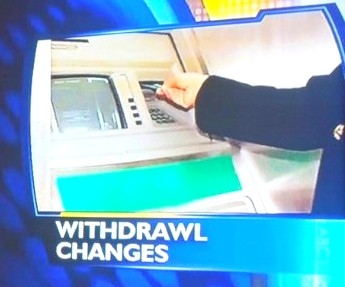
While the above rating scales for the actor and the act will be applied somewhat subjectively, the final scale will be totally, purely subjective. I’m going to add 0, 1, or 2 points for how much it pisses me off! A good example would be this screenshot from a local TV station’s newscast a number of years ago:
Photograph of local news story about changes coming to ATM’s in the Raleigh, NC market. Circa 2012.
This one would get a “0” because it amuses me. We live in North Carolina, so of course it’s withDRAWL instead of withDRAWAL! (And by the way, I had to check how to spell withdrawal–it’s what responsible writers do.) Most of the time this type of error in all caps and prominently displayed on the screen of a TV station in the 41st largest city in the USA would rate a “2” because at the time I captured this photo, they routinely were making horrible typographical errors like this. The station broadcasts to the Cary-Durham-Raleigh area which contains more than 1.5 million people. Apparently they fired the person who kept making these errors because they became few and then disappeared altogether.
Which brings us back to the email which set me off this morning. Clicking through to Amazon, I note that the word Gentile is spelled correctly at the top of the book’s description. Therefore I presume some low-level clerk hurriedly typed the description directly from the Amazon page. Much less likely but plausible: it was copied and pasted from Amazon, then Amazon corrected its mistake afterward. The clerk-level role is a 2. The error is grievous, though, one which should have been caught by all but the most ignorant person–apparently no one ever looked at what had been typed. The error is a 4. And because it’s so obviously wrong, it pissed me off a great deal, so I’m throwing a 2 at it. This error rates a total level of 8 out of 10 on the Reader’s Horror scale.
The Caveats:
I have a highly subjective and not terribly consistent approach to how I italicize words versus putting them in quotation marks (single or double). Generalized, when I talk about something symbolically I italicize it; when I am quoting from something I use double quotes. When I want to indicate ‘air quotes’ I use single quote marks.
Also, I stand with William Safire that only a fully quoted independent clause should have ending punctuation inside the quotation marks.
I don’t give a rat’s posterior about split infinitives. If I notice I’m doing it and if I can flip the words around to avoid it and still sound natural, I’ll rearrange the words. The abhorrence of split infinitives comes from Latin teachers. Latin verb infinitives cannot be split (as in the Romance languages), which led them to regard English infinitives as one word. Your eyes can tell you this isn’t true. It wonderfully represents the beautiful fluidity of English, and its ability to totally disregard (hah!) the silly Latin rule. The phrase “totally to disregard” is at once more awkward and slightly different in meaning.
Similar to split infinitives, I don’t overly worry about prepositions at the ends of clauses. If I can easily switch the sentence around, I will. Winston Churchill is famous for being accused of ending a sentence with a preposition and replying, “Madam, that is an accusation up with which I will not put.”
At 70 my opinions tend toward the conservative end of the scale but I started out liberal once. I surmise I’m somewhere in the middle at this point.
Saturday sunrise, Kuhio Bay, Hilo, HI. September 2024.
As I type this the sun is peeking over the horizon here in Raleigh. I won’t see it due to trees and ridges…and because I’m sitting in a windowless room in the basement. Nine weeks ago our first Saturday in Hilo brought an orange glow as the sun peeked over the industrial buildings at the port of Hilo (located east of Hilo proper). I never tired of this. I think people who live where they can see to the horizon unimpeded by anything must have a different outlook on life or at least on the natural world. I know it has that effect on me.
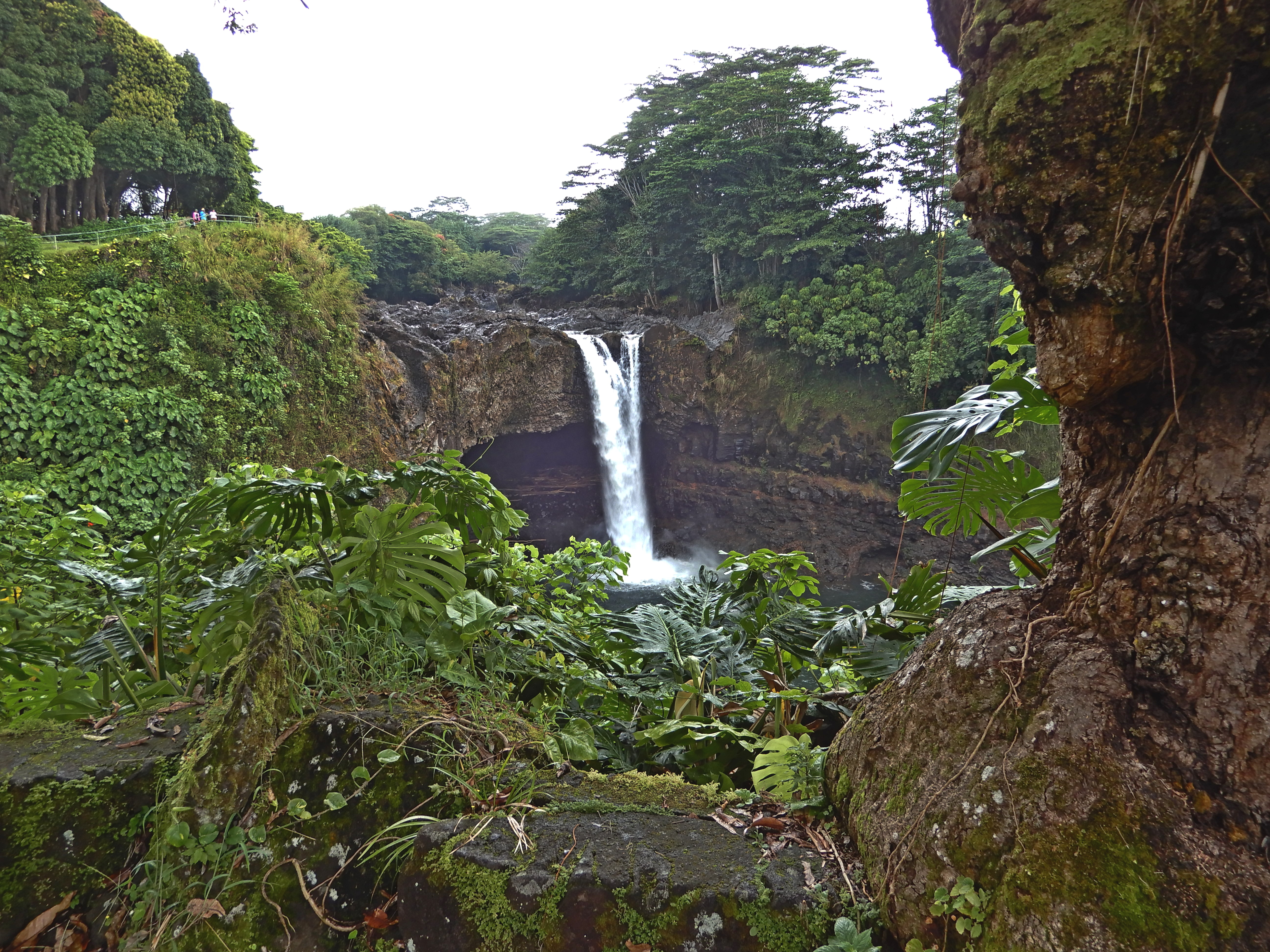
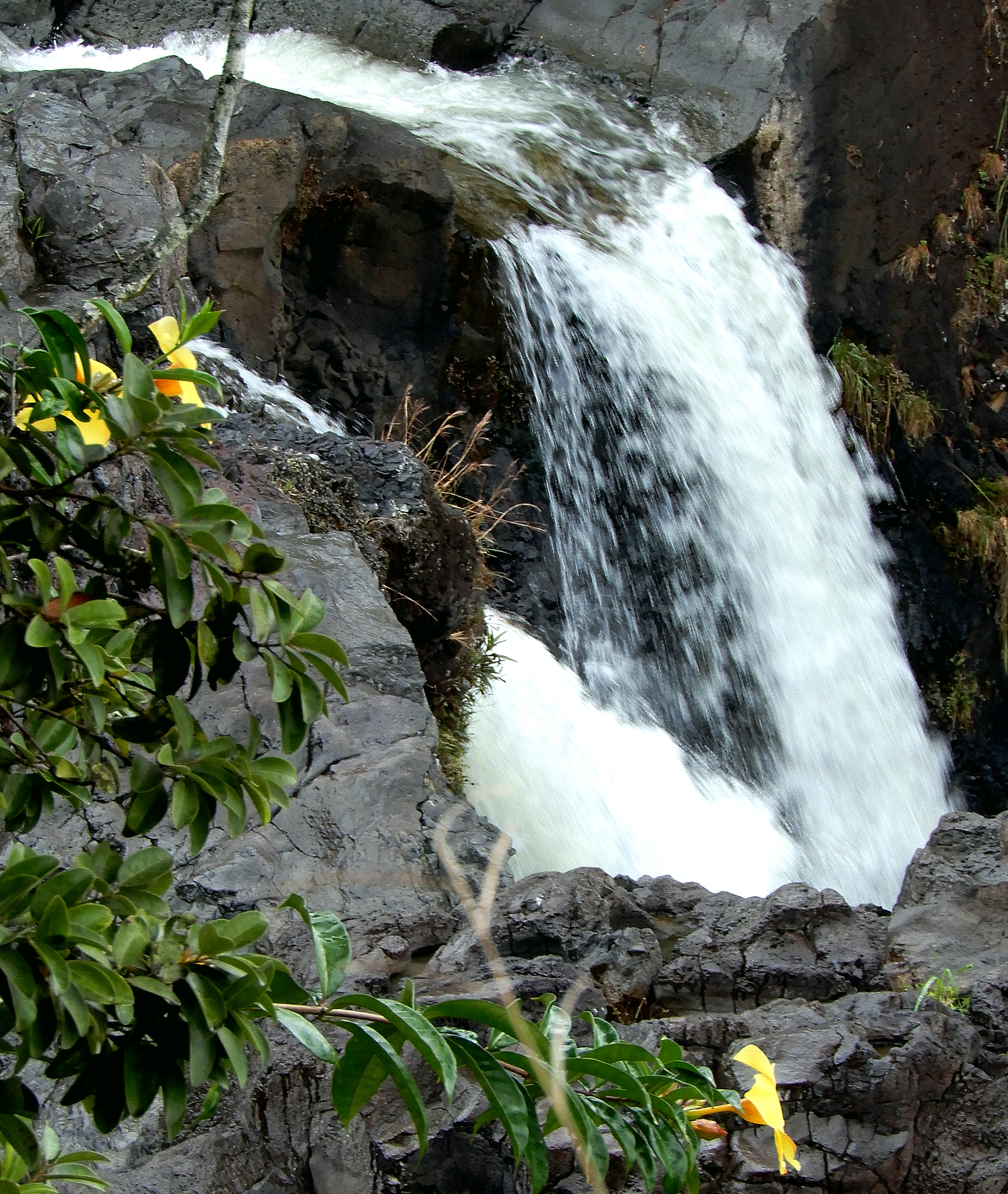
Rainbow Falls, Wailuku River State Park. Hilo, HI. September 2024.
Gray skies colored all of Friday the 13th, as promised by the dawn. After a lazy start, and feeling the effects of our up-and-down trek to ‘Akaka Falls the previous day, we drove all of 3.5 miles or so across Hilo to Rainbow Falls in Wailuku River State Park. A gentle, sporadic spitting of raindrops punctuated our first view of Rainbow Falls (above). They continued as we climbed under the trees for a closer look.
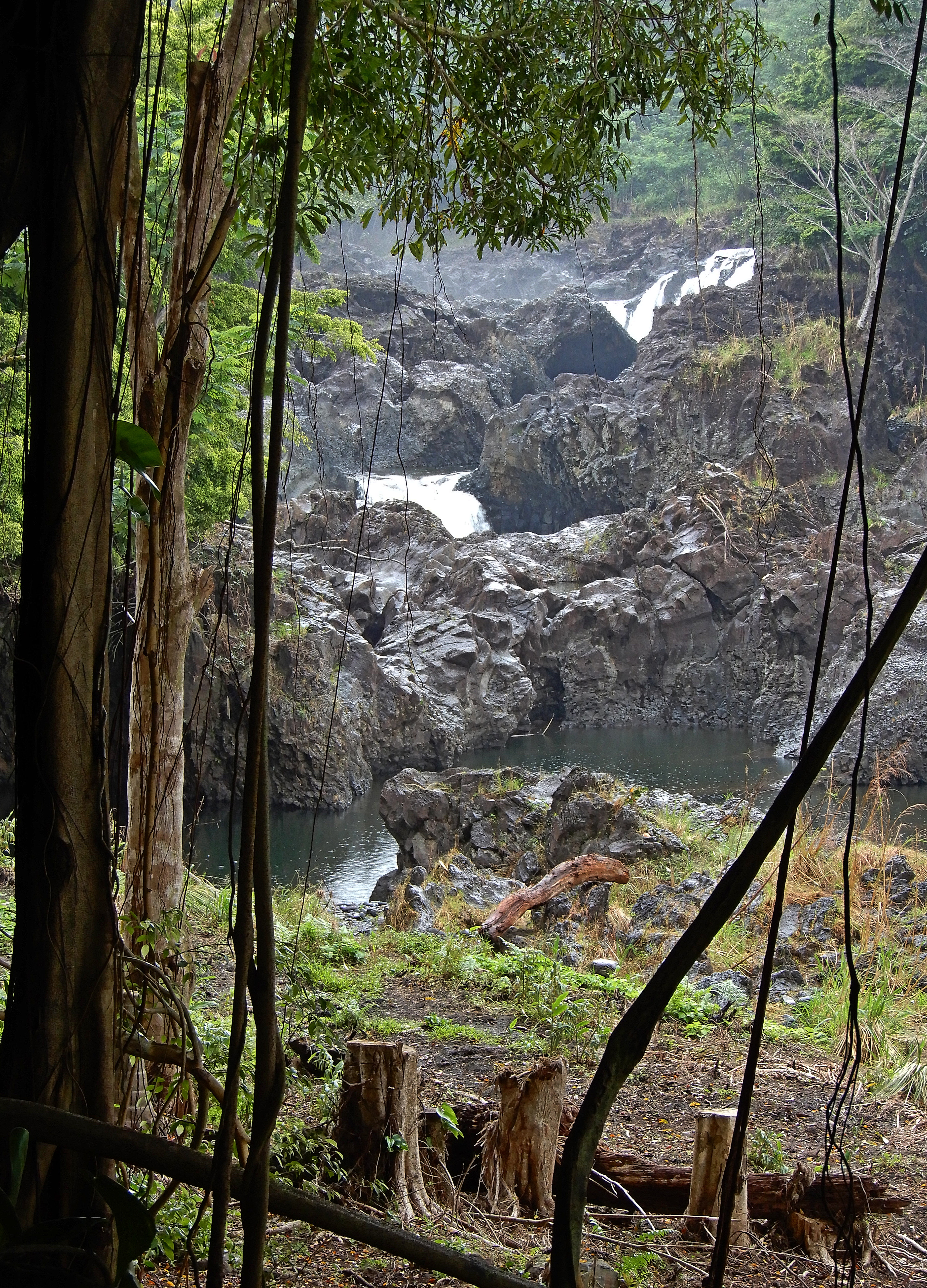
Rainbow Falls, Wailuku River State Park. Hilo, HI. September 2024.
Volcanic rocks made slippery with rain didn’t appeal to us. We stayed under the trees and gazed upriver, unaware another set of falls existed just a short distance away.
The Wailuku River above Rainbow Falls. Wailuku River State Park, Hilo, HI. September 2024.
Weather dictated indoor activities, so we headed to the Lyman Museum (recommended). Ravenous afterward, we grabbed fried plantains and beer at Ola Brewing.
Dawn over Hilo and Kuhio Bays delivered colorful dawns because of the clouds. Waking on our third morning, however, the clouds were thicker and more ominous. Weather generally arrives from the east, after all. Outdoor activities seemed like a bad idea. By this time I’d learned the clouds keep moving; one hour’s clouds do not the day’s weather make. We did collect a few drops later in the day, but the gnarly-looking cloud in the photo here passed by dryly.
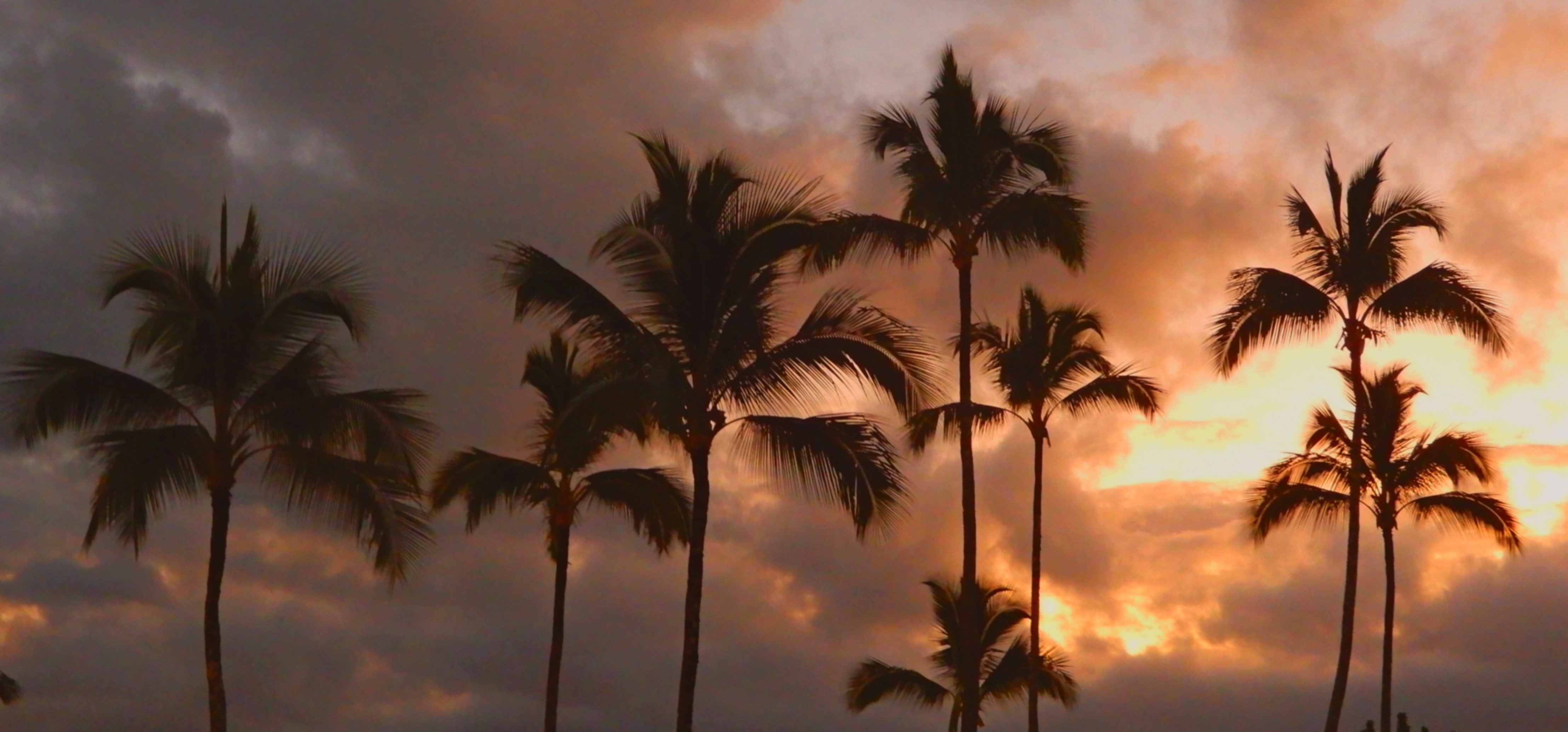
Palms over Hilo Bay at sunset. Hilo, HI, September 2024.
After visiting ‘Akaka Falls, we drove northward (which actually is northwestward) along the coast until we came to Waimea where we admired true free-range chickens and had lunch. I marveled at how dry it had become. The fields as we approached were pastures with cattle at times. Upon our return to Hilo, a day’s-end beer and sunset awaited us.
‘Akaka Falls. It really is this green. September 2024.
On our second full day in Hawai’i, we arrived to ‘Akaka Falls State Park near midday. We paid to park in front of the entrance rather than along the road as some did, paid for entrance, and received a warning from a woman there that the trail required one to go up and down more than 600 steps. Her warning wasn’t an empty one: for nearly a month after our visit I experienced a sharp pain in my left knee when I went up or down stairs. I later learned construction on the path forced us to take the long way around a loop trail, in essence covering three times the normal distance. This trail descends to a stream, crosses it, climbs again on the other side, basically cresting a ridge obliquely to be above Kolekole Stream which plunges 442 feet at ‘Akaka Falls. One hears but does not see a variety of birds. Foliage is lush, a result of the near-constant rain (measured best in feet). It sprinkled on and off while we visited.
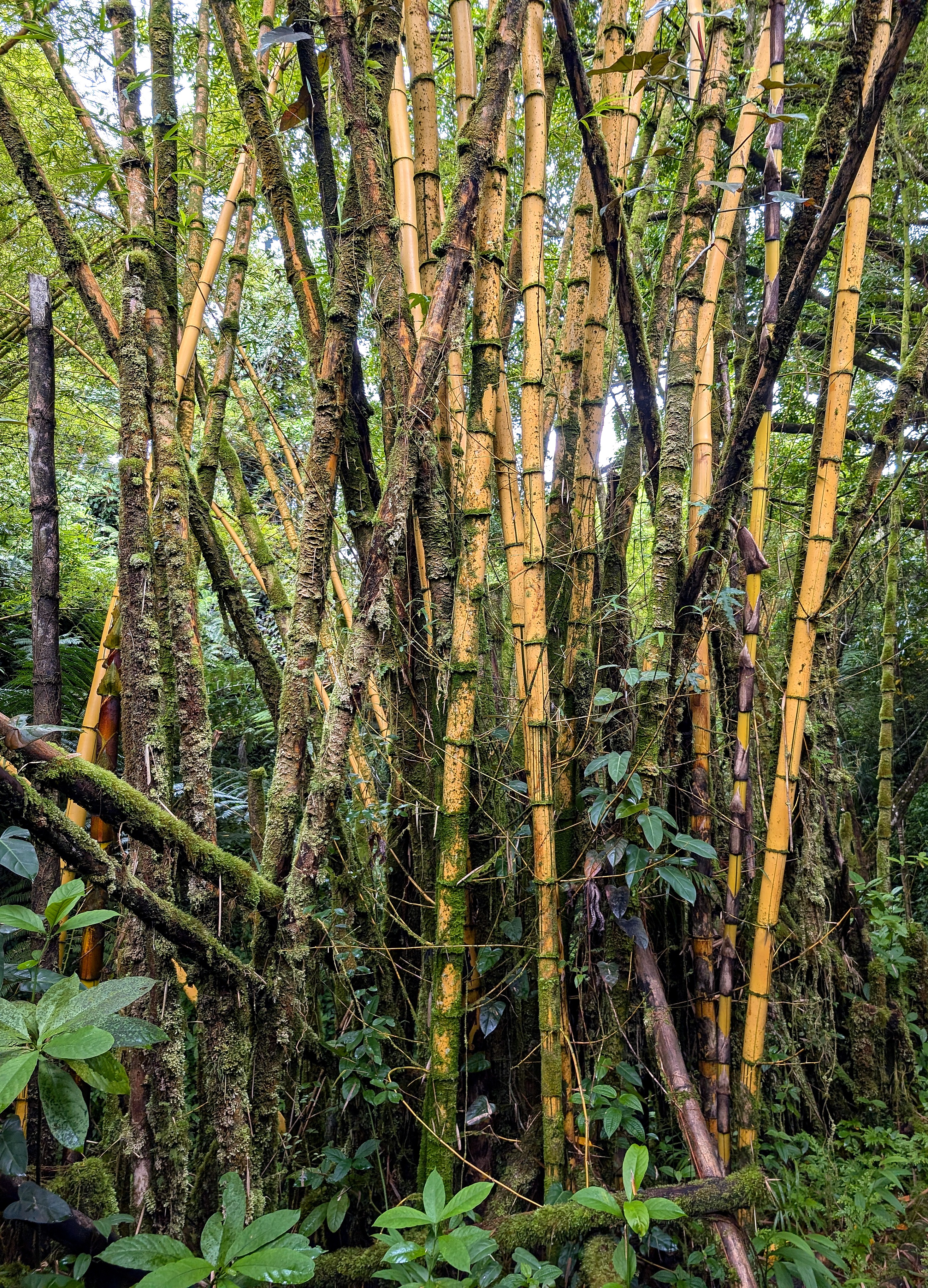
Bamboo stand in ‘Akaka Falls State Park, Big Island, HI. September 2024.
Our rental car, trees, vines, and a curve on the Old Mamalahoa Highway. The Big Island, HI. September 2024.
If you find yourself on the Big Island, and most especially if you stay on the east side in or near Hilo, a must stop (for the physically fit) is Akaka Falls State Park. As you head north to that park–only 15 miles distant, a very easy drive–just past Paukaa you’ll see a typically yellow/orange/ochre, diamond-shaped highway sign telling you that to your right is a “Scenic Highway” with a little sign beneath that says it’s four miles in length. Hopefully someone in your car (perhaps you?) will say as my wife did, “Let’s take that!” When you jerk the steering wheel to the right in the Papaikou census area (pop 1314), you’ll be on the Old Mamalahoa Highway.
These aren’t my best photos. Skies were overcast. Dense tropical foliage made it dark everywhere. Green predominates. The road twists, turns, offers few places to just pull over to grab a photo.
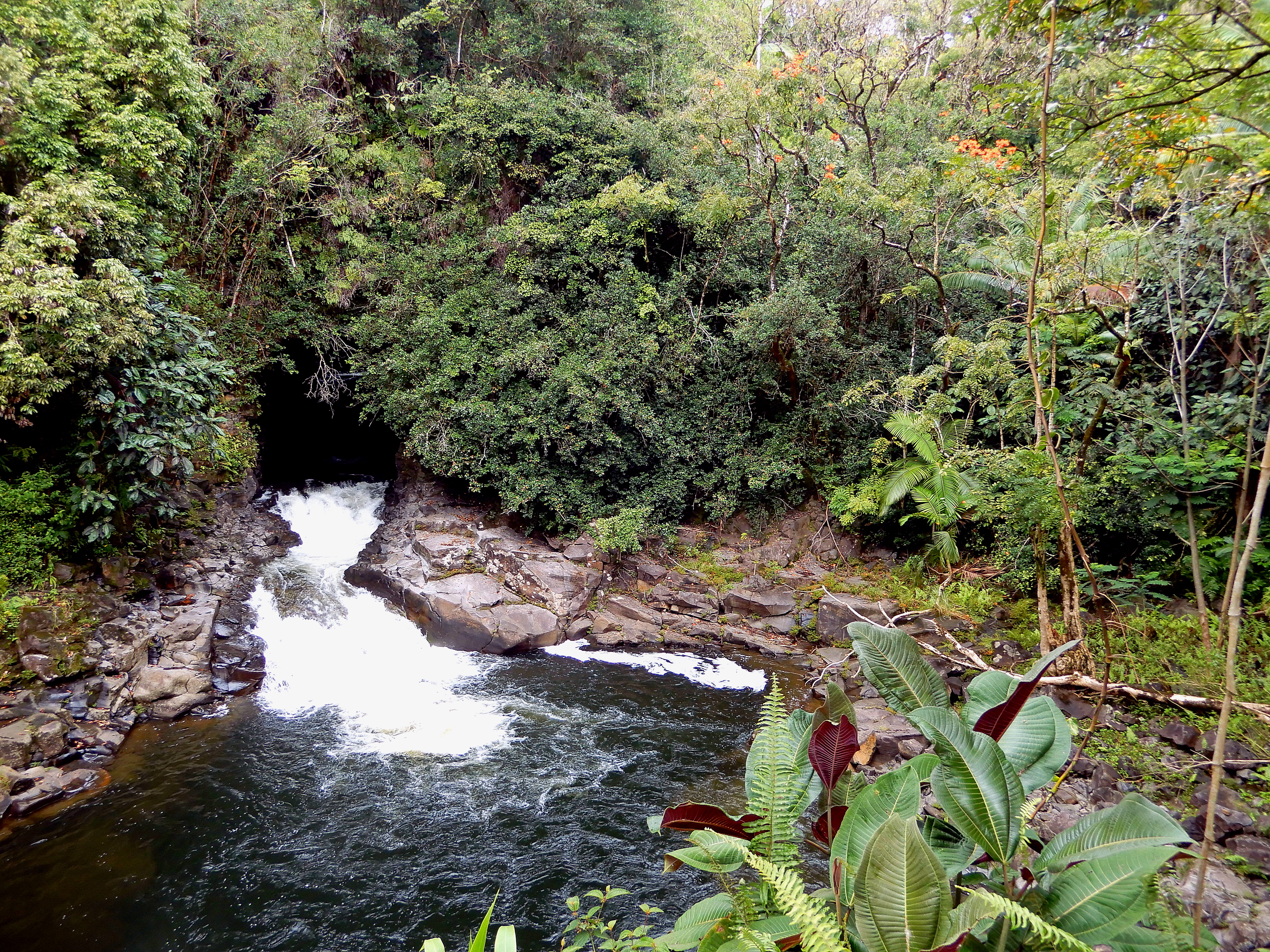
Halfway in we stopped at the Hawai’i Tropical Botanical Garden. It looked interesting, and it had restrooms. Our interest waned when faced with admission prices of $30/each and the prominent display of mosquito repellant for sale right beside the register. Translated from “customer-eze”, the signs basically said, “You’re a fool if you don’t apply repellant.” I’m sure it’s a wonderful point of interest: it features a valley down to the ocean with 2,500 species of plants. Nevertheless, we drove on. We stopped soon after when we found a bridge and a wide spot to pull off the road.
Kawainui Stream, Big Island, HI. September 2024.Kawainui Stream, Big Island, HI. September 2024.
I had become fascinated by a orange-red flower growing high in the canopy. At this stop we found ourselves above some of these trees, permitting me to photograph them:
Big Island, HI. September 2024
Driving north as we did, one suddenly pops out of the dense foliage and into a grassy pasture area on the edge of Pepeekeo. Joining the main highway, we drove on to Akaka Falls.
The Pride of America (Norwegian Cruise Lines) leaving Hilo Harbor, having just sailed through the opening in the breakwater. September 2024.
Our room at our Hilo hotel afforded me a delightful perk because it faced Hilo bay and its breakwater. I hadn’t realized only the larger rooms faced this direction–just a lucky pick, I guess. I’ve always had a curiosity about boats and ships, but especially commercial ships. I’ve never had a desire to work on a ship–heck, I barely want to be on one at all. Maybe that’s what makes it intriguing to see ships plying their trade in coastal waters.
After checking in to the Grand Naniloa hotel on a Tuesday, we witnessed a Norwegian Cruise Lines ship leaving the bay at dusk (above). By Wednesday morning I realized the passage in the breakwater lay to the west of us, but moorage lay to the east. Therefore, all of the ships passed our balcony in a leisurely fashion, guided by two tugs. (Astute readers will note the commercial docks in all my sunrise photos posted to date.) Within 24 hours I learned this would be a frequent feature of our visit.
Guiding her out; our first full day. September 2024.Dawn, our second full day. The Pasha Hawaii and a tug-guided barge of containers. September 2024.
I never did figure out the exact roles of the two tugs. One always headed out after the first one, and one always peeled off and headed back to the dock as they guided the ship in–leaving the other tug to finish the job.
Tug #2, heading out to catch up with the job at hand. Day #3. September 2024.Still catching up! September 2024.
They worked at night too….
Bringing in a container ship. Day #5. September 2024.
Getting ready to leave, again on a Tuesday, we managed to complete the cycle: the Pride of America returned to stay docked all day before heading out again on a Tuesday evening. We left a few hours later, but I still see it as I write these words, magical perhaps to no one but me.
The Pride of America, guided once again by The Tug That Remained. Day #7. September 2024.









 all the voices in my head