Reader’s horror 241210

Yesterday I read the word jell in the New York Times. If most errors I highlight represent analogs of fingernails on blackboards, this one joins a select group which seems more like needles in my eye or somesuch. Why? Because…

Once there existed the word gelatin/gelatine. In the very early 1700’s French people contrived the word (gélatine) from the Latin gelare meaning “to freeze, congeal” and has roots in the concept of coldness and freezing. Gelatin (my preferred spelling) became shortened to gel to make a verb meaning “to become a gelatin” and around the 1950’s took on a figurative meaning, “to come together and agree well.” Diverse opinions would get discussed and a consensus would gel around a course of action. It branched out to other shades of this meaning.

Once there existed the word jelly. We know what that is; we like to eat it on toasted bread products. Substances would jell to become jelly. By the beginning of the 1900’s a figurative meaning evolved, meaning “to solidify” referring to an idea or project ‘firming up’. A film in the works for years would start to jell around a specific path forward and a casting call would go out.

Though extremely subtle (and frankly, extremely subjective), gel means diverse things coming together and firming up. But jell means the innate properties of a something which should come together and firm up, do so. Not exactly the same.

Obviously both gel and jell look like twin brothers of different mothers, but by my childhood and young adulthood in the 60’s and 70’s the use of jell seemingly had disappeared. That’s a personal observance; maybe it remained widely used, just not in one blessed thing I read. During that time a common product, Jell-O, began whipping the commercial airwaves with every star personality it could find (even if some turned out later to have been sexual predators). And guess what? I began to see jell used where gel had been used before.

I suspect, have suspected, and will continue to suspect the re-introduction of jell doesn’t represent an informed decision to use a word with connotations of sweetness, and doesn’t get limited to projects or ideas firming up. It represents a giant wave in the ocean of writing which has rolled through the ranks of writers too damn ignorant or lazy to realize they’ve co-opted a contrived version of a contrived brand name which comes from gel. And the entire concept of gelatin itself was contrived when the product was invented.

I’m not going to rate this one because “nobody’s right if everybody’s wrong,” and I hate admitting I’m wrong. Hmmph.

Clouds from the ground

My first photo at Volcanoes National Park: a steam vent on the edge of the Kilauea crater. September 2024.

The island of Hawai’i could be called triangular. The west coast roughly runs north to south. From its northern tip, though, the coast runs northwest to southeast. Then from that easternmost point it runs northeast to southwest to join up with the west coast. Situated inland from the southeast-facing coastline lies Volcanoes National Park. Volcanoes presents much more than just dormant craters. Its most active feature (inland) turned out to be the first thing we saw: steam vents. Craters? I found their vastness difficult to comprehend.

Kilauea from steam vents on north rim, looking southwest. September 2024.

I’m not even sure the photo above shows only Kilauea. I see “Hale Ma’uma’u Crater” on the ol’ Google Maps. Lava flowed in 1919, 1921, 1954, 1959, and on and on I would guess. I paid little attention to information, so I’ve only myself to blame! Seeing it seemed more important than reading about it on signs, the internet, pamphlets, and the like.

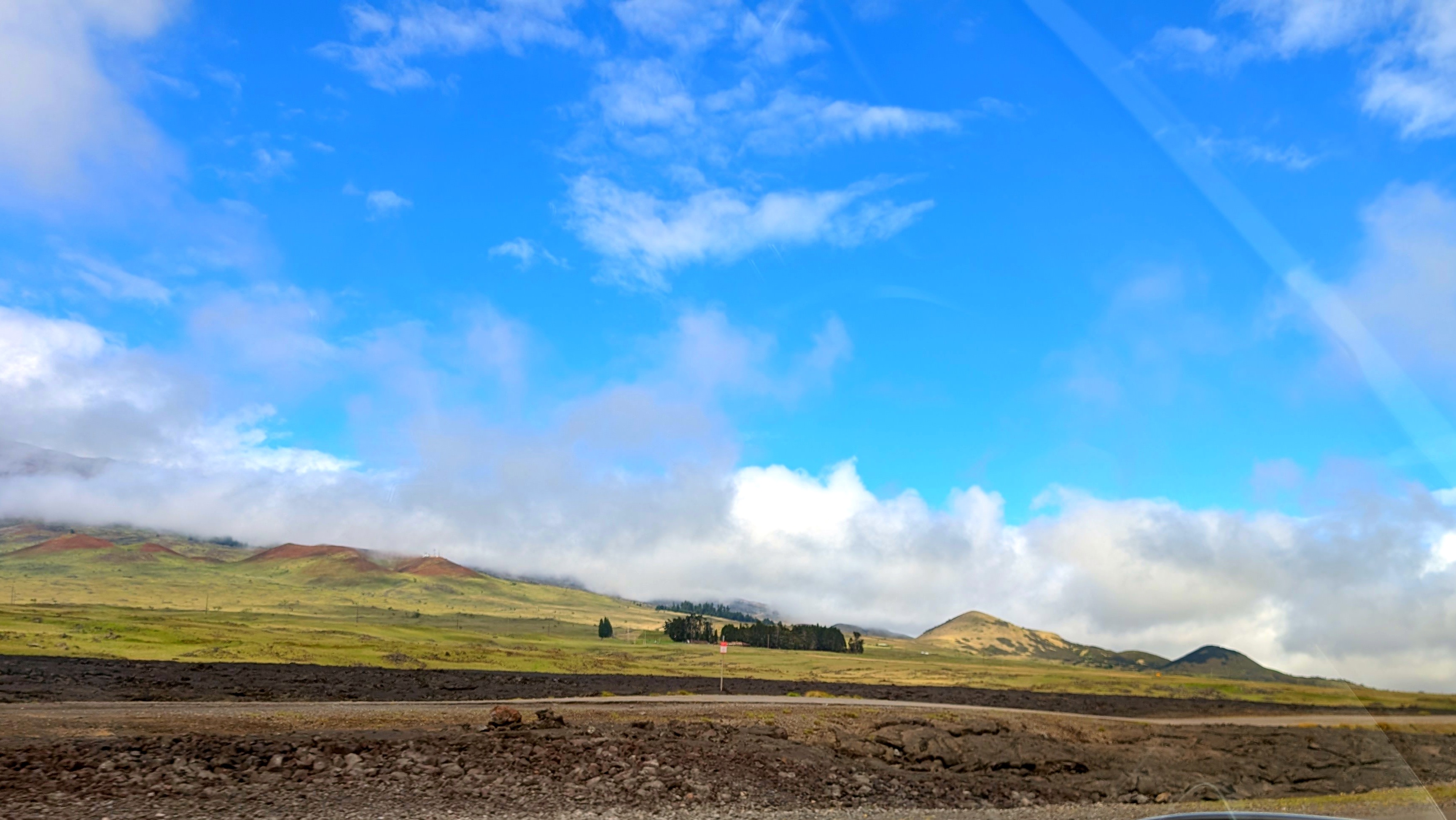
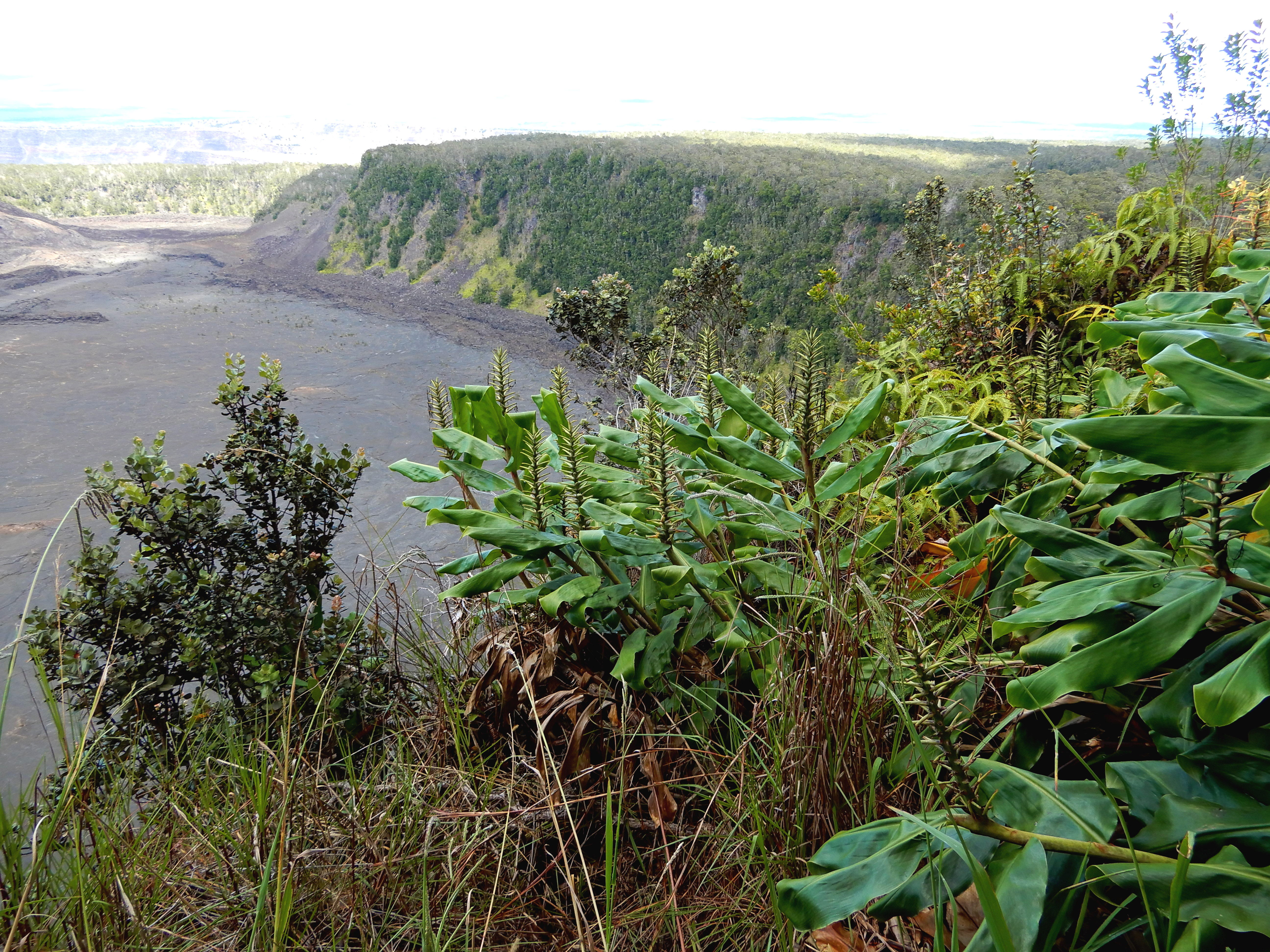
Trade winds blow northeasterly toward the park. There are dry plains inland, but plenty of slopes catch the moisture. Plant life abounds there. Even in this dryness:

On the edge of the steam vents. Volcanoes National Park, September 2024.

Where the rain can fall, things change rapidly. Just a few miles away from the photos above…

Kilauea Iki Overlook trail. Volcanoes National Park, September 2024.

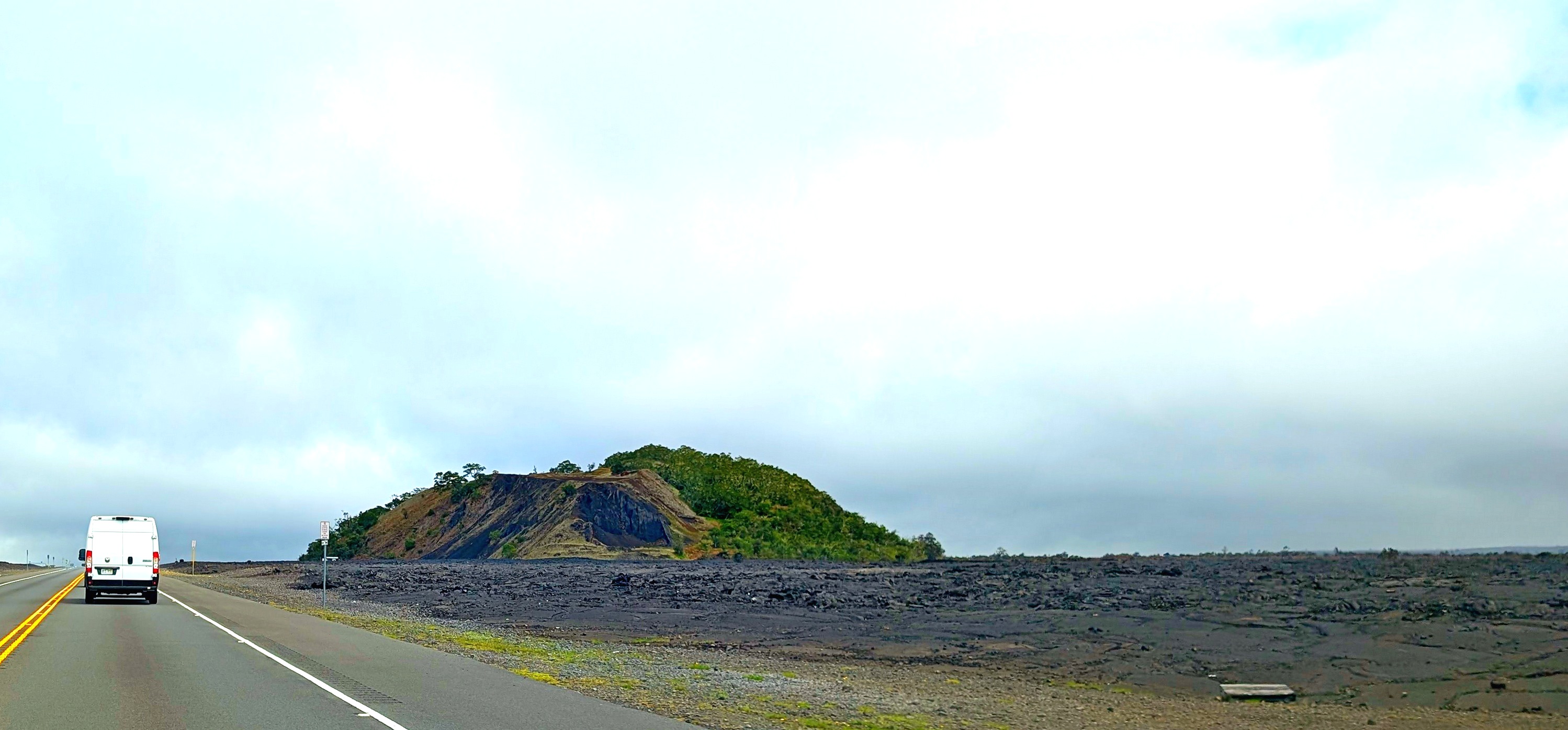
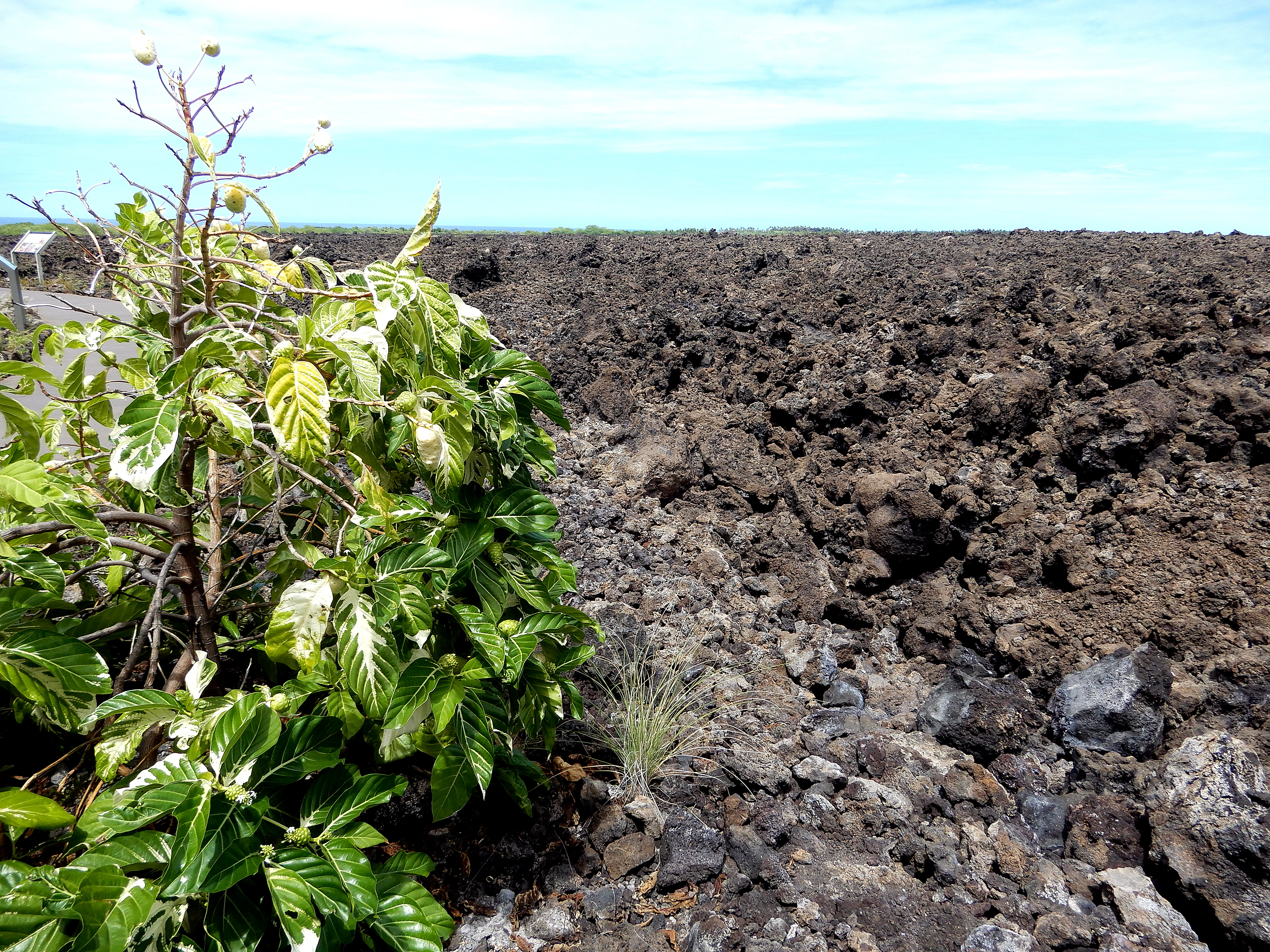
Eventually I realized this incredibly wide circle we were tracing surrounded a ‘family’ of volcano craters. We continued past many tantalizing side trips, acknowledging our (a) laziness, (b) general physical un-fitness, and (c) certain time constraints. Turning off of the Crater Rim Drive where it intersected Chain of Craters Road–further westward travel was blocked–we traced the path of lava flows to the ocean.

Approaching the coast in Volcanoes National Park. September 2024.
Where lava meets the sea: Holei Sea Arch. Volcanoes National Park, September 2024.

Now that I know more about this park, I would go back to look into lava tubes, to hike a bit here and there, to see if some of the roads had opened up, and to maybe hike down into a crater…maybe. It looked kinda boring to be truthful.

‘Yep, the rock looks just as black down here. Why did we hike down here again?’ Volcanoes National Park, September 2024.

It all impressed this guy who grew up with the volcanoes of the North Cascades, a far different kind of thing.

Cats, humans, and existentialism

Petunia, in the winter woods. Circa 1984.

Petunia became known as the Acid Cat, christened as such by my friend Jeff after he watched this little tiny ball of fluff race up and down our hallway bouncing off of the walls, Ricochet Rabbit-style. I am not exaggerating. She would jump up and bounce off of the wall about a foot above the floor, like a parkour athlete.

This post represents bait-and-switch, however. Petunia only stands in for Henri. My wife and I have just finished watching a couple of YouTube clips of Henri the Existential Cat, a series we dearly loved a decade ago. If you have never heard of this, I direct you to this link in which Henri more or less gets introduced, and this link which shows Henri encountering a new resident of the house. But I would encourage you to watch them all. It will take an hour or two out of your day. You will likely thank me, particularly in these times of trial when existing might be the most we can hope for. Henri rather perfectly sums up my existential dilemma during this time of Advent with mindless Christmas celebrations of mercantilism all around me.

[Unfortunately, some of the episodes have been taken down. It has been 11 years after all. Try this one instead. It’s newer, but gives you a very good introduction to his attitude and his feelings about his roommates.]

Merry Advent, y’all. I’ve just about finished my Christmas newsletter, supercharged by my new approach to it. More later.

Flaking out

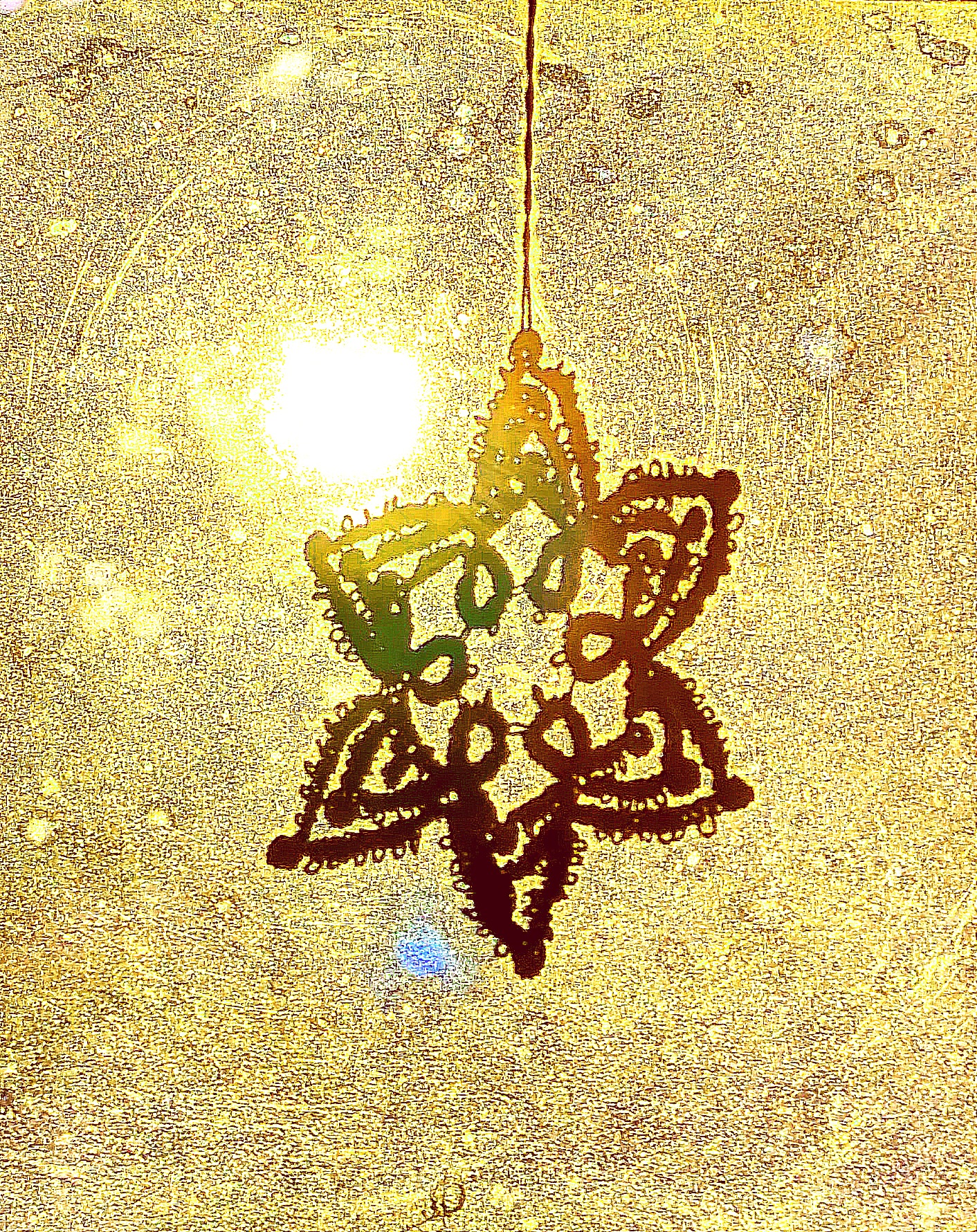
Tatted (and tarted) snowflake in a window. November 2024.
  • I discovered 30 minutes in my day! Our holiday newsletter has reached 50% completion. For the first time in several years, I am “on schedule”—I dare not say “ahead” both due to the Law of Jinxing and because I see little time to work on it during the next two days. My Sunday deadline approaches, just as Tuesdays did decades ago when I worked on weeklies. Let me tell you, there’s nothing like starting a Tuesday knowing you don’t have enough copy to fill the empty pages! It really gets the creative juices flowing! I used the same approach as a teacher, walking in some days only clutching a topic in my mind. Lesson plans? Hah!
  • We kicked Covid out for good this week, but like with any unwanted guest there’s a bit of cleaning up to do. Last night’s choir rehearsal—my first in four weeks, my second in two months—did a number on my throat, partly because I had to violate the “sing from your diaphragm” rule on several pieces. My muscles ache from weeks spent primarily sitting in this office chair. The cough hasn’t completely disappeared either, small but annoying.
  • And lastly, one of the readers of this site and the one who partly inspired a trip to Michigan in 2023, may be amused by the photo below. I’m not a cider drinker, but I think this is being newly distributed here in NC:
From the exurbs of Detroit! Spotted in a Raleigh, NC, grocery store. November 2024.

Blogus interruptus

I’ve reached the Thanksgiving through who-knows-when-it-all-will-get-done time of the year. My current project, the annual Christmas newsletter, occupies virtually all of my writing bandwidth because it’s a true news letter. This old journalist packages it as a four-page newspaper complete with individual stories, headlines, a masthead, photos, captions, all of it written in the third person. It takes 40 to 80 hours depending how much I agonize over it. (I’m lying: it takes at least 80 hours.)

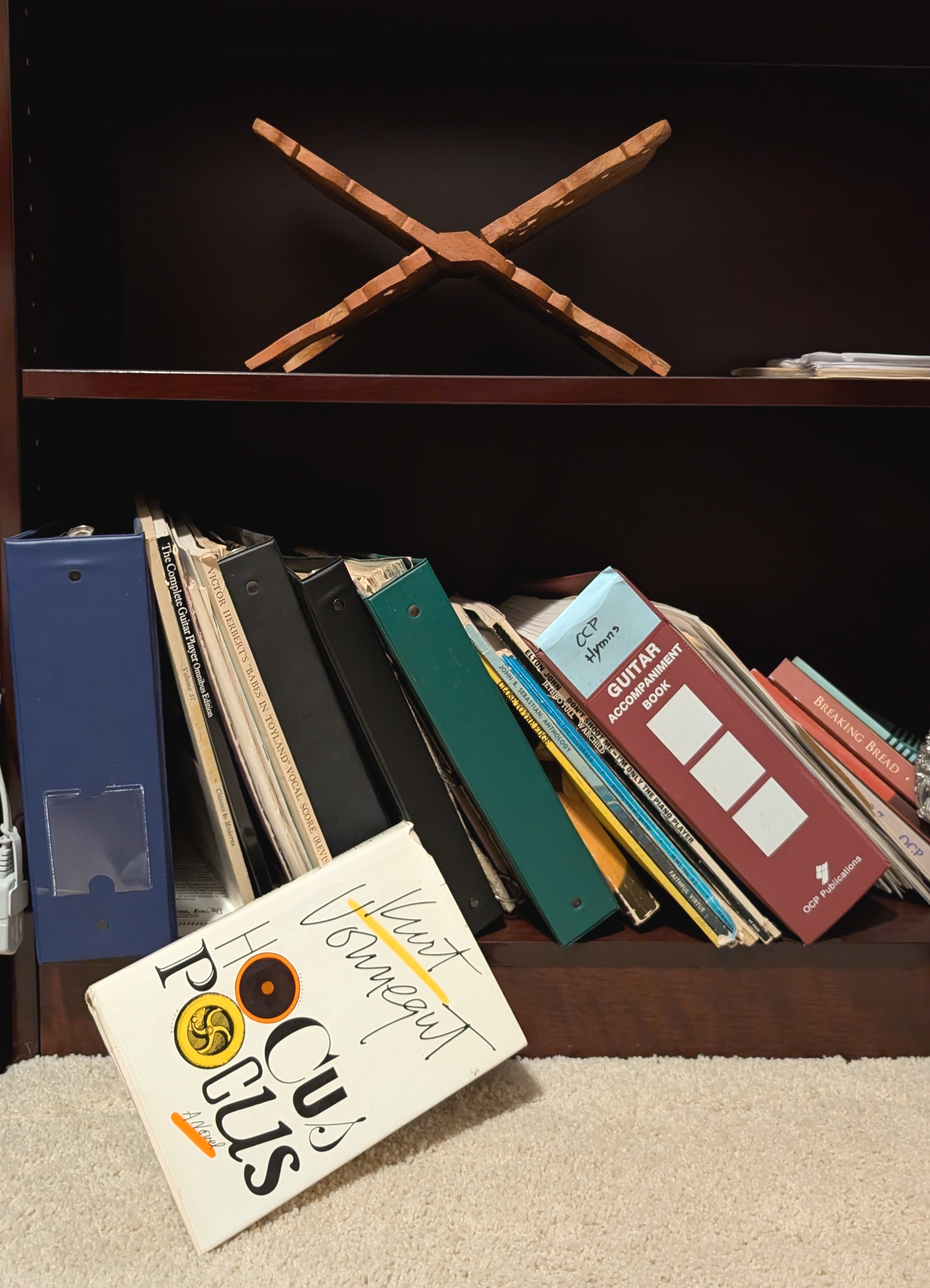
Meanwhile, one of our cats decided to get his paws on some Vonnegut, but apparently became disgusted it wasn’t Cat’s Cradle.

The original shelf for this book is the next one up from the bookstand in the photo. I didn’t even know they could read. December 2024.

A perfect day for…

…volcanoes! We forced the agendas for our final two Big Island sightseeing days, simply by allowing our lazy natures free reign. Sunday received its designation, Volcanoes Day, and promptly rewarded us with an atmospheric eruption.

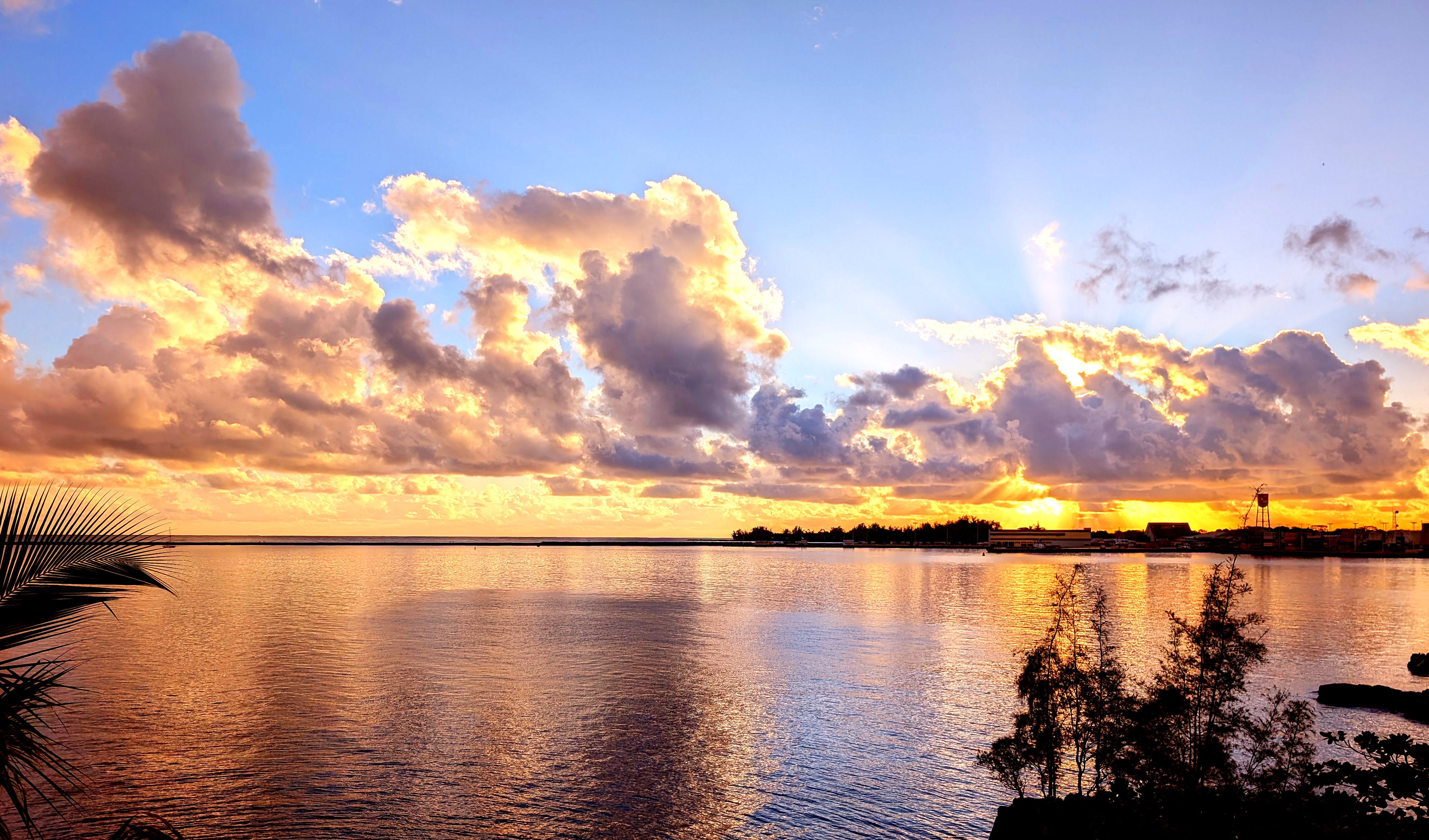
Yes, the colors are emphasized. Reality always seems more dramatic than can be captured photographically.
Sunrise over Kuhio Bay. September 2024.

A selective, pre-Thanksgiving playlist in narrative form

A few days ago my Daily Discovery playlist on Tidal offered up a track by Robben Ford, “Talk To Your Daughter” from 1987. It was pretty good, good enough to click through and see what else he’s done. Holy crap. The guy’s been around for 45 years and he’s still playing it hard? How the heck have I gone all those years and never heard of this guy?

After listening to that entire album, I listened to his newest recording available on Tidal, Live At Montreux 1993 released in 2024. Okay, now I’m really intrigued. He’s playing blues sometimes, jazz other times, and he’s echoing Jeff Beck, Kenny Wayne Shepherd, John McLaughlin, Al DiMeola, and a bit of Eric Clapton? His vocals sound like JW-Jones (another great guitarist)?

I’ve since listened to Night In The City (Live) partially; Schizophonic (again, partially); and Lost in Paris Blues Band a perfectly excellent recording with six other musicians I don’t know. In the discography I see he’s played with Bill Evans for an album released in 2019. If that’s the jazz pianist, I’m intrigued. He’s played with Charlie Musselwhite and Jimmy Witherspoon before turning 25. His first solo album in 1976, Schizophonic, resulted in the Yellowjackets, a well-known American jazz-fusion band. He’s release 30 albums, either as a solo act or with a partner or two. He’s played as a session musician in so many sessions it’s difficult to count. Let’s just throw a few names in: Miles Davis; Jing Chi; Little Feat; Tommy Emmanuel; Barry Manilow; Michael McDonald; Bob Dylan; Joni Mitchell; and gosh, we better stop or I’ll just be pasting in the Wikipedia article. Let’s just add this: five Grammy nominations and named one of the “100 Greatest Guitarists of the 20th century” by Musician magazine.

Additionally, we watched Elvis Costello and T-Bone Burnett appear on The Late Show with Stephen Colbert which prompted a bit of listening of tracks from my favorite (and only) Burnett album, The Criminal Under My Own Hat.

In other listening news:

  • Delbert McClinton’s Nothing Personal continues to enthrall with its combination of country, blues, and soul. Highly recommended if you like the raw side of music.
  • I’ve been reading Rocks Off: 50 Tracks That Tell the Story of the Rolling Stones by Bill Janovitz which tells the musical history of the Stones through what he considers to be salient songs. It’s a joy to listening to the tracks while reading his in-depth analysis thereof. I’m up to “Under My Thumb”.
  • And finally, all this good semi-modern blues, i.e., “it came out since 1990,” drove me to Kenny Wayne Shepherd. Today’s final albums: Dirt On My Diamonds, Volumes 1 and 2 (two separate albums) and Live In Chicago still one of my favorite live albums. If you don’t get either a chill or a jolt from “Dance For Me Girl” then you’re either not a rock/blues lover, or you’re not alive.

Reader’s Horror 241122

“Remember when Trea was the shiny new thing we were all exited about, back before we kneeled beside our bed each night?”

The above was posted on The Good Phight, a semi-professional blog about the Philadelphia Phillies hosted on SBNation. In case your eyes zipped over it, the error is “exited” for the intended word “excited”.

Author’s role: This is an author who has a day job. Writing never danced on stage for him as a possible role in his adult life. We therefore rate this a 2.

Egregiousness of the error: This is either a typo or an autocorrect error the author missed. (I doubt any editing occurs on this site.) A plain typo rates a 1, an autocorrect a 2. I’m going with the benefit of the doubt here that he just plain forgot to hit the “C” key. It’s a 1.

My personal reaction rating: I like this site. I willingly suffer the numerous run-on sentences, the failed verb tenses, the just plain “WTF did he mean there” writing. This is more mild than mild for this site. I’m giving this a 0.

Final rating: 3.

A soul’s place

Twenty-five years ago I purchased the book A Home for the Soul: A Guide for Dwelling with Spirit and Imagination by Anthony Lawlor. It featured beautiful photos and promised to address that point where functions meet features and both bow to the soul. Unfortunately Lawlor’s book, though gorgeously printed, never connected with me–it remained a beauty with no brains. I mention this because the idea has long played out in my head and heart that we are drawn to some places on Earth more than others, despite our innate interest in almost all of them. I’ve mostly thought this gets imprinted on our psyches during the formative years of our childhoods, much as ducklings will imprint on their mother. (I wonder how this would work with children of military personnel and others who move their families frequently to vastly different geographies?)

Recently a friend of mine quoted author Pat Conroy who made his mark writing books set in coastal South Carolina, including The Citadel in Charleston. In this particular quote, Conroy described how the Low Country spoke to his soul. This returned me to my

South Carolina Low Country. Edisto Island, October 2014.

ideas of place. Much as I like the coastline of Eastern America, and the distinctive features of it from Chesapeake Bay south, it never ‘grabs’ me. Intellectually, I love its nooks and crannies, its sultry feeling which exudes relaxation, its birds, the novelty (to me) of its marsh grasses, and the soul-satisfying feeling brought on by its mostly horizontal nature.

In Hawai’i, though, I found my heart beating in sync with its coastline as if I had found a long-lost sibling. I suspect this has something to do with being taught at an early age that “coast” means “what it looks like around Puget Sound” and to a lesser extent the Pacific Coast of Washington State: volcanic rocks to the coastline; cliffs of sand, sedimentary rock, and mountaintops which send their flanks plunging through the intertidal zone to significant depths in mere meters. But could it be more genetic? As far as I know, my ancestors all came from either Norway or that island divided into England/Scotland/Wales. From photos it seems a rocky coastline, lashed by pounding waves, much of it featuring knobby cliffs which prohibit dipping one’s toes in the water–and this water is crystal clear.

A lovely day in the Pacific Northwest–it’s not raining! North of Newport, OR. October 2011.
Compare and contrast: another west-facing Pacific Ocean shoreline. Maui, HI, September 2024.

A counter-argument: what to make of the three centuries my patrilineal line spent in the mountains located at the Virginia/North Carolina border? Of my matrilineal line descending from the hollers of Kentucky to live along the Ohio River? Do I counter that with my father’s mother, whose parents stepped off the boat straight from Norway? Or the suspected similar condition for my mother’s father who was put up for adoption by a Swedish lass?

I land on nurture more than nature. I believe my father preferred eastern Washington with its undulating surface of grains and grasses because he had been raised in a similar grassy, agricultural flatness outside Minneapolis and later, in Havre, Montana. My friend associates the North Carolina coast with meaningful times in his life, not least of which was refurbishing a getaway house on the Intracoastal waterway with his father. My brother and I experienced a semi-dry climate through high school. Perhaps this explains why, after decades spent in rainy and cloudy western Washington, he retired to Santa Fe?

The rolling wheat lands 40 miles west of Spokane, WA, where I grew up. See also Havre, MT, and the breadbasket swath of Middle America. August 2017.

Unless…unless… I must admit, I like rain. I discovered this when I moved to the Philadelphia area in 1992. In 1997 I returned to Spokane, WA, a semi-arid part of the country. Four years later I could barely get out of town quick enough, and the dry, dusty summers played a large role in that attitude. I found I did like rain, just not the rain of Puget Sound which I experienced on and off during my childhood and lived in from 1976-1981. Rain on the east coast of America doesn’t resemble rain in the Puget Sound area, despite both regions receiving similar amounts annually. (Philadelphia–41.45in; Seattle–37.13in, both according to WorldClimate.com.) Rain clouds on the east coast bring rain, and then they go away. Rain clouds in Puget Sound just hang around seemingly forever, misting you once in a while to remind you they carry moisture. Where, then, does this love of rain come from? Why don’t I like snow? I experienced it every winter of my childhood, and I continued to do so through my 47th year. Is it my North Carolina ancestors calling to me through our shared genes, reminding me that for centuries we Pilchers have enjoyed warmer, less snowy climes? If so, would they in turn find the wind- and surf-lashed cliffs of western England and Wales instantly familiar and soothing? It’s a confusing amalgamation of influences.

Maybe we just like what we like, inexplicable as it may be. A postcard I have reads: “Every traveler knows it is possible to be homesick for a place one has never seen.”