Reporter, editor, photographer. Eighth grade teacher of English and computers. Actor. Quality assurance professional for pharmaceutical manufacturing. And always a writer.
Dawning sun over Bois Blanc Island and Lake Huron, due east from Mackinaw City, MI. July 2023.
On Day 5 we found ourselves in Mackinaw City because I wanted to visit Mackinac Island, primarily because my parents had visited there some decades ago and raved about it. Mackinac Island prohibits cars (although they cleverly hide the internal combustion-powered snow removal equipment). Transportation occurs on feet, horseback, or some form of a bicycle/tricycle. While there we observed a plumber cycling through the woods with a little trailer carrying his tools. When planning the trip I had rearranged part of it to avoid being there over a weekend. When we viewed the crowds on a July Thursday it seemed a well-thought idea.
One travels to Mackinac Island primarily by ferry (unless one owns a boat or is rich enough to fly to the tiny airport). Two ferry services exist, both privately owned. Ours ran different types of boats at different times; like many things having to do with Mackinaw City and Mackinac Island, little explanation was offered. My supposed purchase of ferry tickets when I booked the hotel turned out to be so much nothingness: we were told on check-in to let them know if/when we wanted to ‘activate’ that purchase. When we did so and got to the ferry dock, we got in a very small line to enter the waiting area for the ferry, only to be told that we only had vouchers which needed to be redeemed for actual tickets. That line serpentined like a badly organized TSA check-in. Bottom line: just go buy a ticket, the voucher system only added 15-30 minutes to the process. Our particular ferry took an extra five minutes to motor north and westward at the beginning of its voyage so that we could pass under the Mackinac Bridge–at the time it was built, the longest in the US (or world?):
Mackinac Bridge, MI. July 2023
For an island where the easiest form of transportation is a horse-drawn taxi, Mackinac surprisingly is not small. Maps show it to be more than 2.5 miles long by 1.75 miles wide (both at their greatest distance). We were put off by the admission fees in place for pretty much everything, including people who would give you a tour of their historic house for a fee. Feet are free, however, so we hiked up the steep(!) slopes, eventually coming out at the highest point of the island with a decent view toward Lake Huron:
Lake Huron and the coastlines of Canada from Mackinac Island. Sugar Loaf in the foreground. July 2023.
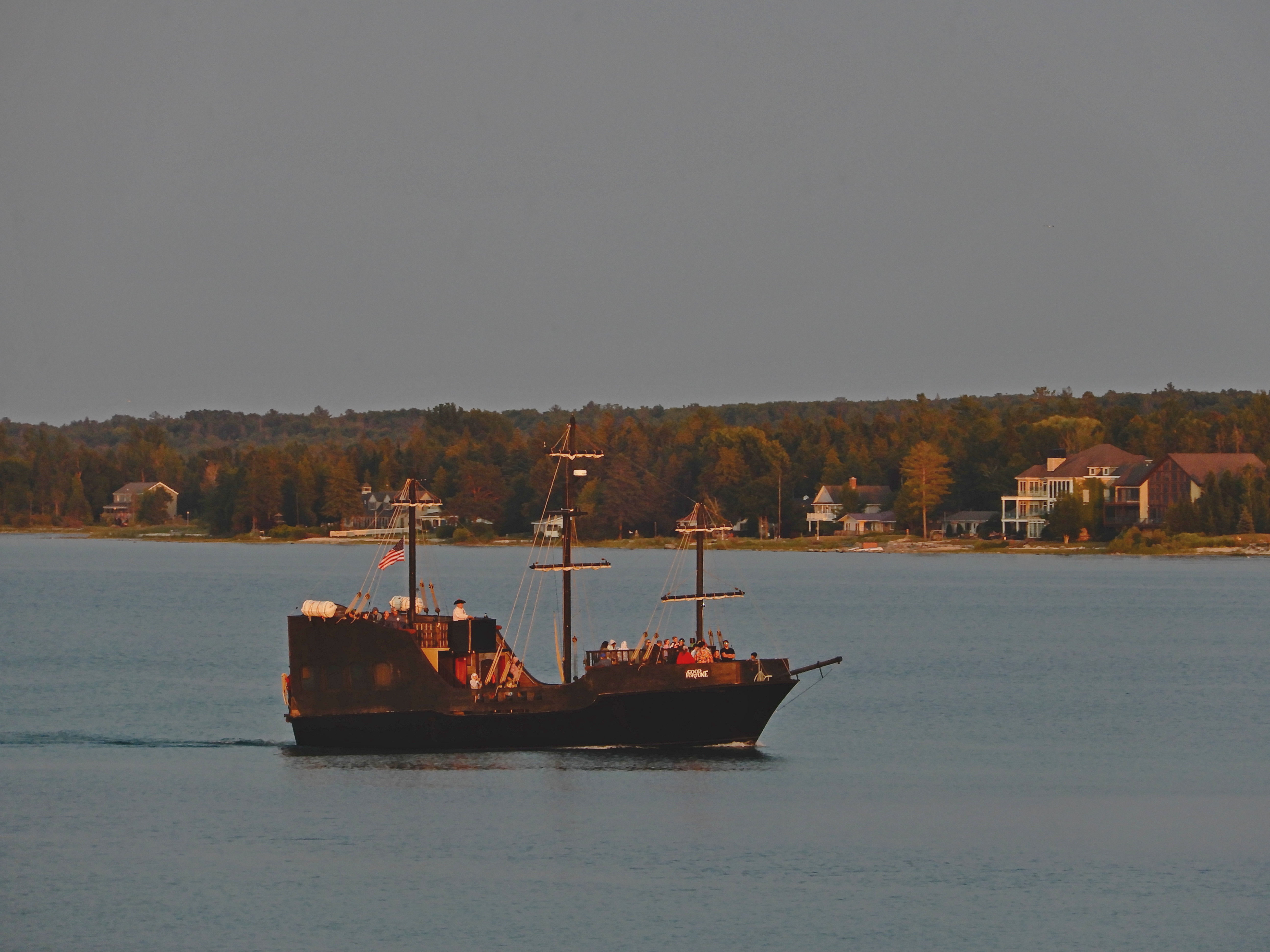
A “short cut” through the cemetery, a stop for beer, and it was back on the ferry for us. This trip occurred on a much slower boat, but it beat waiting an extra half hour for a quicker one. A fine dinner of Great Lakes fish with a wonderful view really topped off the day. As the sun set, we saw the ‘special’ Pirate Ferry ride coming in. (We never did figure out what pirates plied their trades on Lake Huron, nefarious or otherwise.)
“Pirate” vessel, Lake Huron, Mackinaw City, MI. July 2023.
Continuing the virtual vacation. Day 1 is here. Day 2 is here and bundled with Day 3 which are here.
Day 4 dawned in Lansing. I woke just a little bit keyed up because we were going to recreate a photo my parents had taken of my dad standing in front of the house he first lived in starting in mid-1925. I’ve detailed that in a scant century of weirdness, which I posted in mid-July. After spending the morning doing that, we returned to the hotel via the state capitol building.
State capitol in Lansing, Mi.\\I. July 2023.
With both the students and legislators apparently on break, Lansing seemed to be a ghost town. We noted some architecturally interesting buildings…
Boji Tower, downtown Lansing. I believe this was/is where the state senators meet or have offices. Lansing, MI, July 2023.
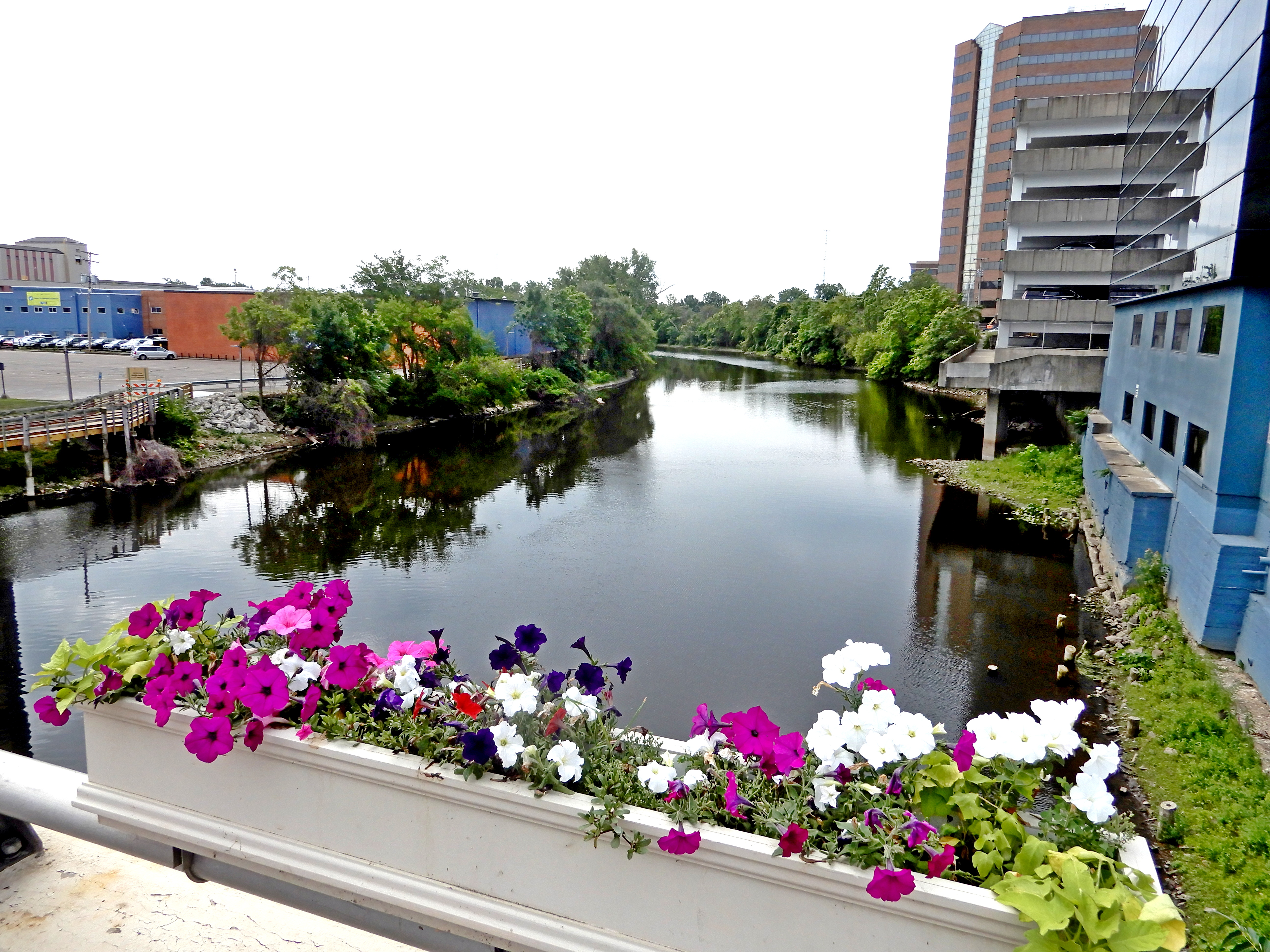
…and crossing the Grand River we resupplied and headed north to Mackinaw City.
The Grand River, downtown Lansing, MI. July 2023.
If Day 3 gifted us with the joys of road tripping, Day 4 erased those good vibes with its monotony. As noted before, US-127 changes its stripes in Michigan showing a real wannabe-a-freeway side. No decorous farms noted our passing. The road barreled past interchanges promising to take us to where most of the little towns and cities apparently went to hide when the concrete came through. Finally the highway gives up altogether, joining I-75 for the final 90 miles or so to Mackinaw City. I made a seemingly boneheaded maneuver when I missed a detour route–road construction occurred everywhere but was especially prevalent in Michigan–and in a sudden panic, turned us onto a “no re-entry” road. The ensuing journey back to I-75 turned out to be the best part of the trip as we were shunted all over the upper tip of the peninsula through small towns and beside pretty lakes before popping out on the streets of Mackinaw City.
Michigan’s road travels seemed particularly boring. Maybe we just weren’t in the right mood. On this day the weather was overcast all day. We don’t like interstates and other controlled access roads except when we’re in a hurry, and on then we usually hate them anyway due to the gridlock traffic jams slowing us down. Looking with Google Earth shows me plenty of lovely forested road in the latter part of our route. Did we just get jaded by then? No matter. We arrived with relief to our hotel in Mackinaw City, the Hamilton Inn where the delightful all-Jamaican staff welcomed us warmly. Yes, all Jamaican. We learned that evening about how one family owns most of the hotels and restaurants in town. We’re not sure if it goes that far, but the Michigan Attorney General’s office probed those businesses a couple years ago and a Public Radio article mentioned at least 20 hotels being owned by the family. We were directed to restaurant across the street where staff also appeared to be Jamaican for the most part. Interesting…
I already summarized Day 2 on the evening it occurred. Our newest National Park outdid itself to interest the casual tourists; we’re excited about visiting many more times to those parts of the park we couldn’t get to. Most of the park (and indeed the state of West Virginia) appeal to the outdoorsy person but I’m an indoorsy person. I’ve been such all my life. As a teenager I might reluctantly put down the book I’d been reading most of the day when the neighborhood guys came around recruiting for a pickup game of football. As a college student I spent many hours biking (freshman) and canoeing (senior), but generally, if you just put a book in my hands, a glass of something handy, and I’d be fine. Indeed, one of the best parts about teaching junior high occurred when I’d arrive home around 4 p.m., pour a beer, light up a cigar, and settle into a chair outdoors, book in hand. West Virginia and New River Gorge N. P. offer a lot to the outdoorsy person. For me, it’s attractions are historical sites, nature, minor hiking, and the general scenery of a mountainous area.
As we left the park and stopped to check our directions, I learned a little about about baseball. I’m a moderately obsessed fan, but baseball grew up with our country unlike other sports here and has deep roots in much of Americana. Who knew that in the middle of semi-nowhere the Cincinnati Reds played an exhibition game?
Historical marker in Glen Jean, WV. July 2023.
Day 2 ended in Cincinnati, adding some serendipity to seeing the marker above. (And 50-cents for admission?! “They must think we’re rich!”) Arriving in Cincy, the calendar thwarted our dinner plan: the Jamaican restaurant Island Frydays didn’t open on Mondays. Instead we walked a couple blocks to a combo Indian and Ethiopian restaurant, two cuisines I never would imagine under the same roof. I felt some trepidation at the Ethiopian offerings (as did my wife); we stayed with the curries and attempted to educate the waitress about beers.
Day 3 offered the discovered joys only a road trip can bring. I noticed that US highway 127 paralleled I-75 but 20-some miles to the west of it. Traveling interstates seems to be not much different than surface highways, except for the continual slowing down and stopping demanded by the latter. In actuality they exist worlds apart. By their nature, interstates isolate you from what you travel past. The insulating nature of “limited access” soon numbs the driver from venturing off the concrete until his gas tank or stomach or kidneys demand it. Foliage, buildings, signs, people are all pushed back from the margins of the traveled road. Sights become the background bit players to the star: the interstate itself.
By contrast, traveling on any other highway surprisingly delights. Though it seems to travel the same route through the same countryside, it does so with panache, familiarity that borders on intimacy with its surroundings, and a deference to the towns which lie along its path. Unlike the interstate, the humble highway goes out of its way to connect town after town rather than pass them by and forcing them to grow strip malls and ‘satellite business districts’ along its path to fill the coffers of the local businesses. We had a lovely day to travel. Temperatures were in the mid-80s, the blue skies sported a few scattered clouds, and we were in no hurry to get to our destination (Lansing). It’s rare to find one highway which connects your departure with your destination; we made the most of it, stopping at will but mostly just admiring the fields, the architecture of the houses, the peculiarities each town develops over time, the crops which differed from North Carolina (or Pennsylvania or Washington), and those little things appealing only to us such as how the soundtrack from my digital audio player seemed to curate the sights taken in by our eyes.
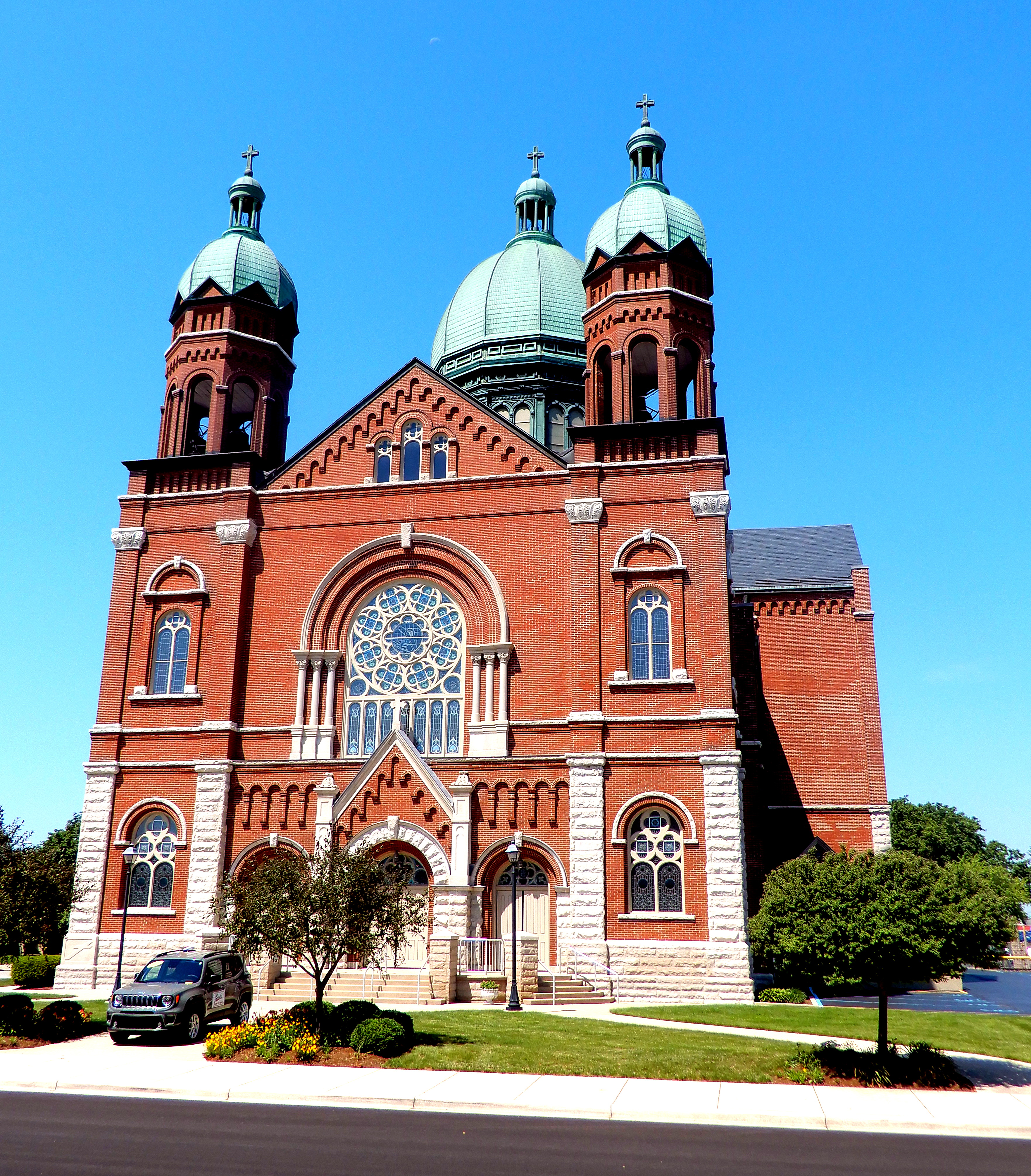
We left greater Cincy through the Mt Healthy incorporated limits, provoking a few chuckles. North of Dayton (which we avoided on US-127) we skirted the shore of Grand Lake and encountered Celina, the seat of Mercer County, population about 11,000. Traveling a minor detour in town, I suddenly espied sacred architecture. Instinctively, I turned left. One block off our route stood this church:
Cathedral of the Immaculate Conception Catholic Church, Celina, OH. July 2023.
After minor research I’m still uncertain why this is a cathedral as it seems not to be a diocesan center of worship. No matter–its beauty stands on its own. How or why such a marvelous church came to exist in such a small community will have to wait for another day.
Interior, Cathedral of the Immaculate Conception, Celina, OH. July 2023.
We were not alone in our admiration. Another visiting couple (retired also, I surmised) came out of the cathedral and urged us to go inside. I’m not sure we would have done so otherwise. Tuesday? When no one seemed to be around? We were overwhelmed. I said a brief prayer, and thanked the local clergy for leaving the building open so that I could use its bathroom.
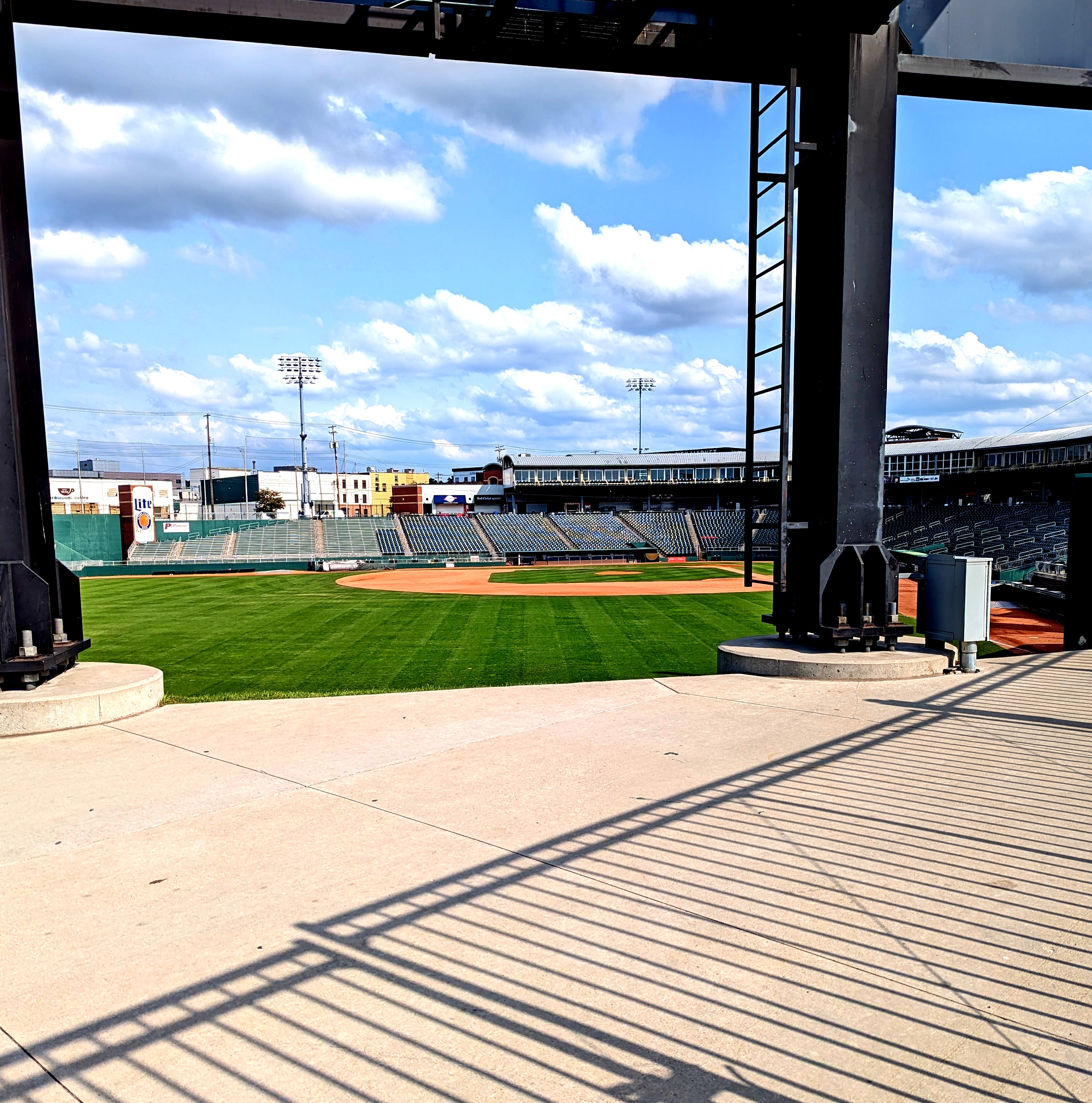
Our day continued in the same manner, but became more mundane as we entered Michigan. The weather had turned to overcast, and we worriedly looked northward to blue-black clouds as we skirted Jackson. All the ills of interstates visited us when US-127 became limited access also. (A sad feature which returned to plague us on Day 4.) Driving into Lansing brought mostly aggravation with it. Our hotel there boasted its newness, and we soon discovered we were only a block from Jackson Field, the home of the Lansing Lugnuts, a High-A team (that’s single A ball). Not only that, but on the backside of the amazingly well-developed ballpark for a Single-A club sits Lansing Brewing Company! We had some of the best chicken tenders I’ve had (though I pretty much avoid them because…they’re chicken tenders), and their beer astounded with its high quality. (We bought a case and a half to go!)
This is NOT a typical Single-A ballpark. Lansing’s Lugnuts play to state politicians (state capitol) and the varied professors and students of Michigan State. Not shown: a new apartment complex looking in from the outfield! July 2023.
Having returned from a trip to Ohio and Michigan a week ago, I’ve decided to re-take it vicariously here. I jumped the gun a couple times while on vacation, though. We’ll see how this goes.
I always plan a shorter drive the first day. This accommodates my inevitable inability to leave on time, thus protecting marital bliss. We had Mr. Lincoln loaded by 10 and left shortly thereafter. Skirting most of Durham, NC, we left I-40 not many miles further to the west for reasons which are still known only to Google’s Navigator. A nice, direct route would have been to strike north On US-29 from I-840 as it rounded Greensboro. Instead we zig-zagged through the Burlington area visiting small places for the first time: Gibsonville, and some too small to appear on the map right now. A couple lashing thunderstorms later we found US-29, left it at Reidsville, and leaving Eden (oh, the symbolism!) crossed into Virginia. Once there we used US-58 to cross the Appalachian/Blue Ridge mountains. If you’ve never driven this route, it’s recommended. Take it soon: we saw major roadwork on either side of us as we twisted our way over the summit, and it seems certain They are straightening the road to make it safer and less interesting. The road travels through hilly land used for horses and small agriculture. As it travels westward things start to get more interesting. The road twists and turns like a mountain stream seeking to escape to the lowlands. Eventually one reaches Lovers Leap a bit east of Meadows of Dan. The view is mixed:
Lovers Leap on US-58, VA. July 2023.Lovers Leap on US-58, VA. July 2023
Unfortunately the road intersects I-77 not too much longer after that. We needed to turn north to Beckley, WV, and our interests turned to rating drivers on a scale of stupidity. Oh, and wondering why West Virginia still accepts cash at its toll plazas in all lanes but one. How quickly one forgets the traffic jams that develop when every driver needs to dig out money to proceed along the road!
Today trains run down
Thurmond's rails laid with
promises we thought
included us, made
us integral to
those trains, controlling them.
Those trains controlled us.

Today, trains still run
through Thurmond, still
sound horns at crossings
where tourists gape their
tourist-gapes, where grass
reclaims what we wrested
from this steep slope.

Us? We melted into
America: most to
nearby towns, some to
Cincy or places
far-flung like bits of coal
escaping from tenders
serving locomotives.

Stocks dove mortally,
banks failed. Ours held on:
two years, five years...
then closed or left. Our
hotels burned, fell down.
Yet tightly we clung
to traditions learned.

Progress ushered steam
engines into history.
Their coal waited uselessly
beside steel tracks. It
heated our homes, true,
but offered nothing more:
we couldn't eat coal.

We sought regular
meals elsewhere, hungry.
Federals bought up what
we never owned anyway.
Thurmond's landed stayed,
profited, found new cows
from which to milk money.
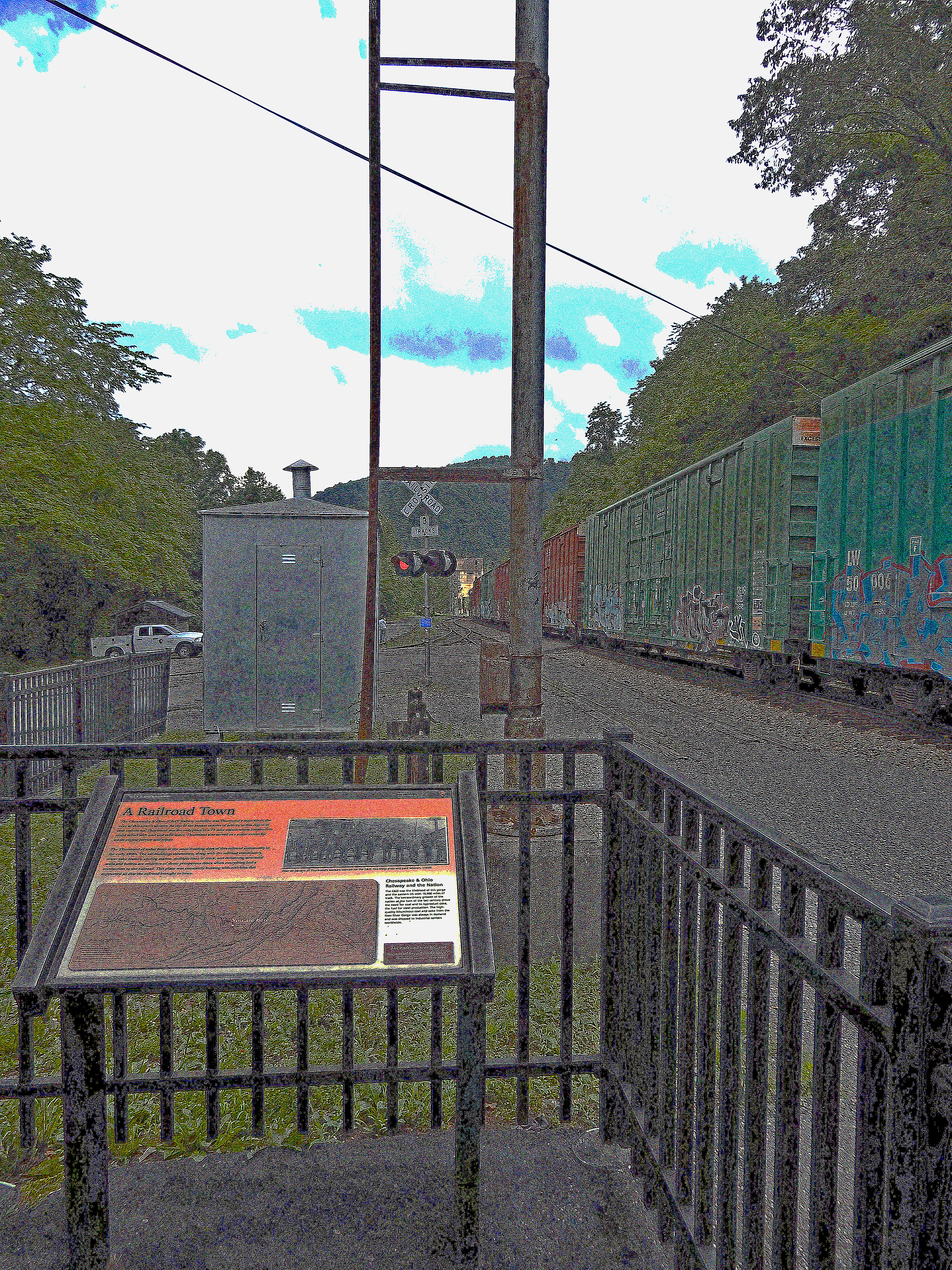
(All photographs were taken in Thurmond, WV, July 2023. Though Thurmond dried up after steam engines ceased to ply the lines–the last one in the early 1950’s–a few persons hung on. In 2020, the population was five.)
On June 22, 1925, my father was born in Lansing, MI. Back then I presume he and his mother stayed in the hospital for at least a week. Remember that, it will come up later. His father, the Rev. Howard Pilcher, had taken what I think was his first job after seminary, supporting youth ministry at a Baptist church there in the Michigan capitol.
In 1989 my father retired in May, shortly before he turned 64. Certain waves move through the business world, and computers had transformed his workplace in the 1980s. He had not bothered to join The Movement, his life at work was getting to be a grind, and frankly, he had struggled with the interior conflict of being a minister’s kid full of ethics and morality while he worked in business. That he worked for a nominal non-profit (a Catholic nun-supported hospital) didn’t seem to make enough of a difference. When he figured that 64 didn’t make that much difference from 65, he bailed.
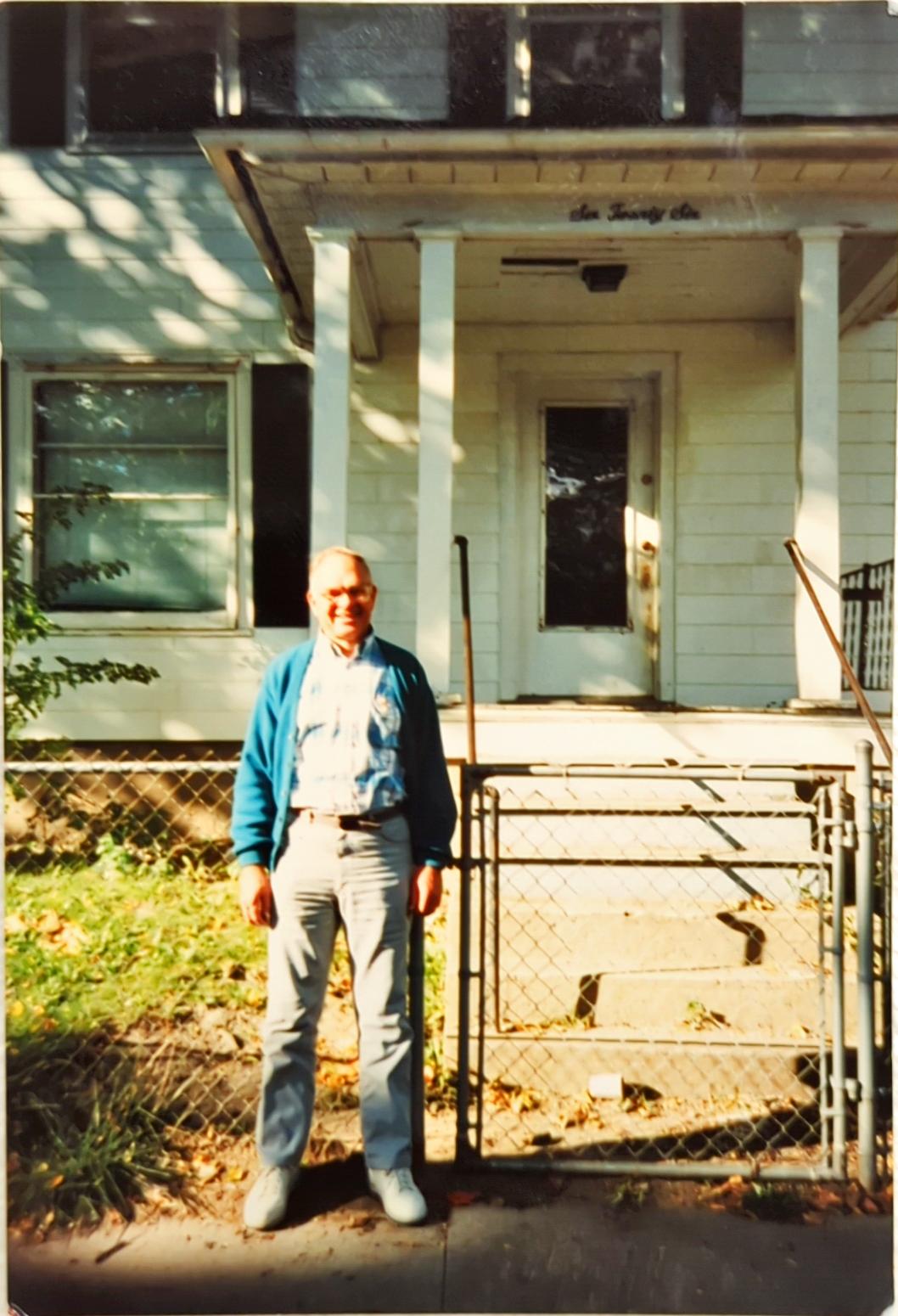
And only four months later, he found his way to the street he had ‘known’ as a newly born infant. He had my mother take this photo:
Howard Pilcher, Jr., in front of his first home. September 1989, Lansing, MI.
In 2013 my father died in December. My mother died in 2019. It was then I inherited all of their photos. Despite common sense saying in a whispered scream, “No! Just throw them away!” I instead sorted through every one of them last fall, noting the ones which documented salient events and/or salient people in our family lives or of my parents’. I ran across the above photo at that time, and smiled when I saw the address written on the back of the photo. Since we were talking about a trip to Michigan, I thought, “why not recreate the photo?” And thus in July 2023…..
In front of my father’s first house. July 2023.
I take a weird satisfaction in knowing it sometimes was weeks before a baby went home with its mother in 1925, and therefore, I stood in front of this house almost exactly 98 years after my father was carried into it. It’s funny how much stock is placed in this house since my father was moved at the age of 3 and never saw it again (to the best of my knowledge) until he was 64. I don’t know the address of his home in Edina, MN, where he lived from 3 to 14, nor do I know exactly where he lived in Havre, MT, during high school–I have a pretty good guess since they were always living in a parsonage provided by the local Baptist church.
As a side note, the resident of the house acted very graciously for all of the photos which were taken. (My wife didn’t understand the framing I wanted when she took the first set.) I went to the door to explain why someone would be doing such a weird thing. I couldn’t tell if he merely relaxed to know it wasn’t anything nefarious, or whether he just didn’t care.
This morning we visited New River Gorge National Park & Preserve. We had only a few hours, though, and this park lends itself to a segmented number of visits: there are four distinct areas, none connecting to the other. We chose the Thurmond area where an abandoned town thrived through the early 1900’s then slowly withered away as steam-powered trains no longer needed West Virginia coal.
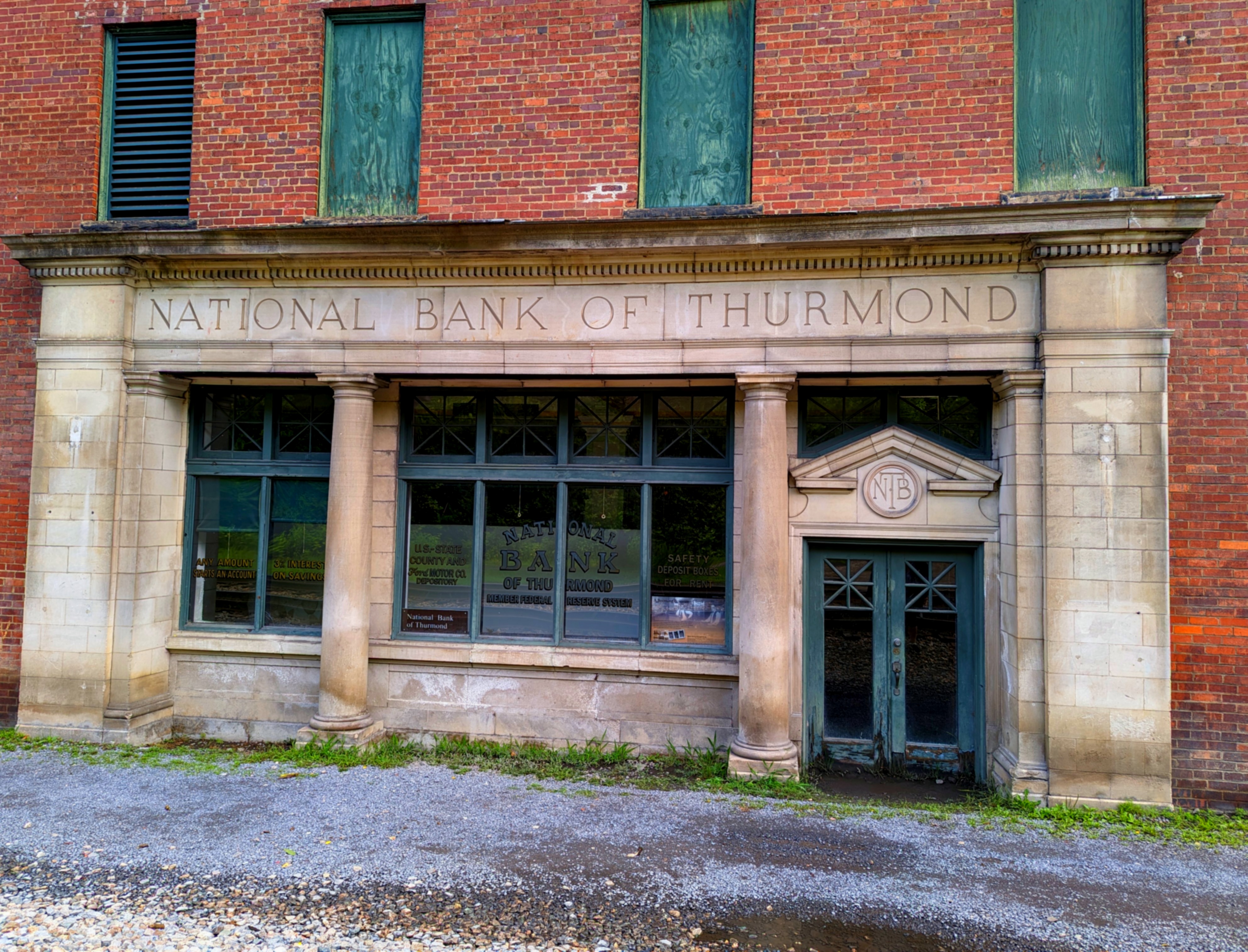
Here’s what once was a thriving bank:
The bank looks out to a pair of still-in-use railroad tracks–we had to wait for a freight before crossing to this main street of the town–and then to the New River, barely glimpsed through the trees.
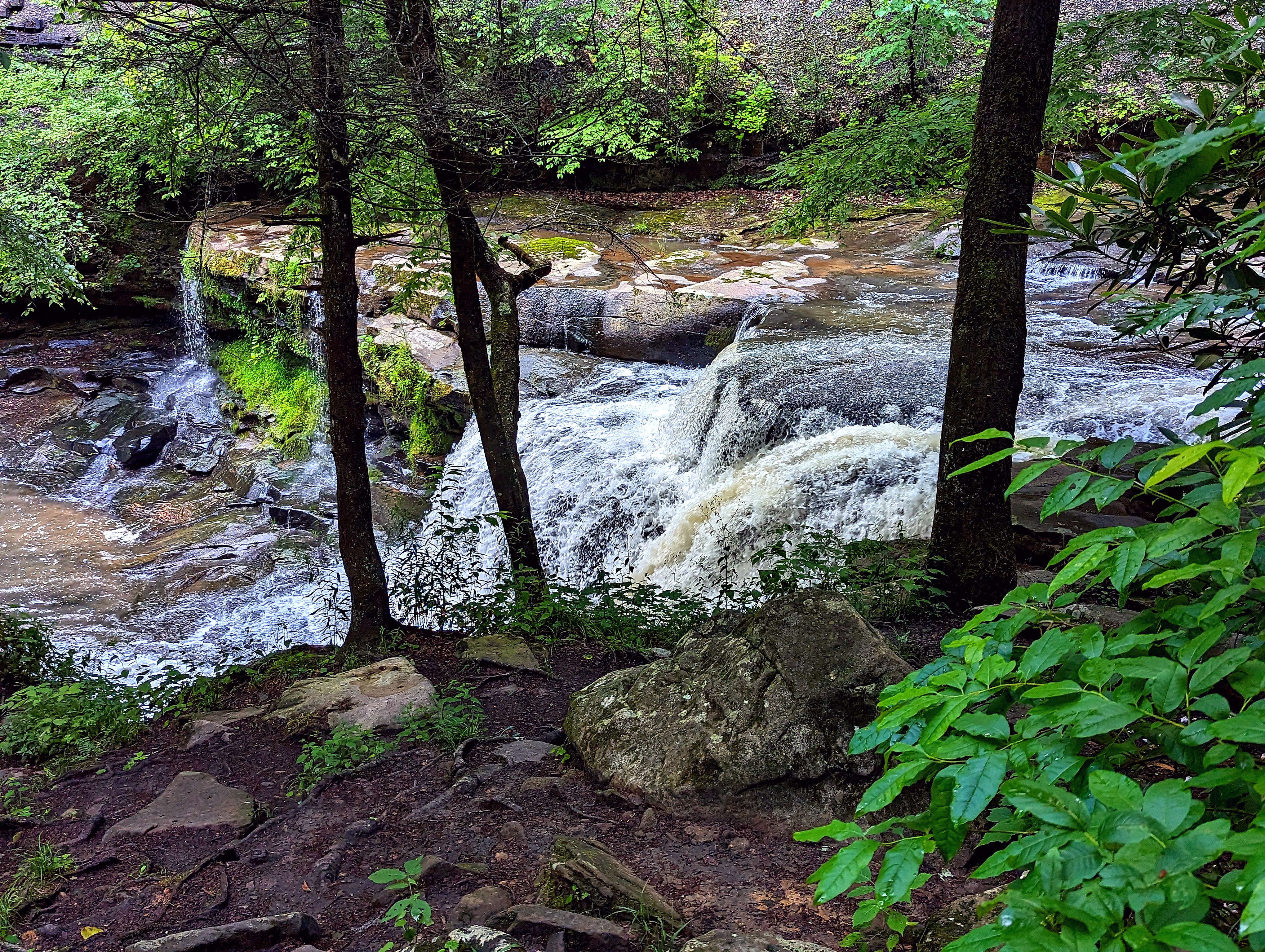
On the way back we stopped at a vehicle turnout beside Dunloup Falls to lunch on the leftover steak from dinner last night, stuffed into some soft rolls (also from dinner):
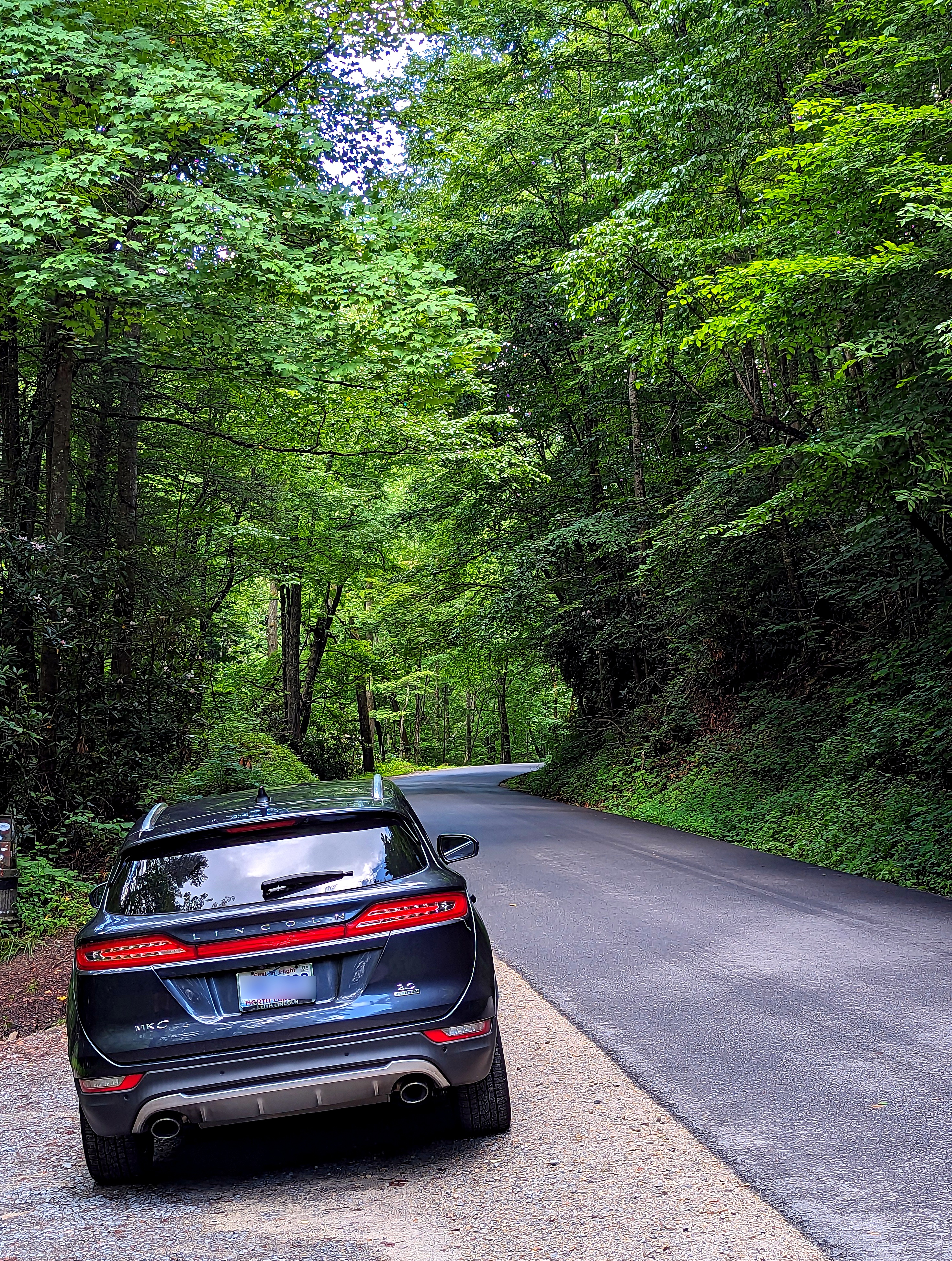
We then pointed our vehicle along the canopied road, joined the USA’s interstate system and motored to Cincinnati.
I’ve been pondering (to quote one of my new favorite bloggers) that I stand on the threshold of 70 and I’ve only 10-15 years of travel left in me. This starkly scares me. I usually figure two or three significant times of travel per year. Twenty to forty-five seems like a goodly amount, but it’s that lower end that makes me wonder: if I’ve only 20 trips left, and I want to go to Europe more than once, to Hawaii, to places in the USA, to just experience certain periods of unfettered wandering…how much is left in me?
It’s funny. You think for much of your life, “hey, there’s plenty of time for that,” because you’re 35 or 45 and decades stretch out before you. Then you get up toward retirement, and frankly you’re just thinking about that retirement. There are a lot of channels to negotiate to retire: income when you’re not working, riding herd on the expenses, and the projects you always thought you’d do but you just didn’t have the time or the money to do them. You negotiate that when suddenly a little global pandemic kinda s-t-r-e-t-c-h-e-s that whole process out. When the world comes to, everyone removes their masks (assuming they were wearing them in the first place), and you realize, “crap, I’m almost 70. How much time is there?”
This clarifies things but in a brutal way. When someone comes at you with a knife, your options suddenly are VERY focused. When life comes at you with a knife…… Didn’t the Fates snip a man’s life thread and end it?
Fog at the mouth of the Columbia River sets a standard for fog. Fog defines where Oregon and Washington share its outlet to the Pacific. It also defined my nascent and up-to-then non-existent career as I drove to Ilwaco, WA, and my second job interview of that early weekend in December 1977.
Car-less at that point of my life, my folks loaned me a 1968 Ford Galaxie 500. Though only nine years old, one could see already why it had been handed down. I piloted this coffin on wheels toward the southwestern tip of Washington through a typically drizzly early winter day in the western part of the state. “Man, talk about wet!” I muttered. At the same time I thought this, I drove my 1968 Ford Galaxie 500 into a fog bank. Until that point of my life–all 23 years of it–I don’t think I had ever realized what the phrase “bank of fog” meant. Within 100 yards I drove from a gray, drizzly day into a shroud of bright nothingness. I could barely make out the highway signs along the shoulder of the road.
How had I gotten here?
Simple. In mid-December 1977 I found myself in imminent need of a job. The University of Washington School of Communications planned to foist me on society with a degree. I had trained, in a mediocre fashion, for a job as a reporter. I realized I wouldn’t get any top-tier jobs at the dailies of Washington State, Idaho, Oregon, and I wasn’t plugged into destinations further away. (No Internet, no networking skills, no time spent learning about how to get jobs pretty much anywhere.) The state association of independent weekly newspaper publishers had to do. For one thing, the association headquartered itself in Seattle just a couple miles from the University campus. I figured, correctly as it turned out, they would be desperate (in a relative sense). Our corner of the US hadn’t experienced the stagflation of the Carter Administration, and talented graduates don’t seek jobs with weekly newspapers. Neither do most graduates want to head to the hinterlands to report about social teas, high school sports, and local city council meetings. It sounded easier, and I was all about easy, then and now.
Shortly after finishing my final final, I traveled to my parents’ home in Spokane. Once there, I gorged on home cooking, spoke to them as little as possible, and grabbed their old Ford for some serious job hunting.
My first stop that early December weekend was in Moses Lake, afairly strange place if you’re from outside of the state. To us it merely offered a respite in the cross-state drive. I met a married couple who owned and managed two newspapers. One was a weekly in Ritzville, WA, which is a small farming-oriented community at the northern edge of the Palouse wheatfields where it enjoys a location on the main east-west corridor through the state, I-90. They also published a paper in Cle Elum, but I do not remember if it was the Miner Echo or the Northern Kittitas County Tribune. I tend to think it was the former.
The owners were salt-of-the-earth, don’t-give-me-shit small business owners in a small community, a class of person I soon was to become deeply knowledgeable about. They didn’t make the job sound attractive. And they offered $125 a week. (Keep that figure in mind.) I told them I was interviewing elsewhere, and I would let them know. Notice they offered me a job on the spot. My alarm was sounding, but not loudly: I had kinda figured this wouldn’t be extremely difficult. A theme of my life to that point, and for a goodly part of my life from thereafter, was to flow into the path of least resistance.
This was a Saturday. I continued after the interview to drive westward, arriving at my dorm sometime in the late afternoon. (What a “thrill” to park a car in the student garage like all the kids that had more money than I did!) On Sunday I got myself up at a non-student, responsible hour, got in the car again, and headed to Ilwaco where an interview at the Chinook Observer awaited me.
My encounter with the fog bank said, “Welcome to Ilwaco.” It continued, growing more dense as I got into town. I found the office and parked outside. Upon knocking on the door, I was met by a pasty-complexioned man who owned the paper. He seemed ill at ease, hesitant, insecure. I immediately wondered how a man could own a weekly newspaper, the klaxon of any community, the polestar of community ire, and have a personality like this. We had a milquetoast interview and he offered me my second job in two days, also at $125/week. He seemed upset when I said I already had one offer on the table and another interview pending.
The Skykomish River near Monroe, WA, at dawn. There is a river there. And trees on the far bank. Almost as foggy as the mouth of the Columbia River near Ilwaco. Sometime in 1979 or 1980.
On Tuesday two days later I headed to Monroe, WA. Only 15 miles east of Everett and about 30 miles from my dorm in Seattle, Monroe was the gateway to the North Cascades via US Highway 2. Tuesdays, I learned later, was publication day which meant that the paper was being “put to bed” while I interviewed with the owner. I omit his name in case I say something which might get me in trouble.
This interview started out weird and stayed weird. The antithesis of the Ilwaco publisher faced me. He’d served as motorcycle courier in World War II in Europe, and he carried that hard-bitten attitude with him. He revered John Wayne. He kept Cutty Sark in his desk drawer. He ended the interview thusly: “So…I can start you at $150 per week. When can you start?” I trotted out my now-practiced “well-I-have-other-offers-on-the-table” speech and he said, “Well, call them and tell them you’ve accepted this position!” I was caught off guard. He asked, “Do you want this job or not?” I thought (quickly) about $25 more per week. He was offering $7800 per year. In 1977 more than 25% of Americans earned less than this. I was young. Earning less than the median American ($13,572) didn’t sound that awful. I would be working as a reporter. I told him yes, I would give those others a call. He said:
“We’ve got phones, I’ve got an extra office. You can call from there.”
So I wound up on a Tuesday in mid-December sitting in what was definitely not an office but more a glorified cube (and would soon become my cube), calling the other two publishers and telling them that I had accepted an offer elsewhere.
Because we were at this point looking at the issue which would come out right before Christmas, we agreed it would make the most sense for me to arrive right after Christmas and start work on Monday the 27th. I got in the old Ford Galaxie, drove to my dorm, cleaned it out, and drove to Spokane. I celebrated Christmas with my family, including my brother, home from a separate university in the state.
On Sunday the 26th I drove across the state for the fourth time that month, the old Galaxie towing a U-Haul trailer with all my possessions. I got to my mother’s childhood home in Seattle very late afternoon, when it was dark. There my grandparents bequeathed me a chair and some other odds and ends, some of which–like the chair–I own to this day, more than 40 years later. I pulled into the parking lot for the Monroe Motel later that evening, checked in, and reported to work the next morning.
Fog defines my entire job interviewing process and my newspaper work thereafter. I’d no idea what I really wanted to do other than write. I couldn’t discern which job sounded better until the last publisher just plain told me. I stumbled through my first year until I managed to trust that all those empty inches would somehow be filled by Deadline Day. Less than four years later I drifted into something else.
Four Sundays have passed since last I posted, and more than a month since anything of significance graced (?) this blog. Let’s catch up and be witty about it (I hope). In mostly reverse order….
Red oak with tree trimmers. Raleigh, NC. June 2023.
In the photo above a local tree-trimming service prepares to limb the dead branches out of this fine red oak in our front yard. Most of the branches overhang the street or sidewalk and thus pose a safety risk for anything/anyone who happens to be beneath them. I could try to describe where they are in that photo, but only one is distinct. It’s in the upper, left-center of the photo, a dark silhouette against the light green pines behind it. No, not that one. The one snaking down away from it. In all, the two-man crew lopped four main branches and about a half dozen minor ones. The thick end of the branches measured six to eight inches, and I got a nice box of firewood out of it all. This company has given up cutting trees down (losing 30% of their revenue stream in the process), focusing instead on maintaining the health of the ones we still have on this planet. Further, they offer to return your yard to a natural meadow state (for a pretty hefty fee), something we are seriously contemplating. They use organic, natural substances for maintaining shrubs and trees. They help support the native plants and help eradicate or tame the non-natives. I’m pretty stoked about it–if we go the full makeover route, I may give them free advertising by mentioning their name!
Backyard bird feeding station #2. Raleigh, NC. June 2023.
“Month of Sundays” continues: I’m embarrassed to put up such a mundane photo, but I’ve yet to take any good ones. Last Sunday we sat to enjoy this new bird feeding station erected the day before. The squirrel/raccoon baffle works, at least for squirrels anyway, and by including mealworms in the feeder on the right I’ve managed to entice the bluebirds to feed once again. (Haven’t seen them since I quit offering mealworms about nine months ago–long and boring story.) I’m excited to use a Nikon app to link my camera to my phone and take photos of the birds without being anywhere near either them or the camera. It should be good. (It may not work at all, but permit me my optimism.) Installing this pole system proved serendipitous: the same day I planned to install the new pole system, I found the nice, squirrel-proof feeder which normally sits on the pole in the background nearly torn off, likely by something big, like a raccoon, perhaps a possum. Three of four nut-and-bolt fasteners were gone, and it hung sideways by the final remaining one.
Makin’ tortilla chips. May 2023.
Not exactly another Sunday back: the penultimate day of May I spent preparing what I call Deconstructed Nachos. It starts with taking all those fading tortillas which we never can keep up with and turning them into chips. We had several avocados at peak ripeness; they became guacamole. Some heirloom beans (Buckeyes, I think) from Rancho Gordo received the Mexican-flavored cooking I favor, using a recipe from a book I’ve carted around for 45 years. Using the same cookbook, I turned them into a bean dip. Then we just dip the chips instead of piling the ‘stuff’ on top of the chips. Sometimes I’ll make a picadillo, but we skipped it this time, and indeed skipped the melted cheese on top. Goodbye May! You were delicious!
In the past two months there has been baking….
Poppy rolls from the book From Scratch by Michael Ruhlman, baked in a cast iron skillet. They held lots of shredded pork and coleslaw and were dressed with Lexington BBQ sauce. May 2023.Hearth bread from The Bread Bible by Rose Levy Beranbaum. May 2023.
There was altogether wa-a-a-ay too much of this…
A fine grain-and-hop concoction in one of the new Teku glasses purchased from Victory Brewing Company in Downingtown, PA. I’m thinking it’s a Belgian-inspired brew from Haw River Farmhouse Ales. May 2023.
…and too little walking and exercising. If there had been more, perhaps I would have encountered more of these while walking….
Deer crossing where the City of Raleigh has built a drainage pipe under the road just north of our house by a couple hundred yards. This allows an unnamed creek to flow to Haresnipe Creek. May 2023.
I’ve now marked the first ten days of my 70th year on this planet. I’d like to think it’s time to get serious, but why start now? Seriously, I need less serious and more lighthearted enjoyment. Apologies for a rambling travelogue through my past two months. We’ll get back to Serious Stuff again. You’ll see.












 all the voices in my head