about this blog

Bibliophilia: dictionaries

How to look up words before the Internet. July 2025.

Today I needed to move two of my bookcases because I inconveniently parked them underneath the main water shutoff valve to my house. Downstream of that valve is the Pressure Relief Valve (Pressure Regulating Valve?) or PRV which will be replaced tomorrow. Books moved include the latter half of the alphabet for authors of fiction, plus poetry, essays, books about reading and language, literary quarterlies, literature anthologies, drama, and the stuff I call “books too big to fit anywhere else”. Moving these books renewed the love affair I have with them.

I cannot claim to have coined the word bibliophilia but my spell checker doesn’t like it. Obviously a primitive type of AI with all the words at its digital fingertips would sneer at such a word. I maintain it exists, nonetheless, and I further claim it describes a condition similar to addiction in that those afflicted with it do not recognize it as a malady. Rather they proudly lean into it right up to the moment it degrades their lives into sociopathy. I never had a lot going for me in the sociopathy-avoidance spectrum; it therefore has impacted my life little.

Though I read 99% of my books electronically now, I’ve developed no attachment to them the way I have to the physical ones. Perhaps it’s because I don’t have the history with them? No matter. I realized today what a wonderful paradigm for a series of posts! Forthwith:

I’ve carted around the above two dictionaries since 1978. They were ‘useless’ even then. The one on the bottom has a copyright of 1939 on it, with 14 more copyrights stretching back to 1903 on the reverse of the title page. In 1939 my mother was 10. This must have guided her through the end of elementary school and through high school. It undoubtedly felt the fingers of my grandfather paging through it as he sought a word for some of his reports and letters. He would have been in his 40’s at the time.

As with the bottom dictionary, the one on top reminds me of a relative also. When my mother was in her early teens around 1941-1943, her Uncle Dennis came to live with his half-sister (my grandmother) and her small family. He needed to establish residency in Washington State because he planned to attend the University of Washington. I’m not sure if he worked for a year or attended high school. This dictionary is copyrighted 1942, and its title I feel reflects his academic bent. (He went to work in an athletic supply store in Seattle after graduation, eventually bought it with one or two partners, and had a very comfortable life financially. The store was called Athletic Supply.)

All my childhood I stared at these dictionaries and pulled them out again and again, every time we visited my grandparents. I’m pretty sure where my brother and I slept is where my great-uncle lived for that year. Upon graduation I guess he figured he didn’t need the dictionary anymore. My grandfather had finished off the basement in gorgeous tongue-and-groove pine boards, and he built in next to his desk the bookcase which held these two volumes.

As I may have detailed before, I purged about 400 books from our library in 2020, primarily so I could use some of the shelves to display family memorabilia. Books I felt held no special tug on my heart joined those I felt wouldn’t be read again nor would they need to be consulted. It represented a Marie Kondo approach: if the book brought joy, it almost always stayed on the shelf. The rest were boxed up and shoved in a closet. One doesn’t just throw away books unless they’re an ignorant cretin which means they likely don’t own books in the first place. (Although there was that mother/daughter pair I saw once at a giant book sale who were buying a shopping cart full of books based on how they looked! Books as interior design elements! Horrific to think such people exist.) I’ve since found an outlet in a used bookstore/coffee shop/beer & wine cafe which gives me credit for the books I drop off. Imagine that! I drop off a half dozen hardbacks, and I get to buy three pints on half-price Wednesday!

Though 400 went to live in the closet, an even 1100 remain. I can’t believe that when I look at the shelves, but that’s what my library cataloging program says. Today, just pulling down about seven shelves of books inspired such joy and memories. There are the literary quarterlies I got from Eastern Washington University while teaching English. And there are the half dozen volumes of varying size I needed to buy for my Medieval Literature class. Oh look, there’s the best book I ever read on the slipperiness of translations (Le Ton Beau de Marot: In Praise Of The Music Of Language by Douglas R Hofstadter who previously had won the Pulitzer Prize for Gödel, Escher, Bach: An Eternal Golden Braid). Oh, my college literature texts! The glorious translation of Anna Karenina purchased on the first family vacation I organized just a couple years before my father died. And look there, the slim volume of fairy tales my parents and grandparents read to me when I and my brother were quite young.

Some of it is snob appeal. I make no apologies for that. If you can’t be proud of yourself for having read a goodly collection of great literature, if you think it a waste of your time, then I ask, why did you waste it? Didn’t you have something better to do? Like, I don’t know, trade it for a differently colored book which matches your decor better?

In the weeks ahead I’ll focus on particular books which spark that wonderful joy of reading…like the books about reading itself!

Frolicking

Lap number…I dunno…I lost count. Fawn feeling frolicky, Raleigh, NC. July 2025.

I almost feel embarrassed to post this photo of such poor quality. In my defense, the fawn zipped by so quickly, this represents my best. Much like a swimmer in a lap pool, the fawn ran back and forth, taking about 100 yards for each lap. The crashing of the brush is what grabbed my attention. It had rained for hours the previous night, which caused me to attribute the crashing sound to a falling branch at first. I tried to pan with the fawn, but you can see how difficult that was. Additionally, I shot the photo through the screen of my screened-in porch. Meanwhile, mama calmly moved from yard to yard sampling the greenery.

Potted greens for a doe. Raleigh, NC, July 2025.

A slippery fish

Fish at Maui Aquarium. September 2024.

For several weeks I’ve written, re-written, and re-re-written a difficult piece about my father. Its point still eludes me. I fear several things: I’ve attempted to describe something, but I’m only describing it superficially; I’ve selected an inferior topic to one which begs to be heard; or perhaps what I’m writing about doesn’t rise to worthiness. This has delayed my promise to myself to post one piece of writing about my father every Sunday. It’s been like attempting to grasp a wriggling fish. I shall continue to rant to the air, to myself, to my wife—heck, to the birds on the grass—about this, and hope it gels in my mind and in my words.

Until then I’ll post a few photos, and maybe I’ll write something less weighty, something which elicits a few chuckles or wry reactions. Yes. That would be it.

Our sunflower

Eastern honeybee (?) on just opened sunflower. July 2025.

I feed birds, mostly black-oil sunflower seeds. This year it looks like I’ll through about 400 pounds of them. Apparently one got planted in our newly landscaped front yard, and there amid many of the similar-spiky Obedient plants was this lone sunflower. I love sunflowers. Therefore, I got pretty irritated when something, probably a deer, nipped off the top where a bud had been forming. The joke’s on the deer, though. By trimming the plant, it put up TWO stalks from where it had been lopped, each of which had buds…until one burst open on Independence Day.

Crape myrtles…

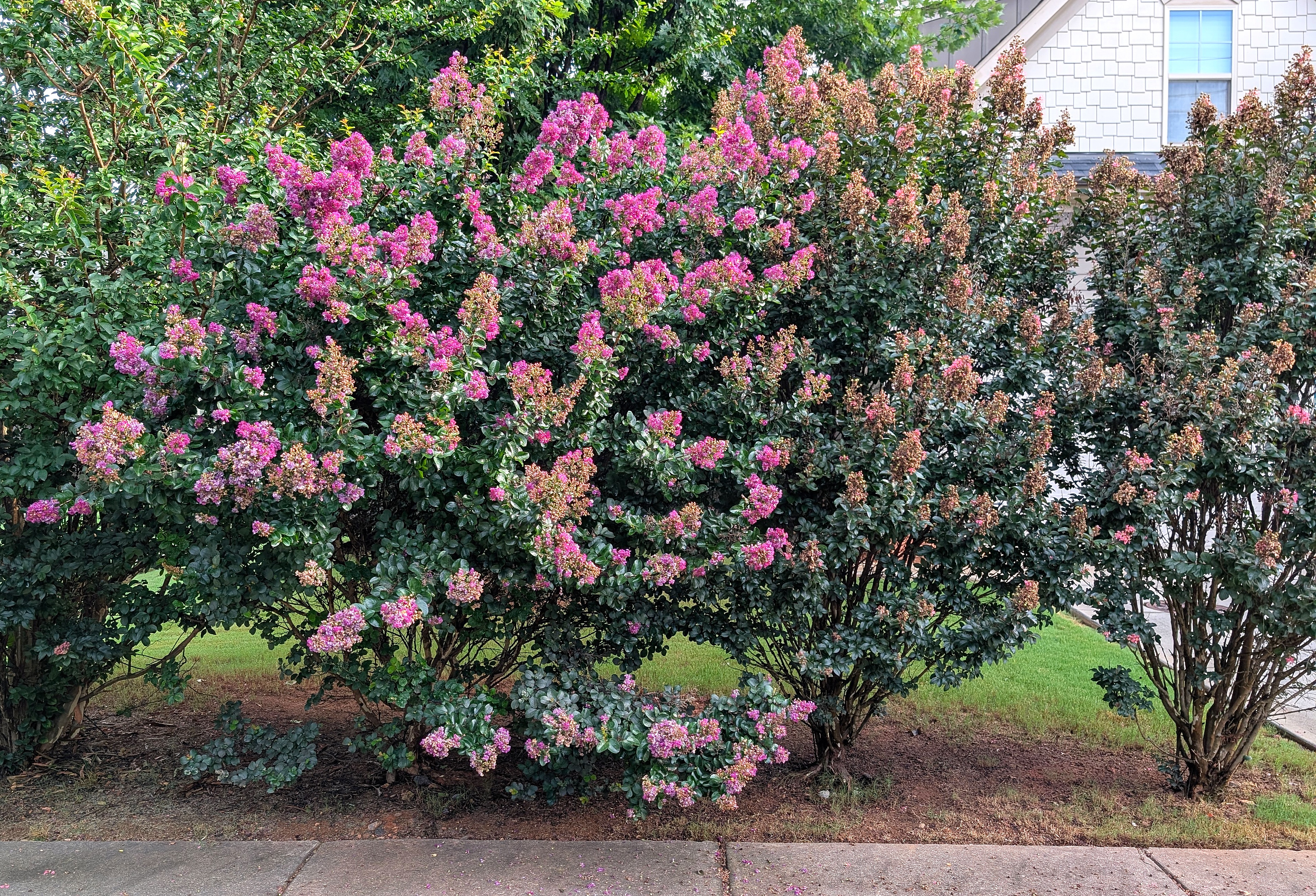
…or crepe myrtles if you prefer…seem ubiquitous here in Raleigh, NC. From what I read and hear they’re throughout the South, though I haven’t paid enough attention while driving through our neighbor states. Crape myrtles take their time, slowly becoming substantial trees of a type called thicket trees. They can be well-tended and trained, as this one is:

With care, the trunks grow together. Raleigh, NC. July 2025.

Usual care involves letting them grow as they will, but pruning suckers and sometimes trimming the tops to shape them:

Crape myrtle with usual thicket look and showing white blooms. Raleigh, NC. July 2025.

Crape myrtles are everywhere here. The photo above is across the street from the first photo. The thicket-trunked myrtle in the foreground has a substantial myrtle right to its left, the one with a more substantial trunk. Follow the sidewalk and you’ll see two more, smaller (younger) crape myrtles flowering. These last two demonstrate the variety of the approximately 50 species of crape myrtle (or are a particular cultivar of one):

Younger, different crape myrtles. Raleigh, NC. July 2025.

Crape myrtle are maintained by the City of Raleigh in the decorative medians:

Three “City” crape myrtles at the end of my street. Raleigh, NC. July 2025.

To me the Ultimate Crape Myrtle lives in my neighbor’s yard. Its branches extend from the edge of the sidewalk and tower over her house. It’s at least 30 feet tall. Someone appears to have pruned a few suckers in its youth, but mostly it’s been left to its own.

Crape myrtle in neighbor’s yard. Our white car and yard in the background. Raleigh, NC. July 2025.

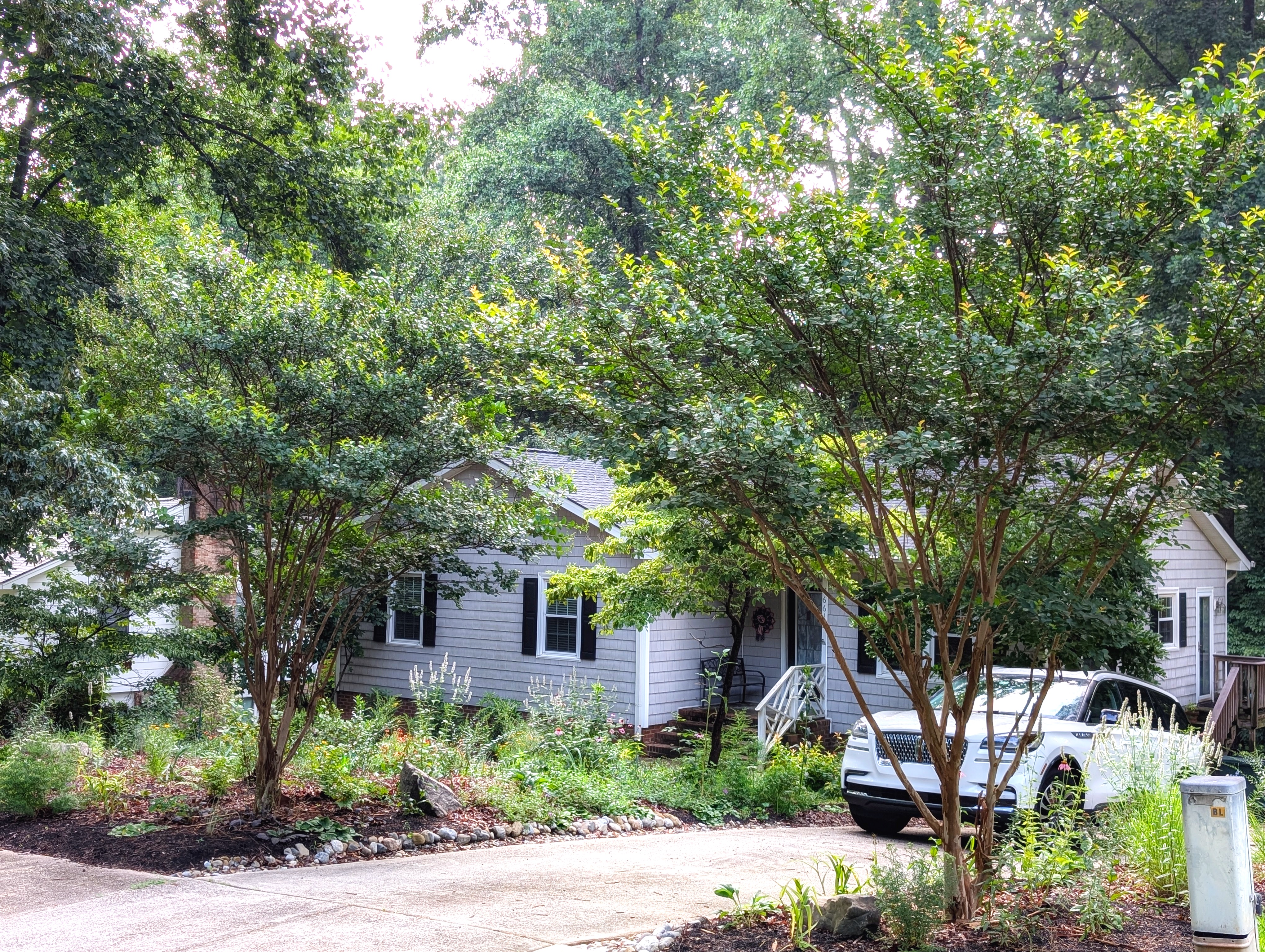
And then there are our crape myrtles. Ours were planted sometime between 2007 and 2014 (using Google Maps Street View), with the most likely time frame being 2010-2012, a period when the former owners rapidly changed the landscaping and interior of the house. The myrtles probably were purchased as saplings, and have doubled in height for the eight years we’ve lived here. For reasons I suspect have to do with amount of sunlight and my utter lack of any care beyond occasional pruning, they flower very late. I suspect sunlight because my other neighbor has three, also near the sidewalk, which haven’t bloomed yet either. In the photos above you might have noticed most of the myrtles nearing the end of their blooming period. Ours?

Our two crape myrtles, either side of the driveway, not blooming. July 2025.

But here’s the thing: though closely identified with the American South, they are not native to it. To quote the NC State University’s Extension Gardener website, “[Crape myrtle] is native to the Philippines, Japan and central Himalayas to southern China and Indochina.” Our whole move the past 12 months has been to replace everything in the front yard with native plants. (note that in the photo above) After a year of debate, and many years of saying, “Maybe they will bloom better when they get bigger,” we’ve decided to replace them. (Sorry, former owners. Consider it payback for removing that big tree in the front yard and not properly having the stump ground. I nearly broke my ankle in that mess many a time.) On one side will be an ‘Amethyst’ witch hazel which blooms in winter and very early spring. (Photo here.) On the other side will be a serviceberry. It mimics the look of a crape myrtle with the multi-trunk growth, but it will provide berries for birds and other critters.

All right, I’m craped out.

July surprise

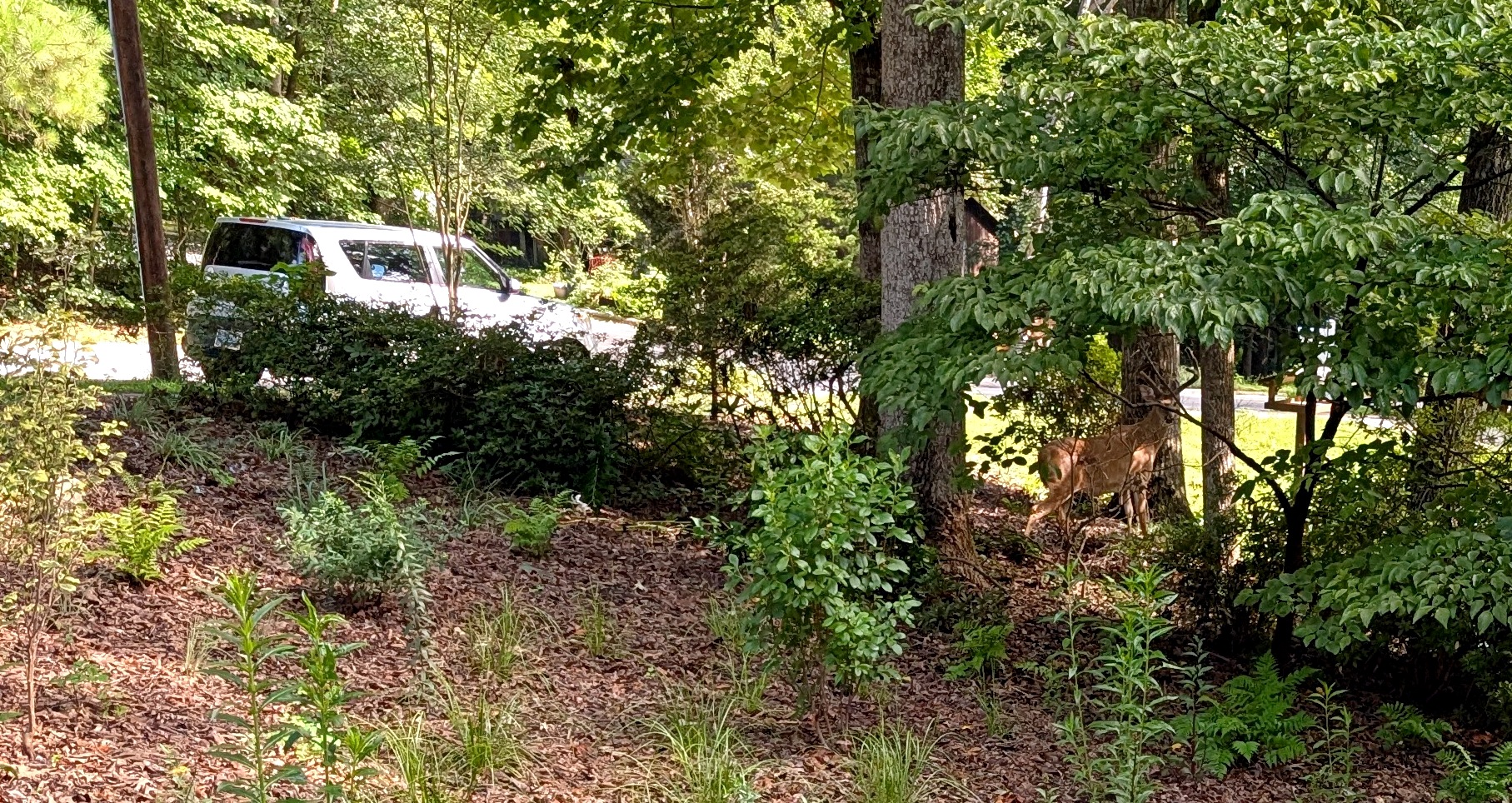
Eight-point buck meandering through our trees. July 2025.

Our street, above, regularly sees traffic of 35 mph and above now that a lot of drivers have discovered it’s a better-than-nothing shortcut from one arterial to another. (Raleigh arterials commonly have a 45 mph speed limit.) It amazed us therefore to see this buck come down the slope of the yard across our street, then cross the street around 9 a.m. and continue downhill between our houses. Here’s a lower-resolution close-up from the photo above:

Eight points!. July 2025.

We lost sight of him for a minute, then my wife spotted him in the back corner of the neighbor’s yard. He was in no hurry. He’s eating some leaves there…

Mid-morning snack. Feeling cocky. July 2025.

Goodbye, June

Eastern carpenter bee working the beebalm. June 2025.

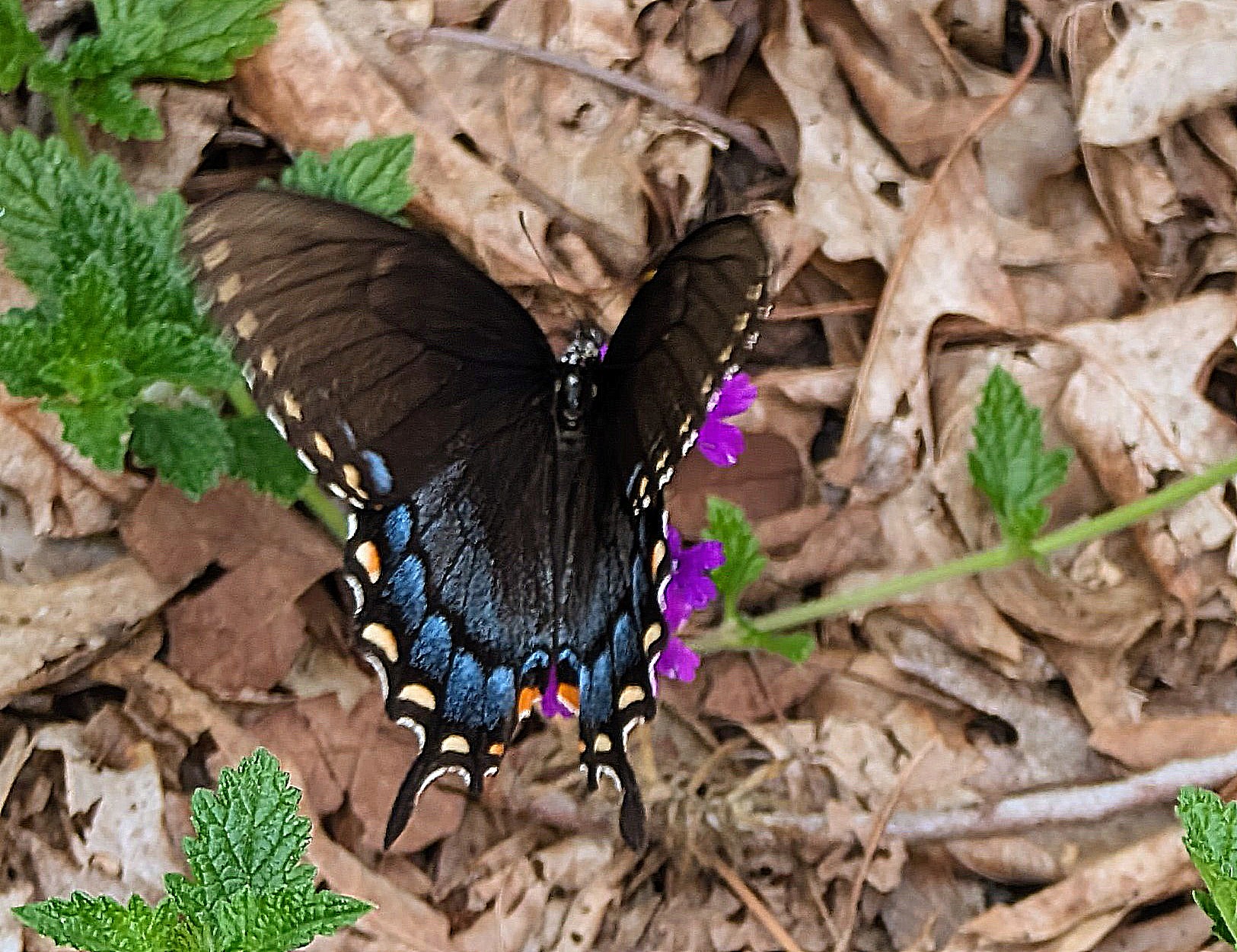
I opened the month shooting photos of the beebalm with a swallowtail butterfly on it. This photo is from the same set. The swallowtails, bumblebees, and little tiny bees I haven’t identified yet all had to work around the behemoths of the flowers, the carpenter bees. At 1.25-1.50 inches (or more!) they pretty much go where they want to. Now the beebalm has slowly dropped all those fuchsia-colored petals. (Or are they petals? I don’t know much about plants.) All that remains are the ball in the center, still suspended on those long stems. Our new visitors love these: goldfinches. They flit from flower to flower, their nearly weightless bodies hardly making the stems bend at all. It seems too soon for seeds, but what do I know?

Summer temperatures, documented a few days back, will continue for the near term future. Americans look forward to celebrating Independence Day on Friday, the 249th of our country’s existence. In these muddled times, I wonder what that will bring. Meanwhile, the business of life marches on, from the mundane (it’s Gather the Garbage Day) to the inconvenient (workers coming to work on the leak in the bathroom shower) to the calm and simple (my wife returned from a coastal sojourn yesterday afternoon; this day will be our first together in a week).

Have a truly blessed day, y’all!

HBP: photo break 1

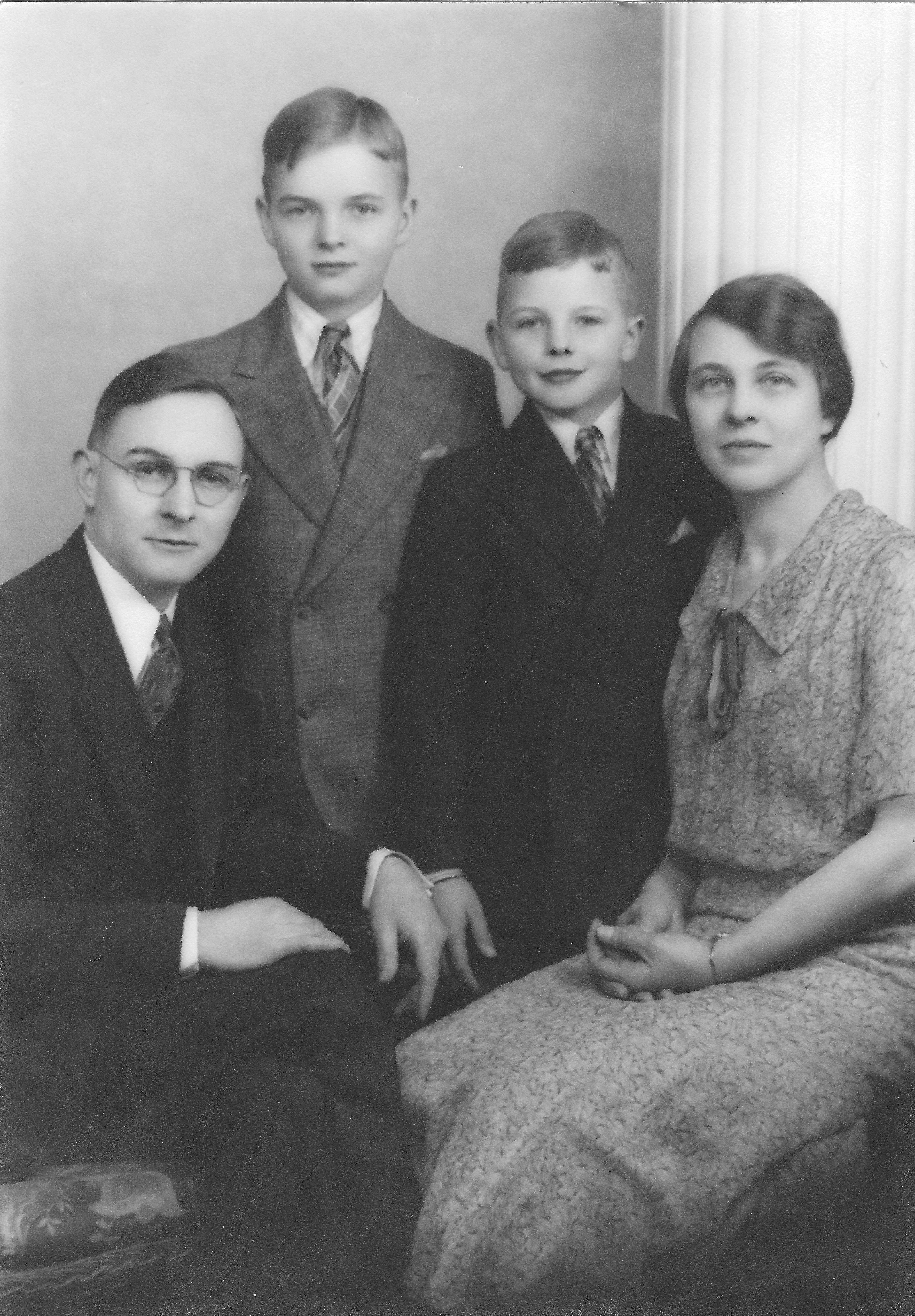
I’m partially through my next installment about my father, Howard Bliss Pilcher, but it will not be published today. My goal is “every Sunday” but this week’s post is a sober and kinda negative thing about him. Regardless of how deserved that viewpoint may be, I want to pair it with another installment which is more upbeat and entertaining. Instead I offer this portrait of my father’s family from 1938. This photo was taken in Minnesota which makes it a year prior to the family’s move to Havre, MT. Based on family values, I’m estimating it would have been a formal thing around Easter because of the importance of that day for a minister. My father is nearing 13 if so, and I’m pretty sure my uncle will be 10 soon. My grandparents are in their early 40’s.

Left to right: The Rev. Howard “Bliss” Pilcher, sons Howard and Gordon, and Esther (Dahl) Pilcher. Edina, MN, 1938.