
If my self-defined word bibliophilia means both a love of books and a certain madness about them, what then describes a certain madness about books written by others about that very madness? A madness for madness? Is that a thing? Where and when does it stop? Ever? (Death would be a safe bet.) Of those who love to read, there exists a subset who thrill, not to be reading, but in anticipation of reading. Cue Carly Simon. People in this subset feel a fevered, shaking promise when entering a funky bookstore in the middle of nowhere and the first ten titles they see scream “READ ME! NOW!!” And yet…
Within this subset of bibliphiliacs, a smaller, more exclusive sub-subset exists. These distinct suffers of bibliophilia feel an intimate rush when they espy that one volume probing directly into their literary, book-loving soul, purporting to deliver not just a few hundred finely written pages but promising those pages will satisfy not just their book-lusting souls but will simultaneously glorify the very building blocks which construct the objects of their obsessions. It’s a feedback loop not unlike the pleasure paddles given to rats which OD’ed on opiates. It’s as if one of their objects of desire shed all the clothing of characterization and plot or rhetorical structure and laid themselves bare for the reader’s ultimate satisfaction. No wonder we tingle all over and feel a slight loss of rationale thought when we see these titles.
My, my. Did it suddenly get warm in here? Let’s cover up and move on…
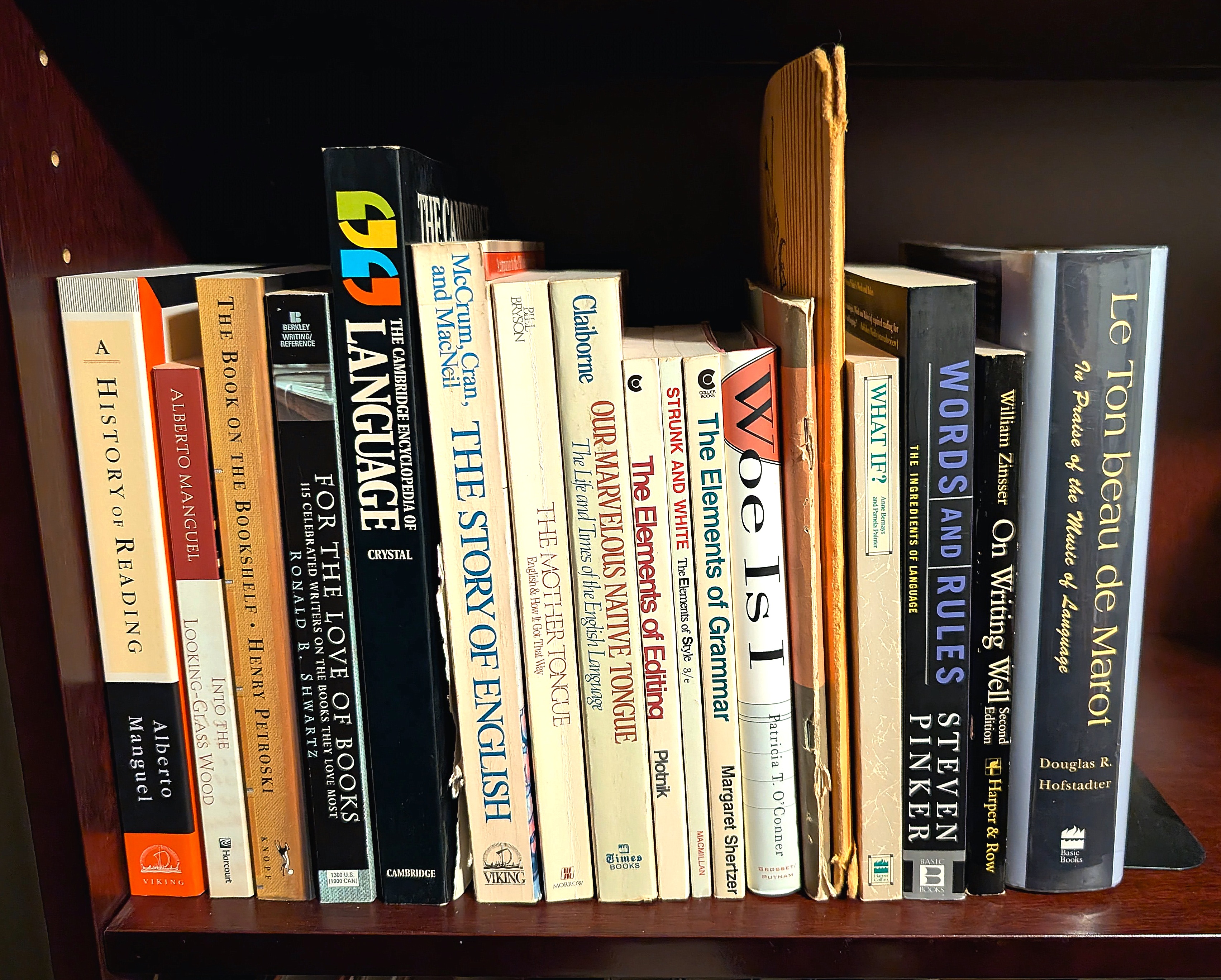
Despite having degrees in both Communications and English, I possess a scant half-shelf of books about the language I use. Perhaps this relates to the Communications degree carrying a focus of journalism and the latter one a focus on literature. The English degree also had a few courses pared from it because of the additional classes I had to take to get the “.Ed” added to the end of it. Linguistics interested me until I encountered the arguments for Noam Chomsky’s innate grammar versus the classic thought that grammar remains culturally induced. I suppose this means something important to someone, but who really cares right now? All books I bought for linguistics possessed such rarified, dry prose to make them insufferable the moment I finished the class which required their purchase.
Other books departed for different reasons. Those which all claimed to be about “being a writer” fell victim to The Purge of 2020 when I removed about a third of the library to live in boxes designated for assignment to others…or to the trash. I determined at that time I will never be A Writer although I will write. A freeing decision. Joining those were books which celebrate the language of English and which I found only mildly amusing: volumes by William Safire, Willard Espy, and Richard Lederer all sit waiting to grace someone else’s shelves.
Nine “keepers” don’t appear on the shelf at all because they are points of data in Kindle form. Several lovely books appear in this group: Ella Minnow Pea: A Novel in L:etter [sic] by Mark Dunn, sadly prescient for our time, where a Council decrees the removal of letters one by one from all written and spoken communication; Alex & Me: How a Scientist and a Parrot Discovered a Hidden World of Animal Intelligence—and Formed a Deep Bond in the Process by Irene Pepperberg which I haven’t read yet but which looks great; Our Magnificent Bastard Tongue: The Untold History of English by John McWhorter, a slightly controversial book dealing with how certain aspects of English came into being; and The Professor and the Madman: A Tale of Murder, Insanity, and the Making of the Oxford English Dictionary by Simon Winchester, a true story about a murderer incarcerated due to insanity who nevertheless overwhelms the compilers of the OED with 10,000 entries. I’m looking forward to two more: Empires of the Word: A Language History of the World by Nicholas Ostler; and Kant and the Platypus: Essays on Language and Cognition by Umberto Eco.
Missing from the shelf because I loaned it ten years ago to a friend who I believe is “still getting around to it”: Don’t Sleep, There Are Snakes: Life and Language in the Amazonian Jungle by Daniel Everett. Though some revile him, the book fascinated me. Everett traveled to the Amazonian jungle to proselytize Christianity to the Pirahã mostly by learning their language and then translating the Bible into it. A trained linguist, he discovered the Pirahã have no counting system, no fixed words for color, no concept of war, and no personal property. I seem to recall they didn’t have all the temporal aspects of language (past, present, future and the permutations thereof). The title comes from their belief that evil spirits (and snakes) can only get you when you fall asleep, therefore they attempt to sleep as little as possible. They sleep communally and at all times several will be awake talking to each other.
I decided to take pity on you. Rather than a lengthy bibliologue through the shelf, left to right (because that’s how these things are done), I’m breaking things out for individual treatment. In my subjective view of the shelf, L to R, it breaks into books about books and reading them; books about English, including how to physically present it on the page; a few books I’ve retained which promise advice on writing; and one lovely volume which defies categorization but touches on the meaning of words, poetry, and translation, all while tackling the relationship of cognition to language and adding in the personal pain of losing a spouse to a killer disease.
Or am I delaying and stringing out this series to heighten my pleasure? (It’s getting warm again…)
 all the voices in my head
I have an old friend who, among my familiars, had the largest personal library I had seen until I met you (not counting Biltmore and other such examples since they are not my familiars). This friend has a routine, more like a ritual really, when he gets a new book, typically hard cover.
He gets home from the book store and places the book on a table wher he can admire it for a few moments. Then he picks up the book, opens it to a random page near the center, plants his face into the pages and breathes in deeply the aroma of fresh ink, binding glue and pulp.
Then he turns to the last page of the story and reads the final paragraph. He ponders it for a moment, then turns to the beginning and starts to read, beginning at the title page and reads all the notes, index, and forward before settling into the story.
It was quite interesting to watch him perform this ritual the first few times he went through it, but after a while, it was just his SOP.
Thank you for prodding that old memory.